


The Architecture of the Shadow War
By the time the sirens at Ali Al-Salem Air Base in Kuwait register the incoming trajectory of an Iranian proxy drone, the men and women sprinting toward the reinforced concrete bunkers are not exclusively, or even primarily, wearing the uniform of the United States Armed Forces. They are the mechanics who keep the F-15s in the sky, the logisticians who manage the sprawling supply chains, the cybersecurity analysts defending the perimeter networks, and the private security operators standing watch on the blast walls. They belong to an invisible army—a privatized expeditionary force that has fundamentally altered the calculus of modern geopolitical conflict. As we stand in the volatile first week of April 2026, the Middle East is ablaze with a regional war that has shattered the illusion of a contained, surgical military footprint. The Pentagon recently confirmed 365 U.S. service members wounded in action as the conflict with Iran reached a boiling point, culminating in the closure of the Strait of Hormuz and the downing of American aircraft. Yet, this official tally is a deliberate, structural fiction. It excludes the staggering, rapidly compounding casualties of the civilian contractors who form the true backbone of American power projection in the region.
To understand the current theater of operations, one must look past the press podiums in Washington and examine the obscure, bureaucratic ledgers of the Department of Labor. Through the legal architecture of the Defense Base Act (DBA), a federal workers’ compensation program, the true human cost of the Middle East escalation is being quantified in disability ratings, psychiatric evaluations, and multi-million dollar insurance settlements. The surge in DBA claims across the Persian Gulf, the Levant, and the broader Middle East is not merely a statistical anomaly; it is a glaring indicator of a systemic shift in how superpowers project force. The modern American empire is no longer sustained by the blood of uniformed conscripts, but by the actuarial math of privately insured contractors.
This privatization of geopolitical risk is a masterclass in strategic asymmetry. By outsourcing the logistical and security burdens of forward operating bases to Private Military Companies (PMCs) and defense conglomerates, governments effectively launder the political cost of war. When a uniform returns draped in a flag, it triggers national mourning, congressional inquiries, and shifts in presidential approval ratings. When a civilian contractor from North Carolina, or a third-country national from Nepal, is maimed by shrapnel or mentally shattered by the relentless tempo of rocket alerts, their trauma is processed quietly by corporate HR departments and specialized workers’ compensation attorneys. The strategic intelligence of this arrangement is profound: it allows the state to maintain a massive, highly capable footprint in hostile environments without triggering the democratic friction traditionally associated with prolonged overseas deployments.
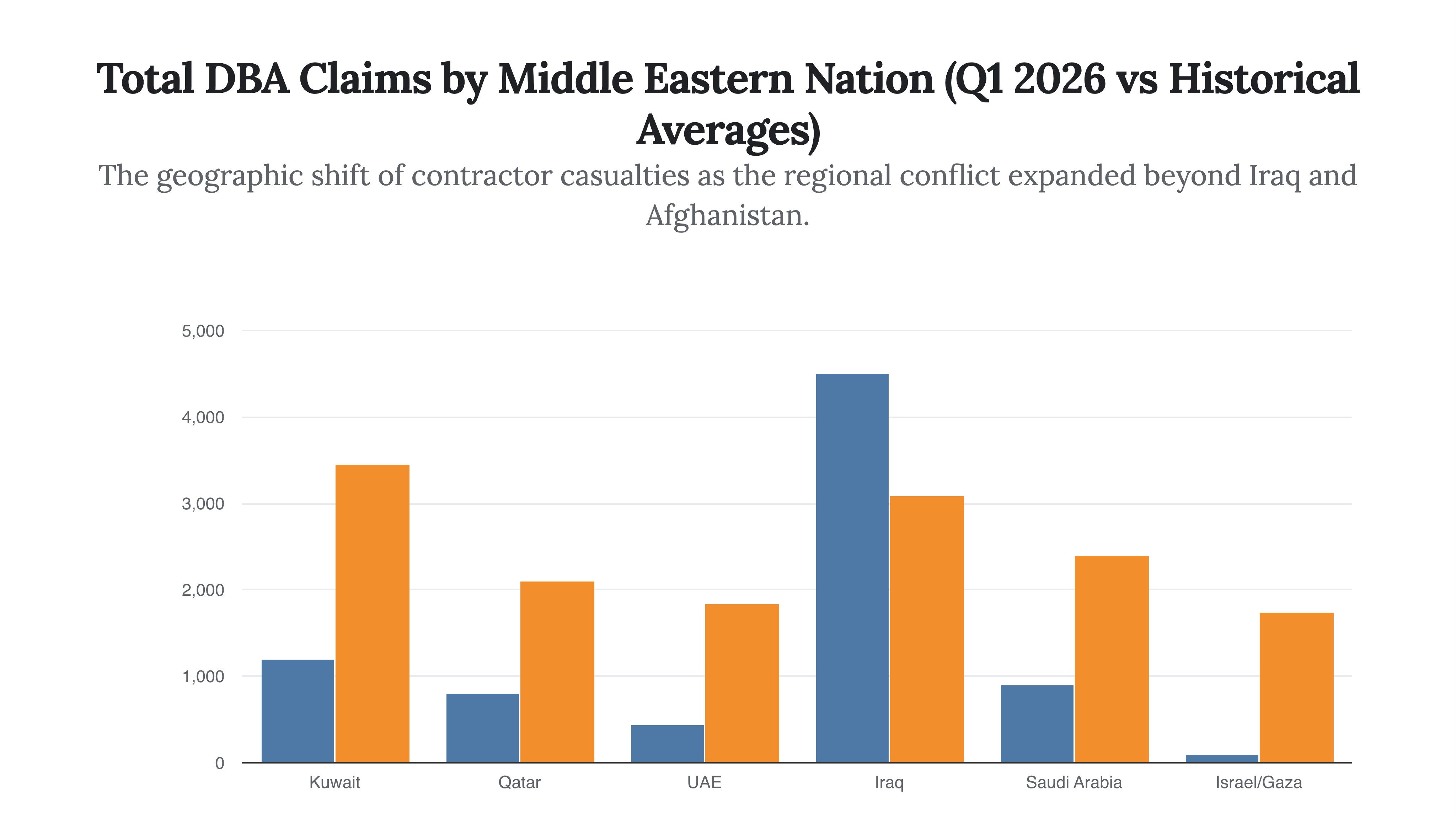
The data from the first quarter of 2026 paints a grim picture of this outsourced reality. As joint U.S.-Israeli operations against Iranian targets intensified in March, triggering retaliatory strikes across the Gulf, bases that were previously considered relatively safe logistical hubs—such as Al Udeid in Qatar and NSA Bahrain—became active targets. The chart above illustrates the violent geographic pivot of DBA claims. Historically, Iraq and Afghanistan dominated the Defense Base Act registries. Today, the epicenter of contractor casualties has shifted to the wealthy Gulf states and the volatile Levant. The staggering 3,450 claims emerging from Kuwait alone in just the first three months of 2026 represent a complete rupture in the historical baseline, driven by the intense targeting of bases like Ali Al-Salem by Iranian ballistic missiles and drone swarms.
This geographical shift carries profound strategic implications. It signals that the era of the “safe rear echelon” is over. Long-range precision munitions, loitering munitions, and proxy militia networks have effectively flattened the battlespace. A civilian IT contractor maintaining server farms in the United Arab Emirates is now exposed to the same kinetic risks as a forward-deployed infantryman in the Syrian desert. This equalization of risk has caught the defense contracting industry—and its insurance underwriters—in a brutal, highly expensive reality check.
The Economic Calculus of Plausible Deniability
The reliance on PMCs and civilian contractors is deeply rooted in the intuition of Game Theory, specifically the concepts of information asymmetry and the principal-agent problem. The “principal” (the U.S. Government) seeks to execute complex, highly dangerous operations in the Middle East—from maintaining advanced Patriot missile batteries to running complex logistical supply lines. The “agents” (the PMCs and their employees) are hired to execute these tasks. In a transparent system, the principal would absorb the full political and social cost of the agent’s failure or demise. However, the system is intentionally opaque. By interposing layers of corporate structure and private insurance between the government and the bleeding worker, the principal successfully externalizes the political cost while retaining the strategic benefit.
Governments do not hire private military companies to win wars; they hire them to launder the political cost of human casualties. This dynamic creates a moral hazard. Because the public does not see the contractor body bags on the evening news, policymakers face less domestic pressure to de-escalate conflicts or reconsider strategic deployments. The true toll of the escalating conflict in the Middle East is thus hidden in plain sight, fragmented across the dockets of administrative law judges and the balance sheets of insurance conglomerates.
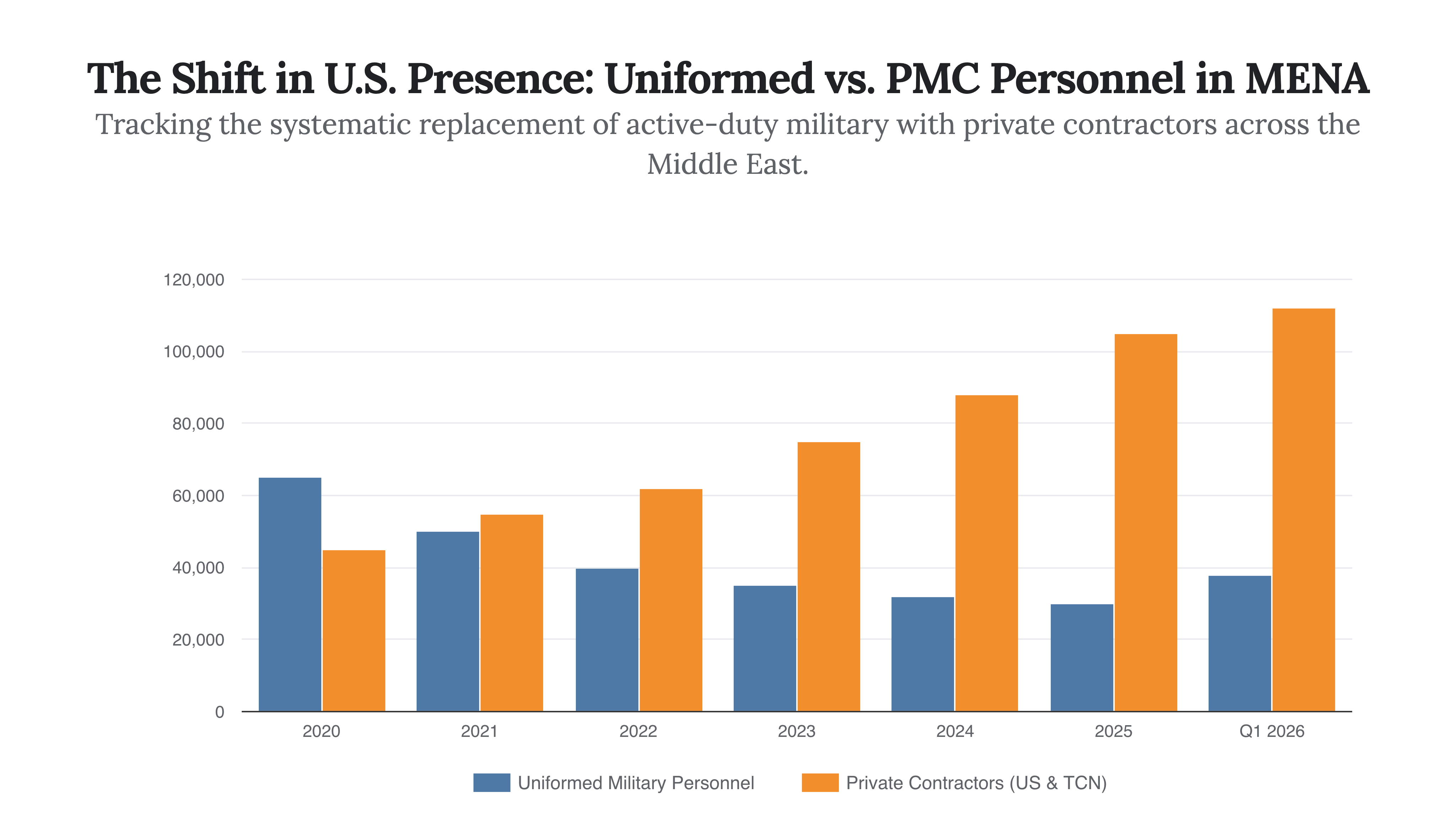
As visualized in the personnel footprint data, the ratio of contractors to uniformed personnel has inverted dramatically over the past six years. Even with the emergency mobilization of 100,000 Israeli reservists and the reinforcement of U.S. borders in early March 2026 due to the Iran escalation, the contractor workforce remains the dominant presence. These 112,000 contractors are not a monolith. They range from highly paid former Tier 1 Special Operations veterans providing armed escort services, to American expatriates supervising construction, to a vast underclass of Third-Country Nationals (TCNs) from nations like Uganda, Nepal, and Colombia who perform the grueling, low-paying labor of guarding perimeters and preparing food.
The economic disparities within this invisible army are vast, but the physical vulnerabilities are universally shared when the sirens sound. The defense contracting industry operates on a high-margin, high-risk model. Companies bid aggressively for lucrative Department of Defense contracts, factoring in the cost of mandatory Defense Base Act insurance. But as the geopolitical risk profile of the Middle East has degraded—transitioning from asymmetric counter-insurgency to near-peer, state-on-state conventional warfare—the insurance premiums have skyrocketed. War Hazards Compensation Act (WHCA) provisions, which allow insurance carriers to seek reimbursement from the U.S. government for injuries caused directly by “war-risk hazards,” have become the ultimate financial safety valve for the industry. This means that, ultimately, the American taxpayer is still underwriting the cost of the trauma; it is simply routed through a Byzantine bureaucratic apparatus that shields the human reality from public view.
The Gaza Experiment and the Limits of Privatized Security
Nowhere is the complexity and moral ambiguity of this privatized model more apparent than in the Gaza Strip. In early 2025, amid the devastating aftermath of the Israel-Hamas war and the collapse of local civil authority, a profound security vacuum emerged. The United Nations and traditional humanitarian organizations found the environment “inherently unsafe,” with distribution points routinely turning into deadly chaotic scrambles. Neither Israel nor the surrounding Arab states were willing to commit their own troops to the politically toxic task of policing breadlines in a devastated urban landscape. Enter the private military contractor.
In February 2025, a North Carolina-based PMC known as UG Solutions stepped into the void. They began heavily recruiting former U.S. Special Forces veterans, offering staggering compensation: $1,100 per day, bolstered by a $10,000 signing bonus. Their mandate was unprecedented: to manage checkpoints and secure humanitarian aid distribution routes within Gaza’s interior. This deployment represented a radical new frontier for PMCs—the militarization of humanitarian logistics in one of the most volatile, hyper-scrutinized patches of real estate on the planet.
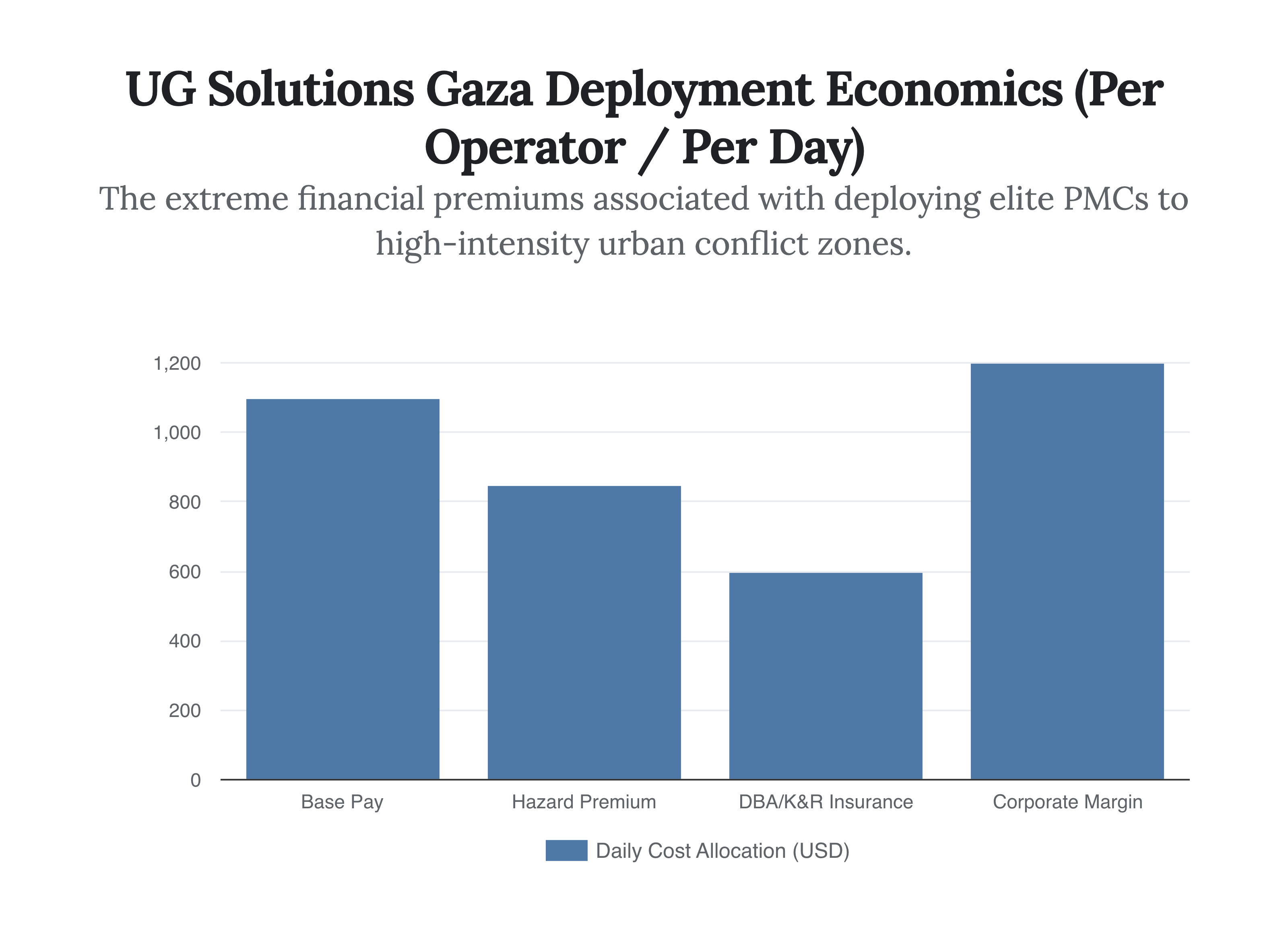
The financial architecture of the UG Solutions deployment, as broken down above, is illuminating. While the operator takes home $1,100 in base pay, the actual cost to the contracting entity (often a blend of international donor funds, allied governments, or obscure NGOs) approaches $3,750 per operator, per day. A massive portion of this overhead is consumed by specialized insurance—not just standard DBA workers’ compensation, but Kidnap and Ransom (K&R) insurance, Repatriation insurance, and extreme War-Hazard premiums. The insurance syndicates of Lloyd’s of London and other global underwriters priced the Gaza operation as a near-certainty for casualties or hostage scenarios.
Gaza became the ultimate testing ground for the privatization of humanitarian security—a grim laboratory where former Special Forces operatives were paid $1,100 a day to guard distribution points that the United Nations had already deemed inherently unsurvivable. The results were highly controversial. While PMCs offered a “neutral” compromise—more palatable to Israel than a UN force, though deeply resented by Palestinians—their presence introduced new volatile vectors. PMCs operate under strict, but often classified, rules of engagement. Historically, as seen with Blackwater in Iraq’s Nisour Square in 2007, private contractors possess a lower threshold for kinetic engagement than highly disciplined, publicly accountable regular military units. The presence of heavily armed, American private operators in Gaza quickly became a flashpoint. Palestinian civil society groups violently opposed their return in 2026, pointing to data from the Gaza Government Media Office which claimed that over 70% of aid-related fatalities occurred near distribution points overseen by foreign contractors or military forces. The “Gaza Experiment” proved that while you can outsource the trigger pull, you cannot outsource the geopolitical fallout.
Unlock deeper strategic alpha with a 10% discount on the annual plan.
Support the data-driven foresight required to navigate an era of radical uncertainty and join a community of institutional-grade analysts committed to the truth.
The Doctrine of the Zone of Special Danger
The legal framework that governs these casualties is as complex as the battlefields themselves. The Defense Base Act is not a standard workers’ compensation policy. It is governed by a powerful legal precedent known as the “Zone of Special Danger” doctrine. In a standard domestic workplace injury, the employee must be actively engaged in their job duties at the time of the injury to qualify for compensation. If a worker slips at a grocery store on their day off, their employer is not liable.
The Zone of Special Danger doctrine, however, recognizes that deploying a civilian to a war zone or a highly volatile, culturally restrictive environment fundamentally alters the parameters of employment. In places like Saudi Arabia, Iraq, or Qatar, the contractor is entirely divorced from their normal life. Therefore, almost any injury sustained during the deployment—even during off-duty hours, while exercising in a base gym, or sleeping in a CHU (Containerized Housing Unit)—is considered to have arisen out of the “zone of danger” created by the employment.
When an Iranian ballistic missile strikes a logistics hub in Kuwait, the resulting trauma is legally categorized not as an act of war, but as a compensable workplace injury. This doctrine has been relentlessly tested during the early 2026 escalations. When Iranian drones breached the airspace over Al Dhafra Air Base in the UAE or NSA Bahrain, forcing thousands of contractors into bunkers at 3:00 AM, the physical injuries sustained during the frantic scramble—shattered ankles, torn ligaments, concussions from impacting bunker doors—all became DBA claims. The insurance companies, naturally, fight these claims aggressively. They challenge the causal link, demand exhaustive medical documentation from war zones where medical records are famously sparse, and employ fleets of defense attorneys to mitigate their payouts.
