



The Macro Liquidity Shift: Silicon Over Carbon
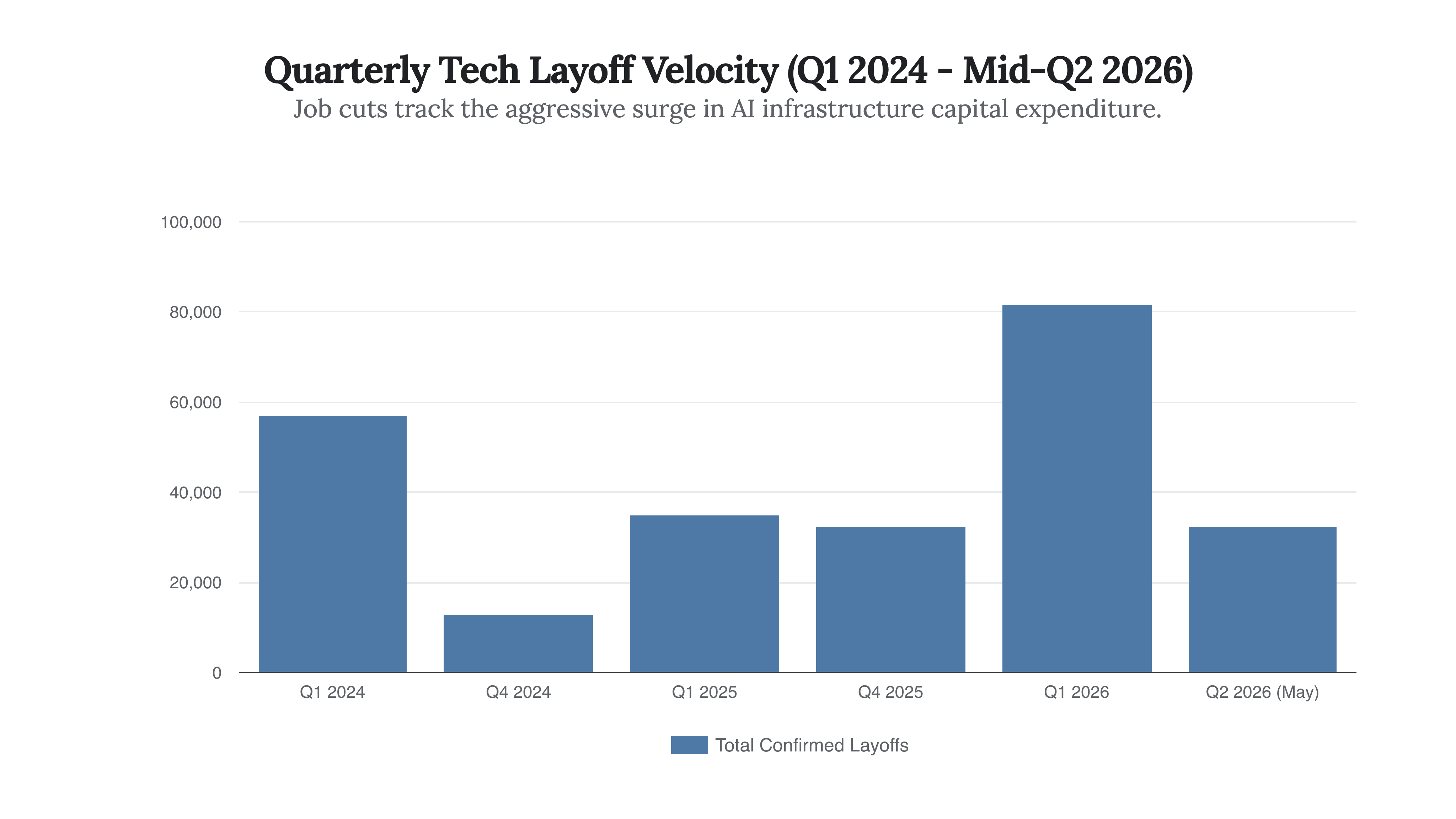
In the first 142 days of 2026, the global technology sector ruthlessly eliminated 114,210 jobs across 150 tracked enterprises, representing a daily average of over 800 terminations. This operational purge has fundamentally destroyed the post-2025 consensus that the worst of the tech industry’s contraction had already concluded. The first quarter of 2026 recorded approximately 81,700 layoffs—the highest quarterly bloodletting since the interest-rate shocks of early 2023. The sector rapidly compounded this severity by adding over 32,500 additional casualties in the first six weeks of Q2 2026. By all current trajectories, 2026 is mathematically guaranteed to surpass the 124,636 total cuts finalized in 2025 within mere weeks.
However, the underlying structural mechanics of this current wave represent a radical departure from historical workforce corrections. Unlike the reactive, panic-driven downsizing of 2023—which was primarily triggered by an aggressive tightening of macroeconomic liquidity by central banks—the May 2026 contraction is proactive, highly capitalized, and surgical. Technology conglomerates are no longer cutting staff to survive a liquidity crisis; they are explicitly unwinding their human capital dependencies to finance an escalating arms race in artificial intelligence compute infrastructure. This is not a recessionary event; it is a deliberate reallocation of enterprise capital from human payroll to frontier hardware.
The sheer velocity of the reduction highlights a profound operational shift. As of mid-May 2026, the 114,210 figure is not merely a data point; it is a manifestation of an entirely new corporate operating model. The zero-interest-rate environment of the early 2020s incentivized the hoarding of human talent as a defensive moat. Companies over-hired simply to deny competitors access to engineers. In the 2026 macroeconomic environment, that equation has entirely inverted.
For the first time in the modern history of Silicon Valley, the absolute size of a software engineering organization is actively penalized by public markets as an indicator of operational inefficiency and a failure to automate.
The new, undisputed market moat is compute capacity, and human capital is being liquidated to fund it.
The Financial Reality: Profitability Meets the Purge
A granular analysis of late-Q1 and Q2 2026 corporate disclosures reveals a severe, counter-intuitive decoupling between company financial health and workforce retention. In past economic cycles, mass layoffs were lagging indicators of fiscal distress. Today, they have been weaponized as leading indicators of structural margin expansion.
A company cutting 17 percent of its workforce on the exact same day it raises financial forecasts is not a company in distress; it is an institution proving that AI-driven margin expansion is an absolute market mandate.
Consider Intuit’s aggressive mid-May 2026 restructuring. The financial technology titan, responsible for TurboTax and QuickBooks, summarily eliminated 3,000 to 3,100 roles worldwide, accounting for roughly 17% of its global staff. This execution did not follow a missed earnings report or a collapse in consumer demand. It was executed alongside a massive $8.6 billion revenue quarter and following a highly profitable tax season. CEO Sasan Goodarzi explicitly framed the purge as a strategic necessity to consolidate operations and pivot aggressively toward AI integration. Intuit deliberately targeted middle-management and “coordination heavy roles,” while simultaneously winding down physical offices in Reno and Woodland Hills to centralize resources. By systematically erasing the roles that traditionally served as connective tissue within large corporate bureaucracies, Intuit is signaling that large language models are now capable of executing the inter-departmental communication and project management tasks that previously required human oversight.
Similarly, Meta Platforms initiated a fresh round of cuts in late May 2026, eliminating 8,000 jobs—amounting to 10% of its remaining staff—while concurrently reassigning 7,000 workers strictly to AI-specific initiatives. Notifications were dispatched with ruthless efficiency, landing in the inboxes of Singapore-based employees at 4:00 AM local time. This personnel shedding is directly inversely correlated with Meta’s capital expenditure, which is projected to swell beyond $125 billion in 2026 to secure frontier-lab GPUs and virtualized data center capacity. The multibillion-dollar capital required to fuel large language models is being extracted directly from the legacy corporate payroll.
The Data Reality: AI as the Corporate Executioner
For the last eighteen months, corporate communications departments obscured the direct impact of automation behind sanitized euphemisms like “macroeconomic headwinds,” “organizational flattening,” and “post-pandemic normalization.” By May 2026, that pretense has entirely evaporated. According to verified industry tracking, 61% of all major job cuts explicitly cite AI as the primary justification.
The April 2026 report from outplacement firm Challenger, Gray & Christmas confirmed that artificial intelligence was the leading cited catalyst for job cuts for the second consecutive month. In April alone, 21,490 layoffs—representing 26% of the 88,387 total cuts across the broader U.S. economy—were explicitly attributed to AI and automation implementation.

This marks a definitive inflection point where technological displacement has surpassed traditional economic factors like market conditions, cost-cutting, and company closures. Cloudflare offers a crystalline example: the networking and security firm laid off over 1,000 workers in early May 2026, explicitly linking the reduction to a staggering 600% increase in the internal usage of AI tools over a
