


The Anatomy of a Real-Time Price Shock
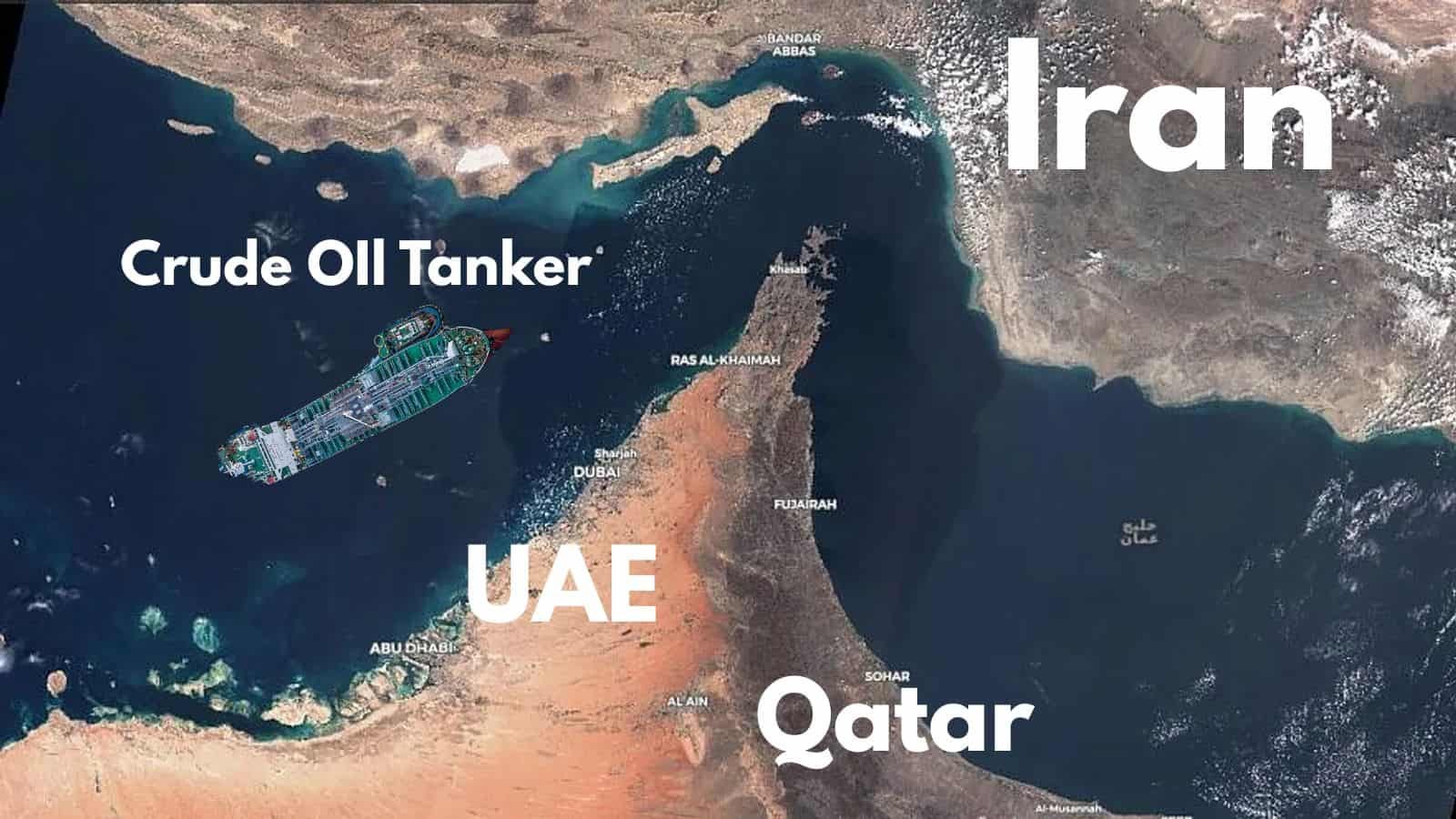
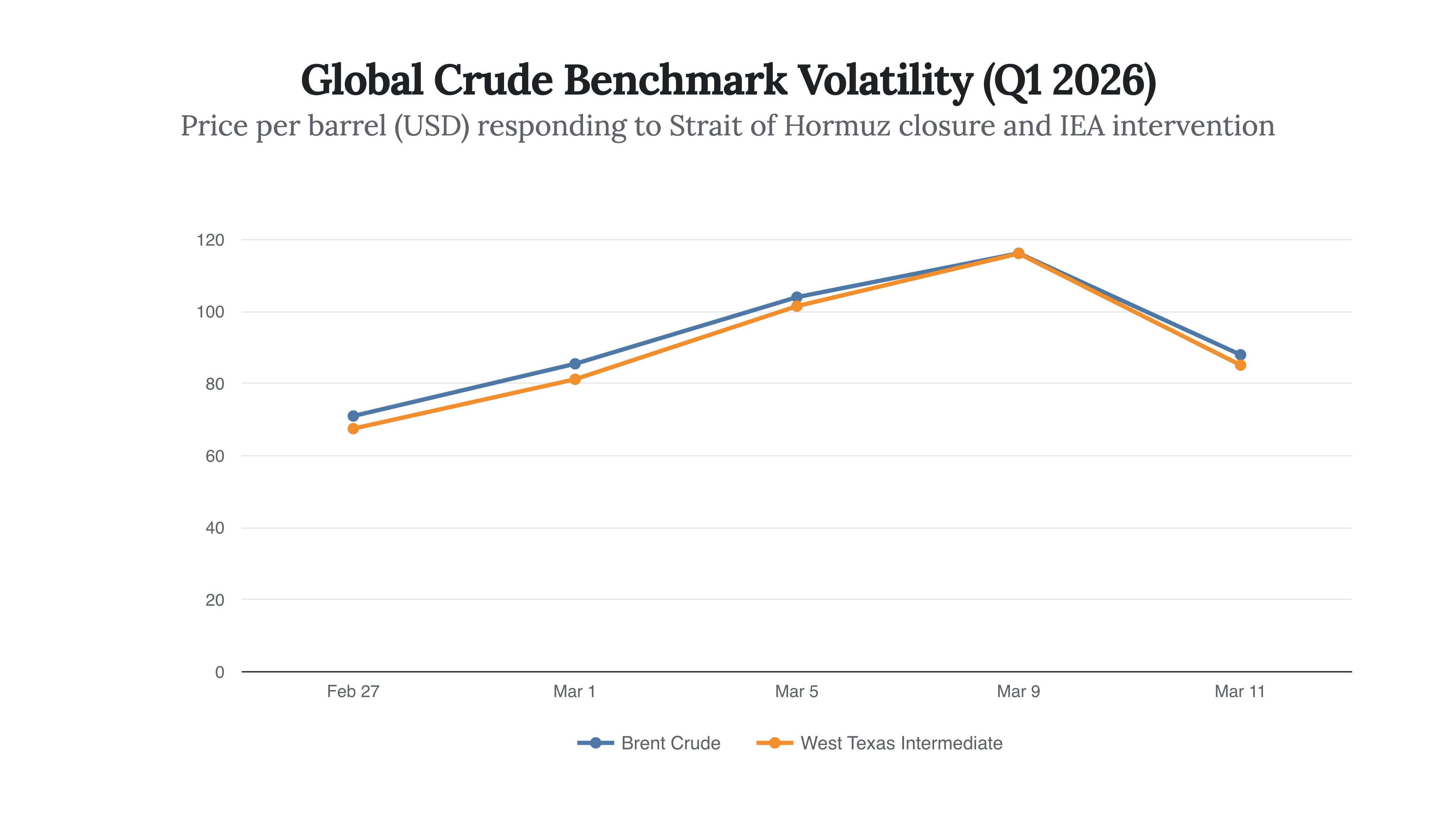
On March 9, 2026, the global energy matrix experienced a violent, algorithmically accelerated repricing event. Brent crude, the international benchmark, briefly eclipsed $116.18 per barrel, breaching levels unseen since the geopolitical supply chain breakdowns of 2022 and 2023. West Texas Intermediate (WTI) followed in lockstep, breaking $116.11 amid an unprecedented 85% price spike over a compressed two-week window. The catalyst was not a shift in organic macroeconomic demand, but the effective closure of the Strait of Hormuz following escalating military action between the U.S., Israel, and Iran.
This data reality forces an immediate recalculation of the baseline risk premium. Nearly 20% of the world’s daily oil supply transits through this single maritime chokepoint. By effectively neutralizing commercial shipping through asymmetric drone threats, ballistic missile posturing, and the subsequent cancellation of maritime insurance coverage, Iran executed a dominant strategy in asymmetric warfare: maximizing global economic pain with minimal conventional force projection. Furthermore, Saudi Arabia was forced to preemptively shutter 2.0 to 2.5 million barrels per day (b/d) of offshore production across the Safaniya, Marjan, and Zuluf fields purely due to security proximity. The global energy apparatus has transitioned from a model of supply-demand equilibrium to a high-stakes, geopolitical hostage dynamic where maritime chokepoints dictate sovereign inflation rates. The spot market is no longer pricing in physical barrels; it is pricing in the probability of regional contagion and the speed of electronic trading systems that execute risk-off protocols in milliseconds.
Game Theory at the Chokepoint: The IEA’s Tit-for-Tat
To understand the extreme volatility defining March 2026, institutional capital must map the Payoff Matrix of the primary actors. The current conflict is a classic non-cooperative game characterized by profound information asymmetry. Iran’s objective is deterrence via the credible threat of sustained supply destruction. The counter-strategy, executed by the G7 and the International Energy Agency (IEA), is a coordinated, massive weaponization of global emergency stockpiles.
By March 11, the announcement that the IEA was preparing the largest strategic reserve release in human history—dwarfing the 182 million barrels deployed in 2022—forced Brent crude to instantly crash back down to the $88 level. Japan and Germany signaled preemptive releases, executing a coordinated Tit-for-Tat algorithmic response against the Hormuz blockade. By weaponizing the Strategic Petroleum Reserve as a real-time price suppression mechanism, the G7 has transformed a passive emergency stockpile into an active instrument of economic warfare. This establishes a new Nash Equilibrium: the geopolitical risk premium is capped not by new physical drilling, but by the artificial flooding of the spot market by sovereign states willing to drain their national security buffers to break an adversary’s leverage.
Unlock deeper strategic alpha with a 10% discount on the annual plan.
Support the data-driven foresight required to navigate an era of radical uncertainty and join a community of institutional-grade analysts committed to the truth.
The Incentive Structures of North American Shale
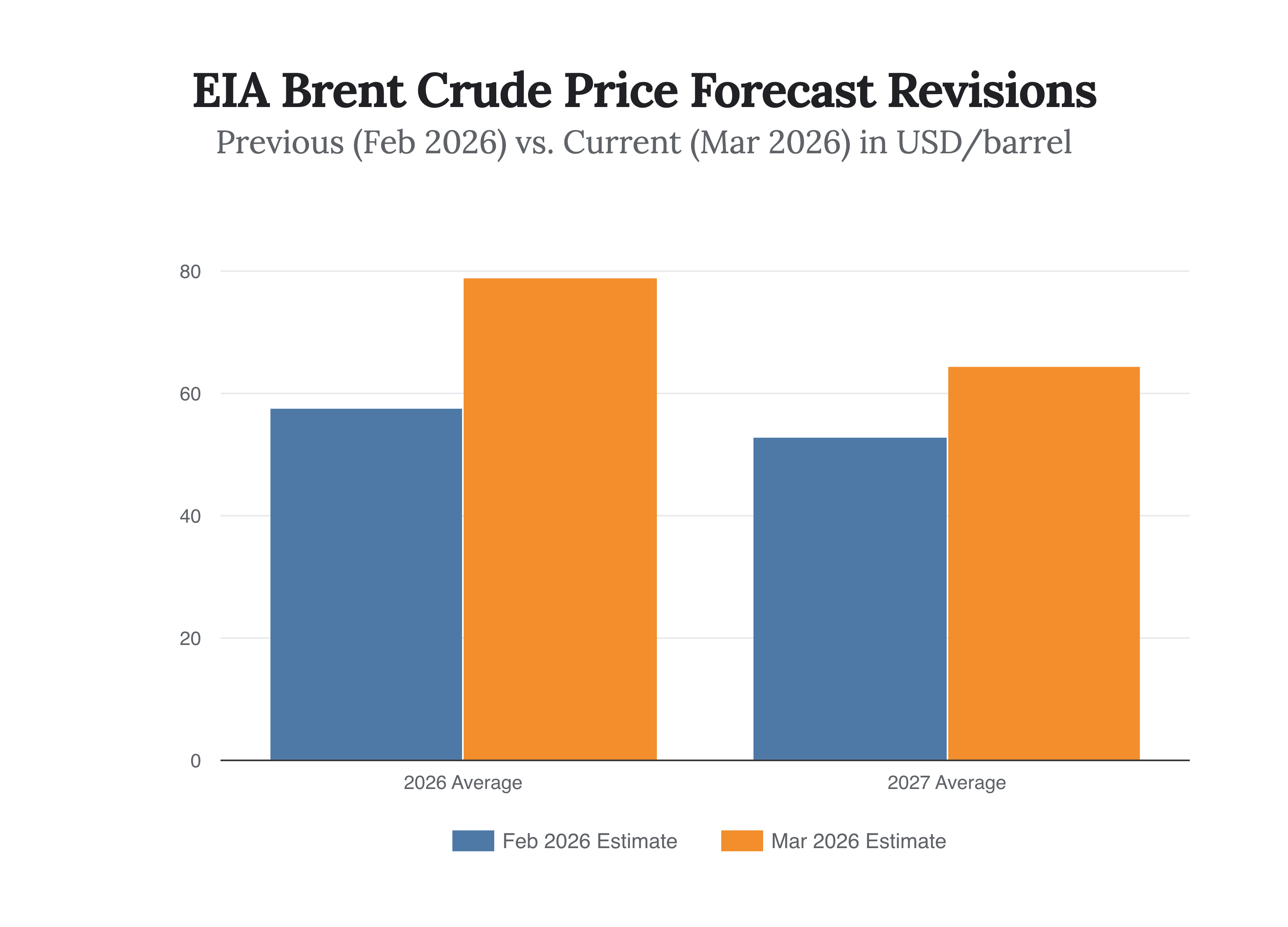
The second-order effects of this Middle Eastern volatility are profoundly reshaping North American energy economics. On March 10, 2026, the U.S. Energy Information Administration (EIA) released its Short-Term Energy Outlook, radically revising its baseline forecasts based on a newly implemented, highly sophisticated well-level decline curve analysis model. The EIA raised its 2026 Brent crude average to $78.84 per barrel—a massive upward revision from a deeply bearish $57.69 estimate issued just weeks prior.
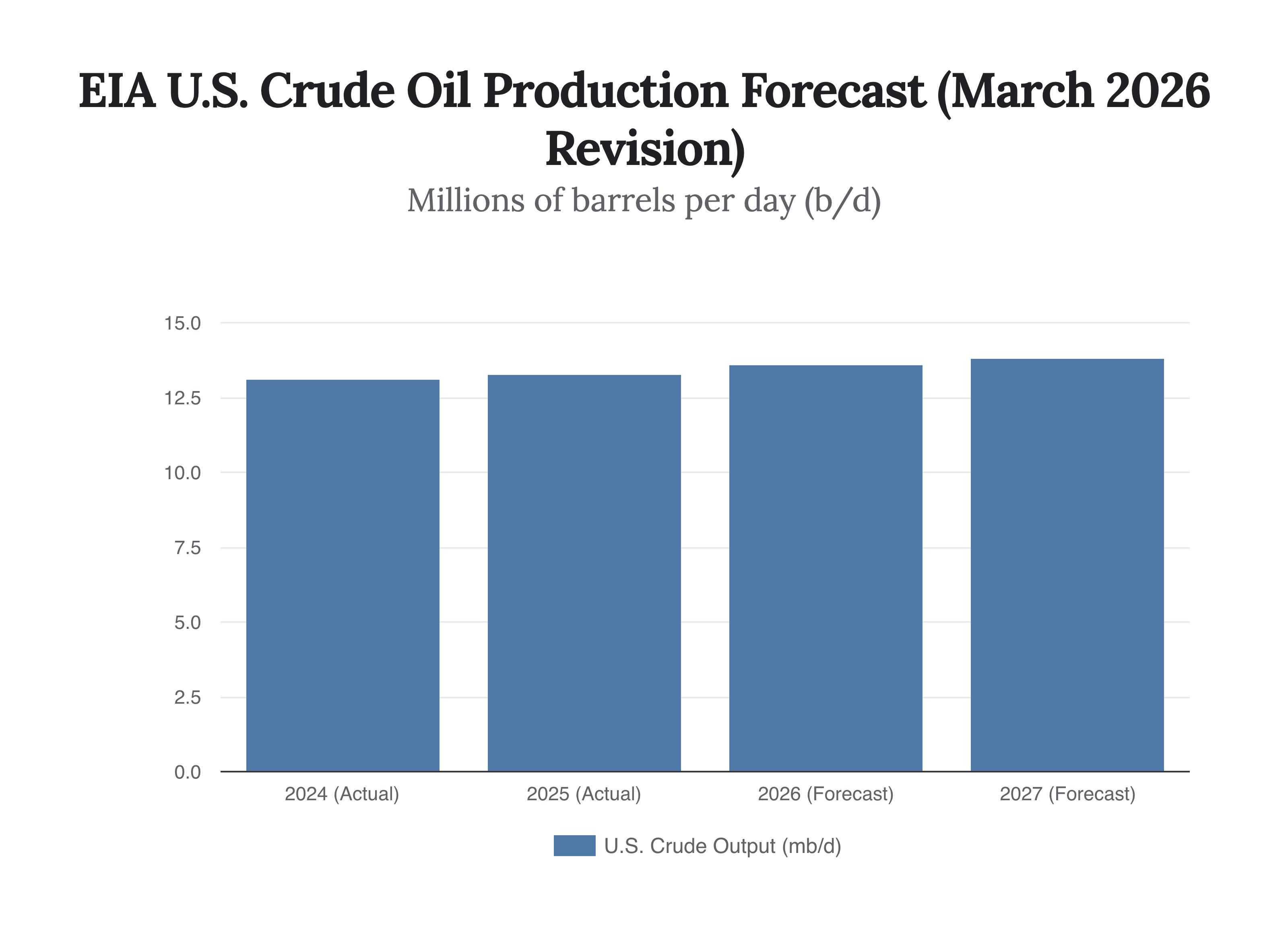
In game theory, a sudden structural shift in the payoff matrix alters the dominant strategies of all market participants. For U.S. shale producers, this sustained price floor acts as an exogenous capital subsidy. The EIA now projects U.S. crude production will reach a staggering 13.61 million b/d in 2026, rising to 13.83 million b/d in 2027. The Permian Basin, aided by expanded pipeline capacity allowing more associated natural gas to reach the market, is the primary beneficiary of this dynamic. Every missile fired in the Persian Gulf effectively underwrites the capital expenditure of the American Southwest, structurally transferring long-term market share from OPEC to North American shale. The conflict creates a strict non-zero-sum outcome for U.S. producers, who capture significantly higher operating margins without bearing any of the physical risk associated with Middle Eastern extraction.
OPEC+ and the Prisoner’s Dilemma of Spare Capacity
While the spot market focuses obsessively on the daily volatility, the institutional data reality is that the broader global oil market is hurtling toward a massive structural surplus. Prior to the March disruptions, analysts projected a global oversupply peaking at nearly 3.8 million b/d by late 2026. In this environment, OPEC+ is trapped in a multi-trillion-dollar Prisoner’s Dilemma.
In February 2026, OPEC+ actually increased output by 445,000 b/d, with Saudi Arabia pumping 10.88 million b/d. The cartel possesses massive spare capacity but cannot deploy it without fundamentally crashing the price below their fiscal breakevens (Saudi Arabia requires roughly $90/bbl to fund its Vision 2030 domestic mega-projects). If OPEC+ holds production flat or cuts further, they lose permanent market share to the U.S., Guyana, and Brazil. If they open the taps to reclaim market dominance, they destroy their own sovereign revenue base. OPEC+ is currently executing a forced retreat, prioritizing baseline market share over price maximization as the structural reality of an impending 2026 supply glut overwhelms short-term geopolitical panics. The cartel’s historical ability to act as the central bank of global oil has been severely degraded by the highly elastic production response of non-OPEC actors.
Second-Order Effects: Mean Reversion in the New Equilibrium
The data reality of March 2026 dictates that extreme volatility is the new mathematical baseline. Market participants must immediately recalibrate their models away from traditional supply-demand fundamentals and toward event-driven algorithmic trading. The current price action—an 85% surge followed by a 25% collapse in under 72 hours—demonstrates that the market is entirely captive to headlines regarding military strikes and IEA stockpile interventions.
For institutional capital, the dominant strategy is to fade the geopolitical spikes. The underlying macroeconomic fundamentals for 2026—sluggish Chinese demand growth (projected under 200,000 b/d) offset only slightly by their 1.0 million b/d strategic inventory stockpiling, alongside an eventual resolution to the maritime blockades—point to a heavily oversupplied physical market by Q3 and Q4. The Nash Equilibrium for the remainder of 2026 suggests a violent mean-reversion toward the $70/bbl range once physical transit through the Strait of Hormuz is forcefully reestablished. High-agency investors will view the current geopolitical risk premium not as a sustained commodity super-cycle, but as a temporary, artificially induced dislocation ripe for strategic short-term exploitation. Until the physical lanes clear, expect the oil market to trade less like a global commodity and more like a volatile proxy for Middle Eastern game theory.