


The Macroeconomic Baseline: The Death of Disinflation
The global disinflation narrative that dominated early 2025 has entirely collapsed as of Q2 2026. The European Commission and the United Nations have issued consecutive revisions confirming what leading maritime and energy indicators have flagged for months: the Middle East conflict—spearheaded by the escalating US-Iran confrontation and persistent Houthi disruptions—has fundamentally and structurally altered the macroeconomic baseline. Global GDP growth is decelerating rapidly while cost-push inflation is violently re-accelerating. The United Nations “World Economic Situation and Prospects as of mid-2026” report formally downgraded global growth to 2.5% for 2026, dropping 0.2 percentage points below January projections and lingering dangerously below pre-pandemic norms.
The localized shock in the Levant and the Arabian Peninsula has transformed into a global economic contagion. The European Commission recently slashed its 2026 eurozone growth forecasts to a staggering 0.9%, down from an optimistic 1.2%, while simultaneously revising inflation projections upward to 3.1%. In developing economies, the uptick is even sharper, with energy and food import costs tearing through central bank targets. The Asian Development Bank has echoed these alarms, warning that prolonged disruptions will choke growth and spur inflation across the Asia-Pacific region, recommending that governments transition from broad-based energy subsidies to highly targeted, time-bound fiscal support just to maintain systemic stability. The single most dangerous assumption in modern capital markets is that central banks possess the mechanical leverage to tame supply-side geopolitical shocks without inducing a deep, structural recession. The data reality dictates that the global disinflation trend underway since 2023 has been permanently halted by the friction of physical warfare.
The Asymmetric Energy Shock and The Strait of Hormuz
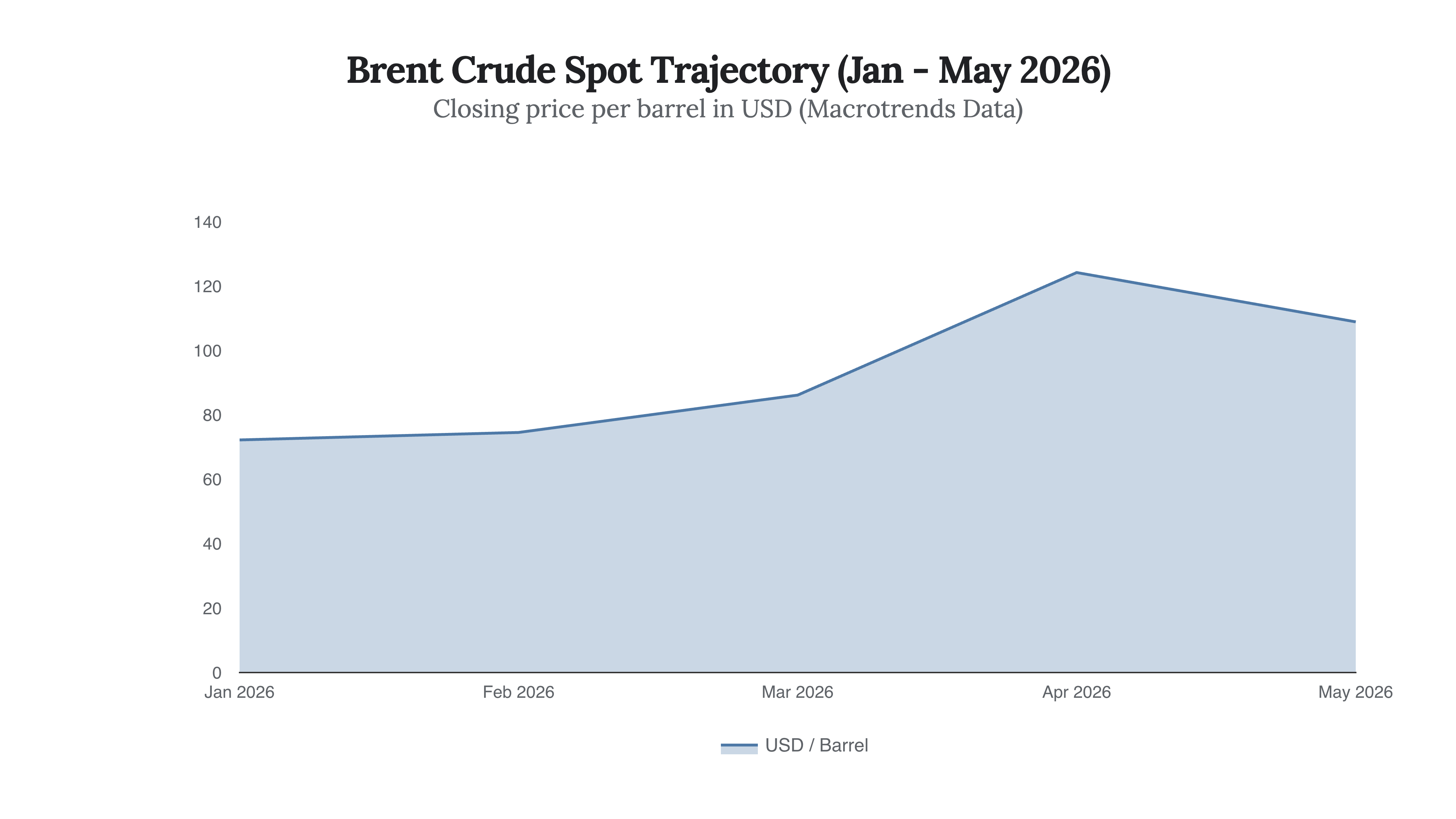
Brent crude’s trajectory over the first half of 2026 tells the story of a physical market pricing in total asymmetric risk. In late 2025, oil hovered comfortably in the low $70s, lulling market participants into a false sense of energy security. As of late May 2026, Brent futures are wildly oscillating between $105 and $111 per barrel, having breached an astonishing $124.24 at the end of April 2026 following the breakdown of initial ceasefire talks and the rapid escalation of the US-Iran naval standoff. The underlying tension revolves around intelligence reports indicating Iran currently holds roughly 10,000 kilograms of enriched fissionable material, effectively transforming the Gulf into a radioactive tripwire. Barclays has maintained a baseline average Brent forecast of $100 per barrel for 2026, but expressly noted that risks are skewing significantly higher.
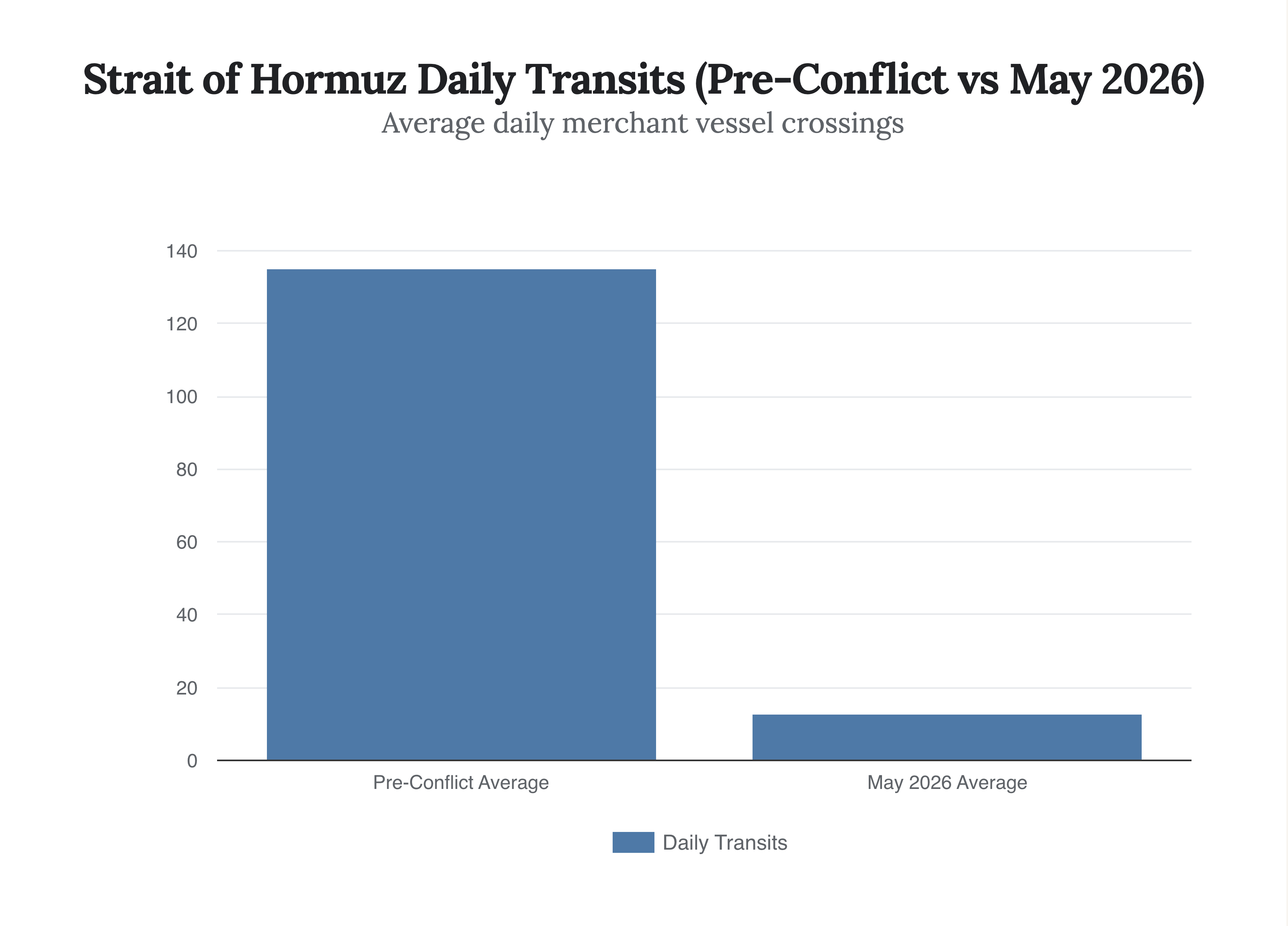
The data reality mapping the Strait of Hormuz—the world’s most critical energy chokepoint responsible for roughly 20% of global oil consumption—shows it is functionally barricaded. Daily transit volumes have imploded. Prior to the current phase of the conflict, the strait saw an average of 125 to 140 merchant vessels cross daily. Today, in May 2026, that number has evaporated to a mere 10 to 16 vessels per day, primarily comprised of Chinese-flagged ships, such as the Zhong Gu Nan Chang, that are uniquely insulated from the immediate Western-aligned hostilities. Energy markets are no longer pricing in a temporary geopolitical premium; they are structurally adapting to a bifurcated ocean where Western shipping is effectively blockaded from the world’s most vital maritime chokepoints. The logistical bottleneck is immense, with maritime trackers indicating at least 1,500 merchant vessels and 20,000 sailors currently stranded in the broader Gulf area, awaiting diplomatic breakthroughs that appear increasingly remote.

Maritime Chokepoints and The Mid-Voyage Cost Explosion
The secondary shockwave from the Middle East is obliterating supply chain normalization. With the Red Sea already compromised by ongoing Houthi ordnance and the Strait of Hormuz effectively severed, global shipping is in a state of terminal rerouting. The Cape of Good Hope detour is no longer an emergency contingency; it is the permanent baseline for the foreseeable future. This massive diversion adds roughly 3,500 nautical miles and 10 to 14 days to standard Asia-Europe and Asia-US East Coast voyages, effectively evaporating 6% of global fleet capacity overnight. Look at the Drewry World Container Index (WCI) for the third week of May 2026. The composite index has surged 6% in a single week to $2,712 per 40ft container, following a massive 12% jump the week prior.
