


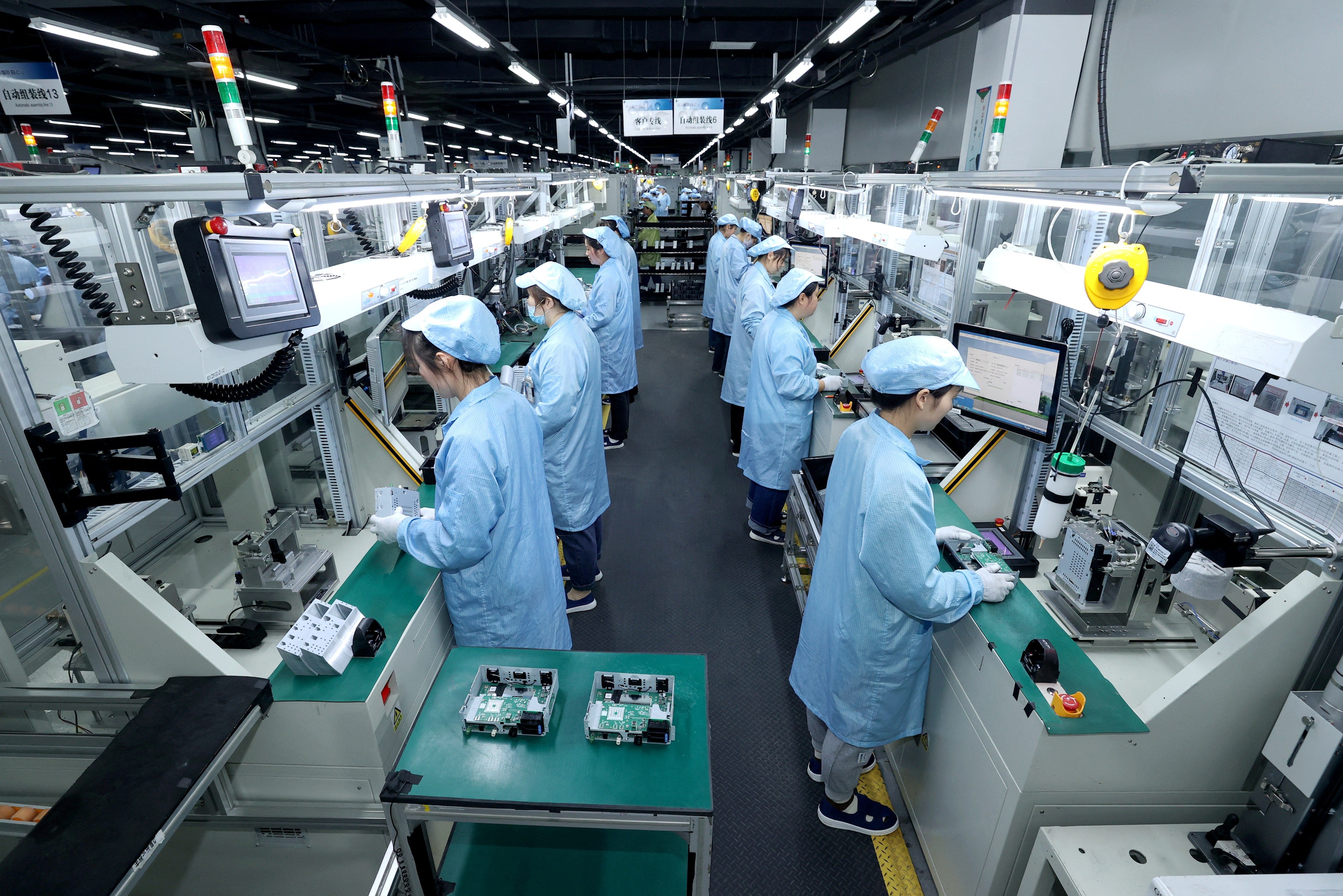
The latest readings from the factory floor of the world’s second-largest economy present a dangerously misleading picture if viewed in isolation. In October 2025, China’s official manufacturing Purchasing Managers’ Index (PMI) slumped to 49.0, signaling a clear contraction that spooked markets. Yet, a parallel survey focusing on smaller, private, and more export-oriented firms, the Caixin/RatingDog PMI, registered 50.6—slower growth, but growth nonetheless. This schism is no mere statistical anomaly; it is the most critical diagnostic of China’s current economic malaise.
While Beijing’s stimulus measures may be keeping state-owned behemoths on life support, they are failing to address the acute pressures facing the private sector, which is grappling with collapsing foreign demand and a brutal domestic price war. This divergence reveals a two-speed economy struggling with its own internal contradictions, posing a profound risk to global supply chains and investors who misread the headline numbers. The core strategic challenge is no longer just about a slowdown, but about a fundamental decoupling within China’s own industrial base.
Deconstructing the Dichotomy: A Split-Screen View of China’s Industrial Engine
The October 2025 data paints a starkly divided picture of China’s manufacturing landscape. Understanding the nuances between the official and private surveys is paramount to grasping the true state of play. The divergence is not just in the headline number but is reflected across the critical sub-indices that measure the sector’s vitality, from new orders to employment.
A Tale of Two PMIs: State vs. Private Sector
The official PMI from the National Bureau of Statistics (NBS) primarily surveys large, often state-owned enterprises (SOEs). Its dip into contraction at 49.0 in October suggests that the domestic-focused, state-supported segments of the economy are losing momentum. Conversely, the Caixin/RatingDog PMI, which polls around 650 smaller, private companies, reflects the reality for the more agile and globally-integrated part of the economy. While its fall from 51.2 in September to 50.6 indicates a slowdown, the fact it remains in expansionary territory is significant. This suggests that while conditions are worsening, the private sector is, for now, keeping its head above water, largely propped up by a resilient, if weakening, domestic consumer.
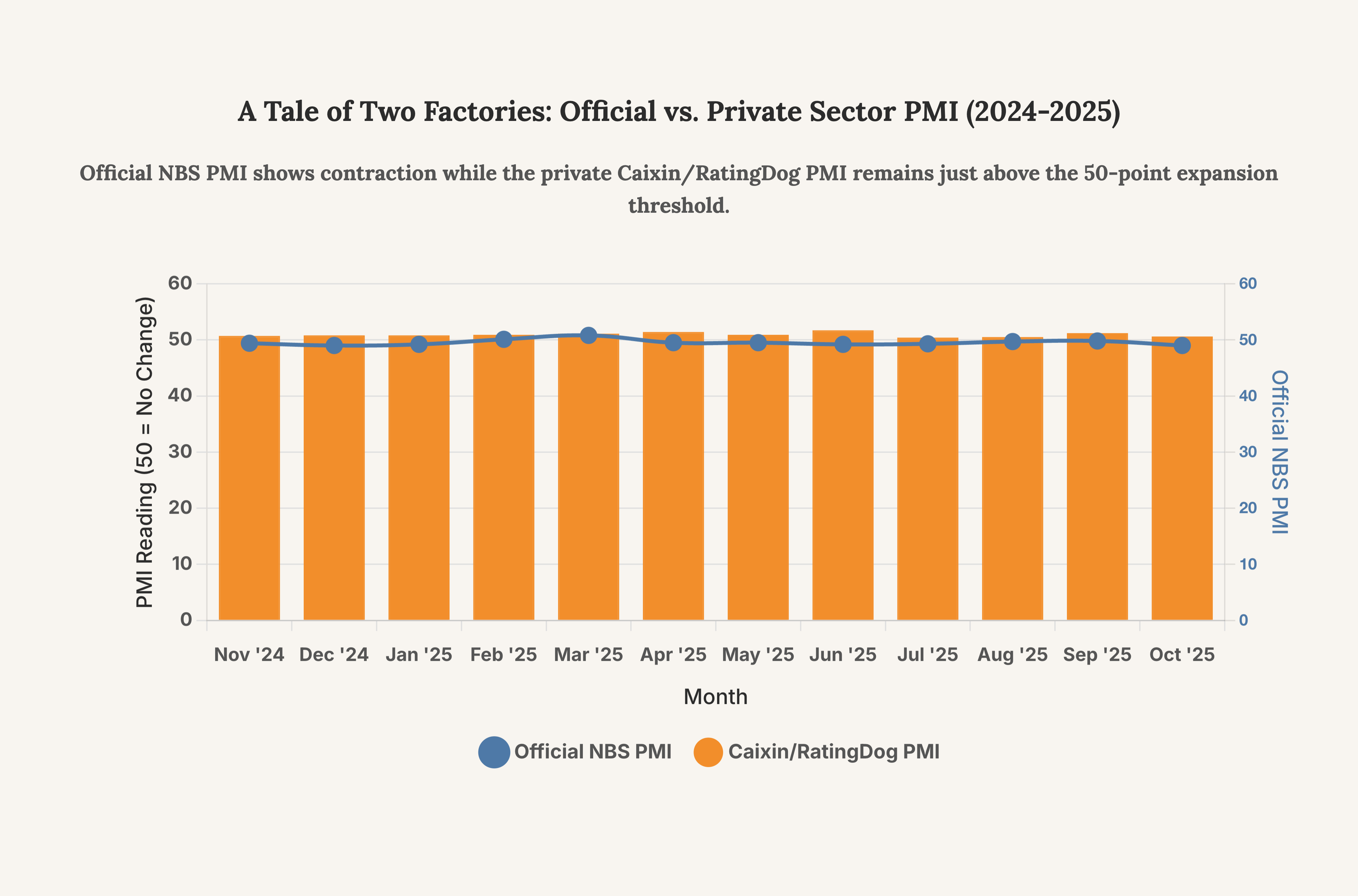
Caption: The chart above illustrates the growing divergence between the official PMI, reflecting large state-owned firms, and the Caixin/RatingDog PMI, which tracks smaller private enterprises.
The External Storm: Collapsing Export Orders
The most alarming signal across both surveys is the unambiguous weakness in external demand. The new export orders sub-index in the private survey fell at the quickest pace since May 2025. Respondents directly attributed this to heightened trade uncertainty and softening global economic conditions. This is a critical blow for the private firms that are often the most exposed to international markets. The official survey corroborates this trend, showing a steep decline in its own export order sub-index. This indicates that the strategy of front-loading exports to get ahead of potential tariffs has run its course, leaving a demand vacuum that domestic consumption is struggling to fill.
The Fragile Prop of Domestic Demand
While foreign orders evaporate, domestic demand has been the primary factor keeping the Caixin PMI in positive territory. The survey noted a fifth consecutive monthly rise in new business, supported by sales promotions and resilient, though not spectacular, local consumption. However, the official PMI’s new orders sub-index fell to 48.8, suggesting that demand from the large SOEs and the government-backed projects they supply is faltering. This creates a precarious situation: the private sector is depending on a domestic consumer whose confidence is being steadily eroded by a protracted property crisis and a weak labor market.
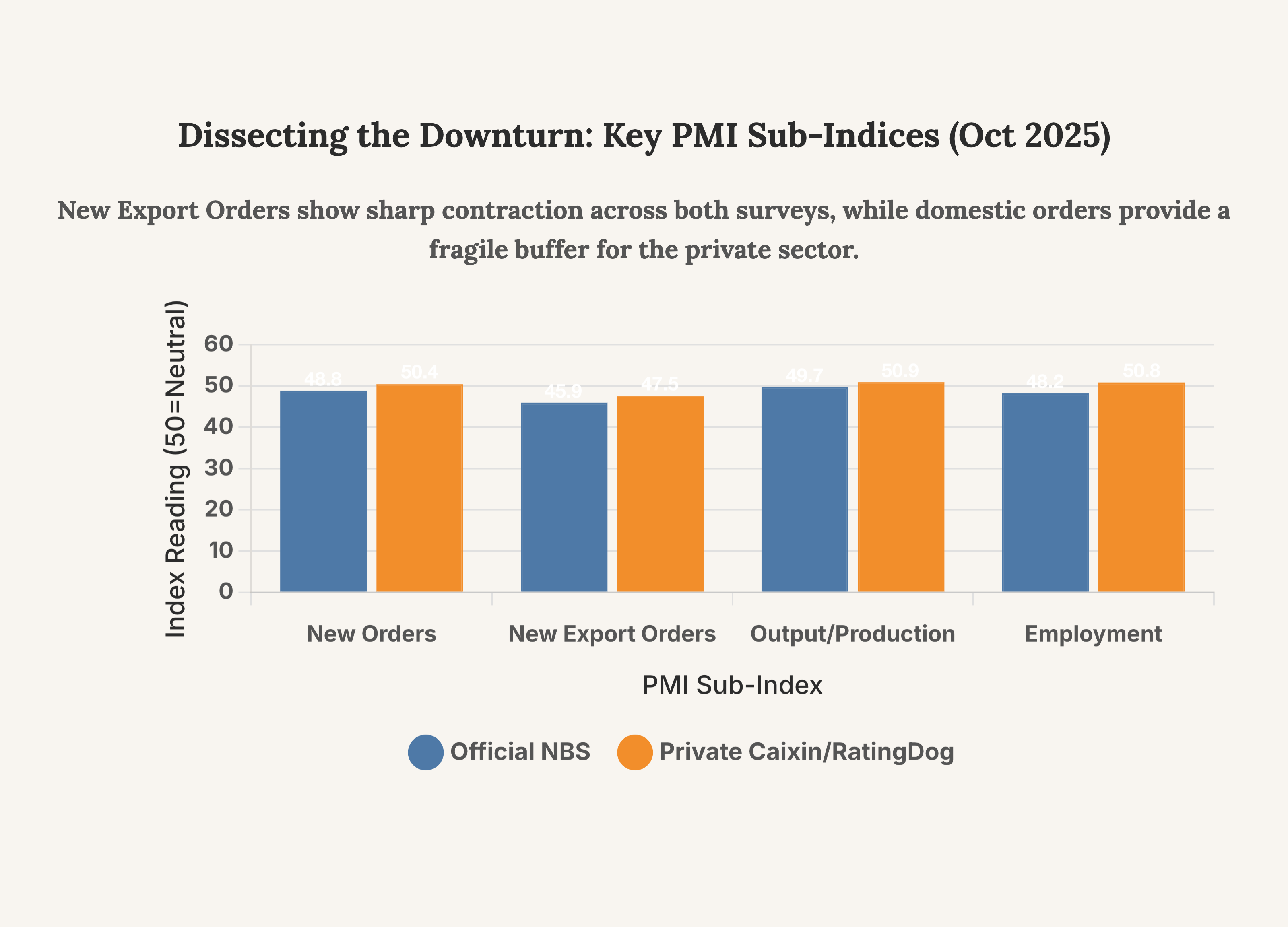
Caption: A breakdown of the October 2025 PMI data highlights the severe contraction in new export orders, a key drag on the entire manufacturing sector.
The Deflationary Vise and the Jobs Conundrum
The slowdown in activity is creating a toxic cocktail of falling prices and a deeply uncertain labor market. These two forces feed off each other, suppressing corporate profits, stalling investment, and dampening the consumer sentiment needed for a genuine recovery. This feedback loop represents a significant structural headwind for policymakers in Beijing.
The Factory-Gate Price War
A persistent and worrying trend is the deflationary pressure emanating from China’s factories. To secure a share of the shrinking demand pie, manufacturers are aggressively cutting selling prices. The Caixin survey noted that firms reduced prices at a faster pace in October amidst easing cost pressures and greater market competition. This is the micro-level manifestation of a macro problem: China’s Producer Price Index (PPI), which measures the cost of goods as they leave the factory, has been in negative territory year-on-year for over a year. Data from September 2025 showed a 2.3% decline. This factory-gate deflation squeezes profit margins, discourages new investment, and can eventually bleed into consumer prices, raising the specter of a broader deflationary spiral that is notoriously difficult to escape.
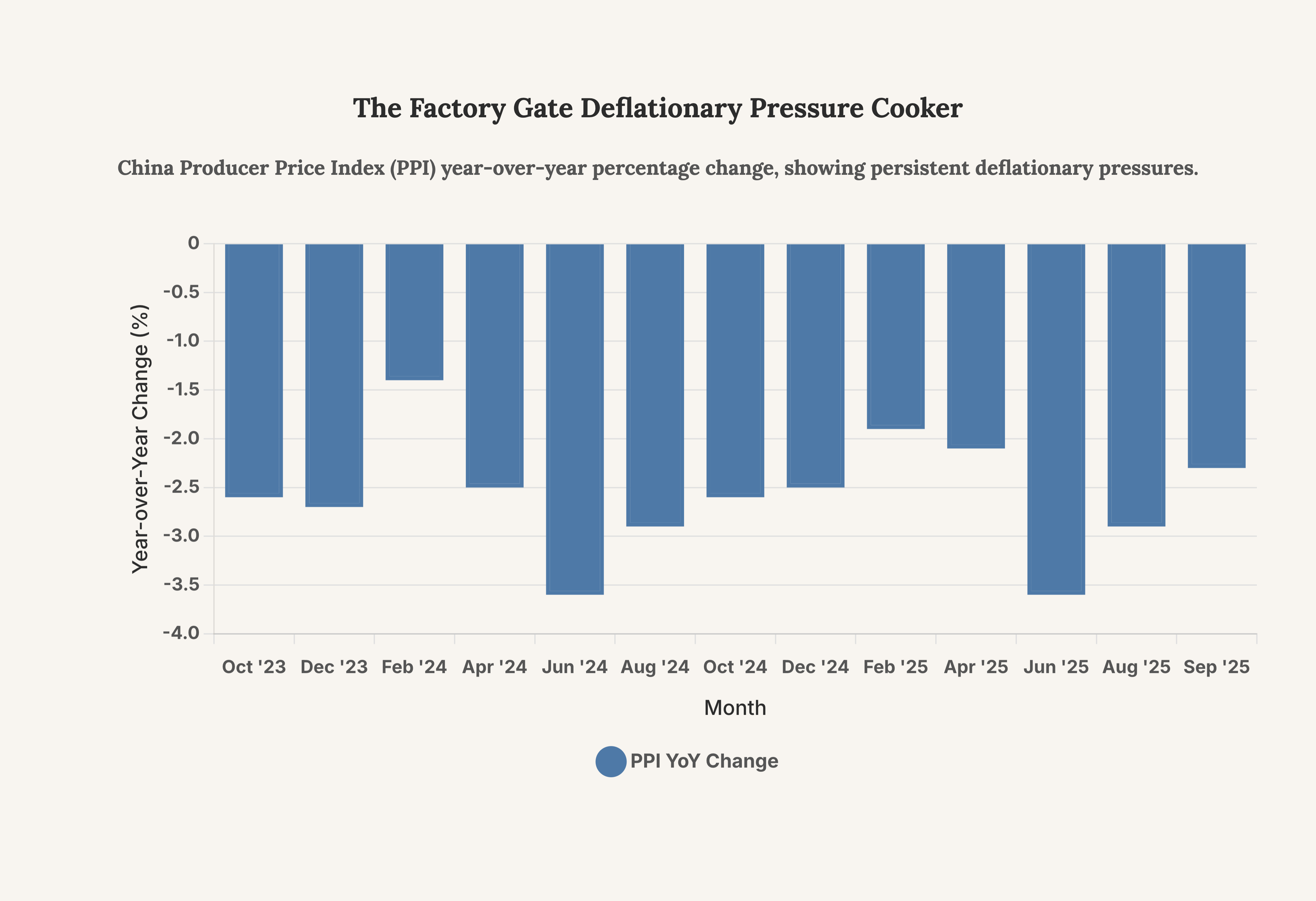
Caption: The PPI has been in negative territory for a prolonged period, indicating that industrial deflation is becoming entrenched, squeezing corporate profitability.
A Job Market at Odds
The employment data presents one of the sharpest contradictions. The private sector-focused Caixin survey showed employment rising for the first time in seven months, with firms hiring more staff to handle workloads. Yet the official survey’s employment sub-index remained firmly in contraction. This divergence likely reflects the different realities of the firms surveyed. Smaller, more adaptable private firms may be hiring opportunistically, while large SOEs, often overstaffed, are in a phase of consolidation. However, any optimism from the Caixin reading must be tempered by the dire state of the youth labor market. The unemployment rate for 16-24 year olds stood at a staggering 17.7% in September 2025, down slightly from an 18.9% peak in August but still crisis-level. This suggests a profound structural mismatch between the skills of a record 12.2 million new graduates and the jobs the economy is creating, a long-term drag on productivity and social stability.
“China still faces pressure in maintaining stable employment, mainly due to complex changes in the external environment. The coexistence of recruitment difficulties in some domestic industries and great employment pressures for certain groups persists, with ongoing issues regarding a mismatch between human resource supply and demand.” - Fu Linghui, NBS Spokesperson
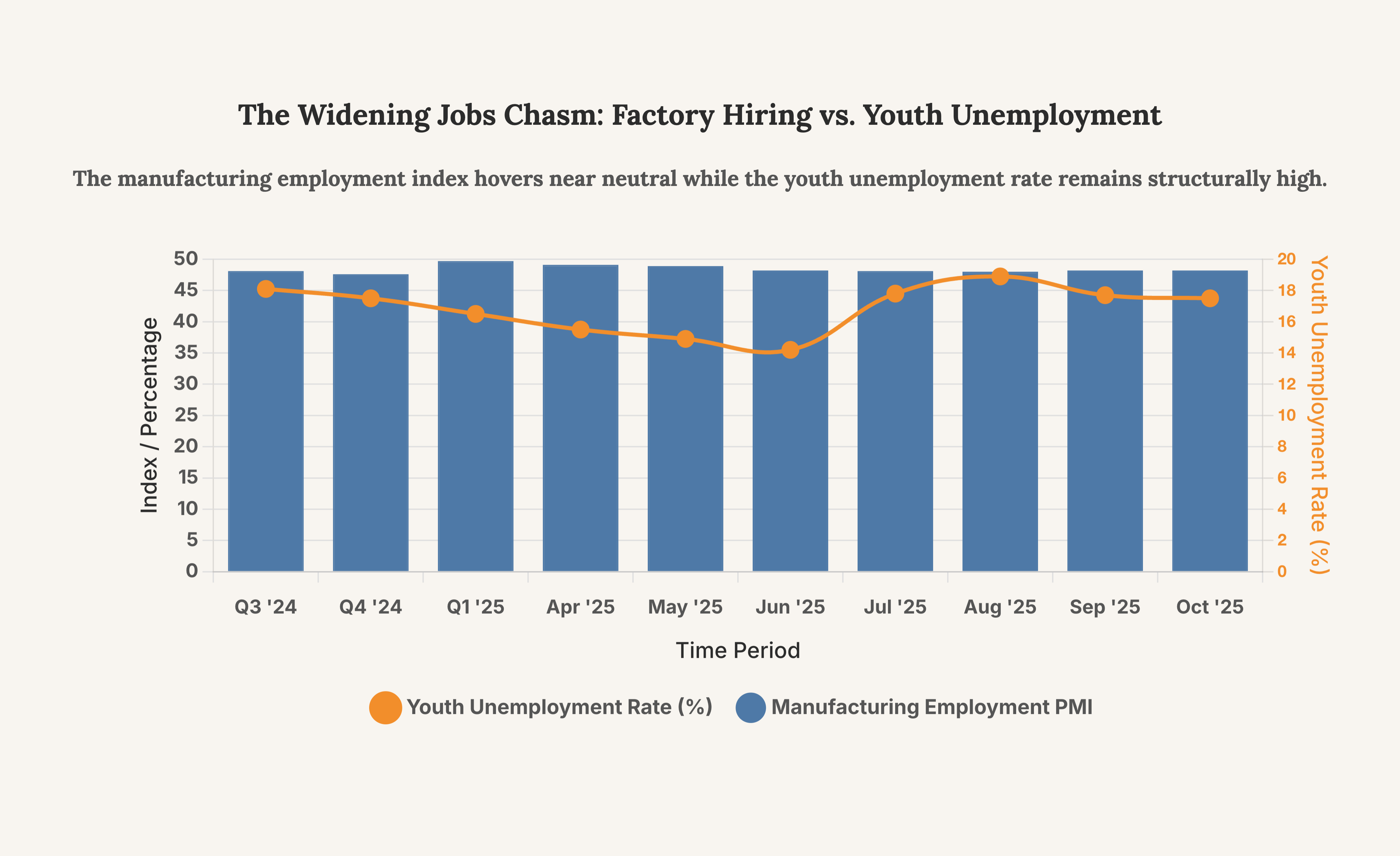
Caption: This chart juxtaposes the cyclical hiring in manufacturing with the persistent, high level of youth unemployment, revealing a deep structural issue in China’s labor market.
Policy Levers and Structural Cracks
Beijing is not standing idle. The government is acutely aware that it needs to meet its annual GDP growth target of around 5%. However, its policy response appears to be sticking to a well-worn playbook that may be ill-suited to the current challenges, while the deep, structural crack of the property crisis continues to undermine any recovery efforts.
Beijing’s Stimulus Playbook: Is It Enough?
The government’s response has focused on supply-side support: injecting liquidity, encouraging bank lending, and channeling investment into strategic sectors like high-tech manufacturing. While industrial output data for the year to date shows resilience, with high-tech sectors like new energy vehicles and industrial robots posting strong growth, the October PMIs suggest this momentum is fading. The core problem is that Beijing’s policies prioritize production over consumption. As one analyst from Chatham House noted, the commitment to rebalance the economy toward the consumer has been a feature of Chinese policymaking for two decades but has had little real impact. This approach risks exacerbating the very problem it seeks to solve: creating more industrial supply in an environment of already-weak demand, further fueling deflationary pressures.
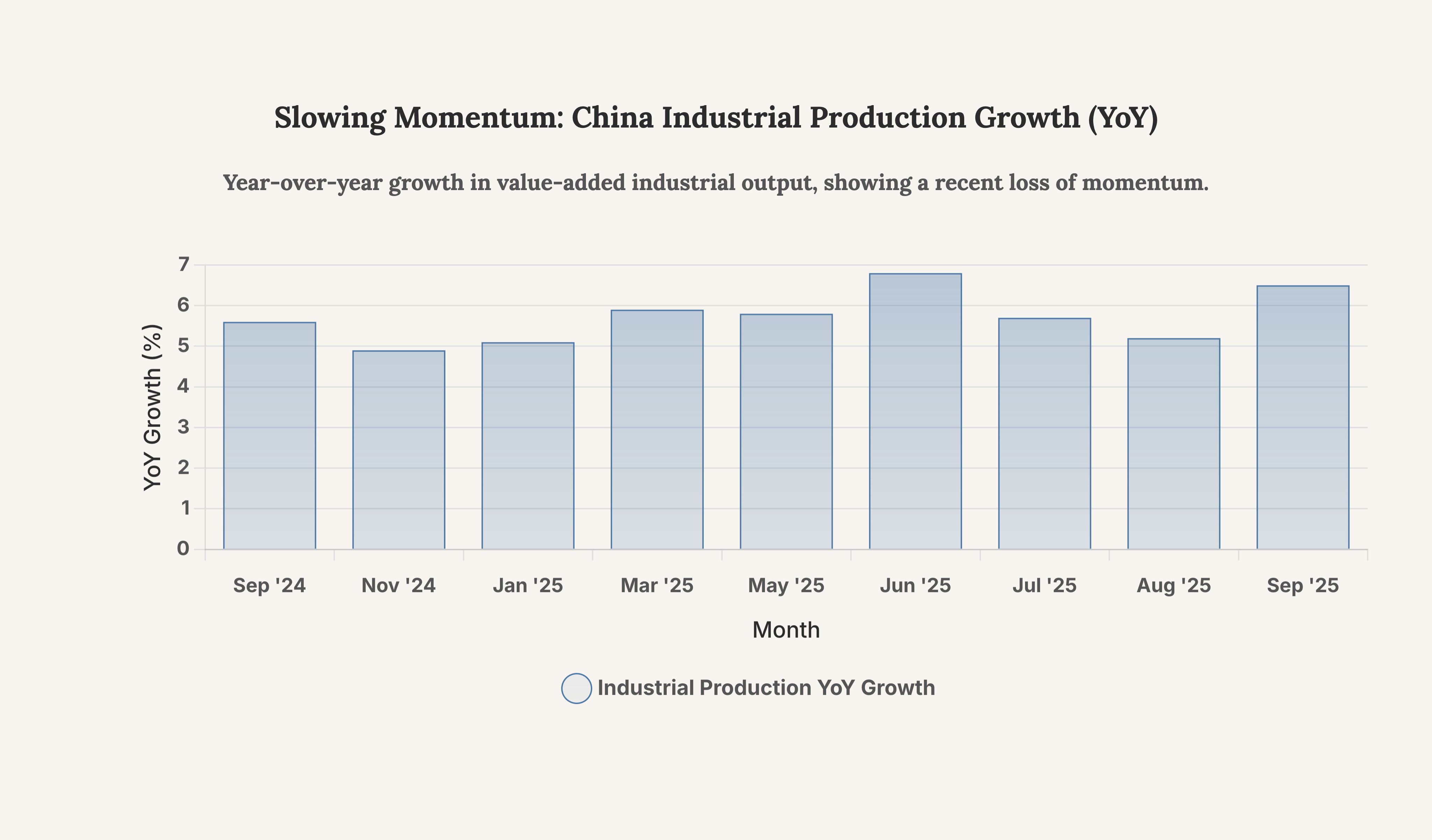
Caption: Industrial production growth, while positive, has shown volatility and signs of weakening in the latter half of 2025, aligning with the downbeat PMI data.
“The PMIs suggest that China’s economy lost some momentum in October, with slower growth across manufacturing and construction. Any boost to exports from the latest U.S.-China trade ‘deal’ is likely to be modest and wider headwinds to growth will persist.” - Zichun Huang, Capital Economics
The Long Shadow of the Property Crisis
No analysis of China’s economy is complete without acknowledging the ongoing crisis in its real estate sector. The sector, which accounts for a significant portion of GDP, remains in a deep slump, with falling prices and sales. This has a direct impact on manufacturing by crushing demand for construction materials like steel and cement. More importantly, it has a devastating indirect impact on consumer confidence. With a large portion of household wealth tied up in real estate, the continuing price declines make consumers feel poorer and less likely to spend, undermining the domestic demand that the manufacturing sector now desperately needs. Until there is a credible and sustainable floor put under the property market, any broader economic recovery will be built on sand.
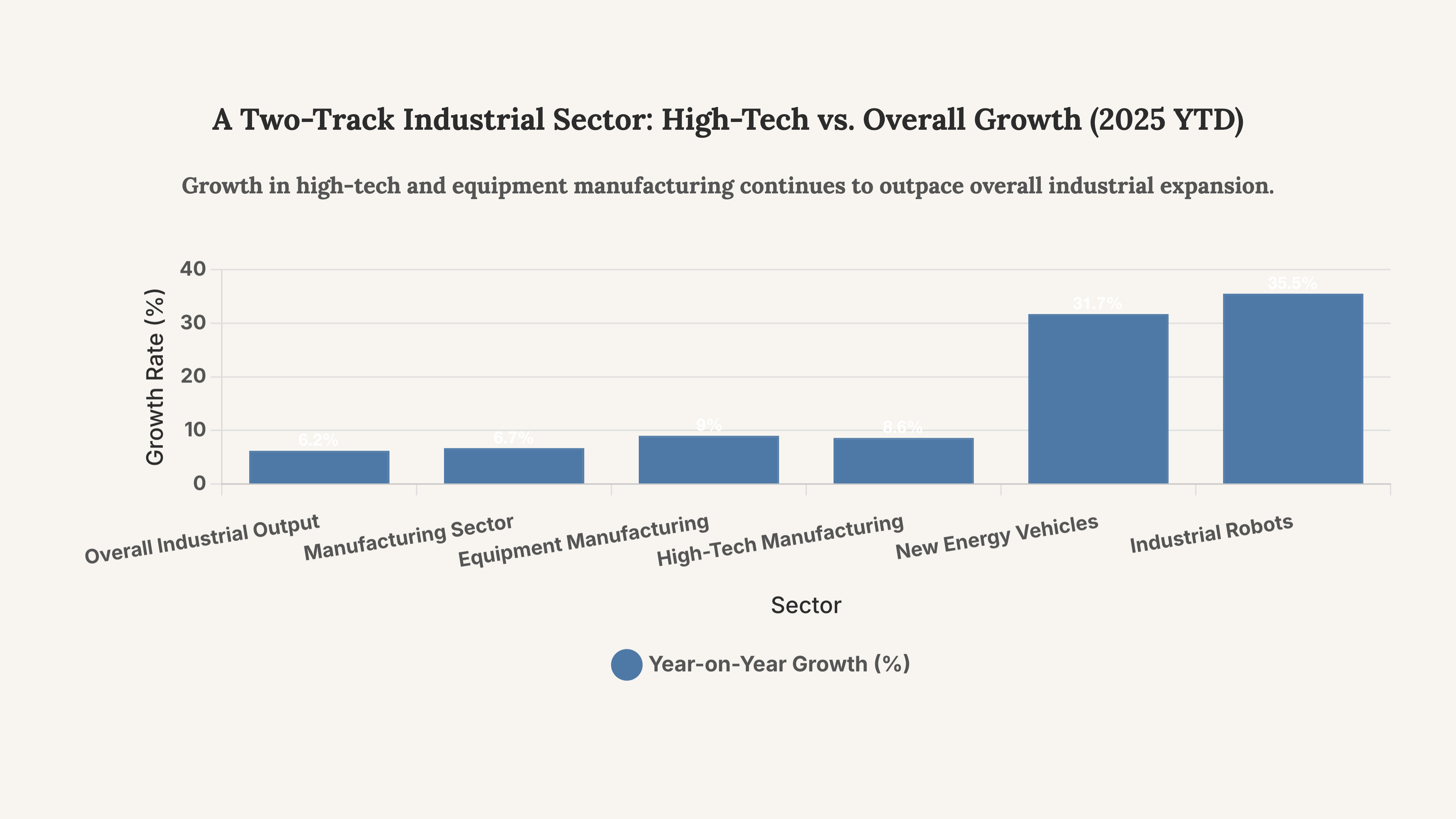
Caption: Beijing’s strategic focus is creating pockets of extreme growth in high-tech areas, even as the broader industrial economy slows, further contributing to the two-speed narrative.
Strategic Foresight and Concluding Insight
The great divergence in China’s manufacturing data is the defining feature of its current economic landscape. The strategic implication is clear: the era of monolithic, state-directed growth is giving way to a more fractured and challenging environment. Investors and corporations can no longer rely on a single headline number to gauge the health of the Chinese market. The reality is a two-track economy where state-backed industries focused on strategic goals like self-sufficiency may remain stable, while the private, export-oriented sector faces a brutal combination of weak global demand and deflationary domestic competition. The key signpost to watch in the coming months will be the evolution of new export orders and the Producer Price Index. If export orders continue to plummet and PPI remains deeply negative, the pressure on the private sector could become unbearable, forcing a more drastic and consumer-focused policy shift from Beijing. Until then, the divergence will likely widen.
The world must stop analyzing the Chinese economy as a single entity; it is now a battlefield of competing internal forces, and the private sector is fighting a defensive war.