


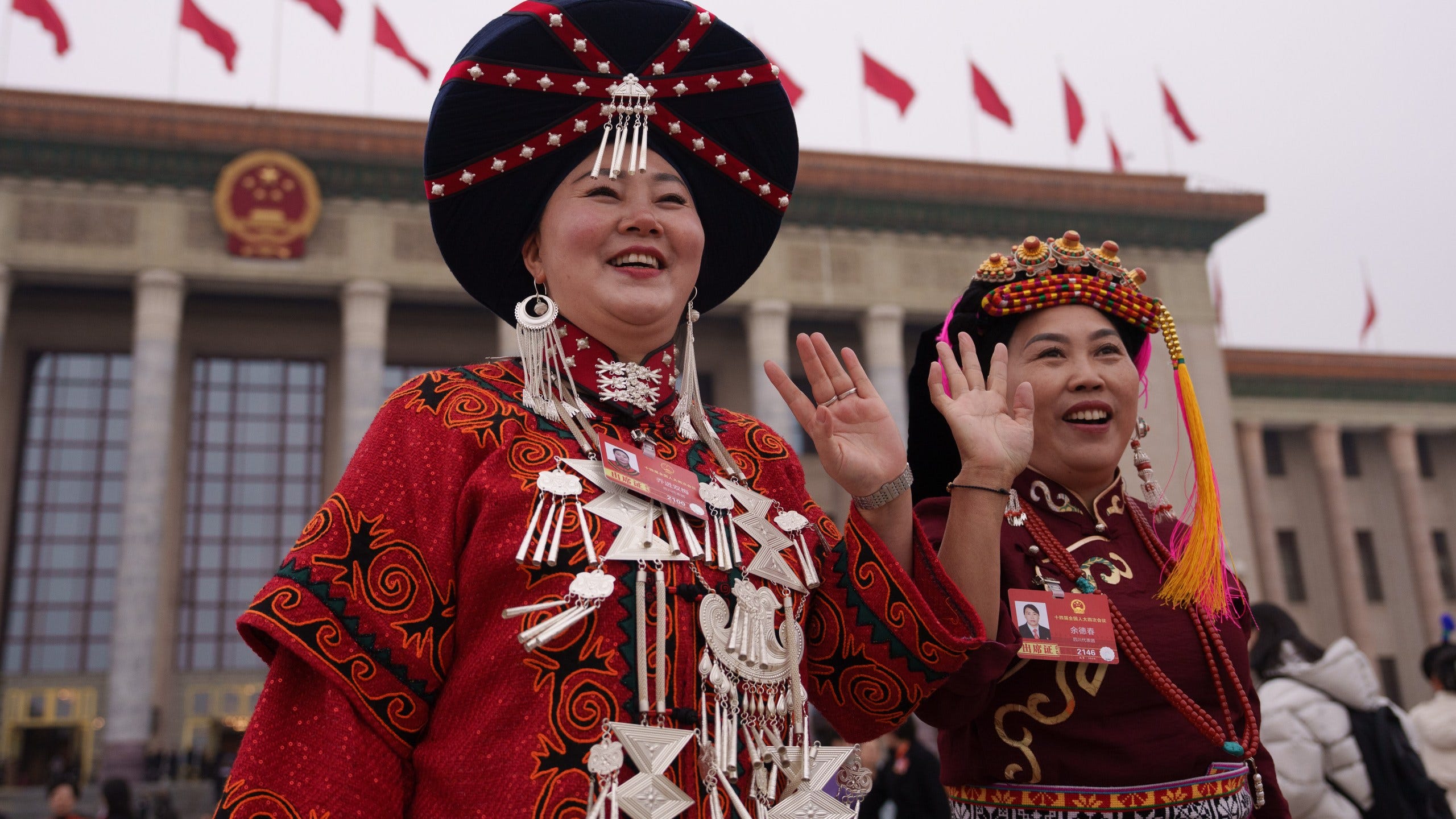
On March 5, 2026, the Great Hall of the People in Beijing became the site of a profound psychological pivot in global economics. As Premier Li Qiang delivered the 2026 Government Work Report to the National People’s Congress (NPC), the headline figure was a departure from decades of economic dogma: China has officially lowered its GDP growth target to a range of 4.5% to 5.0%. This marks the first time since 1991 that the Chinese Communist Party (CCP) has formally countenanced a growth floor below the 5% threshold, signaling the end of the ‘miracle’ era and the beginning of a high-stakes transition to what leadership calls ‘high-quality growth.’
This is not merely a statistical adjustment; it is a recognition of the data reality on the ground. Despite achieving exactly 5.0% growth in 2025, the trajectory throughout the previous year was one of steady cooling, with Q1 2025 starting at 5.4% and slowing to 4.5% by Q4. The 2026 target is a defensive posture designed to manage expectations as the nation grapples with a structural property collapse, a worsening demographic deficit, and the secondary effects of a re-intensified trade war with the United States.
The Statistical Surrender: GDP Targets vs. Reality
For years, the 5% growth target was viewed as a political necessity—a baseline required to ensure social stability and absorb the millions of graduates entering the workforce. By lowering this target to 4.5-5.0%, Beijing is implicitly admitting that the marginal utility of debt-fueled stimulus has reached a point of exhaustion. The 2025 performance was largely saved by a massive frontloading of exports in the first half of the year, as manufacturers raced to beat anticipated tariff escalations from the incoming Trump administration. With that ‘frontloading tailwind’ now spent, the underlying demand vacuum is laid bare.
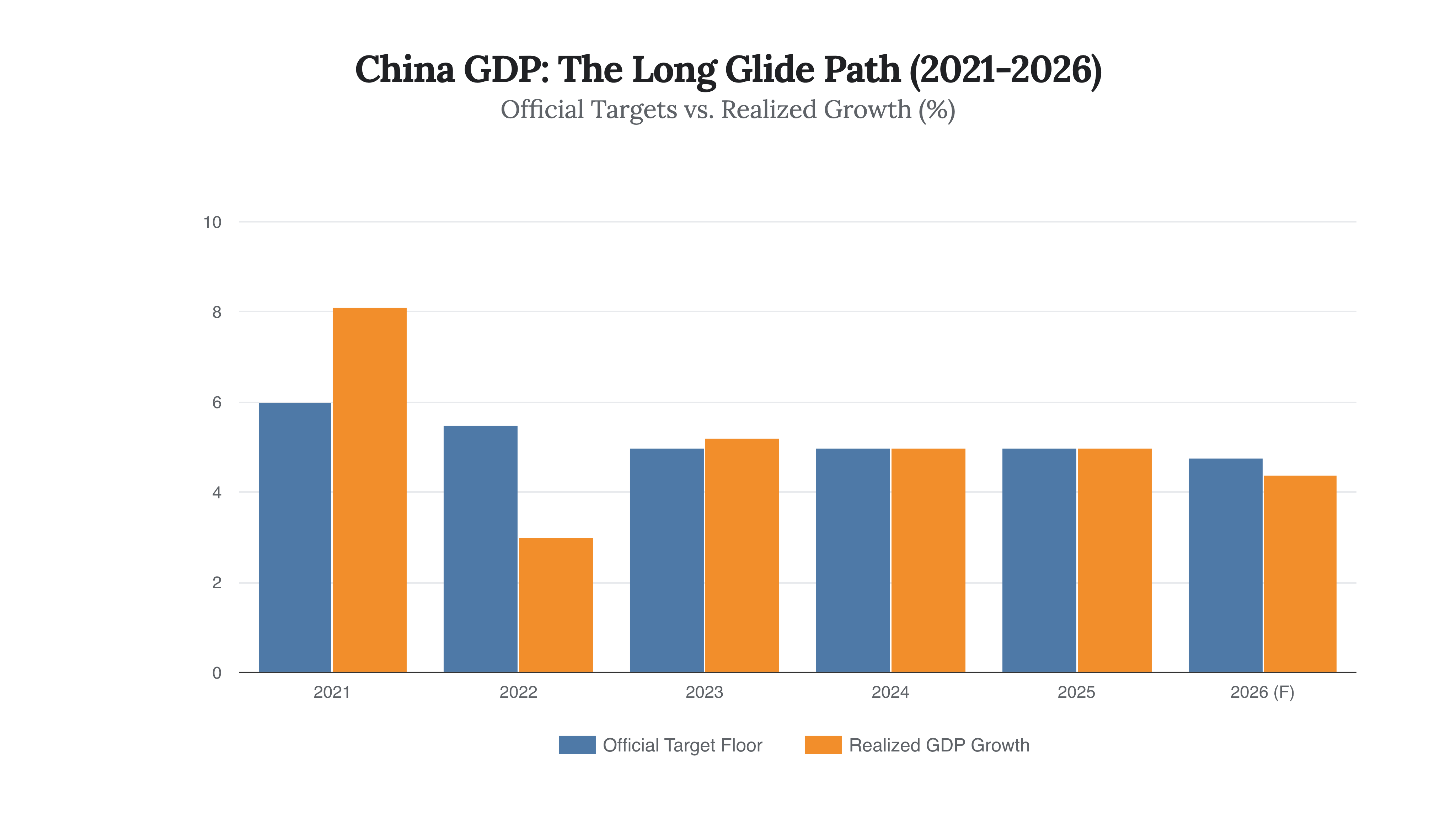
The 2026 forecast of 4.4% (median private institutional forecast) suggests that even the lower bound of the new 4.5% target will require significant fiscal heavy lifting. The ‘quality over quantity’ narrative is no longer an aspirational slogan; it is the only viable path forward for a country where the property sector—once responsible for 25% of GDP—saw a 17.2% decline in investment during 2025.
The Chinese economy has officially transitioned from a global growth engine into a managed stabilization project, where ‘success’ is now defined by the absence of systemic collapse rather than the presence of rapid expansion.
Fiscal Breakthrough: Breaking the 3% Taboo
To support this lower growth floor, Beijing is abandoning its long-held fiscal conservatism. For decades, the 3% budget deficit-to-GDP ratio was treated as a hard ceiling. In 2025, that ceiling was broken, with the deficit target set at 4%. For 2026, the government has maintained this 4% target, budgeting a record deficit of 5.89 trillion yuan ($815 billion).
This capital is being deployed with surgical intent. Unlike the 2008 ‘bazooka’ stimulus which flowed into bridge-to-nowhere infrastructure and luxury real estate, the 2026 fiscal plan is focused on ‘New Quality Productive Forces.’ This includes massive subsidies for the domestic semiconductor industry, AI infrastructure (following the global success of DeepSeek), and a significant expansion of the consumer trade-in program. In 2025, the government allocated 300 billion yuan to subsidize the replacement of old appliances and cars; for 2026, while the baseline for treasury bonds for this scheme is 250 billion yuan, the total pool of ‘ultra-long special treasury bonds’ has been expanded to ensure liquidity remains in the system.
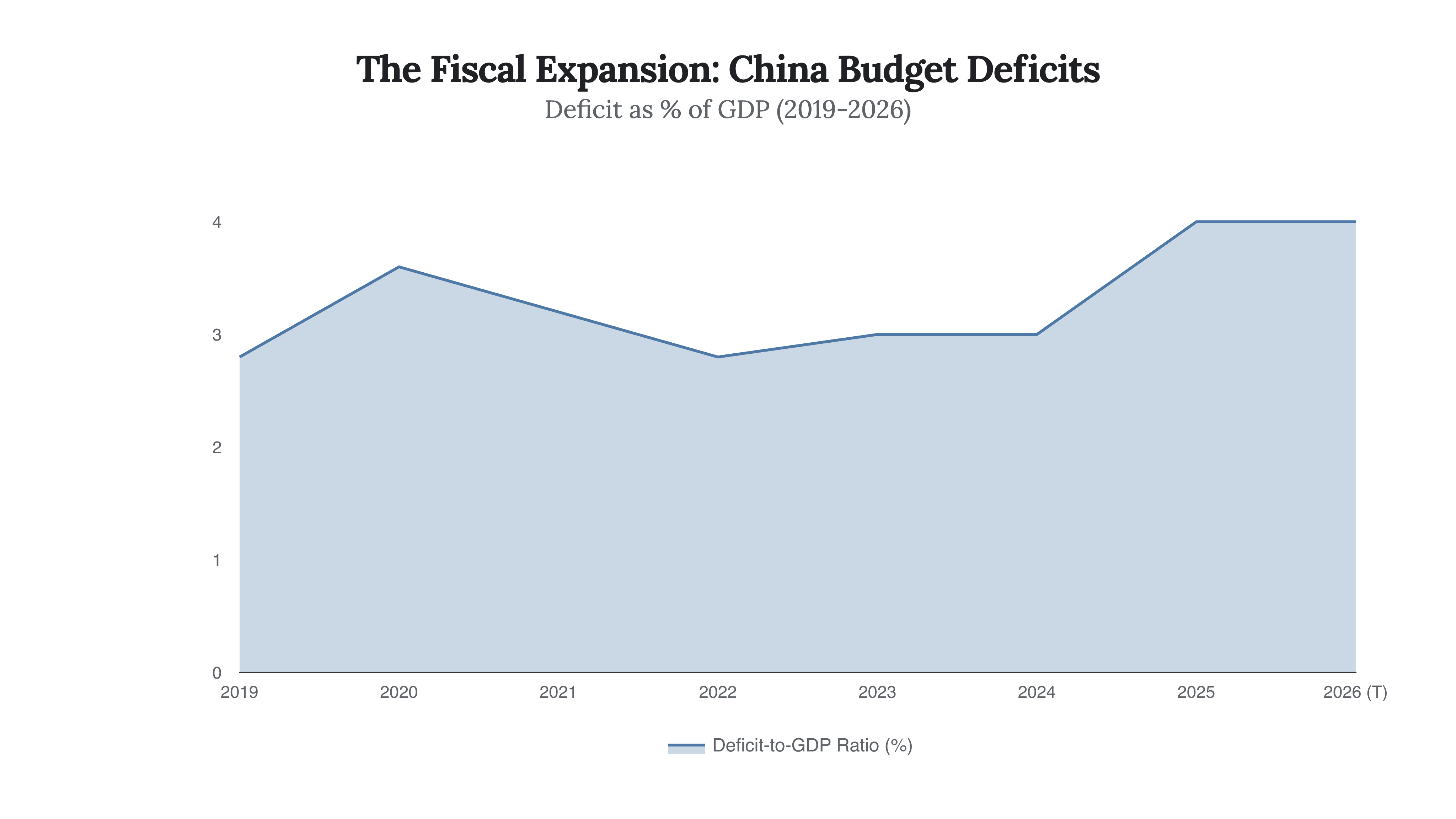
However, the 4% deficit target masks the true level of government leverage. When local government special bonds (4.4 trillion yuan) and ultra-long special treasury bonds are included, the ‘augmented’ deficit is significantly higher. This is a desperate attempt to offset the ‘wealth effect’ destruction caused by falling home prices, which remained largely flat to negative throughout late 2025 and early 2026.
Unlock deeper strategic alpha with a 10% discount on the annual plan.
Support the data-driven foresight required to navigate an era of radical uncertainty and join a community of institutional-grade analysts committed to the truth.
The Deflationary Abyss: A Confidence Crisis
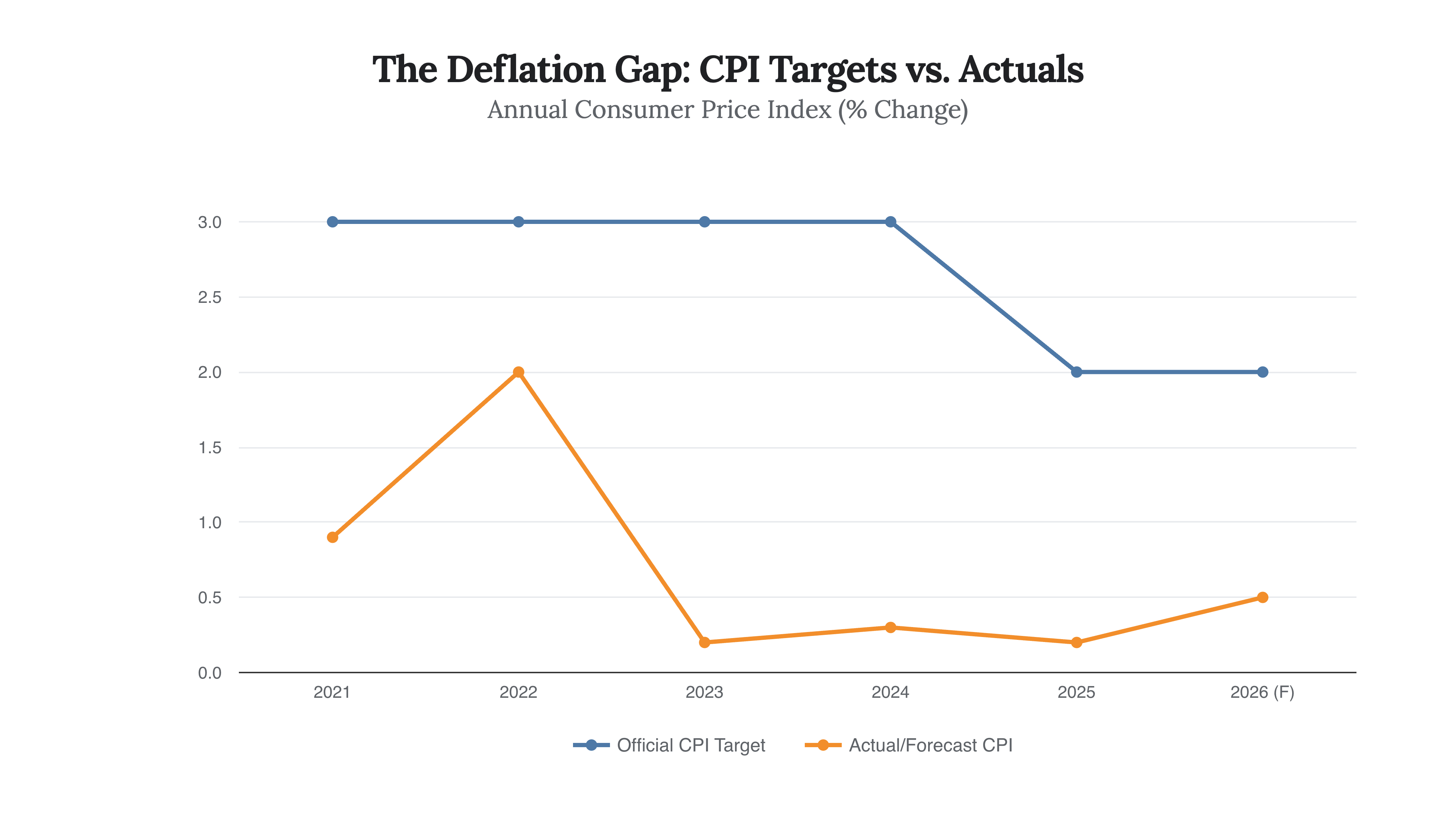
The most alarming metric from the March 2026 NPC was not the GDP target, but the inflation target. Beijing has kept its Consumer Price Index (CPI) target at ‘around 2%,’ the same as in 2025. Yet, the reality of 2025 was a year of zero inflation (0.2%), following 40 consecutive months of Producer Price Index (PPI) contraction.
China is currently locked in a classic debt-deflation spiral. Consumers, seeing their primary asset (housing) lose value and fearing for job security—the urban unemployment target remains a high 5.5%—are hoarding cash. Retail sales grew by only 3.7% in 2025, a far cry from the double-digit growth of the previous decade. The mismatch between the 2% inflation target and the near-zero reality suggests that monetary policy is ‘pushing on a string.’
Beijing’s refusal to engage in direct cash transfers to households remains the single greatest barrier to escaping the liquidity trap, as the leadership persists in a supply-side bias that prioritizes industrial capacity over household consumption.
Geopolitical Headwinds: Trade War 2.0 and the 15th Five-Year Plan
The lowering of the growth target is also a strategic preparation for external volatility. 2026 marks the beginning of the 15th Five-Year Plan (2026-2030). The draft outlines for this period emphasize ‘security’ over ‘growth.’ With US tariffs now sitting at 20% on a broad basket of Chinese goods (and much higher for EVs and semiconductors), China’s trade surplus, which hit a record $1 trillion in 2025, is under immediate threat.
The export engine that saved the economy in 2025—accounting for 30% of total growth—is sputtering. In Q1 2026, export growth slowed significantly as the ‘frontloading’ effect vanished and global demand moderated. The shift to a 4.5% floor is a way for Beijing to grant local officials ‘permission’ to focus on deleveraging and structural reform rather than fabricating data or taking on high-interest ‘shadow’ debt to hit an unrealistic 5% goal.
Second-Order Effects: What This Means for Global Markets
The implications of a permanently slower China are vast. For commodity exporters like Australia and Brazil, the ‘China bid’ for iron ore and copper is entering a terminal decline as the real estate sector transitions into a maintenance-and-renovation model rather than a new-build model. Conversely, for global manufacturing, China’s attempt to ‘grow out’ of its domestic slowdown by exporting its deflationary pressure will result in a flood of low-cost, high-tech goods (EVs, batteries, green energy tech) that will trigger further protectionist responses in the EU and North America.
The era of ‘Peak China’ is no longer a theoretical debate among economists; it is the official policy reflected in the 2026 budget. Investors must now price in a China that is stable, but stagnant—a giant that has decided that survival in the 15th Five-Year Plan depends on cooling the engine before it overheats the entire system.