



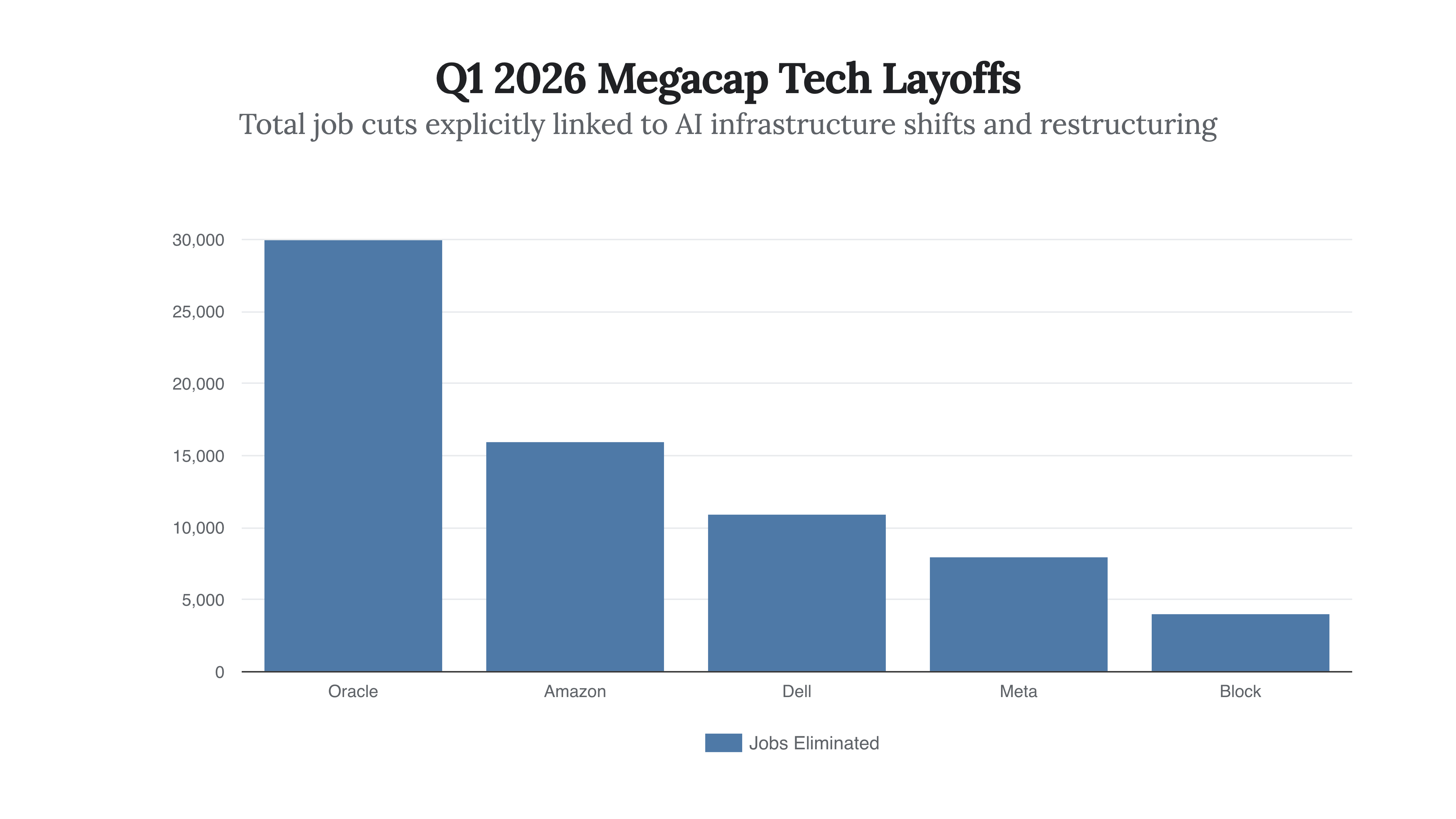
The first quarter of 2026 has been a bloodbath for the technology sector. In just ninety days, over 80,000 tech jobs evaporated globally, compounding a relentless wave of corporate downsizing. Oracle slashed an astonishing 30,000 roles. Amazon quietly shed another 16,000 positions. Meta, in a move echoing its 2023 austerity measures, announced an 8,000-person cut slated for May. Across earnings calls and press releases, a ubiquitous, almost rehearsed corporate narrative has emerged: these are not signs of distress, but the necessary growing pains of AI-driven restructuring.
We are told that artificial intelligence has finally crossed the rubicon from experimental toy to operational workforce replacement. CEOs point to generative AI handling customer service tickets, writing first drafts of code, and categorizing backend financial data. The narrative is neat, modern, and ruthlessly efficient. Wall Street, hungry for margin expansion, has rewarded this rhetoric with immense equity bumps.
But a closer forensic examination of the actual data reveals a massive corporate sleight-of-hand. The defining economic reality of 2026 is that companies are not firing humans because AI can do their jobs; they are firing humans to afford the servers required to eventually build the AI. We are witnessing the largest, most coordinated capital reallocation in modern corporate history, and it is entirely cloaked in the illusion of automation.
The Asymmetric Bluff
To understand the mechanics of this layoff wave, we must look at the brutal incentive structures governing the modern C-suite. The emergence of foundational AI models has triggered an infrastructural arms race. To remain competitive, companies must secure immense computational power. Nvidia GPUs, advanced cooling systems, and specialized data centers require billions in capital expenditures (CapEx). However, borrowing costs remain restrictive, and venture capital is demanding actual profitability rather than subsidized growth.
So, where does a CEO find the billions needed to buy servers? They extract it from operational expenditures (OpEx)—specifically, payroll.
If a technology firm announces they are firing 10,000 employees simply to buy hardware, the market panics. It signals a desperate pivot and a loss of operational capacity. But if leadership frames those same 10,000 layoffs as “AI-driven efficiencies,” the market cheers. Executives possess a critical piece of hidden knowledge: they know their current AI tools cannot yet replace the nuanced output of their workforce. But by controlling the narrative, they perform an asymmetric bluff. They satisfy investors’ demands for AI adoption while quietly shifting the payroll budget into data center infrastructure.
Consider Dell Technologies. In fiscal 2026, Dell reduced its workforce by roughly 11,000 employees, citing “ongoing business modernization initiatives.” Concurrently, the company’s Infrastructure Solutions Group—the division building AI-optimized servers—saw revenue spike by 40%. Similarly, Oracle’s devastating 30,000-person headcount reduction this spring is mathematically aligned with their explosive increase in AI infrastructure and data center spending. The money didn’t disappear; it simply moved from human wages to silicon.
Unlock deeper strategic alpha with a 10% discount on the annual plan.
Support the data-driven foresight required to navigate an era of radical uncertainty and join a community of institutional-grade analysts committed to the truth.
The Great Boomerang Effect
There is a fatal flaw in firing your workforce based on the anticipated capabilities of software rather than its actual utility. As we progress through 2026, the consequences of this aggressive capital reallocation are beginning to fracture corporate operations.
According to comprehensive Q1 2026 data from Gartner and Forrester, we are officially entering the era of “The Layoff Boomerang.” A staggering 55% of employers now report regretting their AI-driven layoffs. The calculus was fundamentally flawed. Executives paraded on financial networks, bragging about replacing entire support and coding divisions with AI agents. But behind closed doors, the AI hallucinations multiplied, complex customer queries stalled, and institutional knowledge evaporated overnight.
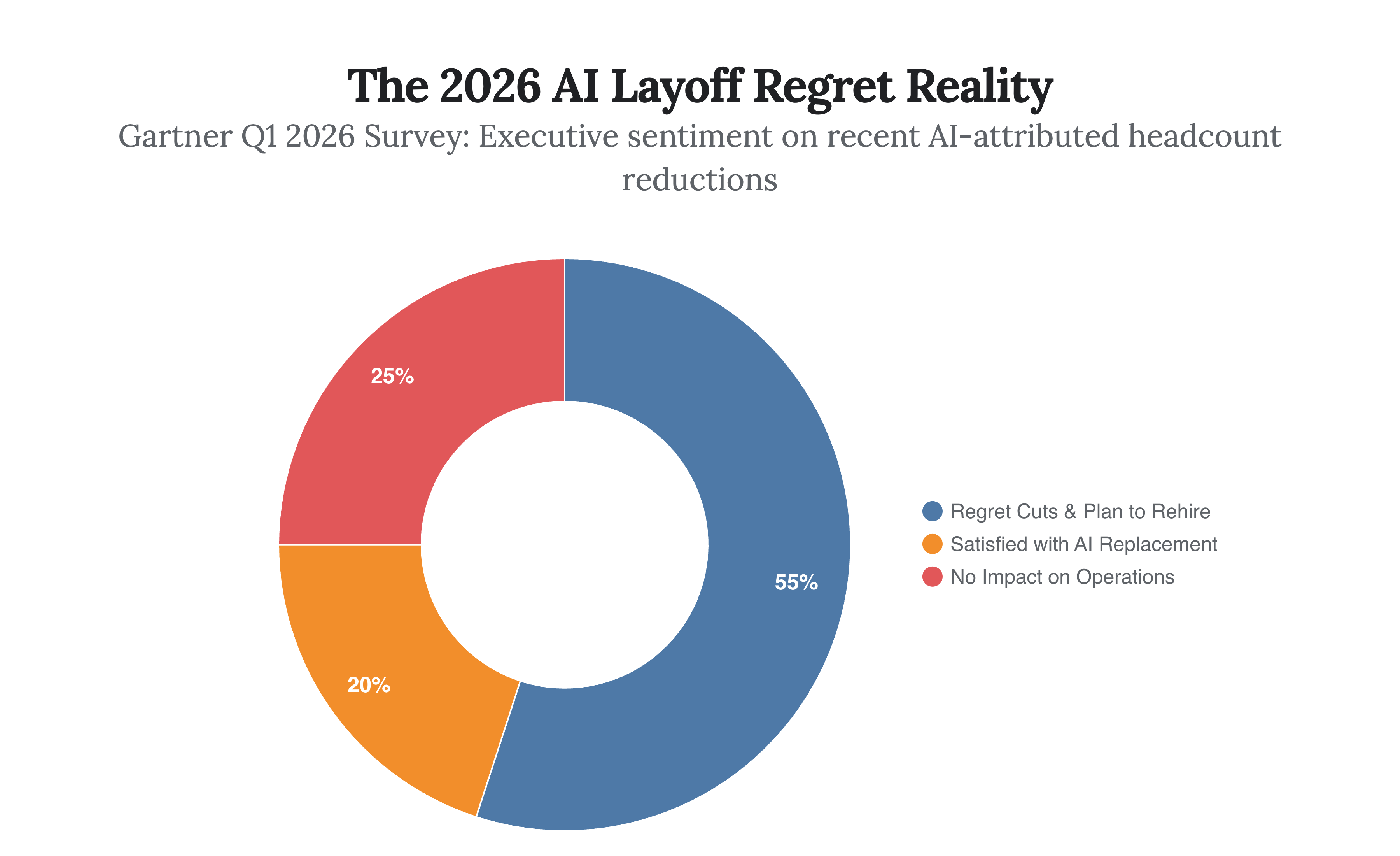
Gartner’s latest predictive models indicate that by 2027, fully half of the companies that attributed job cuts to AI efficiencies will be forced to rehire staff for the exact same functions. The hubris of the 2025 AI adoption wave has resulted in a quiet panic, as companies realize that true enterprise AI requires intense human oversight to function reliably. You cannot fine-tune your way out of a staffing deficit.
We are already seeing this hypocrisy manifest in total headcount numbers. A stunning 92% of companies that proudly announced “AI-driven layoffs” in 2025 actually grew their total corporate headcount by the end of the year. Salesforce, for example, heavily publicized the cutting of roughly 4,000 customer support roles, attributing the shift to AI agents that could handle 50% of incoming service requests. Yet, Salesforce simultaneously hired thousands of sales engineers to sell and maintain those very AI platforms. They didn’t shrink; they merely restructured, discarding entry-level workers to fund specialized tech talent.
The Strategy of Wage Suppression
Beyond capital reallocation, the “AI layoff” narrative serves a secondary, deeply tactical purpose: psychological leverage. In any labor market, the balance of power dictates compensation. During the tech boom of 2021, talent held the leverage. Today, employers are reclaiming it through the strategic deployment of fear.
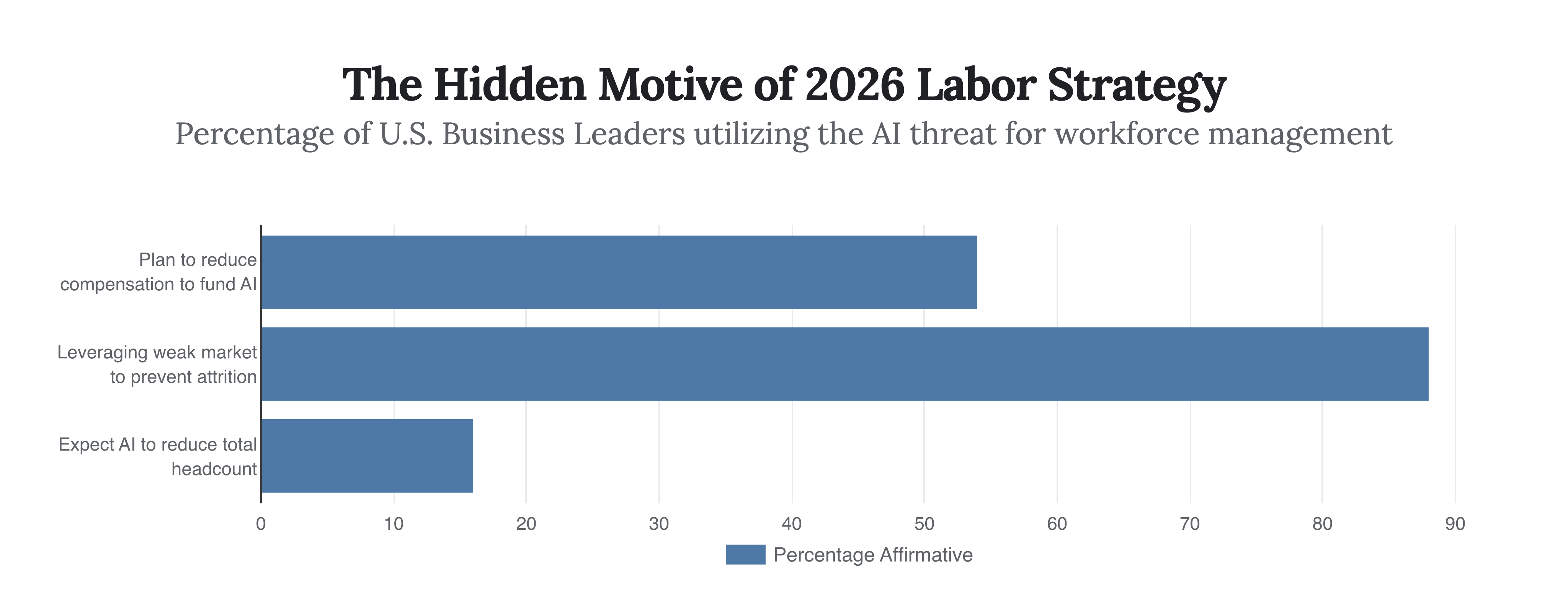
By loudly and publicly linking layoffs to artificial intelligence, corporations project a credible threat to their remaining workforce. The implicit message is undeniable: Accept leaner benefits, lower bonuses, and stagnant wages, or we will hand your workflow to a large language model. This is not hyperbole. In a recent ResumeBuilder survey of U.S. business leaders regarding 2026 strategies, 54% admitted they plan to reduce employee compensation specifically to free up capital for AI spending. Furthermore, 88% of those leaders acknowledged that the currently weak job market makes it significantly easier to enact these cuts without risking a mass exodus of talent.
This tactic is a textbook application of game theory. The employer signals a willingness to replace the employee with a machine. Even if the employer knows the machine is currently inadequate, the employee does not possess the data to call the bluff. Faced with the perceived risk of unemployment in a tightening market, the employee accepts the suppressed wage. The company wins twice: they maintain human output quality while capturing the cost savings they need to fund their actual AI research and development.
We also see this play out in the “Layoff Switcheroo.” Major tech firms are not just firing full-time employees and replacing them with code; they are firing expensive full-time employees and quietly replacing them with cheaper, specialized contractors. They eliminate the burden of healthcare, 401k matching, and severance, reclassifying the labor as a flexible operational expense. The AI didn’t take the job; the company just found a loophole to pay a human less to do it.
Navigating the Reallocation Era
If you are an investor, a tech professional, or a corporate strategist, misreading the current landscape is a dangerous proposition. Believing the surface narrative—that AI is currently capable of executing complex knowledge work end-to-end—will lead to disastrous misallocations of your own capital and career energy.
The immediate threat of AI in 2026 is not an omniscient algorithm taking your seat at the desk. The real threat is a Chief Financial Officer looking at your salary as the missing funding source for their next Nvidia cluster. The 2026 tech layoff wave is an exercise in financial engineering, a desperate scramble to secure a foothold in the future of computing by cannibalizing the present. As the “Boomerang Effect” takes hold in the latter half of the year, expect to see the most aggressive cost-cutters quietly scrambling to rehire the human oversight they so arrogantly dismissed.