


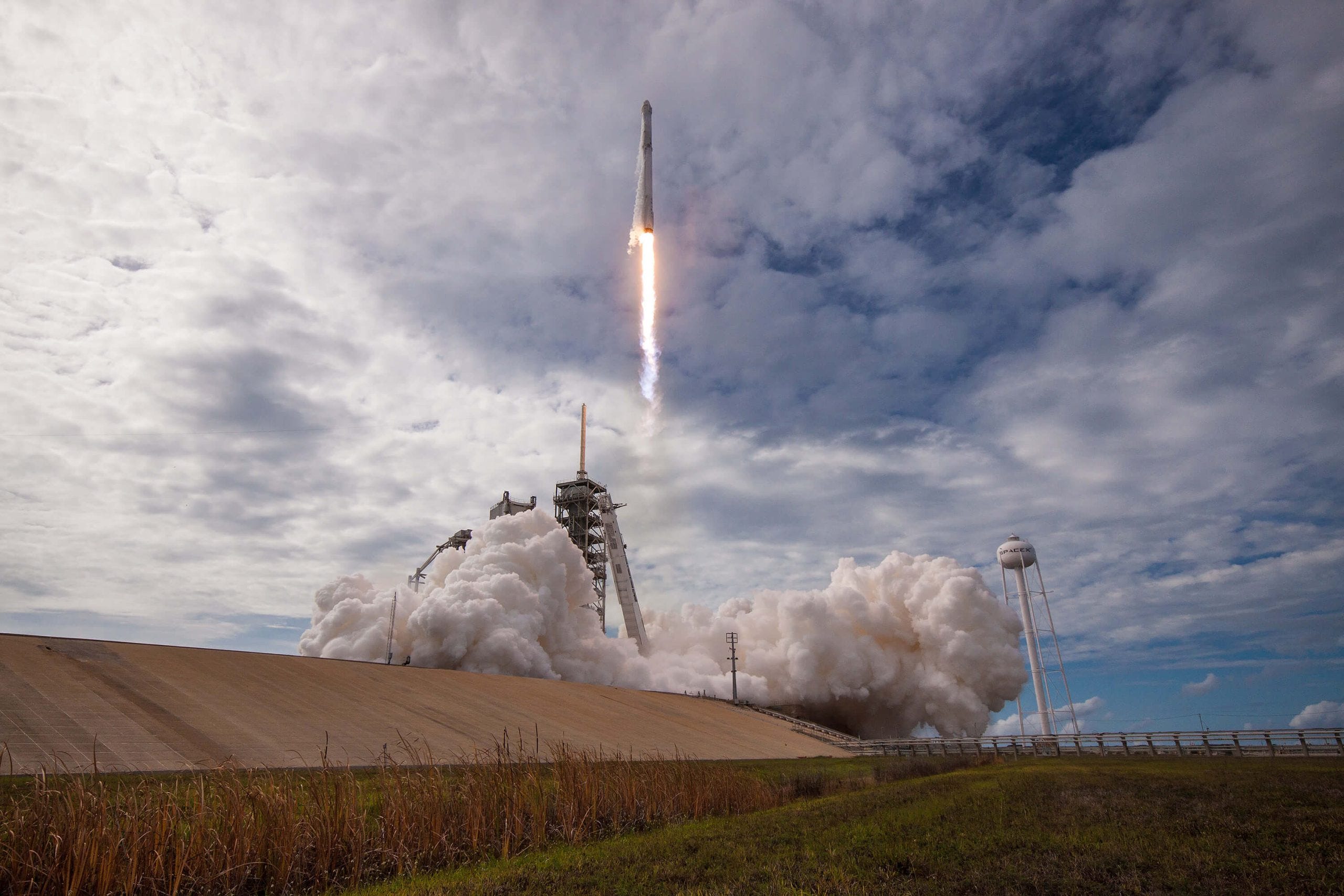
The legacy era of aerospace—defined by cost-plus contracting, national prestige projects, and decadal development cycles—has been effectively liquidated. In its place, a ruthless commercial ecosystem has emerged, characterized by iterative hardware development and a vertical integration model that mirrors the Gilded Age monopolies of the 19th century. The collapse of launch costs to Low Earth Orbit (LEO) is not merely an efficiency gain; it is a fundamental alteration of the physics of the global economy. For sixty years, the barrier to entry for space was gravity.
Today, the barrier is capital efficiency and regulatory maneuvering. We are witnessing the shift from space as a sanctuary of exploration to space as a critical infrastructure layer, as vital and contested as the undersea cable network. This transition is driven by a singular, overwhelming metric: the cost per kilogram to orbit. The strategic implication is that mass is no longer the primary constraint in satellite architecture. This unshackles engineers from the tyranny of miniaturization, allowing for the deployment of massive, power-hungry orbital data centers and synthetic aperture radar (SAR) constellations that provide persistent, real-time surveillance of the Earth’s surface. The data reality is stark: the entity that controls the launch pipe controls the orbital real estate, and by extension, the flow of information on the planetary surface.
The Asymmetric Economics of Lift
The reduction in launch costs follows a power law distribution that has defied historical aerospace modeling. In the Shuttle era, the cost to deploy a payload was approximately $65,000 per kilogram (adjusted for inflation). With the Falcon 9 block 5, that cost plummeted to under $3,000 per kilogram. With the imminent operationalization of the Starship architecture, we are looking at a trajectory toward $100 per kilogram. This is not a linear improvement; it is a deflationary shock that renders virtually every legacy launcher obsolete overnight. This pricing power creates a “moat” so wide that it is effectively impassable for state-backed competitors using traditional procurement methods. The strategic consequence is a bifurcation of the global launch market: a Western commercial monopoly that services the majority of the free world’s commercial and military payloads, and a fragmented, state-subsidized response from China (via the Guowang constellation and Long March variants) and a declining Russia. **The commoditization of orbit isn’t liberating the market; it is creating a feudal system where access is determined by a single corporate entity.**
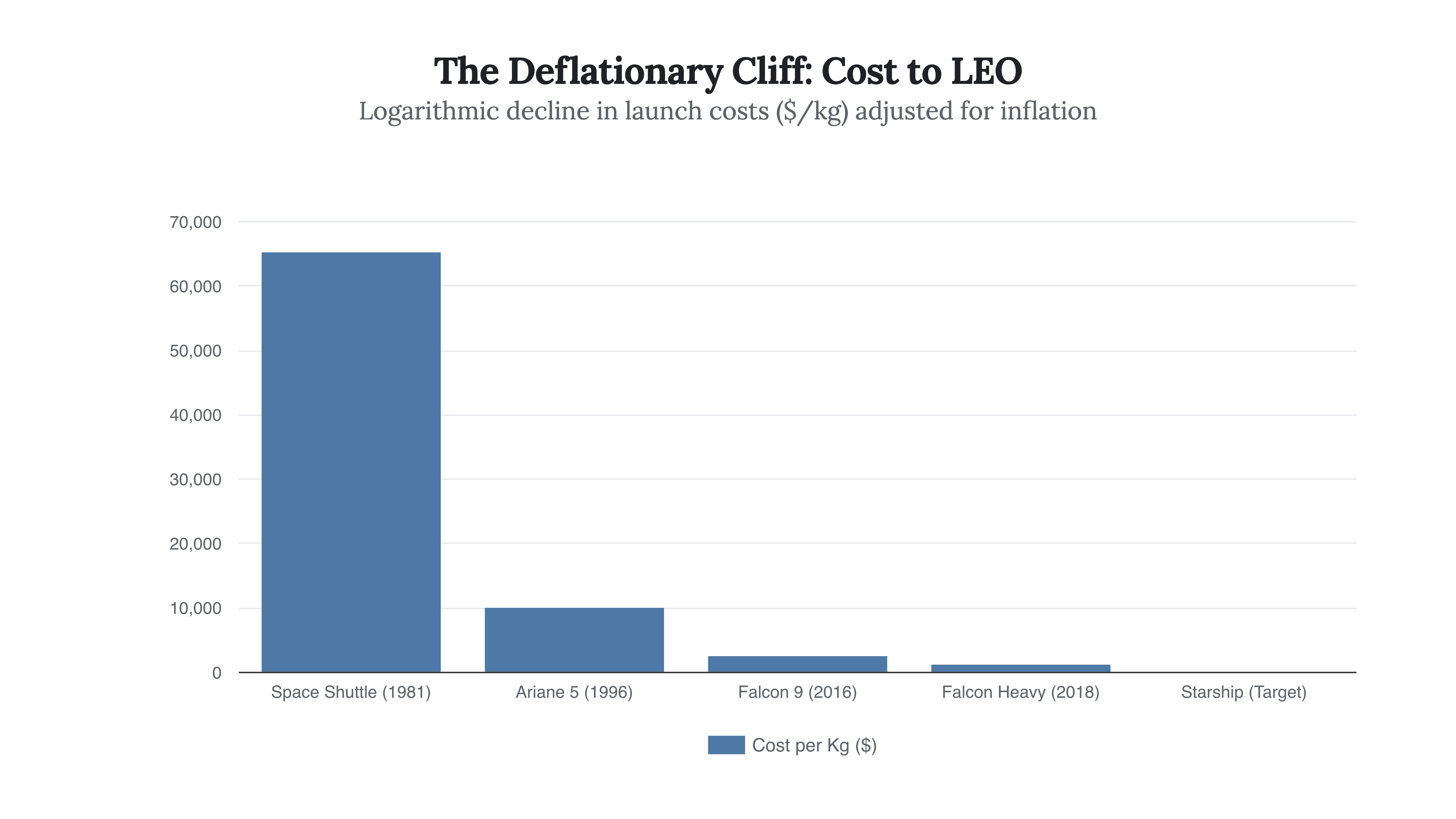
This chart illustrates the destruction of the legacy pricing model. The implication for intelligence and defense is profound: “ exquisite” multi-billion dollar satellites are becoming strategic liabilities. They are slow to build, expensive to insure, and easy to target. The future belongs to proliferated LEO architectures—swarms of thousands of disposable assets that provide resilience through redundancy. If you can launch 50 satellites for the price of one legacy asset, the calculus of anti-satellite (ASAT) warfare inverts; it becomes more expensive to shoot down the swarm than to replenish it.
The Real Estate Grab: Mega-Constellations and Orbital Congestion
The drop in launch costs has triggered a rush for orbital shells. The governing dynamic here is the finite nature of orbital planes and radio frequency (RF) spectrum. While space is vast, the useful belts of LEO (between 300km and 1200km) are rapidly saturating. Starlink, Kuiper, and OneWeb are not just internet service providers; they are occupying the high ground. By flooding specific altitudes with thousands of nodes, early movers are effectively creating a “debris shield” of active satellites that forces latecomers into less optimal orbits or demands complex collision avoidance maneuvers that degrade mission lifespan. The geopolitical ripple effect is the erosion of national sovereignty over information. In the Ukraine theater, we observed that commercial connectivity provided the command-and-control backbone for a nation-state at war. This capability was not provided by the Pentagon, but by a private operator. This signals a shift where commercial entities act as geopolitical proxies. Nations without sovereign launch capabilities or sovereign constellations will become vassal states in the connectivity domain, reliant on foreign corporations for their critical communications infrastructure.
Unlock deeper strategic alpha with a 10% discount on the annual plan.
Support the data-driven foresight required to navigate an era of radical uncertainty and join a community of institutional-grade analysts committed to the truth.
The Capital Rotation: Infrastructure vs. Applications
Investors must distinguish between the “railroad” (launch and bus manufacturing) and the “cargo” (data and services). The last decade saw a glut of SPAC-fueled capital flowing into launch vehicles, 90% of which will never achieve positive unit economics against the incumbent monopoly. The smart capital is rotating downstream. The next alpha generation lies in In-Space Servicing, Assembly, and Manufacturing (ISAM) and Earth Observation (EO) analytics. The current market environment—defined by higher interest rates—has ended the era of “space-for-space’s sake.” Ventures proposing asteroid mining or orbital tourism with twenty-year ROI horizons are facing a liquidity desert. The survivors are those effectively selling terrestrial utility: data that improves logistics, agricultural yield, or insurance underwriting. **In a high-interest rate environment, ‘space-for-space’s-sake’ business models are dead; only those providing immediate terrestrial utility will survive the coming purge.**
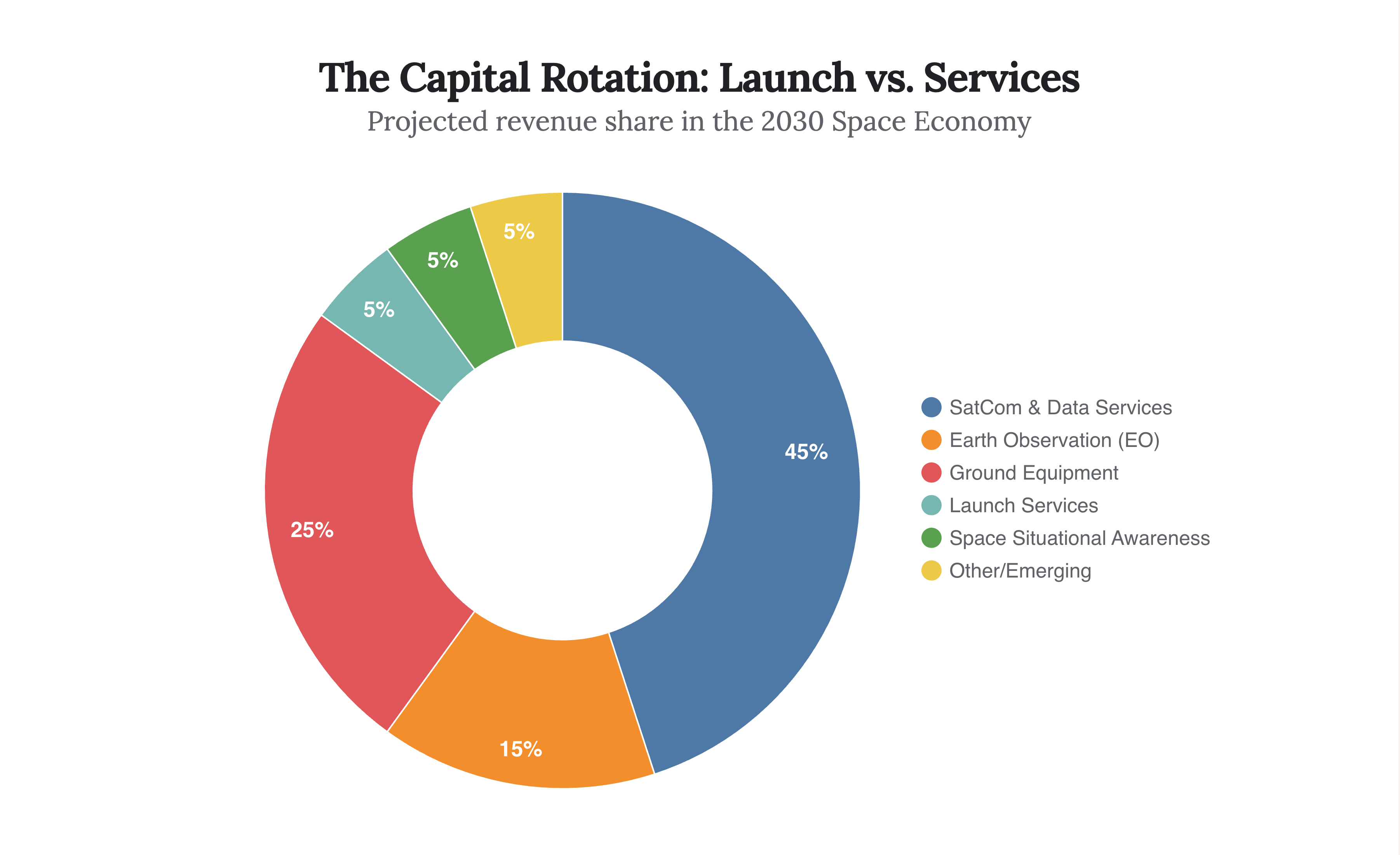
As the chart indicates, launch services—despite the media hype—will comprise a minority of the total value capture. The launch is a commodity; the value is in the bitstream. The “Watch Point” for investors is the emergence of secondary markets for orbital data. Just as the Bloomberg Terminal aggregated financial data, we will see the rise of platforms that aggregate multi-modal space data (optical, SAR, RF, thermal) into actionable intelligence feeds for commodities traders and hedge funds.
The Kessler Horizon and Regulatory Lag
The most underpriced risk in the commercial space sector is the Kessler Syndrome—a cascading collision event that renders LEO unusable. The current regulatory framework, governed largely by the Outer Space Treaty of 1967, is woefully inadequate for a traffic environment scaling from 2,000 to 50,000 active satellites. There is no global air traffic control for space. There are only voluntary guidelines and fragmented national oversight bodies. We are observing a dramatic increase in “conjunction events”—close approaches necessitating evasive maneuvers. This introduces a stochastic risk element to all LEO business models. A single ASAT test or a random collision between defunct upper stages could create a debris cloud that wipes out billions in orbital assets in hours. **We are one collision away from turning Low Earth Orbit into a prison of hypervelocity shrapnel that locks humanity on the ground for a century.**
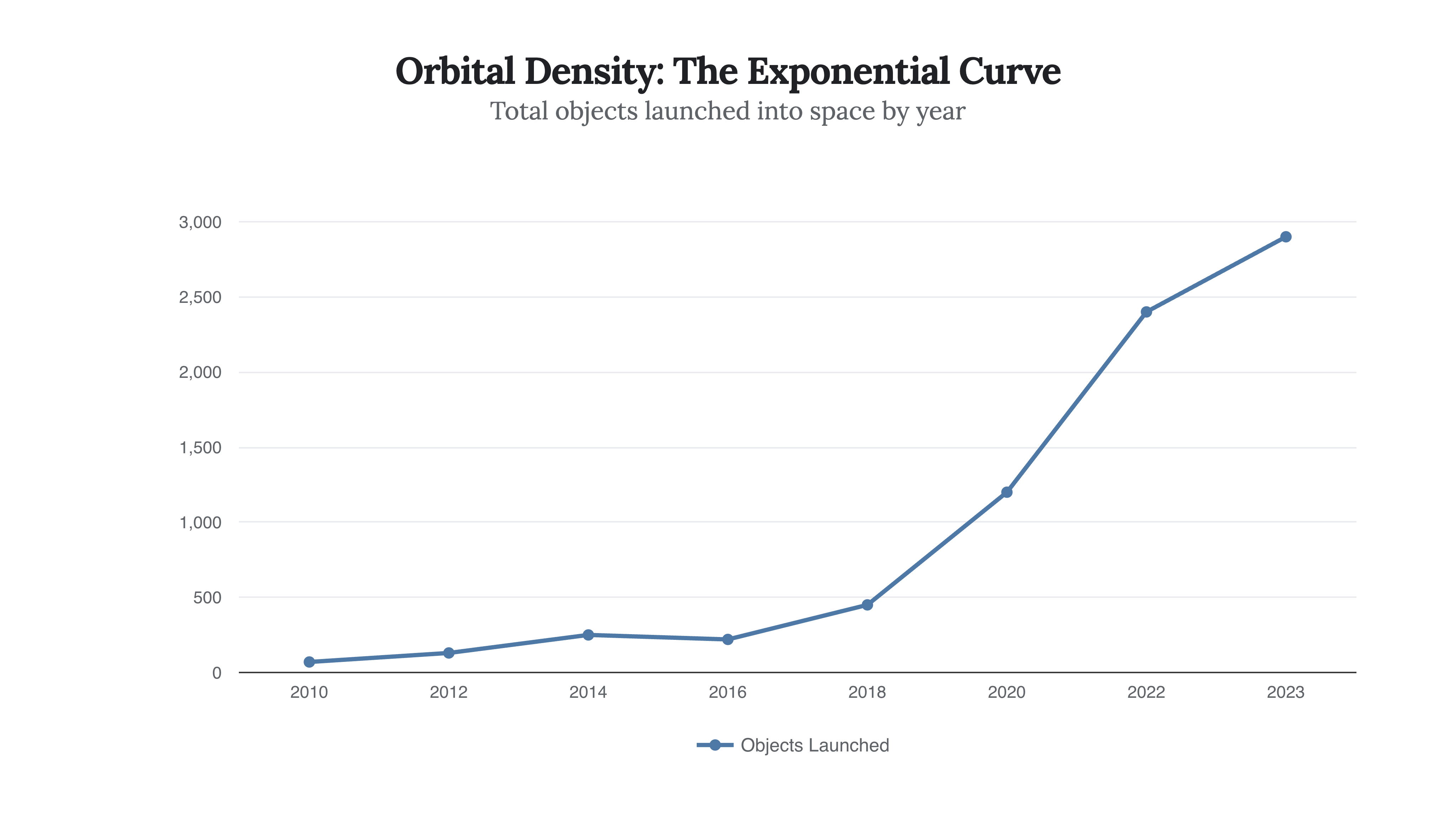
The trajectory is undeniable. The exponential growth in object count requires a corresponding leap in Space Situational Awareness (SSA) capabilities. This creates a defensive investment thesis: companies that can track, map, and potentially remove debris are not just environmental services; they are the insurance policy for the entire orbital economy. Without active debris remediation, the insurance premiums for LEO assets will eventually become prohibitive, stalling the industry’s expansion.
Strategic Synthesis
The commercial space expansion is entering its consolidation phase. The romanticism of the startup era is yielding to the brutal arithmetic of scale. For decision-makers, the imperatives are clear: 1. **Diversify Access:** Reliance on a single launch provider is a strategic point of failure. Support alternative heavy-lift capabilities to ensure supply chain resilience. 2. **Invest in Ground Segments:** The bottleneck is no longer in space; it is in the downlink and processing of petabytes of data. The ground station network is the undervalued asset class. 3. **Monitor Sovereign Reassertment:** Expect nations to impose stricter “sovereign cloud” requirements on space data, forcing operators to build local infrastructure or face market exclusion. The gravity well has collapsed, but the turbulence is just beginning.