



Bottom line up front. Not one dollar of the Graham Act’s 500% and 100% duties has been collected, and the order that sets them cites no HTS heading, Chapter 99 provision or entry instruction to collect them under. We judge it very likely (85%) that no duty under sections 112 or 113 is collected before 31 January 2027. The live risk is narrower: a targeted switch-on against a single country, which the statute makes cheap to threaten and expensive to carry out. Congress has no fast route to take the control back.
Why now
The 18 October trigger date passed on Sunday. Under the order, the 100% duty on the largest importers of Russian crude and gas applies when a country knowingly makes new purchases on or after 18 October 2026. Every cargo loaded since then is conduct that a future determination could cite.
The order was signed on 16 October and waived its own duties in the same document. Within a day the waiver had drawn praise from a Russian envoy, and the Guardian reported the pause amid a deepening row with Ukraine.
Treasury moved in the same direction at the margin. On 15 October OFAC issued General License 128D for Lukoil retail stations outside Russia and General License 130B for Lukoil entities in Bulgaria.
The order contains no expiry date, so no calendar forces a review. Every future move is a decision by the President or the Secretary of State. The useful question is which documents would show that decision coming, and this Dossier sets them out.
The evidence
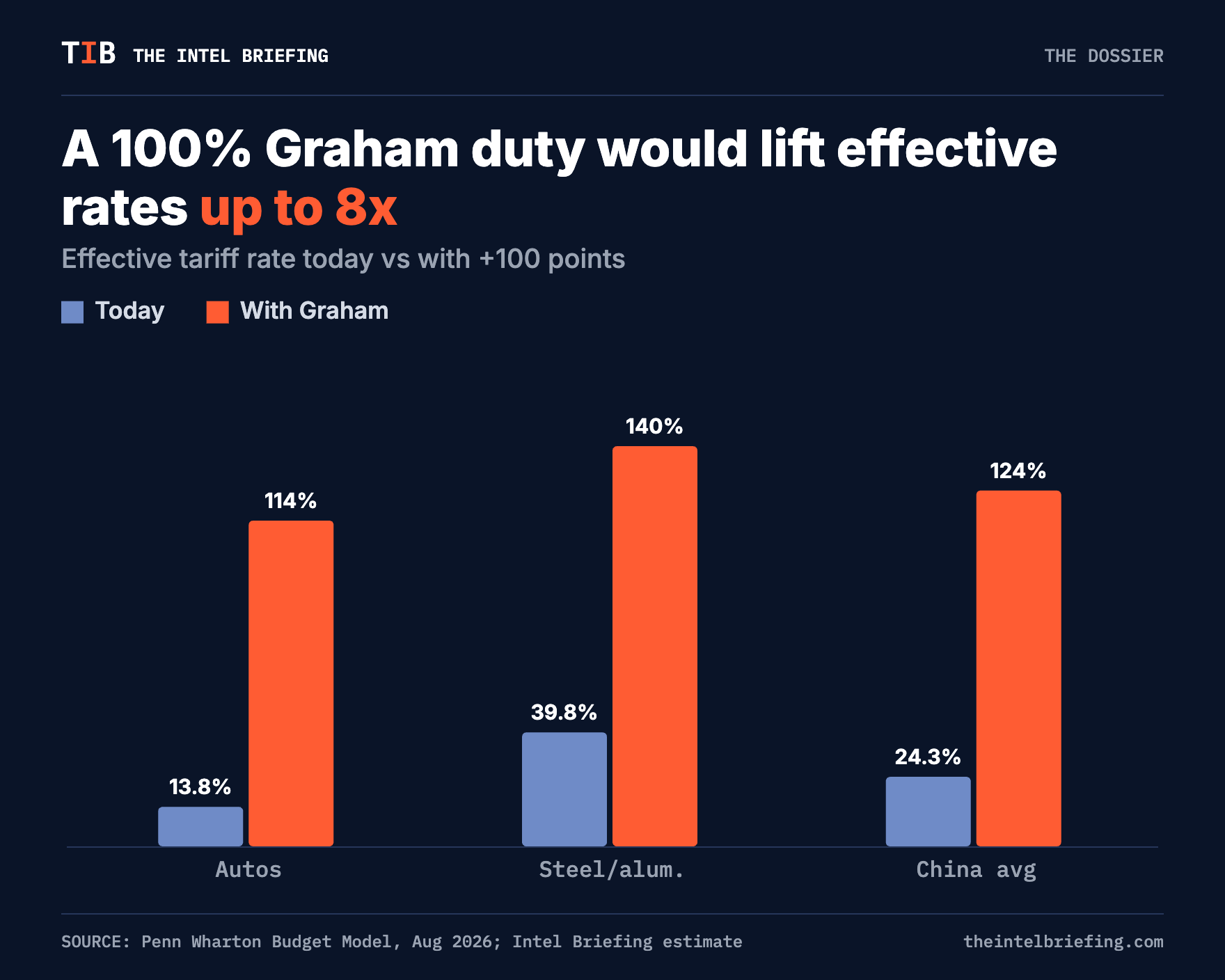
1. The duties would stack on a tariff base already three times its January 2025 level. The Penn Wharton Budget Model puts the US average effective tariff rate at 7.1% in August 2026, against 2.3% in January 2025 and 6.7% in July 2026. China’s effective rate was 24.3%, the highest among major partners. Since 24 July, Section 301 duties of 10% or 12.5% have applied to imports from 60 economies.
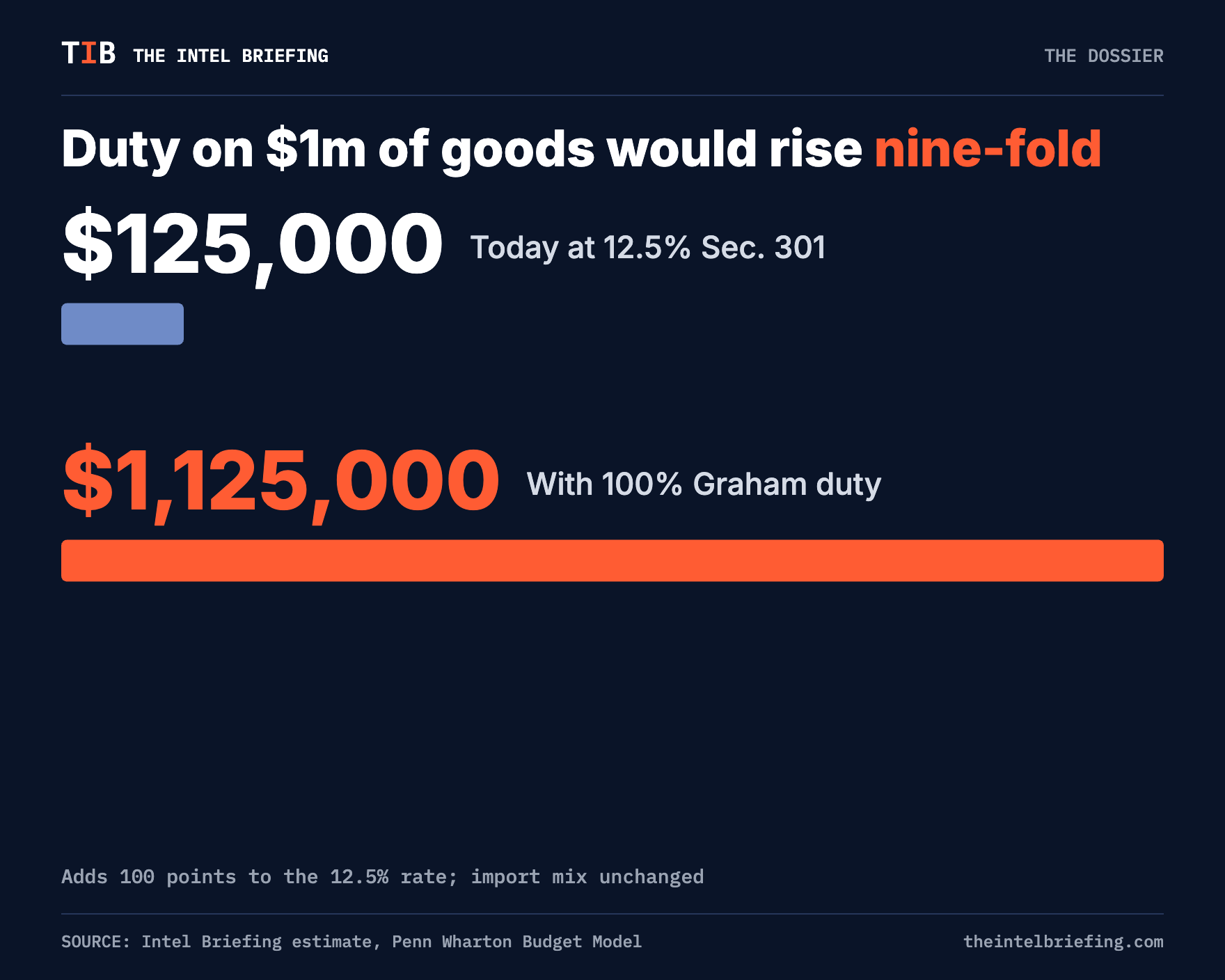
Section 2 of the order says the Graham duties apply in addition to duties under title VII and sections 122, 201, 232 and 301, not instead of them. TIB estimate: on $1m of goods from an economy paying 12.5% under Section 301, duty owed would rise from $125,000 to $1,125,000, nine times as much. For China at its 24.3% average, the effective rate would become about 124.3%, roughly five times the current level. Method: add 100 percentage points to the current rate and hold the import mix unchanged.
2. None of the machinery needed to collect has been built. The order lists no HTS codes, no Chapter 99 lines and no product exclusions. It names no countries either. The 100% duty falls on countries the Trade Representative identifies, and the order did not designate India, China or Turkey.
Before any country is tariffed, section 113(g) requires a written justification to Congress that explains the methodology used to identify it. Section 113(d) exempts a gas buyer whose purchases are below 15% of Russia’s annual gas exports and that has taken significant steps to reduce them. The ranking looks back over the 12 months before enactment.
TIB count: zero of three collection steps are complete. Those steps are a country list, customs lines and a congressional justification.
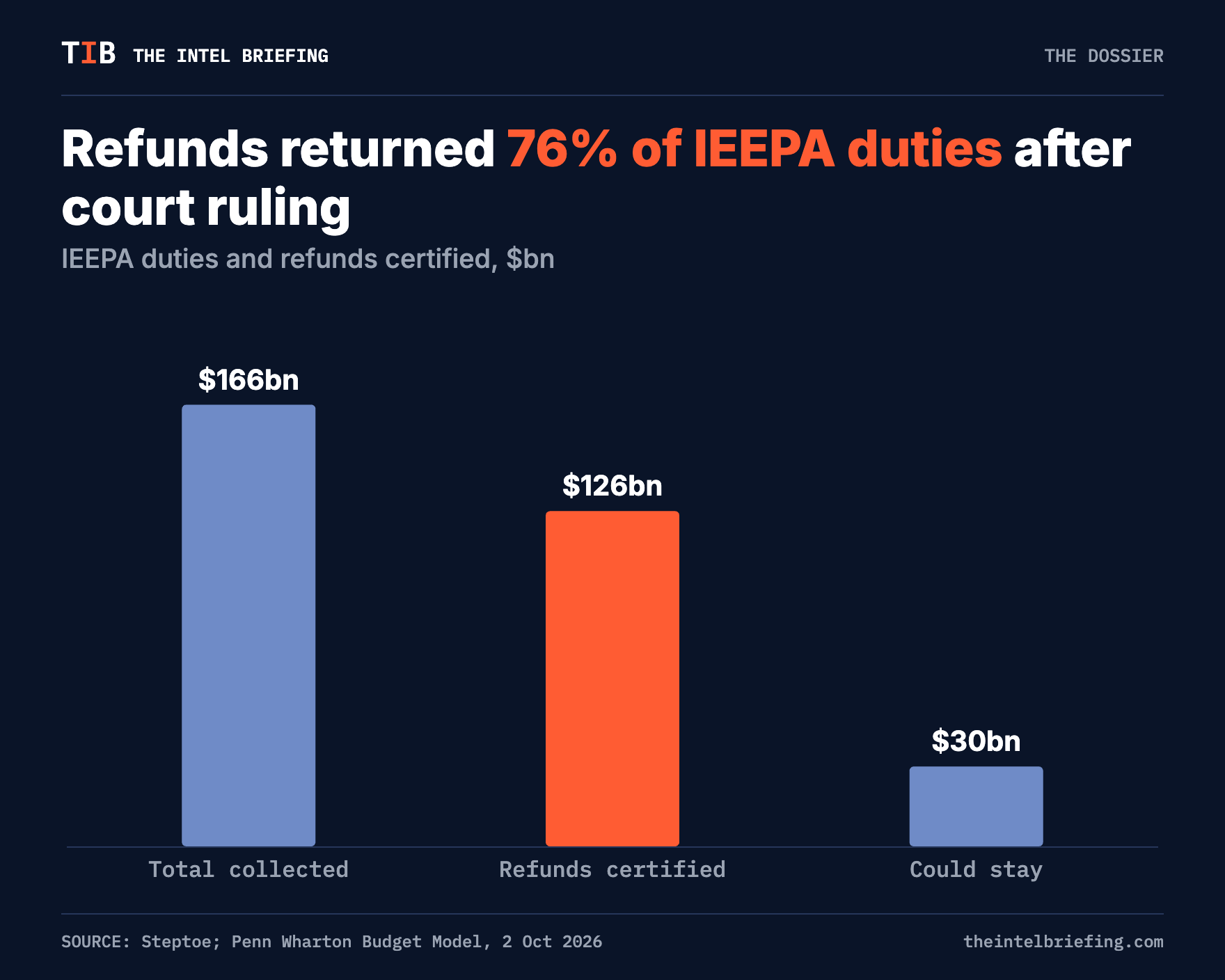
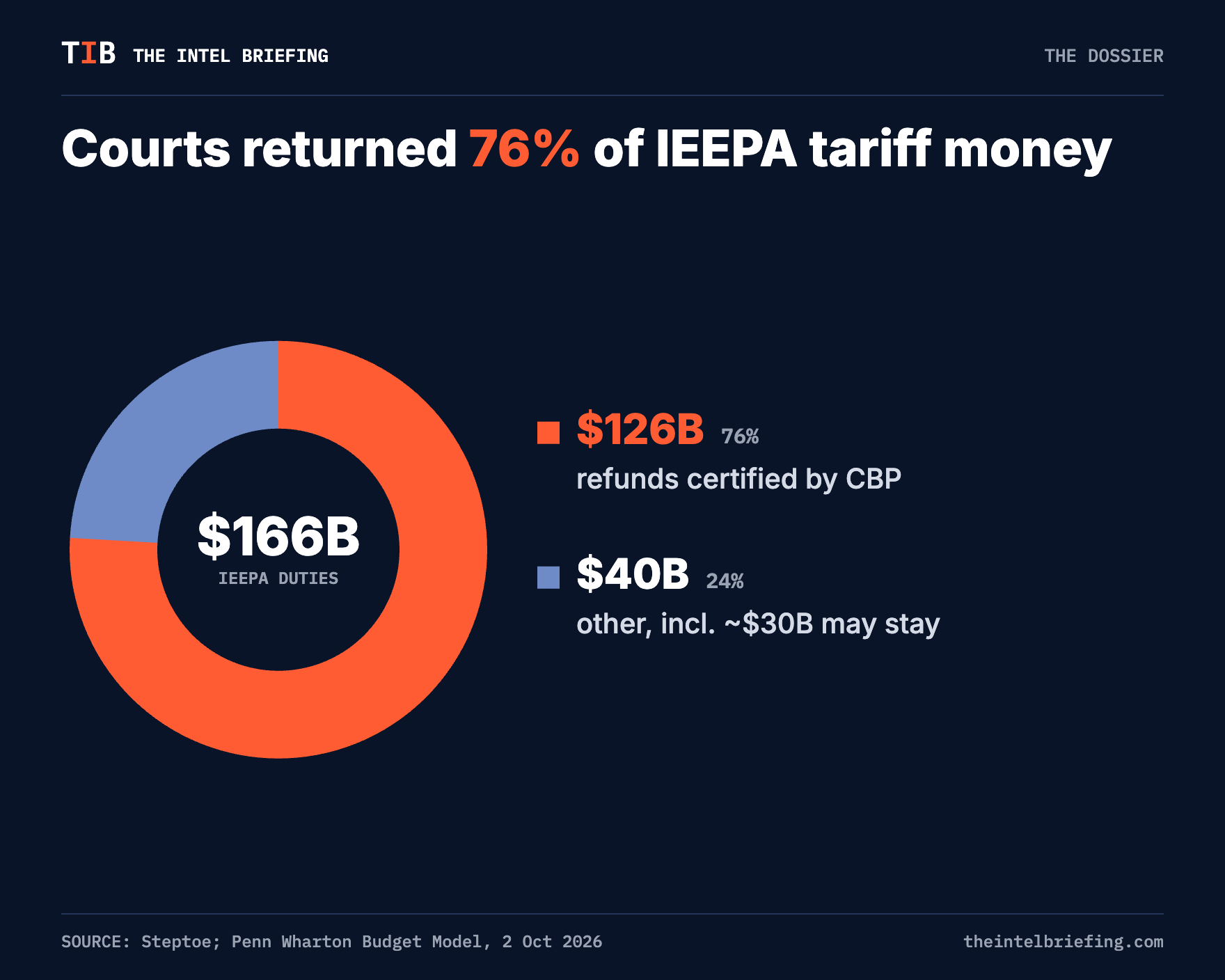
3. The last big tariff reversal was ordered by a court, and it handed most of the money back. IEEPA duties totalled about $166bn on roughly 53 million entries from about 330,000 importers before the Supreme Court held on 20 February 2026 that IEEPA “does not authorize the President to impose tariffs”. By 2 October, CBP had certified about $126bn in refunds, 76% of the total. The trade court estimated that about $30bn could stay in the Treasury without further action.
The Graham Act is a different kind of authority. Sections 112 and 113 expressly authorise the duties, so the IEEPA holding does not reach them. The legal risk that ended the last tariff regime is largely absent here: the switch is political, and the statute puts it in the President’s hand.
Below the paywall, members get the following:
Five new ledger calls (TIB-025 to TIB-029), each with a date and a resolution source.
Four scenarios to 31 January 2027 with odds that sum to 100%.
Six indicators, each with its current value and trigger.
The clause-level point most coverage of the waiver has missed.
An exposure map running from Chinese exporters to Russian state banks and US importers of record.
Dated decision points through 19 January 2027, and what each seat should do now.


