


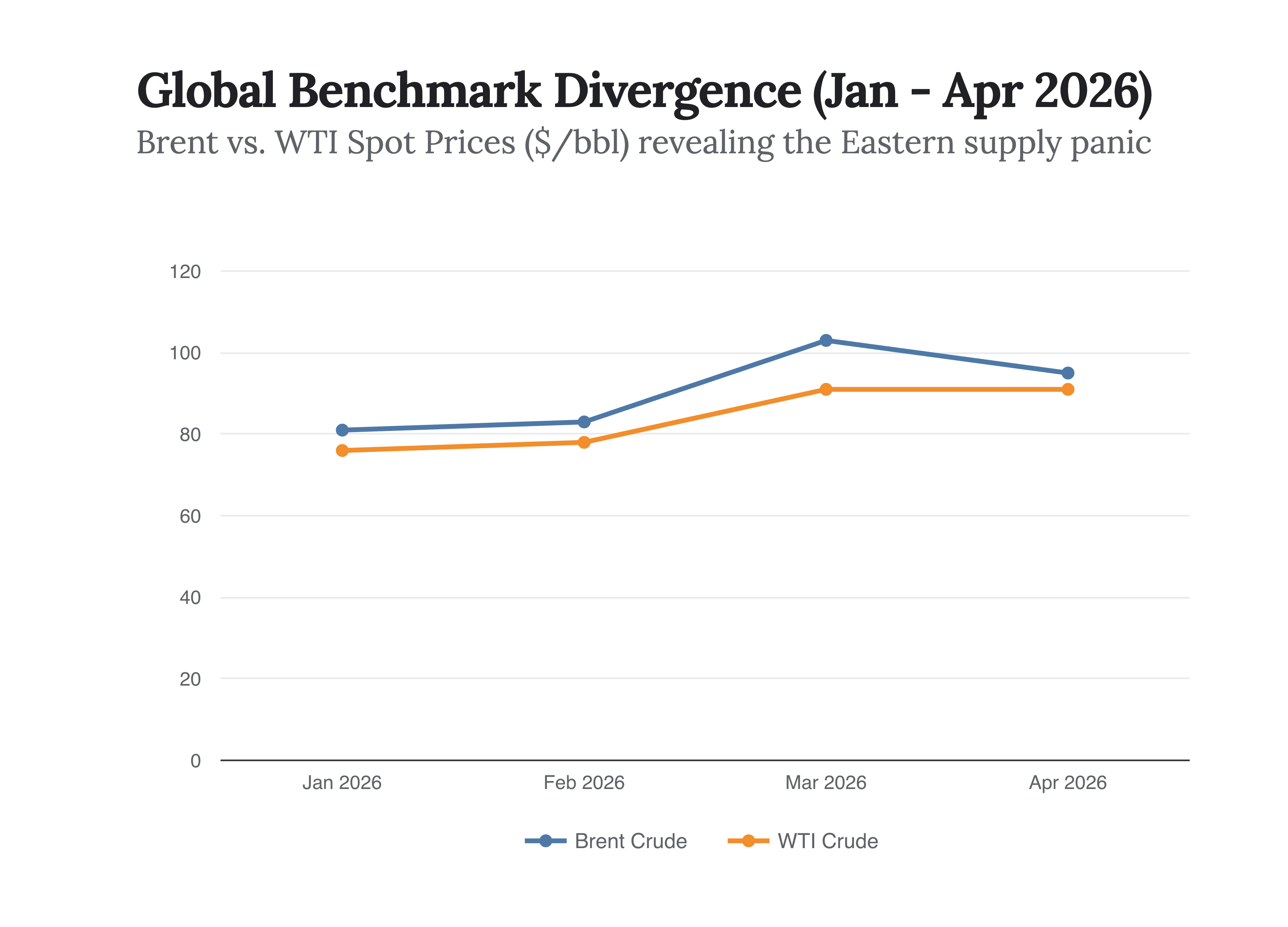
The global energy market is currently experiencing a violent physical dislocation. As of mid-April 2026, Brent crude futures are swinging erratically around the $94.81 per barrel mark, while West Texas Intermediate (WTI) hovers near $91.39. To the untrained observer looking at a daily ticker, this might look like standard commodity volatility. But beneath the surface of these numbers lies a profound and dangerous miscalculation by the broader market.
Just weeks ago, Brent tested the $118 threshold, driven by the escalating conflict in the Middle East and the subsequent de facto closure of the Strait of Hormuz—the most critical energy chokepoint on the planet. The recent cooling of prices back into the mid-$90s has been entirely catalyzed by the announcement of a temporary, two-week ceasefire. Traders in London and New York are currently betting that this tactical pause will seamlessly transition into a permanent structural resolution. They are wrong.
The market is currently pricing a temporary geopolitical risk premium, entirely ignoring the permanent structural damage inflicted on global supply chains. Game theory dictates that a temporary ceasefire is not an equilibrium of peace; it is a repositioning phase. While maritime traffic remains paralyzed and the US military blockades Iranian ports, the underlying physical flow of oil remains trapped. The barrels are not simply delayed—they are ghost barrels, vanishing from a global inventory system that was already dangerously tight.
The Anatomy of a Physical Dislocation
To understand the sheer magnitude of what is occurring, we must look at the actual production data from the original OPEC+ participants. The numbers are staggering. In March 2026, quota-participating OPEC+ crude production plummeted by 7.58 million barrels per day (mb/d) month-over-month, bringing aggregate output down to just 28.3 mb/d. To put this in historical context: this represents the lowest aggregate crude output for the original OPEC members since Operation Desert Storm in 1990.
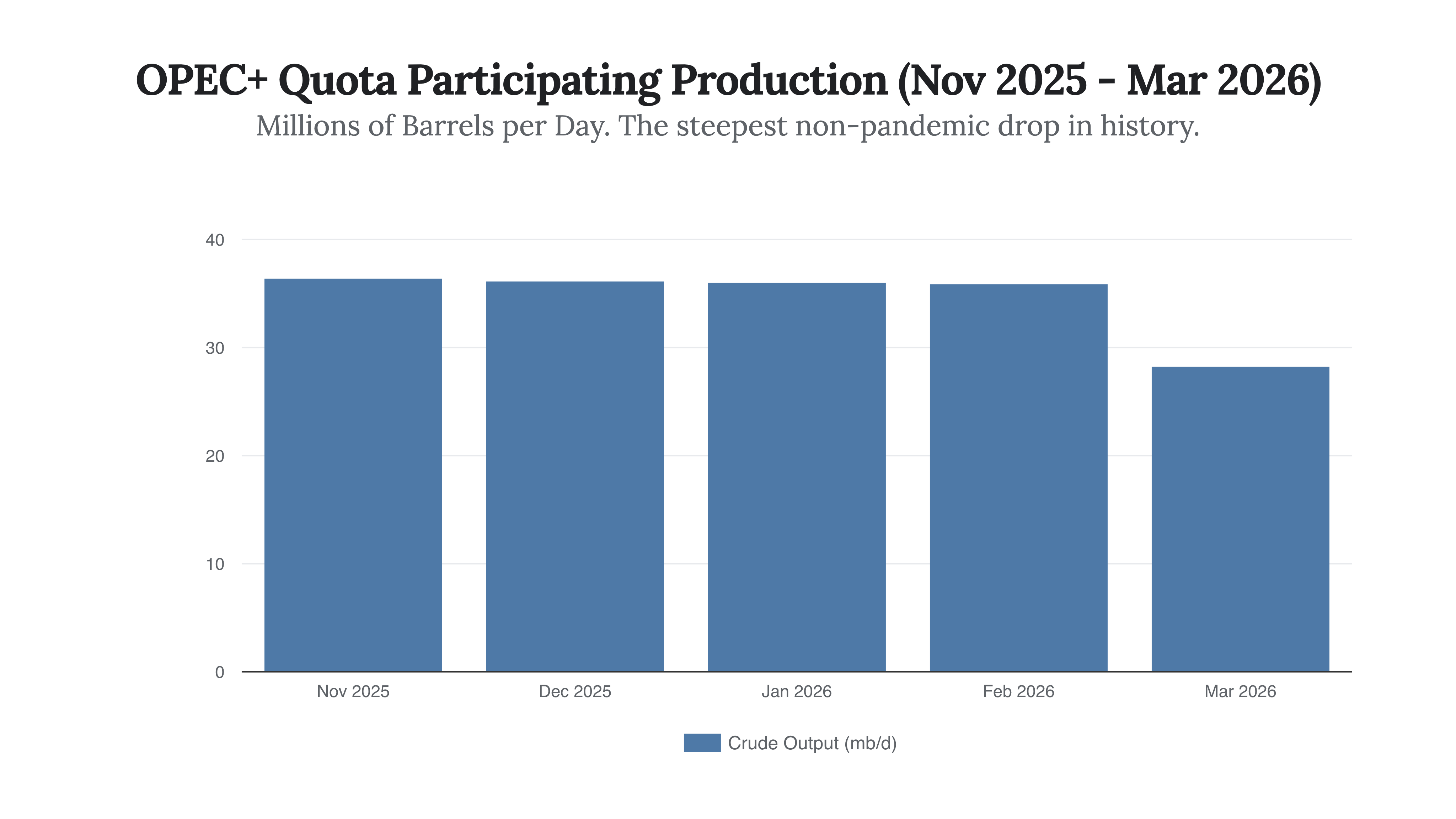
The total global supply loss is even more severe when factoring in non-participating regional actors, with the International Energy Agency (IEA) reporting a catastrophic 10.1 mb/d drop in global oil supply in March. This is the largest sudden supply disruption in modern history, eclipsing the initial shocks of the 2022 Russian sanctions and rivaling the emergency COVID-19 shut-ins.
When we examine the strategic incentives of the key players, the illusion of a quick resolution begins to fracture. Nations with access to alternative export routes—such as the UAE pipeline to Fujairah and the East-West pipeline in Saudi Arabia—are operating these bypasses at maximum capacity, successfully moving roughly 7.2 mb/d. For these actors, the current environment is highly lucrative. They are capturing massive risk premiums on their available barrels while their regional competitors are effectively sidelined. We are witnessing the weaponization of geography on a scale not seen since the 1970s, where the choke point itself becomes the ultimate strategic deterrent.
This information asymmetry is perfectly illustrated by the massive blowout in the Brent-WTI spread. In March, the spread widened to an astonishing $12 per barrel, peaking at $15 per barrel in early April. Brent prices the physical reality of the Eastern Hemisphere, while WTI anchors the West. The explosion in this spread was driven by a desperate scramble among Asian refiners who suddenly found themselves starved of Middle Eastern medium sour crude, forced to pay exorbitant shipping and insurance premiums.
The Secondary Shock: LNG and Distillates
The crisis at the Strait of Hormuz is not strictly a crude oil story; it is a total energy system contagion. The closure has dramatically reduced the flows of liquefied natural gas (LNG) exports, triggering a secondary shockwave across European and Asian import markets.
The strategic leverage has immediately shifted to the United States, but physical infrastructure places a hard cap on that leverage. U.S. LNG export facilities are currently running at absolute peak capacity, exporting nearly 18 billion cubic feet per day of natural gas as of March. With zero spare capacity to increase exports, the spread between the U.S. benchmark Henry Hub spot price and international import prices has skyrocketed. Europe and Asia cannot simply buy their way out of this shortage; the physical ships and terminals do not exist to move more volume.
Unlock deeper strategic alpha with a 10% discount on the annual plan.
Support the data-driven foresight required to navigate an era of radical uncertainty and join a community of institutional-grade analysts committed to the truth.
Simultaneously, the refined product market is fracturing. Distillate crack spreads—the profit margin refiners make on producing diesel—averaged $1.42 per gallon at New York Harbor in March, the highest monthly level since 2022. This has pushed retail diesel prices to peak at over $5.80 per gallon in April. The true cost of the blockade is not just measured in unrefined crude, but in the total paralysis of the global middle distillate and liquefied natural gas markets. For the global logistics industry, which runs entirely on diesel, this represents an inflationary shock that will directly impact consumer goods by Q3 2026.
Demand Destruction as the Only Equilibrium
When physical supply cannot expand to meet demand, the market relies on a brutal mechanism to find balance: price must rise until demand is violently destroyed. Traders relying on non-OPEC+ producers to fill the void are misjudging the physical reality of the U.S. shale patch. According to recent data, U.S. crude output is expected to remain essentially flat through 2026 and potentially soften into 2027, heavily constrained by capital discipline and natural well depletion. The strategic petroleum reserves (SPR) of OECD countries have already been heavily drained, leaving no buffer.
Without a supply-side rescue, the demand side is collapsing. The IEA’s April 2026 Oil Market Report highlighted a chilling pivot. Just one month prior, the agency forecasted global oil demand to grow by 730,000 barrels per day in 2026. Following the closure of Hormuz, that forecast was unceremoniously slashed. The IEA now projects global oil demand to contract by 80,000 barrels per day this year.
In the second quarter alone, demand is expected to plunge by 1.5 million barrels per day—the sharpest quarterly decline since the depths of the COVID-19 pandemic. This is not a story of consumers voluntarily transitioning to electric vehicles. This is forced industrial curtailment. Petrochemical plants in Asia are shutting down because feedstock is prohibitively expensive, and Middle East refineries have cut run rates by nearly 6 mb/d. The global economy is cannibalizing its own growth to survive the price shock, trading long-term prosperity for short-term thermal survival.
The Divergence in Institutional Foresight
Looking toward the second half of 2026, institutional consensus has completely shattered. We are witnessing a massive divergence in how major banks and government agencies model the tail risks of this conflict, creating immense opportunities for strategic arbitrage.
The U.S. Energy Information Administration (EIA) takes a relatively hawkish view in its base case, anticipating that Brent crude will peak at an average of $115 per barrel in the second quarter of 2026 before easing to $88 by the fourth quarter, assuming a slow and highly contested resumption of traffic. Conversely, Goldman Sachs has revised its baseline Q2 forecast down to $90 per barrel, leaning heavily into the assumption that the current fragile ceasefire holds.
However, even the most dovish institutional models harbor terrifying tail risks. Goldman Sachs explicitly warns that if the ceasefire fails and the Middle East production losses persist, Brent could easily average $120 per barrel in Q3 and $115 in Q4.
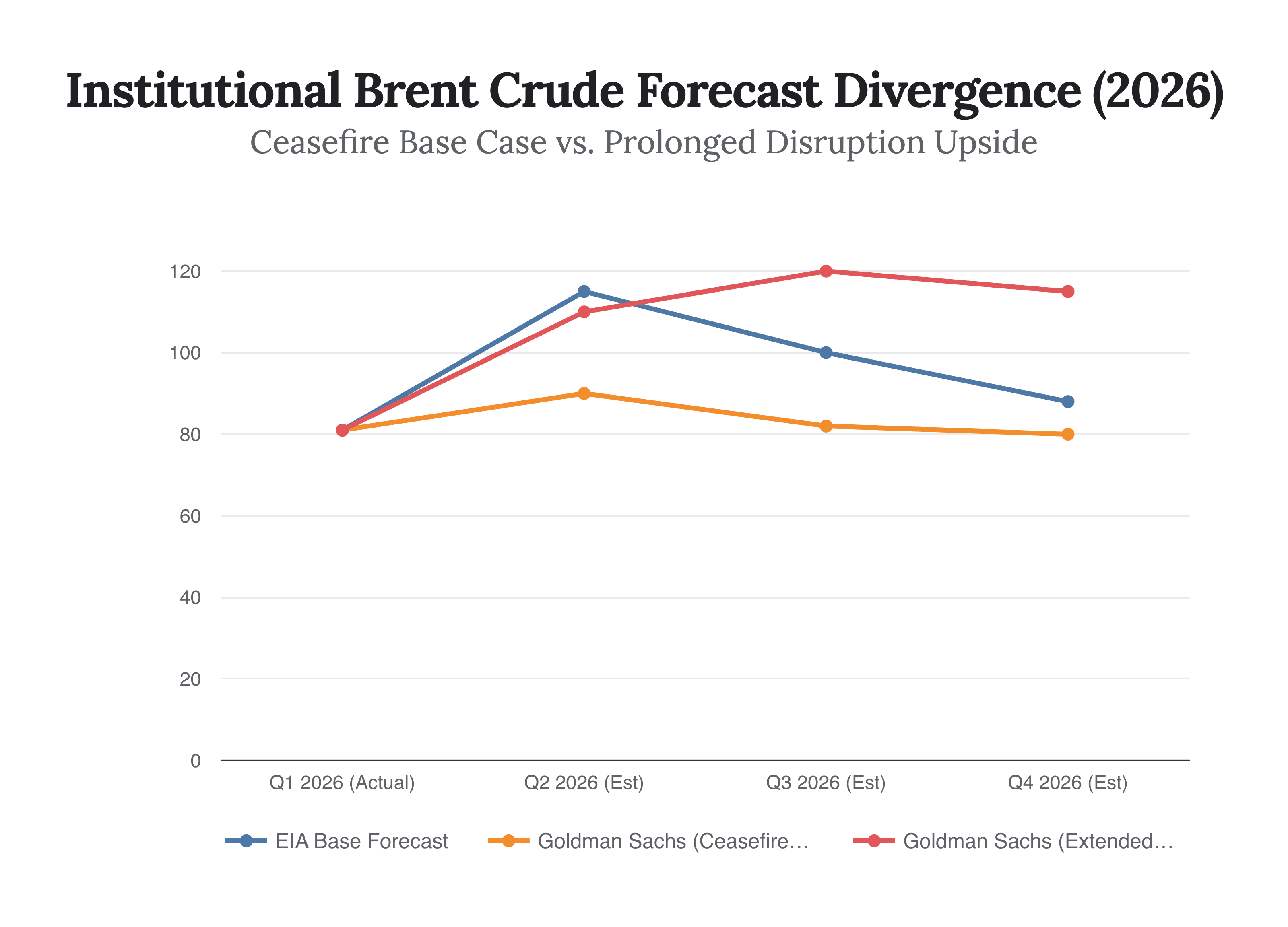
The variance between an $80 fourth quarter and a $115 fourth quarter represents trillions of dollars in global GDP impact, sovereign debt yields, and consumer inflation data. Relying on the base-case “ceasefire” scenario is an incredibly fragile strategy for corporate risk management. The game-theoretic payoffs for a prolonged, grinding standoff are simply too high for the regional actors involved. Iran views the closure of the strait as its ultimate asymmetric leverage against Western financial sanctions, while the U.S. administration faces intense domestic pressure not to capitulate ahead of the midterm elections.
The crude oil lost in March and April of 2026 is already gone. With global observed oil inventories falling by an estimated 85 million barrels in March alone, the market’s physical shock absorbers have been completely eroded. The geopolitical risk premium is no longer a temporary anomaly; it has become the undeniable structural baseline of the new global energy paradigm. Investors and institutions must stop waiting for a return to the pre-conflict equilibrium and begin pricing the reality of a chronically constrained, highly weaponized global energy network.