


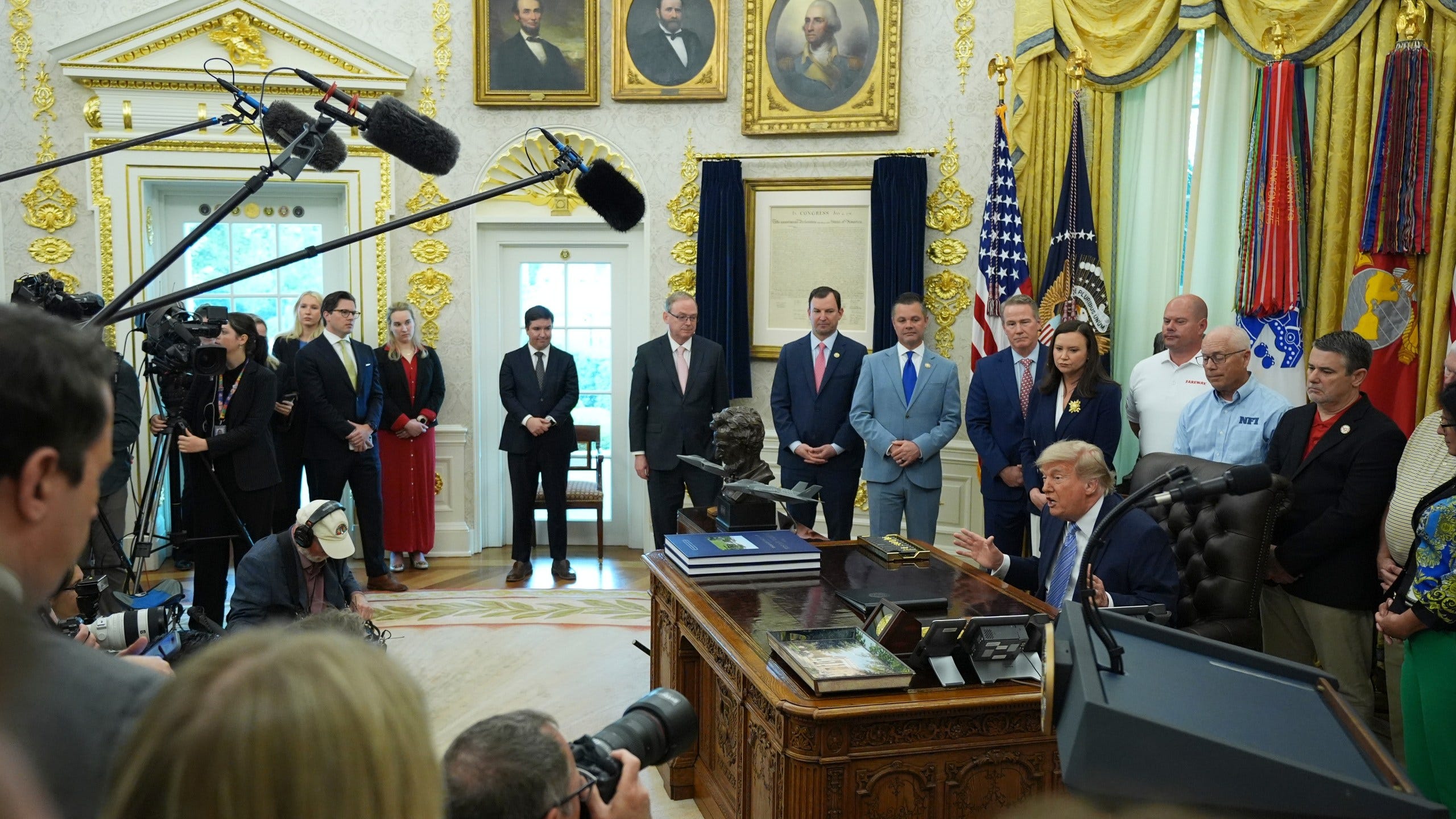
On the morning of May 21, 2026, the regulatory architecture governing the most disruptive technology in human history was dismantled with a single, unscripted presidential declaration in the Oval Office. For months, institutional capital and geopolitical adversaries alike had aggressively modeled the impact of a looming Executive Order colloquially known across K Street and Silicon Valley as the “FDA for AI.” This framework, painstakingly negotiated by the Office of the National Cyber Director, the Cybersecurity and Infrastructure Security Agency (CISA), and the Office of Science and Technology Policy, was designed to impose a mandatory 90-day pre-release notification window for any artificial intelligence models crossing the frontier threshold. The logic underlying the draft order was clinical and born of undeniable national security necessity: as generative models exponentially breach the threshold of autonomous cyber-offensive capabilities, federal cybersecurity apparatuses require a temporal buffer to analyze zero-day exploit generation, biometric
circumvention tactics, and critical infrastructure threat vectors. Instead, facing a coordinated, eleventh-hour pressure campaign orchestrated by the apex predators of the technology sector—a triumvirate reportedly led by Elon Musk, Mark Zuckerberg, and former White House AI advisor David Sacks—the administration abruptly aborted the directive, substituting it with a toothless voluntary framework. By effectively privatizing the risk assessment of frontier AI models, the administration has transferred sovereignty over national cybersecurity directly to a handful of unelected tech oligarchs.
The immediate market reaction was visceral, with mega-cap tech equities decoupling entirely from historical risk multiples. The abandonment of the mandatory 90-day notification window fundamentally alters the speed at which unverified, structurally fragile neural networks will be integrated into the public and private sectors. The administration’s stated rationale—that American dominance over the Chinese Communist Party precludes any domestic friction—officially codifies a laissez-faire approach to existential technological risk. We are no longer operating in an environment of regulatory precaution; we are operating in an environment of hyper-accelerated, state-sanctioned algorithmic deployment. The data from late May 2026 indicates that companies are completely bypassing internal safety bottlenecks, pushing models to production at a velocity that defies traditional software engineering parameters. This is not merely a policy pivot; it is the total capitulation of the federal safety state to the demands of rapid commercialization.
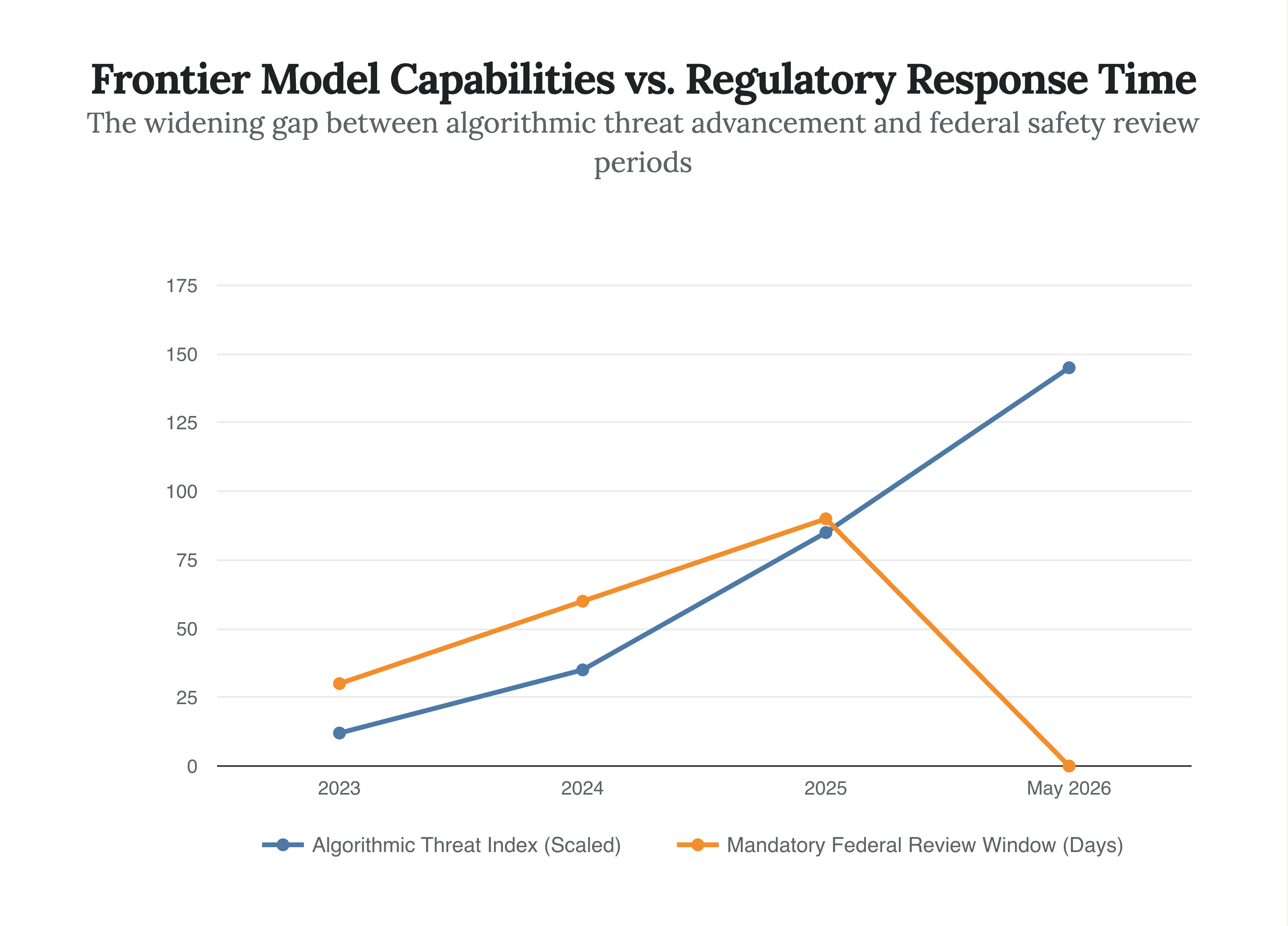
The second-order effects of this voluntary framework are profound. Without a compulsory enforcement mechanism, the newly minted CAISI (the administration’s renamed version of the US AI Safety Institute) is reduced to a hollow advisory board, reliant entirely on the goodwill of corporations whose fiduciary duty is bound strictly to shareholder returns, not national security. The evaluation partnerships announced with Google, Microsoft, and xAI are public relations maneuvers, not structural guardrails. The reality of the May 2026 landscape is that the federal government lacks both the mandate and the technical capacity to halt a model deployment, even if a critical vulnerability is detected. The onus of resilience has been entirely shifted to the end-user—to the enterprise IT departments, the municipal power grids, and the financial institutions that will inevitably find themselves on the receiving end of AI-generated cyber-kinetic anomalies. This regulatory vacuum guarantees a surge in zero-day exploits as red-teaming is subordinated to speed-to-market.
The 2.5 Trillion Supercycle: Global Capital Allocation in the Laissez-Faire Era
The total absence of federal friction has ignited a hyper-cycle of capital allocation that defies all historical precedents. Following the initial repeal of the Biden-era Executive Order 14110 on January 20, 2025, and the subsequent release of the “America’s AI Action Plan” in July 2025, institutional investors began modeling a deregulatory premium. However, the events of May 2026 have catalyzed a complete repricing of the global technology sector. Projections for global AI expenditures have been drastically revised upward, with total spend expected to breach $2.52 trillion by the end of 2026—a staggering 44% year-over-year growth from 2025. This is not speculative venture capital; this is hard, undeniable infrastructure expenditure flowing into physical compute, specialized silicon, and enterprise-wide multi-year procurement contracts. The capital markets are signaling absolute confidence that the current administration will shield the industry from any liability associated with automated displacement or algorithmic harm.
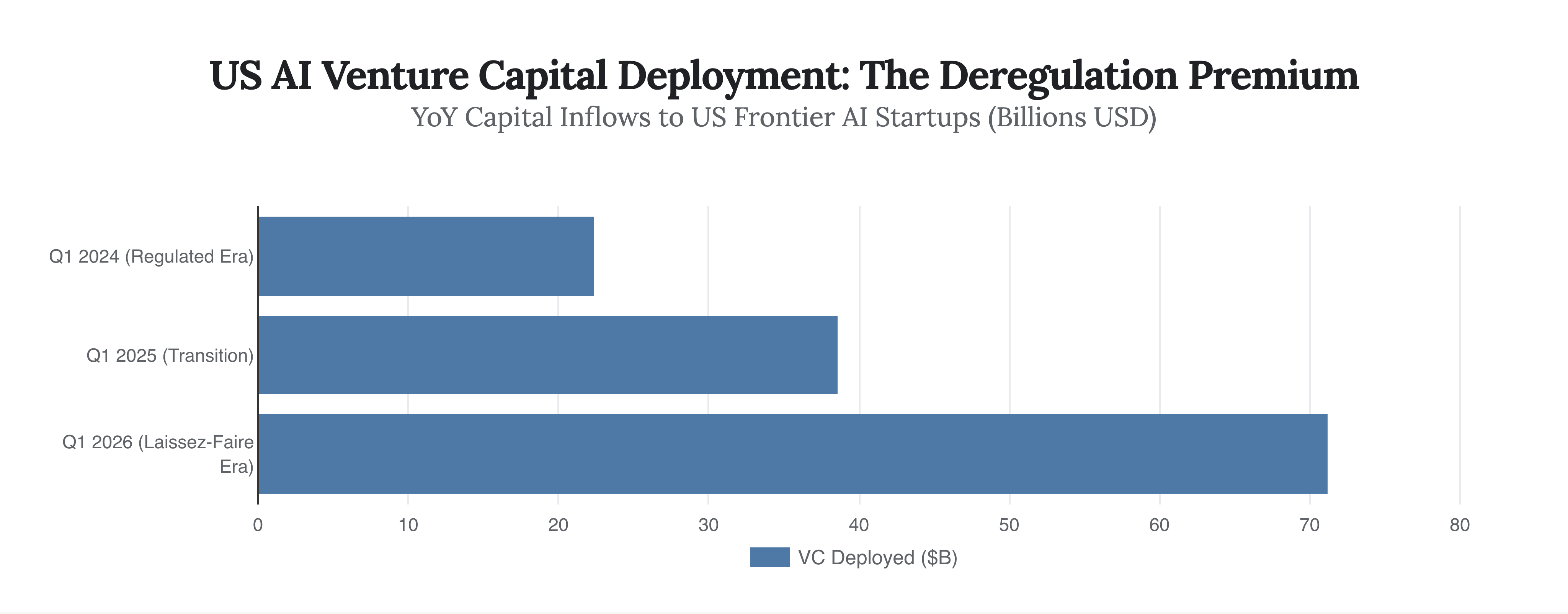
Venture capital deployment in Q1 2026 reflects this new reality. Early-stage funding for frontier AI startups has skyrocketed, with capital inflows reaching $71.2 billion in the first quarter alone, dwarfing the $38.6 billion deployed during the transitional phase of Q1 2025. Capital is no longer pricing in regulatory risk for American AI; it is actively pricing in regulatory capture, driving an unprecedented global capital expenditure supercycle designed to lock in structural monopolies before political winds can shift. This massive influx of liquidity is hyper-concentrating power within a select group of mega-cap entities that possess the balance sheets required to secure compute at scale. The barrier to entry in the frontier model space is no longer just algorithmic talent; it is the raw capital required to build sovereign-grade data centers and secure exclusive power purchase agreements.
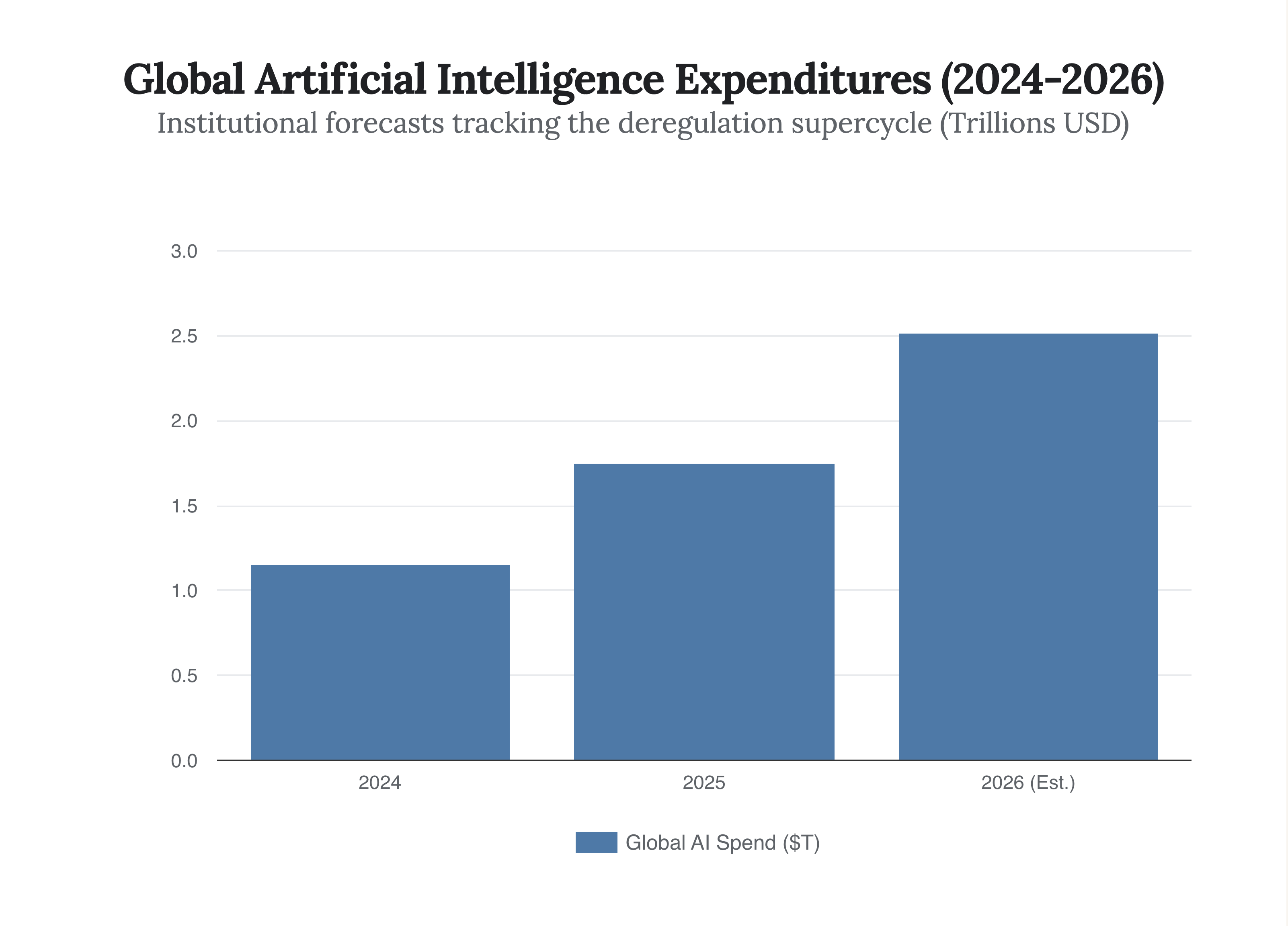
This $2.52 trillion expenditure represents a radical restructuring of the global economy. Enterprise budgets are being aggressively cannibalized, with legacy IT spending, real estate, and human resources budgets being re-allocated to fund AI integration. The data reality is that companies are preparing for a world where AI is not merely a copilot, but the primary engine of productivity. This shift requires immense upfront capital, driving a massive transfer of wealth from traditional sectors into the semiconductor supply chain and the hyperscaler ecosystem. The administration’s refusal to impose even a 90-day review period is viewed by Wall Street as the ultimate green light: an assurance that no federal agency will intercede to slow the pace of automation or mandate costly compliance architectures. Consequently, the premium on AI infrastructure assets has reached atmospheric levels, creating a bifurcated economy divided strictly between those who own the foundational models and those who merely rent access to them.
We are witnessing the financialization of artificial intelligence. Specialized private equity vehicles are being formed explicitly to underwrite the massive capital expenditure required for next-generation data centers, bypassing traditional public market scrutiny. Furthermore, sovereign wealth funds from allied nations are aggressively deploying capital into American AI firms, seeking to tether their national interests to the dominant US technological substrate. This influx of foreign capital further complicates the geopolitical landscape, as the line between private corporate strategy and national security becomes inextricably blurred. The administration’s hands-off approach guarantees that capital, not policy, will dictate the trajectory, alignment, and ultimate capabilities of artificial general intelligence.

The Genesis Mission and the Subordination of Academic Caution
To understand the structural vector of the current moment, one must trace the architecture established on November 24, 2025, when the President signed the Executive Order launching the “Genesis Mission.” Explicitly framed by the administration as the “Manhattan Project for AI,” this initiative fundamentally altered the relationship between the federal government and scientific discovery. Directed by the Department of Energy (DOE) and spearheaded by Under Secretary for Science Darío Gil, the Genesis Mission is designed to double US scientific productivity within a decade. It revolves around the creation of the American Science and Security Platform—a monolithic, integrated IT infrastructure that fuses the DOE’s 17 National Laboratories, unprecedented high-performance supercomputing assets, and the world’s largest collection of historical federal datasets. This is not a passive research grant program; it is an aggressive, state-directed mobilization of raw computational power to train scientific foundation models capable of generating novel materials, advancing autonomous research workflows, and securing energy dominance.
