



The single most dangerous assumption in modern strategy is that your consumer, your employee, and your audience are individuals. They are not. They are multitudes.
For the last decade, the digital ecosystem has been built on the premise of the “User”—a singular, coherent identity moving linearly across the web. Fresh intelligence from late 2024 and 2025 shatters this model completely. We are witnessing the rise of the “Poly-Sync” individual: a person who operates distinct, often contradictory, psychological operating systems across an average of 6.8 digital platforms every single month. This is not merely a sociological curiosity; it is an economic seismic shift.
The cost of maintaining these fragmented selves is no longer just psychological; it is quantifiable. New data reveals that the cognitive “toggle tax”—the energy required to switch contexts and identities—is now draining $450 billion annually from the U.S. economy alone. Meanwhile, a silent arms race has begun to monetize this fragmentation, with the market for digital avatars and identity layers projected to eclipse half a trillion dollars by the early 2030s.
This briefing deconstructs the mechanics of the Fragmented Self, exposing the hidden liabilities for enterprises and the explosive opportunities for those who build the infrastructure for our multiple lives.
1. The Architecture of the Split: Quantifying the Double Life
The concept of “being yourself” has become a statistical anomaly. The latest behavioral data indicates that identity is no longer a fixed asset but a liquid currency, exchanged and altered based on the platform in use. This phenomenon, often termed “context collapse” by academics, has now evolved into “context segregation.” Users are actively building firewalls between their digital personas to survive.
Recent surveys conducted in 2024 reveal a stark generational divide. While older cohorts strive for consistency, the emerging workforce views identity fluidity as a survival mechanism. Nearly half of Gen Z admits to leading a “double life” online, maintaining personas that are structurally different from their offline reality. This is not deception; it is adaptation.
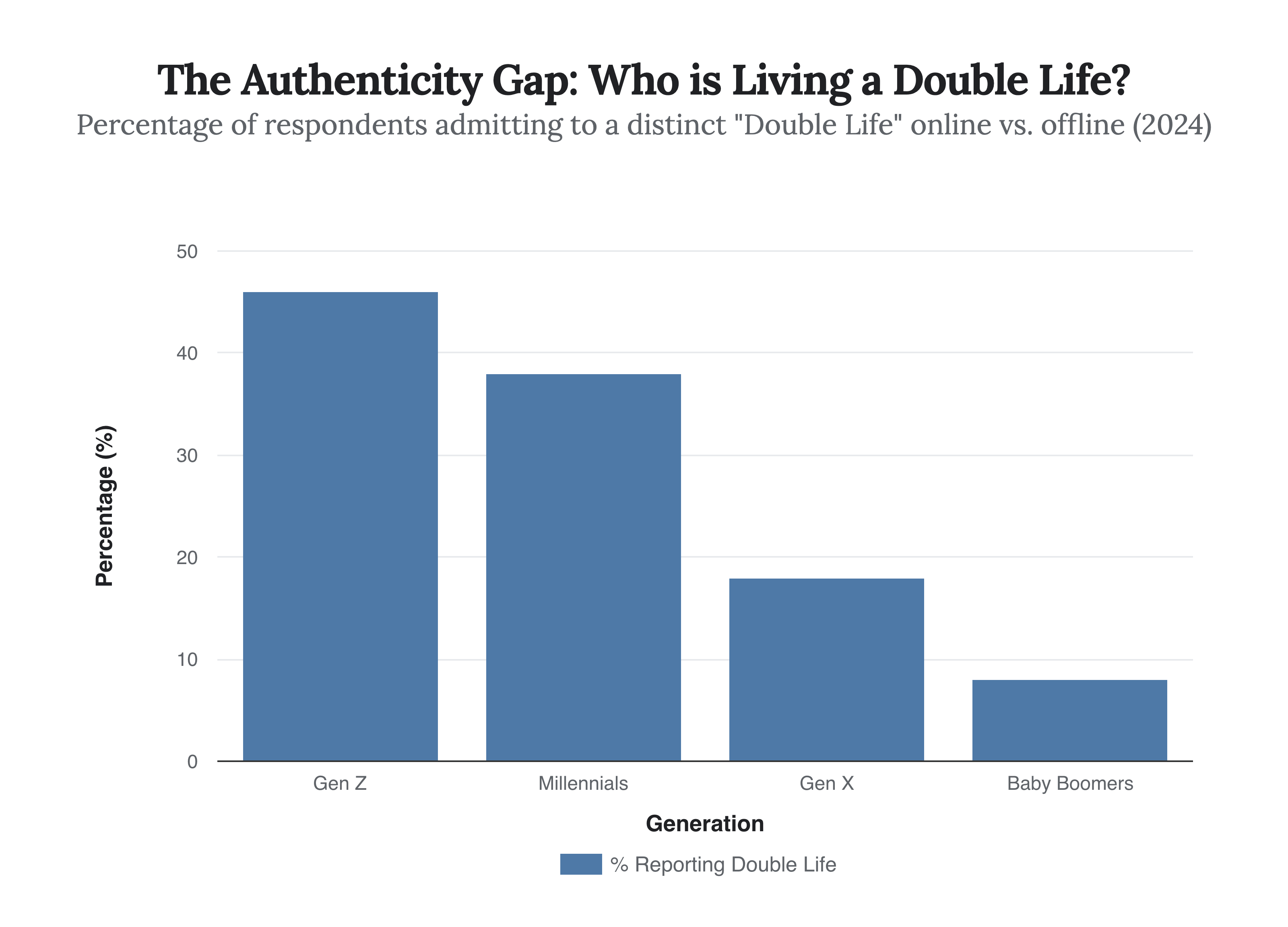
The strategic implication here is profound: Market research based on a singular “customer profile” is fundamentally flawed. If 46% of your future market considers their online self distinct from their physical self, any data aggregating these behaviors will result in a “grey average” that represents no one.
The Platform Fragmentation Index
This splitting is necessitated by the sheer volume of environments users must navigate. The average internet user is not just consuming content; they are managing a portfolio of presence. With an average of 6.8 platforms visited monthly, the mental overhead of code-switching—altering language, behavior, and presentation—has reached a critical threshold.
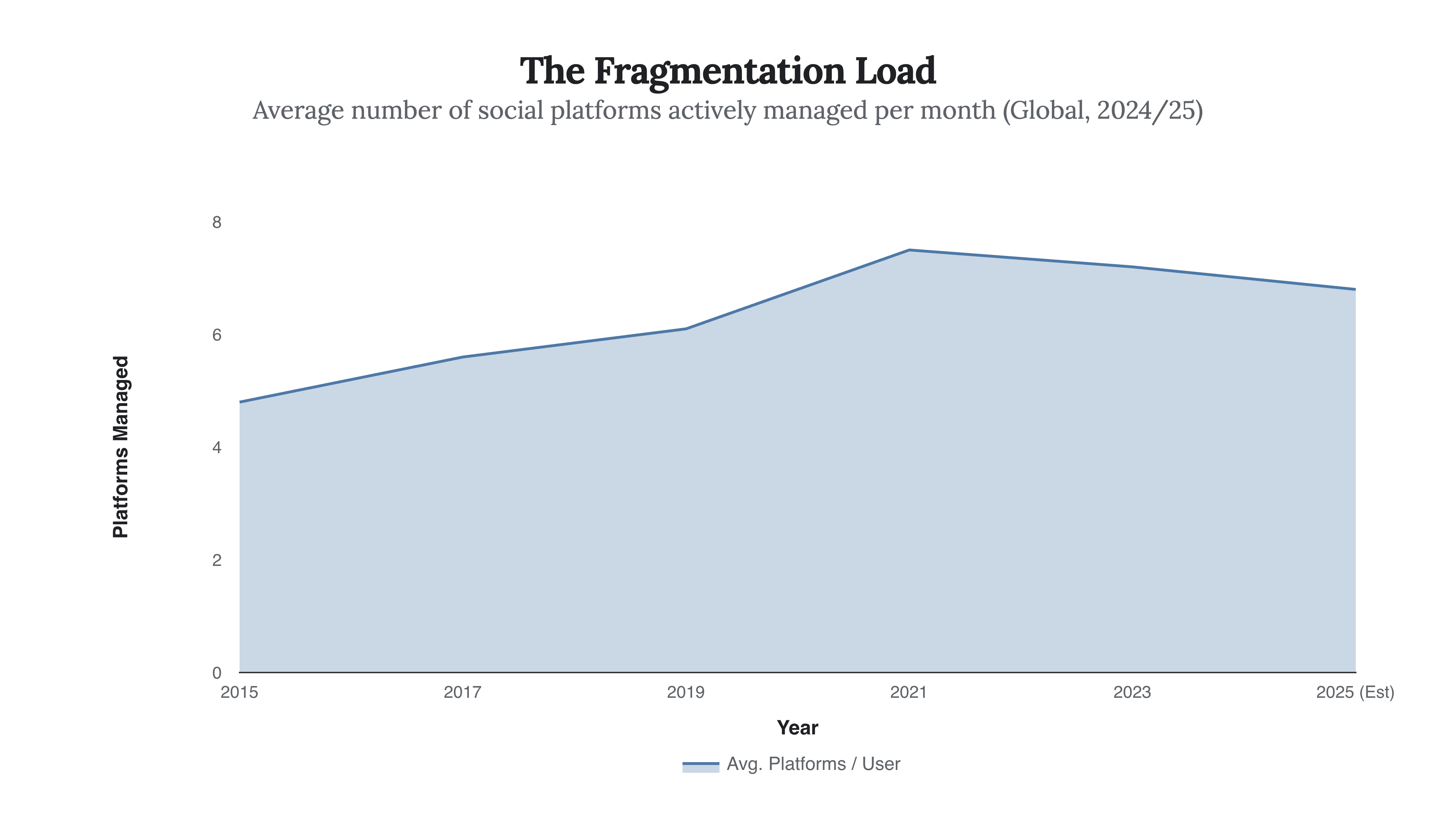
Note the stabilization around 6.8 to 7 platforms. This suggests a “Cognitive Ceiling”—the maximum number of distinct personas a human mind can plausibly maintain before performance degrades significantly. We have hit peak fragmentation; the next phase is rationalization.
2. The $450 Billion Toggle Tax
For years, enterprises focused on the “Engagement Economy,” valuing how long users stayed. They missed the “Disengagement Cost.” The friction of switching between these multiple digital selves—moving from a LinkedIn professional persona to a Discord anon, then to an Instagram curator—incurs a massive cognitive penalty.
