


In April 2025, a quiet revolution was confirmed not in Silicon Valley or Shenzhen, but in the thin air of the Himalayas. Druk Holding and Investments (DHI), the commercial arm of the Royal Government of Bhutan, revealed that its state-linked digital asset operations had generated an estimated $750 million in revenue over the previous year. For a nation historically constrained by its geography—locked between giants and severed from the maritime trade routes that built the modern world—this figure was more than a statistic. It was a declaration of independence.
This is the Sovereignty Swap. Across the globe, landlocked nations are leveraging their only unassailable assets—cooling-ready climates and stranded renewable energy—to host high-value data blocs. By turning their isolation into an asset, they are bypassing the submarine cables and coastal hubs that have long dictated the geography of the internet. The data is fleeing the coast, seeking sanctuary in the mountains.
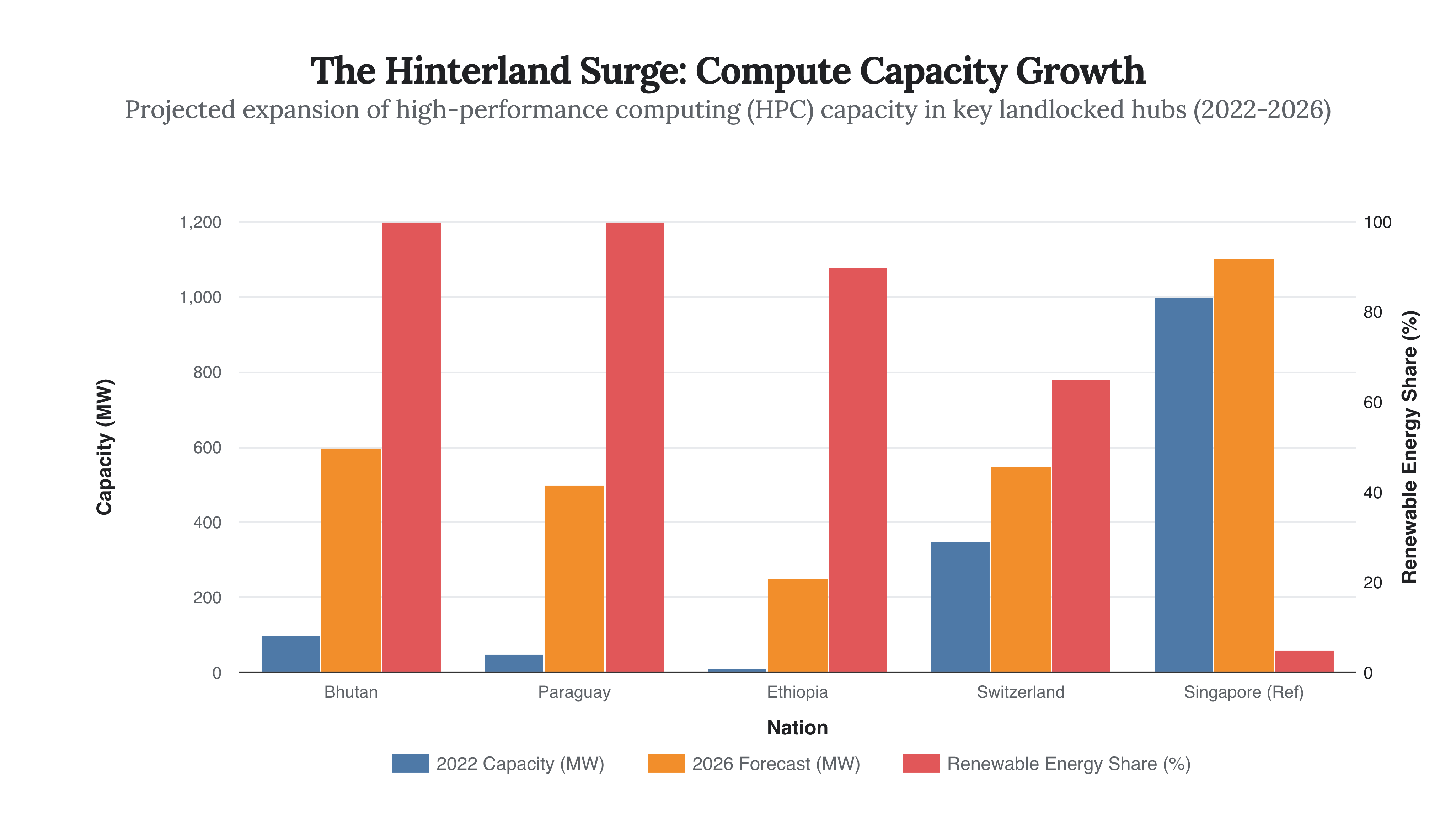
The chart above illustrates the explosive velocity of this shift. While traditional coastal hubs like Singapore face saturation and energy constraints, the \”Cooling Frontiers\” are scaling rapidly. Bhutan alone is expanding its mining and AI capacity from 100 MW to a targeted 600 MW, driven by its partnership with Bitdeer. Paraguay, leveraging the colossal Itaipú Dam, has signed agreements for AI infrastructure that could rival the output of established G7 data centers.
“Bitcoin functions strategically as a battery. Every bitcoin in Bhutan offsets that much mined globally through a coal plant.”
— Ujjwal Deep Dahal, CEO of Druk Holding and Investments (April 2025)
The Energy Arbitrage
For decades, landlocked developing countries (LLDCs) suffered from the \”tyranny of distance.\” Exporting physical goods required transiting through neighboring territories, incurring tariffs, delays, and political risk. The digital economy inverts this dynamic. Electricity, once a stranded asset trapped within national borders, can now be converted into digital commodities—Bitcoin hash rate or AI inference tokens—and beamed instantly over terrestrial fiber.
This arbitrage is starkest in energy pricing. In Virginia or Frankfurt, data centers compete for grid access at premium industrial rates. In the highlands of Ethiopia or the river basins of Paraguay, the energy is not only renewable; it is effectively free of global market competition. The table is tilting away from efficiency toward autonomy.
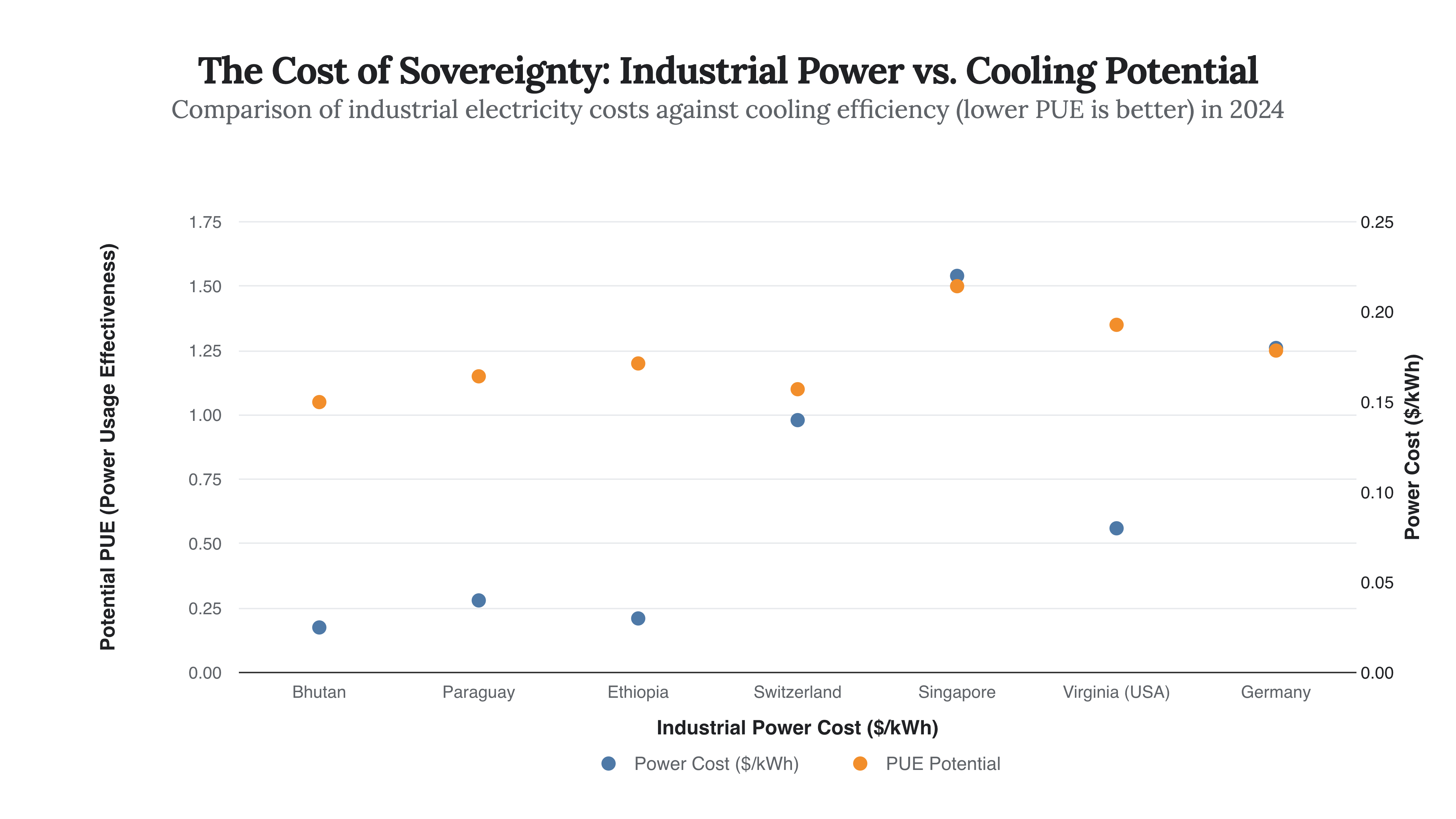
The scatter plot reveals the competitive moat. Bhutan and Ethiopia cluster in the \”Goldilocks\” zone: extremely low power costs combined with high cooling efficiency (low PUE) due to altitude and climate. Coastal hubs like Singapore are outliers in the opposite direction—expensive and hot, requiring massive energy expenditure just to keep servers from melting. This physical reality is driving the \”Sovereignty Swap\”: trading climatic capital for digital relevance.
The Swiss Bunker and the Ethiopian Dam
While Bhutan and Paraguay play the energy game, Switzerland pursues a different vertical: the \”Sovereign Cloud.\” Here, the asset is not just hydroelectricity, but neutrality and physical security. The 2024 approval of the \”Swiss Government Cloud\” and the expansion of bunkers in the Alps signal a retreat from the globalized, borderless internet toward a fortified, state-controlled digital architecture.
Meanwhile, Ethiopia has officially entered the fray. Despite its own connectivity challenges, the government signed a $250 million deal in 2024 to establish high-performance computing infrastructure. By co-locating these facilities next to the Grand Ethiopian Renaissance Dam, they are creating a terrestrial data corridor that bypasses the Red Sea\’s maritime choke points entirely.
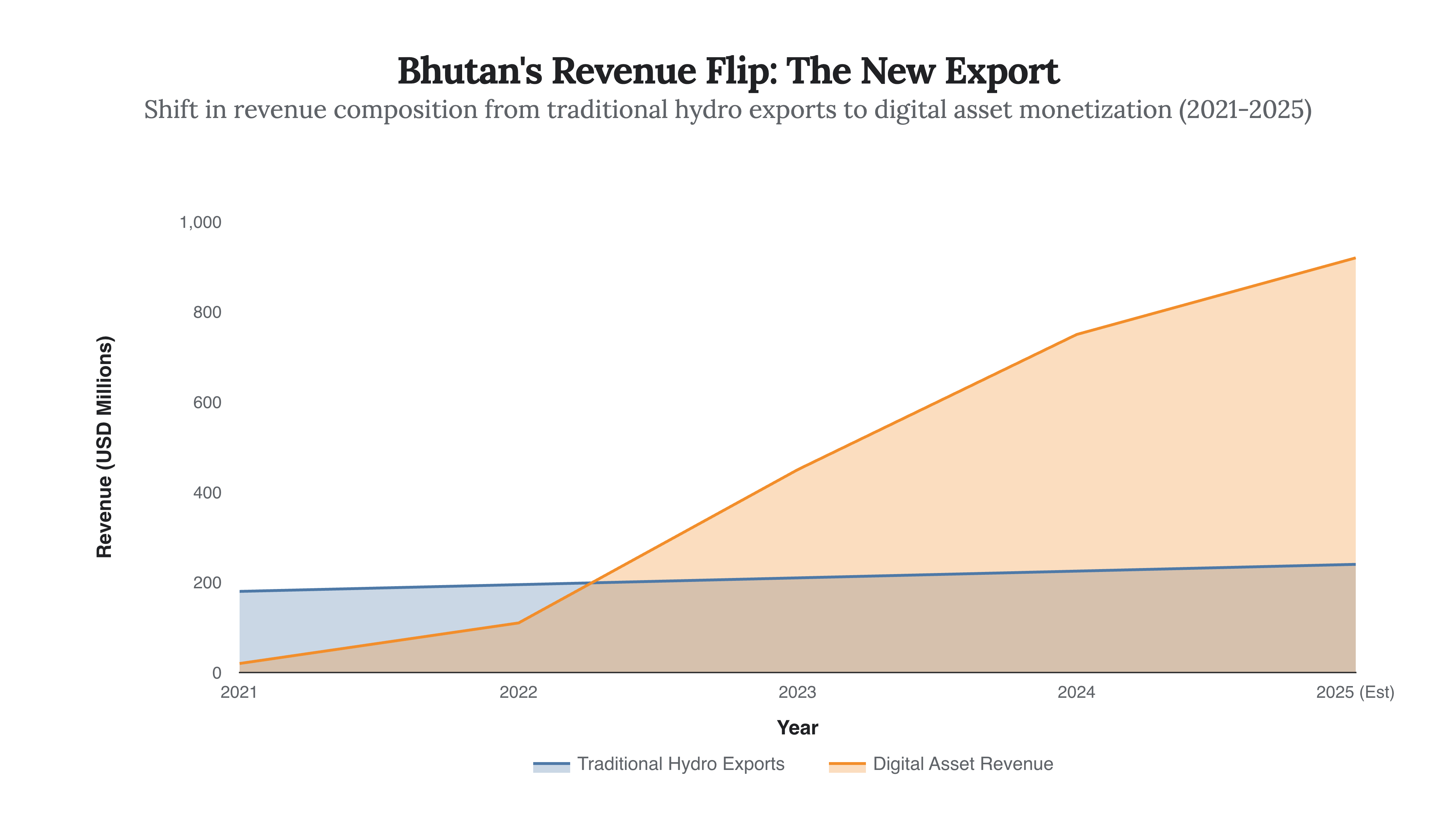
The transformation of Bhutan\’s economy is the most vivid proof of concept. As shown above, revenue from digital assets—effectively \”virtualized hydro\”—has eclipsed traditional electricity exports to India. This decoupling offers a blueprint for other landlocked nations: you do not need a port to export value if you can export the hash.
“Geography should never define destiny. Yet for the 32 Landlocked Developing Countries... geography too often limits development. Together, we can transform geography from a barrier to a bridge.”
— António Guterres, UN Secretary-General (August 2025)
The Death of Distance
This trend challenges the assumption that the internet is an ocean-centric organism. We are witnessing the rise of terrestrial fiber corridors—a digital Silk Road that connects the \”Fortress Nations.\” By relying on satellite backups (Starlink) and cross-border fiber that ignores maritime jurisdictions, these nations are immunizing themselves against the severance of subsea cables.
The implications are profound. The next great data empires may not be built on the coasts of California or the shores of the South China Sea, but in the bunkers of the Alps and the valleys of the Himalayas. The Sovereignty Swap is complete: the landlocked have become the cloud-linked.