


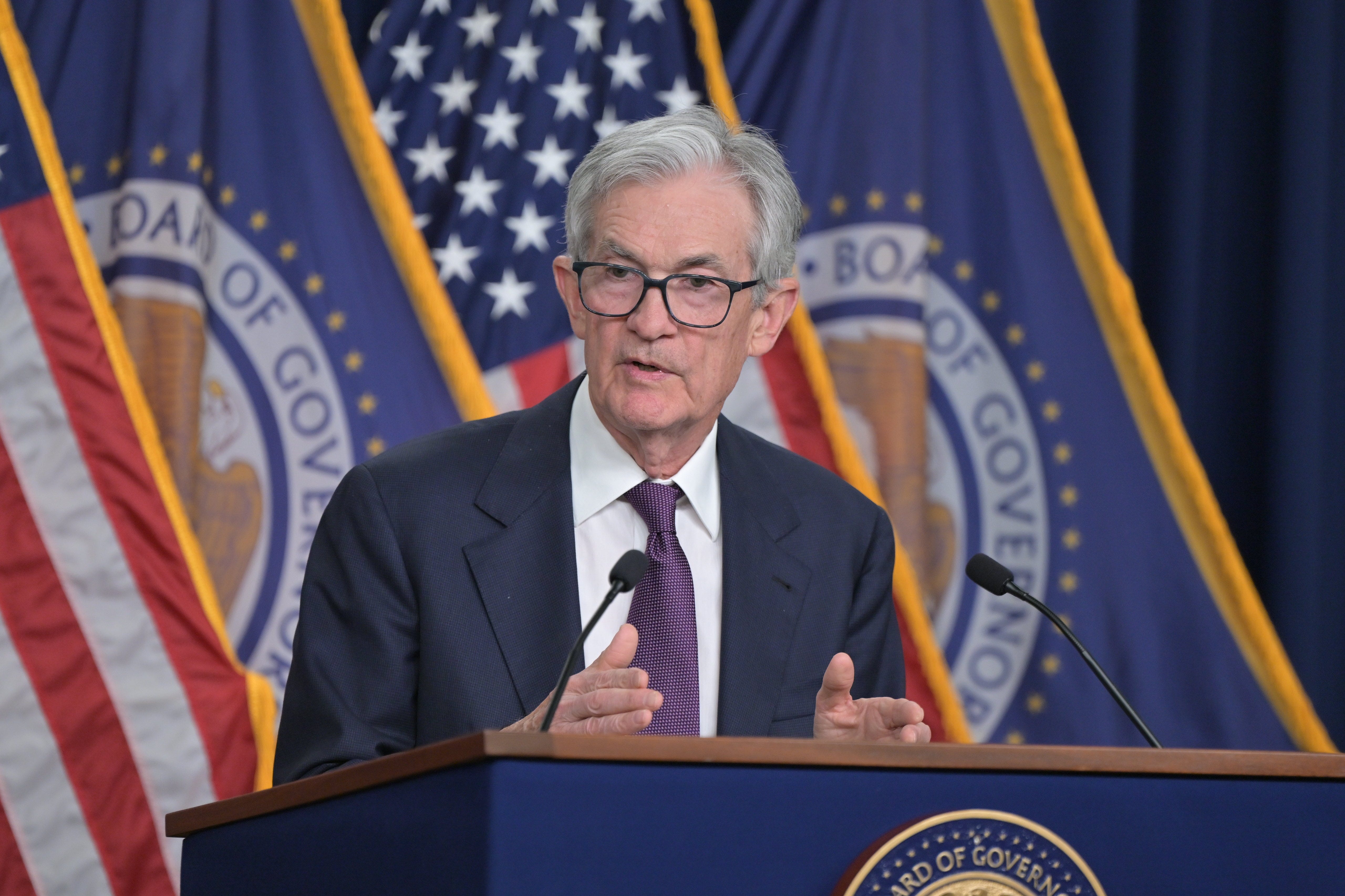
In a move widely anticipated by markets, the Federal Reserve cut its benchmark interest rate by a quarter point to a range of 3.75% to 4.00% on Wednesday, marking the second such reduction this year. This decision lands at a precarious moment for the U.S. economy, one defined not just by conflicting signals but by a sheer absence of reliable data. With a federal government shutdown now stretching into its fourth week, the central bank is flying blind, forced to make critical policy judgments without the vital economic signposts it depends on, most notably the monthly jobs report.
The Fed’s official statement acknowledged this murky reality, noting that while job gains have slowed and unemployment has edged up, its assessment relies on indicators from before the shutdown began. Policymakers cited the “shift in the balance of risks” and “downside risks to employment” as justification for the cut, attempting to provide a cushion for a cooling labor market even as inflation remains stubbornly above their 2% target. The September Consumer Price Index (CPI) showed inflation at 3.0%, a slight increase from the previous month, complicating the Fed’s dual mandate of maintaining price stability and maximum employment.
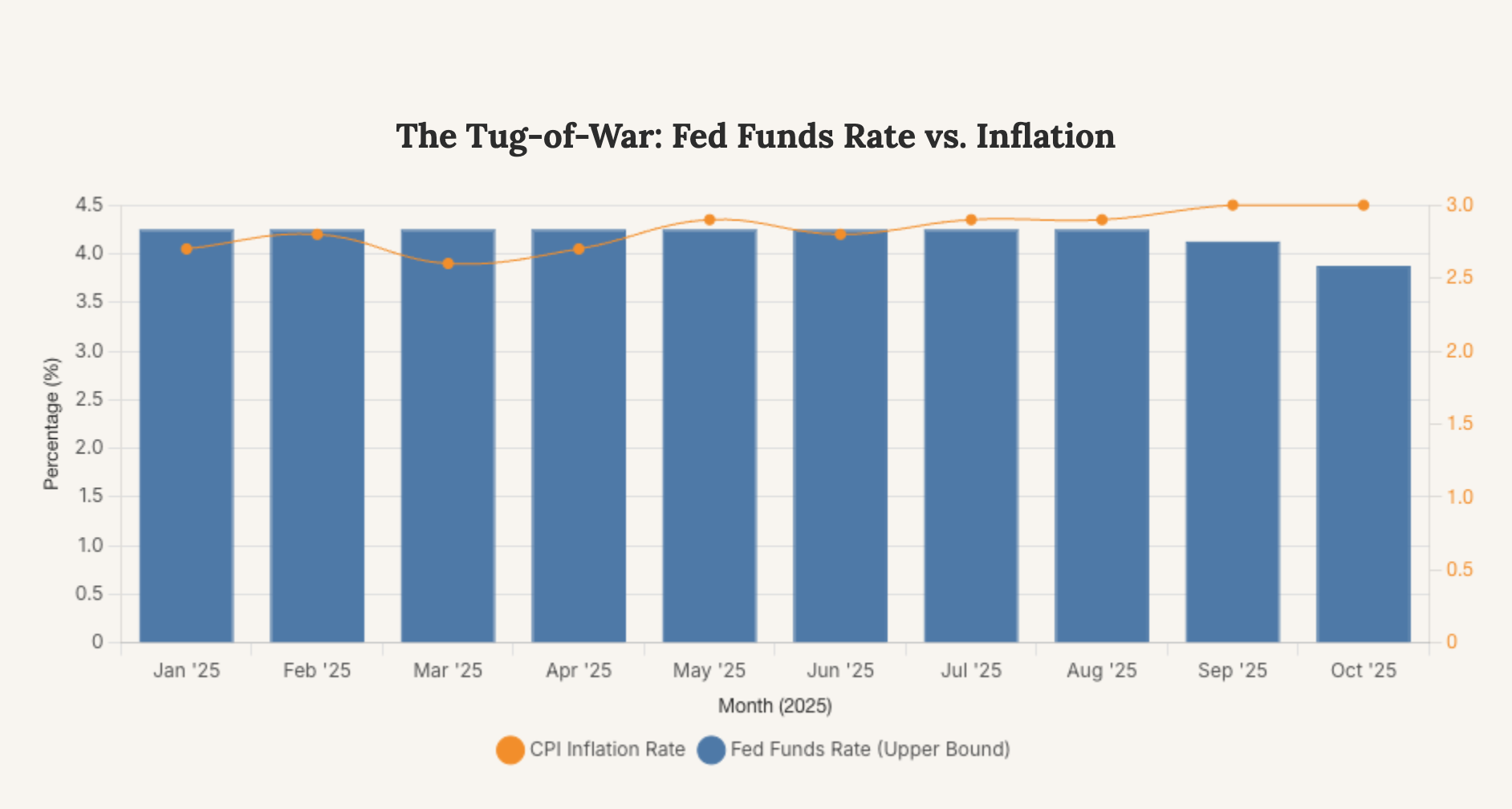
This chart illustrates the Fed’s ongoing dilemma. While inflation has remained elevated, the central bank has pivoted toward easing monetary policy in response to a softening labor market. The two recent cuts, in September and October, represent a decisive shift after a long period of holding rates steady.
“In support of its goals and in light of the shift in the balance of risks, the Committee decided to lower the target range for the federal funds rate by 1/4 percentage point to 3-3/4 to 4 per cent.”
The decision, however, was not unanimous and exposed growing divisions among policymakers about the path forward. Jeffrey Schmid, President of the Kansas City Fed, voted against the move, preferring to hold rates steady, while Governor Stephen Miran argued for a more aggressive 50-basis-point cut. This internal disagreement underscores the profound uncertainty gripping the economic outlook.
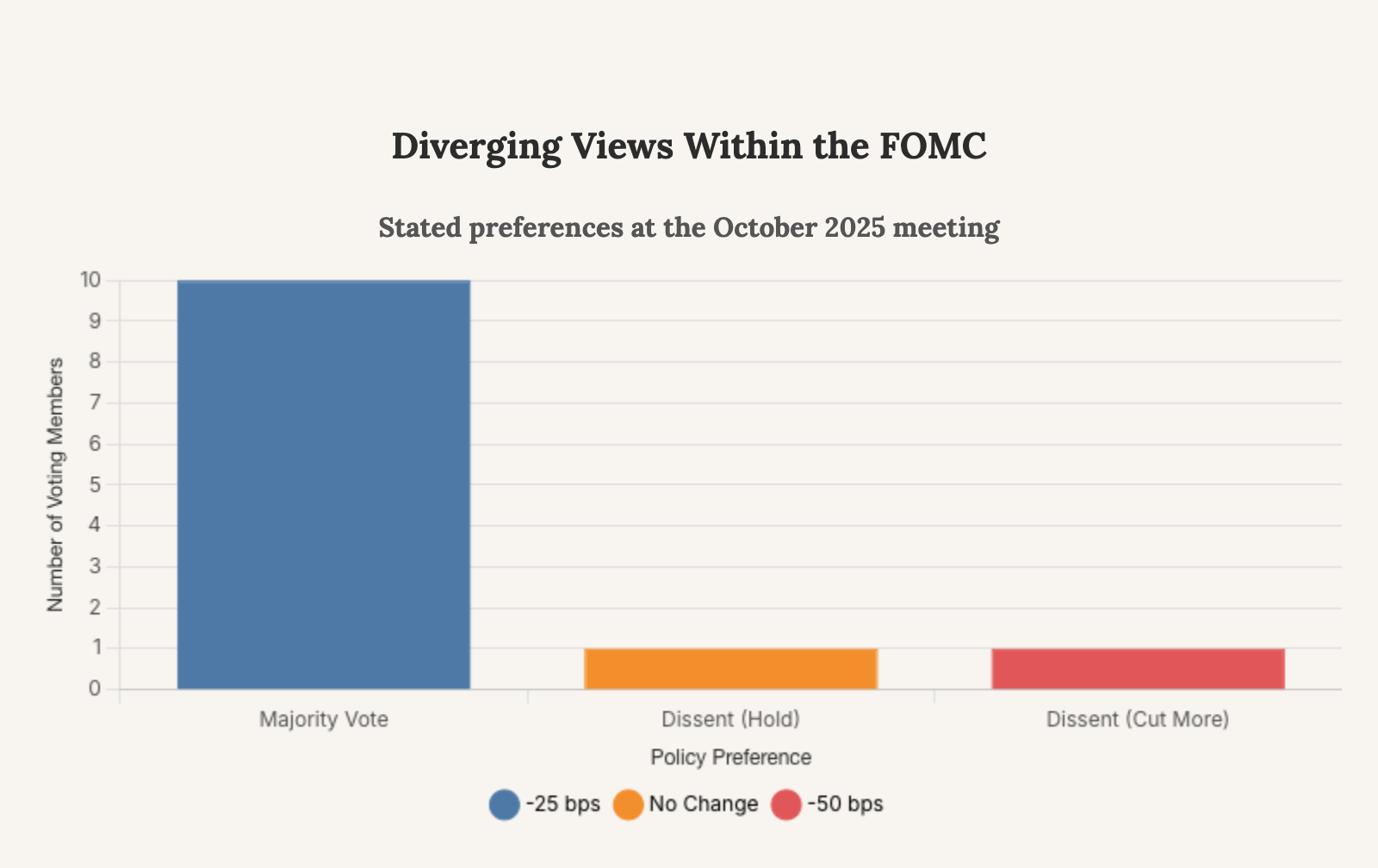
The split vote reveals the tightrope the Fed is walking. Most members see the need for preemptive action to support employment, but a vocal minority worries about either acting too aggressively or not aggressively enough.
“At this meeting, there were strongly differing views about how to proceed. A further reduction in the policy rate at the December meeting is not a foregone conclusion. Far from it.” - Fed Chair Jerome Powell
Looking ahead, the Fed’s path is anything but certain. Chair Jerome Powell was careful to manage expectations, stating that a December cut “isn’t a foregone conclusion” and that “policy is not on a preset course.” The central bank is now in a reactive, data-dependent mode at the very moment that official data has been blacked out. This forces a reliance on private-sector data and anecdotal evidence, making monetary policy more of an art than a science.
Ultimately, the October rate cut is a calculated risk—an insurance policy against a sharper downturn that may or may not materialize. Without its usual instruments, the Fed is navigating through thick fog, guided by a weakening signal from the labor market and the persistent, low rumble of inflation. The defining challenge for the U.S. economy in the coming months will be whether the Fed can successfully steer through this uncertainty without overcorrecting in either direction.