



We are living through the most expensive illusion in economic history. The prevailing narrative—championed by Silicon Valley and echoed by Wall Street—is that we are on the exponential curve of a “productivity supercycle,” driven by AI, SaaS sprawl, and hyper-connectivity. The data, however, tells a radically different story.
While we have successfully digitized every corner of human existence, we have not necessarily improved it. In fact, a deep audit of recent economic and sociological data reveals a startling “Great Decoupling”: as our investment in technology hits record highs, our actual capacity to generate value, maintain mental resilience, and afford a high-quality life is stagnating or regressing.
This is not a Luddite’s manifesto; it is a strategist’s warning. The Global Economy is currently bleeding $8.9 trillion annually due to employee disengagement—a figure roughly equivalent to 9% of global GDP. This loss isn’t happening despite our tools; it is happening, in large part, because of them. We have built a digital infrastructure that extracts attention rather than compounding value.
The Productivity Paradox 2.0: The “Fake Work” Economy
The first crack in the facade is the disconnect between what we spend on technology and what we get out of it. We are currently witnessing a historic divergence between Software Investment and Total Factor Productivity (TFP)—the economist’s gold standard for measuring innovation’s actual impact on output.
The Investment-Outcome Gap
Since 2010, corporate spending on software and intellectual property products has exploded, yet TFP growth has remained stubbornly anemic, hovering near 1.3% in 2024. If the “AI Revolution” were delivering on its promise immediately, we should see TFP verticalizing. Instead, we see the “Solow Paradox” on steroids: we see the AI everywhere but in the productivity statistics.
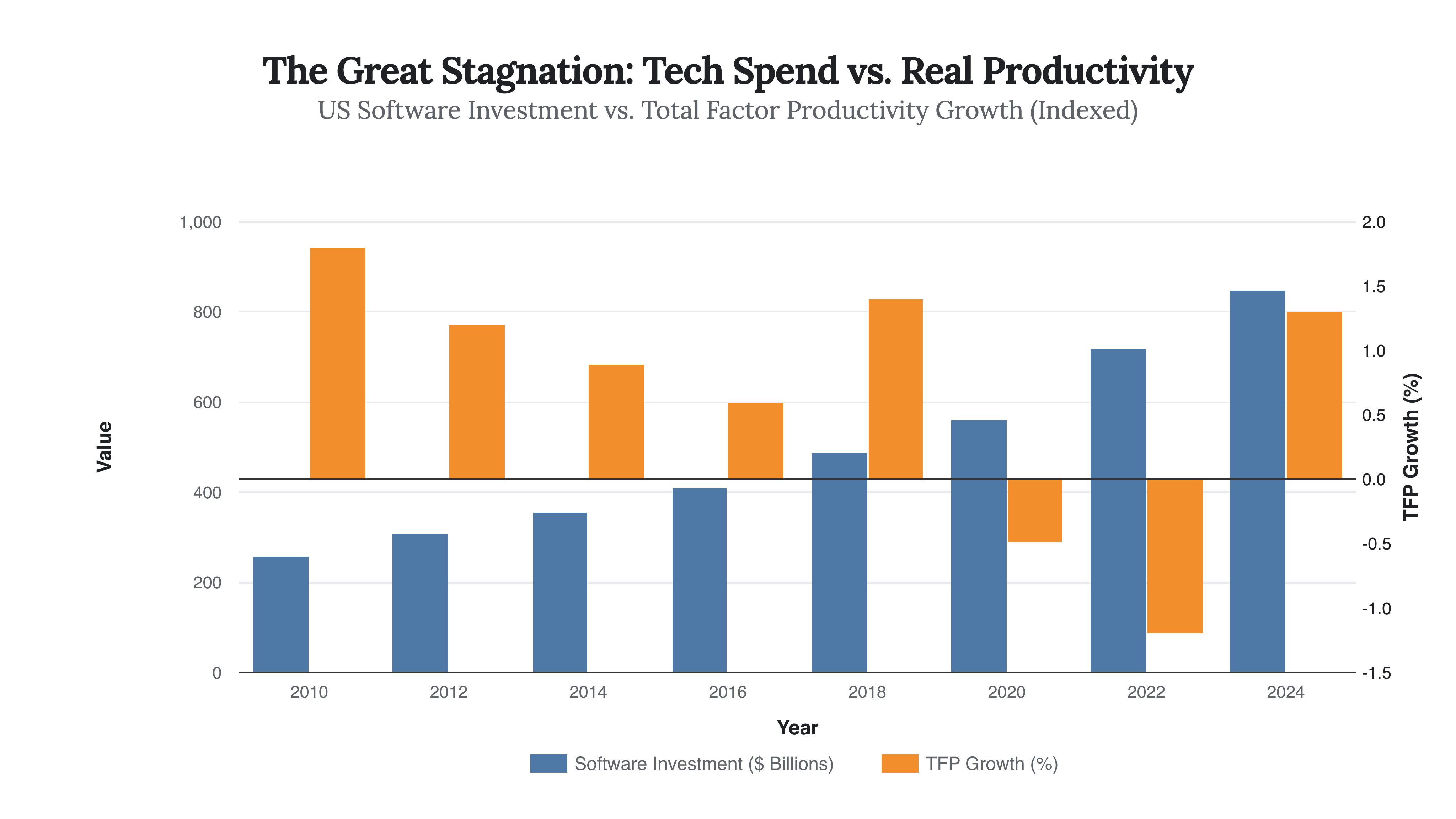
This chart exposes the lie. While we pour nearly a trillion dollars annually into software, our efficiency gains are negligible. Why? Because we have replaced “deep work” with “coordination work.”
The 60% Coordination Tax
According to Asana’s 2024 Anatomy of Work index, the average knowledge worker now spends a staggering 60% of their day on “work about work”—triage, status updates, searching for files, and navigating a labyrinth of 9+ daily apps. Only 27% of time is spent on the skilled craft they were hired to perform.
We have not optimized labor; we have fragmented it. We have traded the friction of paper for the friction of context-switching.
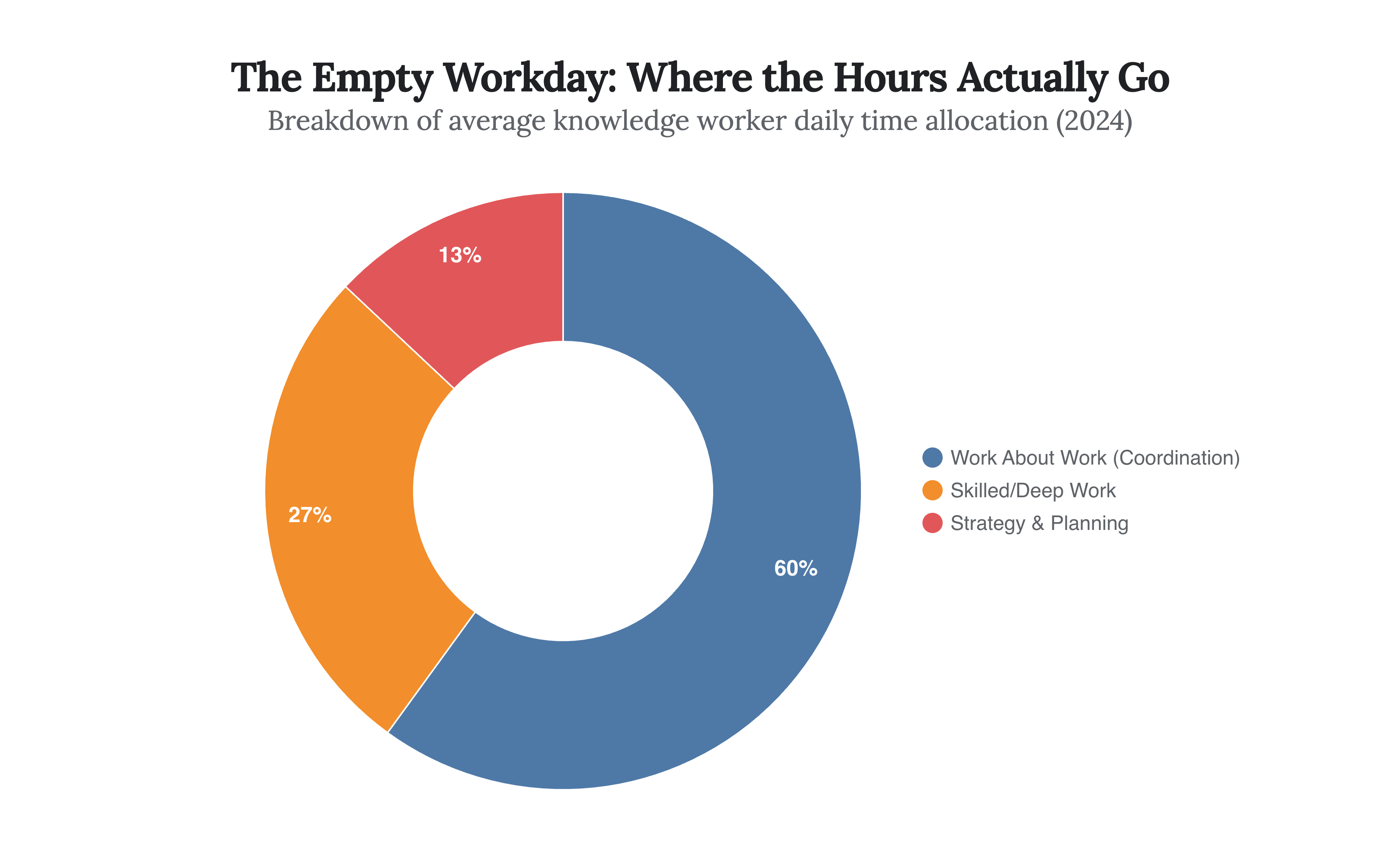
This is the “Digital Debt”: the cumulative cost of the emails, chats, and meetings required just to manage the tools that were supposed to save us time.
The Human Recession: Mental Health as an Externality
If the economic cost is efficiency, the social cost is resilience. The narrative that “more connection equals better lives” is collapsing under the
