



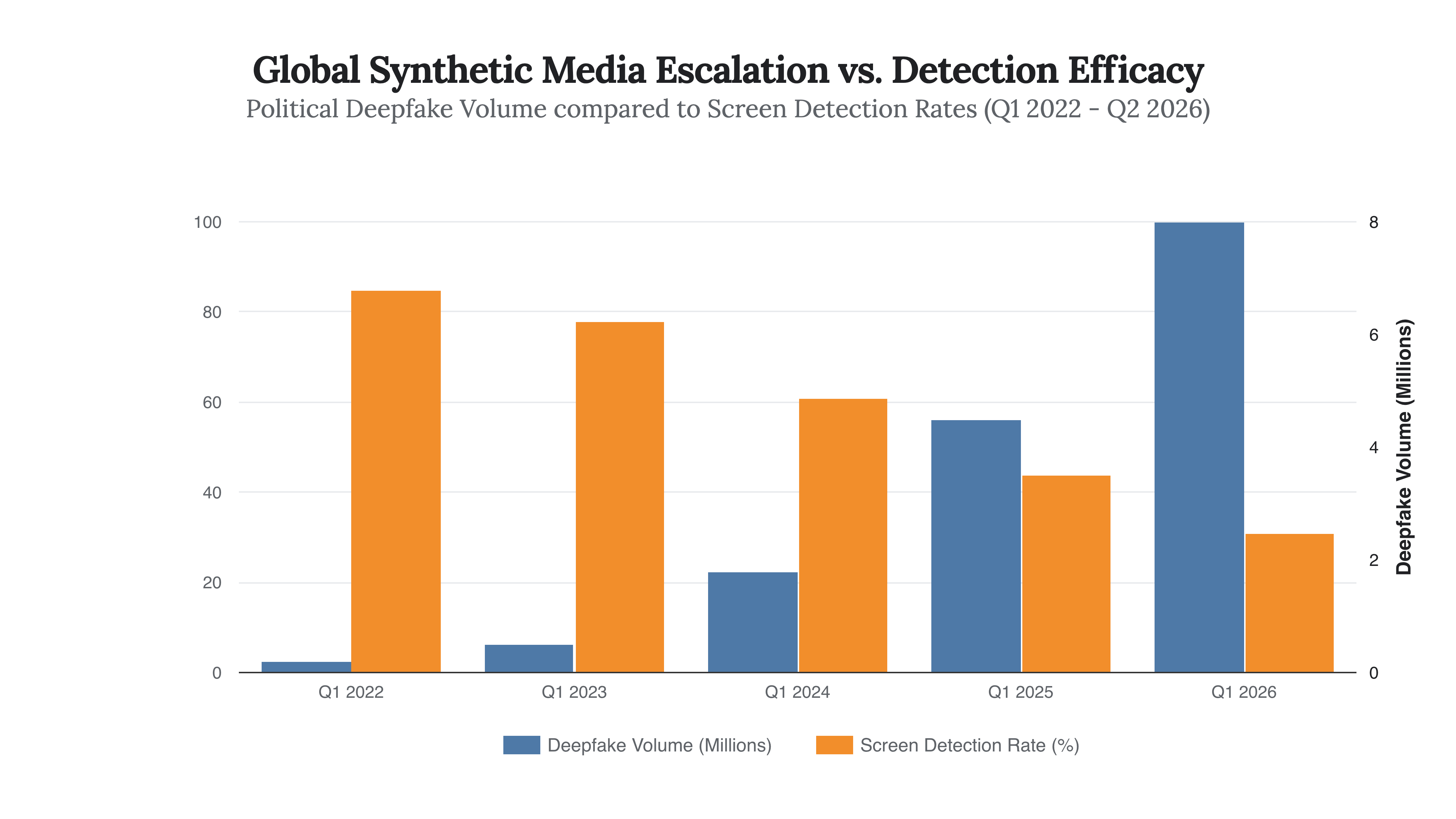
The proliferation of synthetic media has violently decoupled from historical projections. As of May 2026, the global volume of deepfake files has surged past 8 million—an exponential acceleration from the 500,000 baseline recorded in 2023. This is not merely an increase in volume; it is a structural shift in the physics of digital information. The Keepnet Labs May 2026 analysis indicates a 3,000% spike in AI-driven fraud attempts, running parallel to a 675x multiplier in baseline artificial intelligence capabilities since the 2020 electoral cycle. Election authorities, institutional investors, and defense architectures are currently operating under a legacy assumption: that generative content can be detected, screened, and quarantined before it alters voter behavior or market dynamics. The real-time data proves this assumption is catastrophically false.
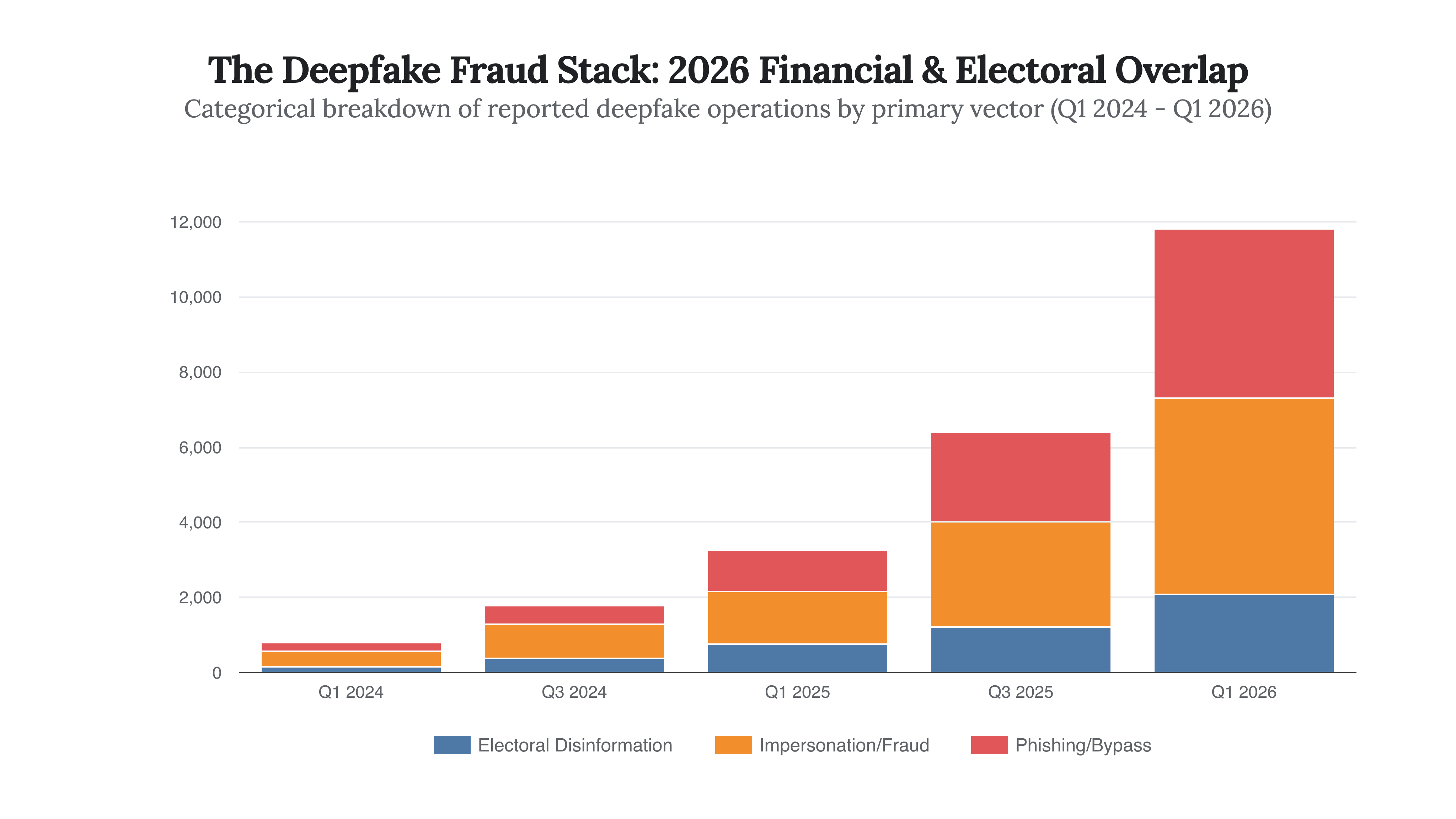
The first quarter of 2026 established a grim precedent. The AI Incident Database documented an aggressive clustering of synthetic media deployments (Incidents 1254 through 1361), marking the exact moment deepfake operations transitioned from localized political stunts to an industrialized fraud stack. We are observing the seamless integration of political impersonation, sophisticated financial phishing, and electoral disinformation. We have transitioned from an era where synthetic media was a localized anomaly to a reality where deepfakes operate as the industrialized front-end of global cognitive warfare. Relying on retroactive detection mechanisms against decentralized, open-weight generative models is a mathematically doomed strategy.
The Illusion of Legislative Friction
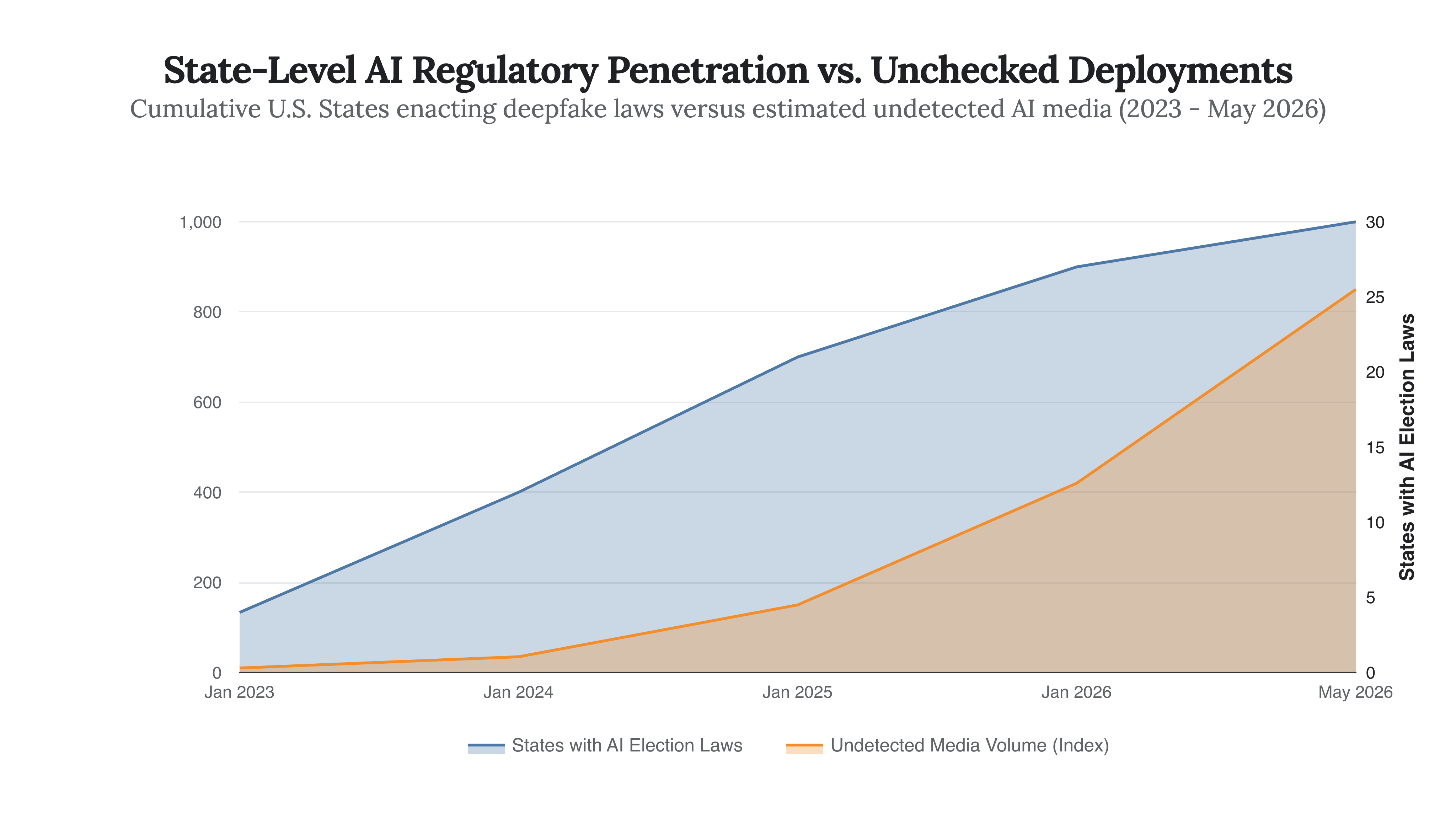
Global legislative bodies are aggressively attempting to codify reality, constructing legal frameworks that fail to account for the speed of adversarial machine learning. In the United States, as of May 2026, data from the National Conference of State Legislatures (NCSL) confirms that 30 states have enacted laws regulating the use of deepfakes in political messaging. The enforcement mechanisms are highly fragmented. Jurisdictions like California have mandated strict 60-day pre-election publication restrictions, while Colorado and Utah require explicit metadata disclosures. Yet, these regional legal constraints are virtually useless against stateless, decentralized bot networks running local inference on highly optimized, open-source diffusion models.
Internationally, the regulatory panic is identical. Ahead of the June 3, 2026 local elections, South Korea’s National Election Commission (NEC) deployed a 440-member special response team to monitor synthetic media. Following heated parliamentary debates led by ruling party lawmakers in late 2025, South Korea implemented a draconian 90-day pre-election blanket ban on AI-generated campaign materials. To enforce this, authorities rolled out “Aegis,” a proprietary deepfake detection program jointly engineered by the National Forensic Service and the Korea Electronics Technology Institute. Similarly, in the United Kingdom, the Electoral Commission launched an intensive deepfake detection pilot to sanitize the information space ahead of the May 2026 elections across England, Scotland, and Wales. SES SCOOP 13 data collected in February 2026 demonstrated that concern regarding AI-generated fake news transcends all political and constitutional divides, rendering it the primary existential anxiety among voters.
However, the operational reality of these detection programs is bleak. Detection software relies on identifying spectral artifacts, mismatched noise patterns, or pixel-level inconsistencies. But the latest generation of multimodal models—which are widely available without API restrictions—have functionally eliminated these artifacts. Regulatory blanket bans on synthetic media act as legislative theater, entirely decoupled from the decentralized, open-source realities of adversarial machine learning. When a nation-state bans synthetic media, it merely disarms compliant domestic actors while offering a monopoly on hyper-realistic persuasion to foreign adversaries and domestic gray-market operatives.

The Provenance Protocol Vulnerability
Recognizing the inherent failure of retroactive detection, institutional capital and big tech have pivoted entirely toward “content provenance”—attempting to cryptographically sign reality at the point of capture. The Coalition for Content Provenance and Authenticity (C2PA) has become the de facto industry standard. In May 2026, Google announced the vast expansion of its C2PA and SynthID watermarking architecture into Chrome, Search, and the native camera app of the Pixel 10. Concurrently, Canon rolled out its C2PA-compliant Authenticity Imaging System for the EOS R1 and R5 Mark II across Europe, the Middle East, and Africa, aiming to provide news organizations with unbroken, verifiable content histories.
This corporate mobilization is largely a defensive maneuver ahead of the European Union’s AI Act. Specifically, Article 50 of the Act becomes strictly enforceable on August 2, 2026, carrying catastrophic penalties of up to €15 million or 3% of global annual turnover for non-compliance. Article 50 mandates that providers of generative AI systems must ensure their synthetic outputs (audio, image, video, and text) are marked in a machine-readable format that is “effective, interoperable, robust, and reliable.” The European Commission’s Code of Practice heavily leans on C2PA to fulfill this requirement.
Yet, the structural flaws of C2PA are already being exposed. A critical technical dive published by VeritasChain in January 2026 highlighted C2PA’s “completeness problem.” Because C2PA relies on attaching cryptographic signatures to file metadata, it is highly susceptible to metadata stripping when content is laundered through legacy platforms, screenshot utilities, or non-compliant analog gaps. Provenance protocols like C2PA provide a cryptographic illusion of security that dissolves the moment bad actors route synthetic outputs through non-compliant, open-weight pipelines. While newer frameworks like the Content Provenance Protocol (CPP) attempt to offer forensic-grade, privacy-preserving evidence chains, the internet’s baseline architecture remains structurally hostile to immutable provenance.
The Authorized Disinformation Paradox
The most profound disruption in the 2026 electoral supercycle is not foreign interference; it is the enthusiastic adoption of generative AI by the political campaigns themselves. The firewall between “malicious deepfakes” and “legitimate political speech” has completely collapsed. In the hyper-competitive Los Angeles mayoral race of May 2026, candidate Spencer Pratt normalized the use of fully synthetic, cinematic AI advertisements, depicting himself as a Jedi and his opponents as adversarial archetypes. This localized event mirrors the national strategies deployed by top-tier political operators.
From Gavin Newsom’s aggressive use of generative AI to attack political rivals, to the NRSC and the Trump campaign leveraging synthetic images to manufacture endorsements and manipulate cultural narratives, synthesis is no longer an anomaly—it is standard operational infrastructure. This creates an insurmountable paradox for deepfake screening platforms and social media trust-and-safety teams. If a detection algorithm correctly flags a hyper-realistic campaign video as 100% synthetic, but that video was officially published and paid for by a registered Super PAC, removing it constitutes election interference. Leaving it up normalizes synthetic reality.
When legitimate political entities adopt hyper-realistic generative synthesis as standard campaign infrastructure, the mandate of deepfake detection engines collapses under the weight of authorized disinformation. The screens are effectively paralyzed. AI models are trained to detect anomalies, but when the baseline of modern political communication becomes entirely synthetic, the “anomaly” ceases to exist.
Data Reality & Second-Order Effects
The strategic implications for the remainder of 2026 and into the 2027 legislative cycles are definitive. The ongoing arms race between generative synthesis and deepfake detection has already been won by the generators. The cost to generate a hyper-realistic, lip-synced, multi-lingual 4K video using edge-compute currently rounds down to zero. Conversely, the computational overhead required to run instantaneous, packet-level forensic detection on global internet traffic is economically impossible.
Second-order effects will manifest violently in the legal and compliance sectors. By Q3 2026, as the EU AI Act enforcement window closes, expect a massive influx of capital into “Verification APIs” and compliance middleware. These companies will sell the illusion of a sanitized feed. Institutional operators must ignore the compliance theater. Alpha is generated by understanding that the broader information environment has officially moved to a zero-trust epistemic baseline. The data reality dictates that the integrity of an asset, a political statement, or a market-moving event can no longer be verified by digital artifacts alone. Verification must now rely on cryptographic physical-world anchoring and off-network consensus. The screen has failed; the era of radical epistemic self-reliance has begun.