


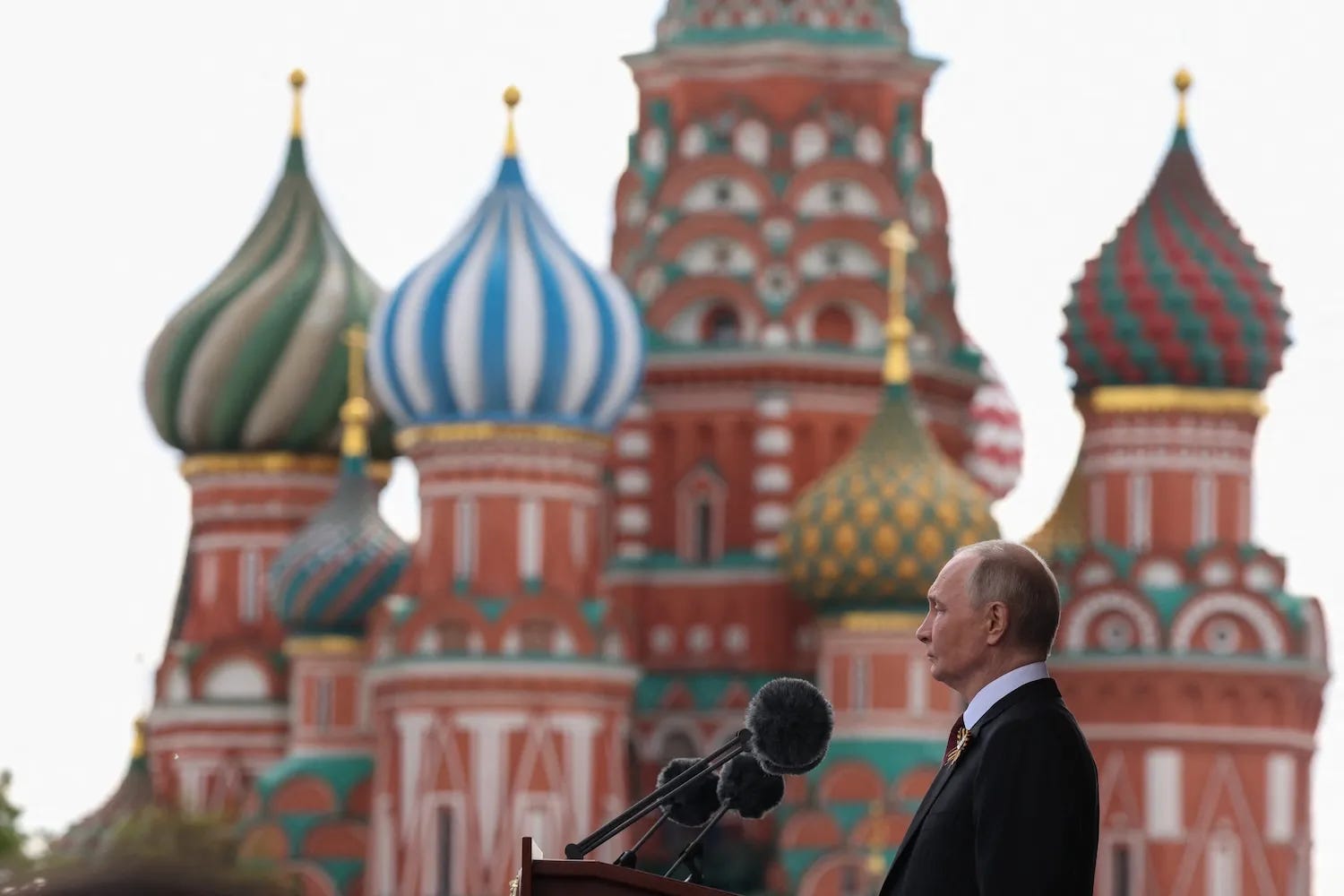
On May 9, 2026, the traditional vibrations of heavy armor that once rattled the cobblestones of Red Square were absent for the first time in nearly two decades. The 81st anniversary of the victory over Nazi Germany, a date meticulously curated by Vladimir Putin to project Russian continuity and martial vigor, has instead become a silent monument to a hollowed-out military infrastructure. As of this morning, the data suggests that the prestige of the Russian state is no longer measured by the length of its missile columns, but by its ability to secure a 45-minute window of survival in a capital city blanketed by electronic warfare and total internet blackouts.
The Vacuum of Red Square: Zero Hardware as a Strategic Admission
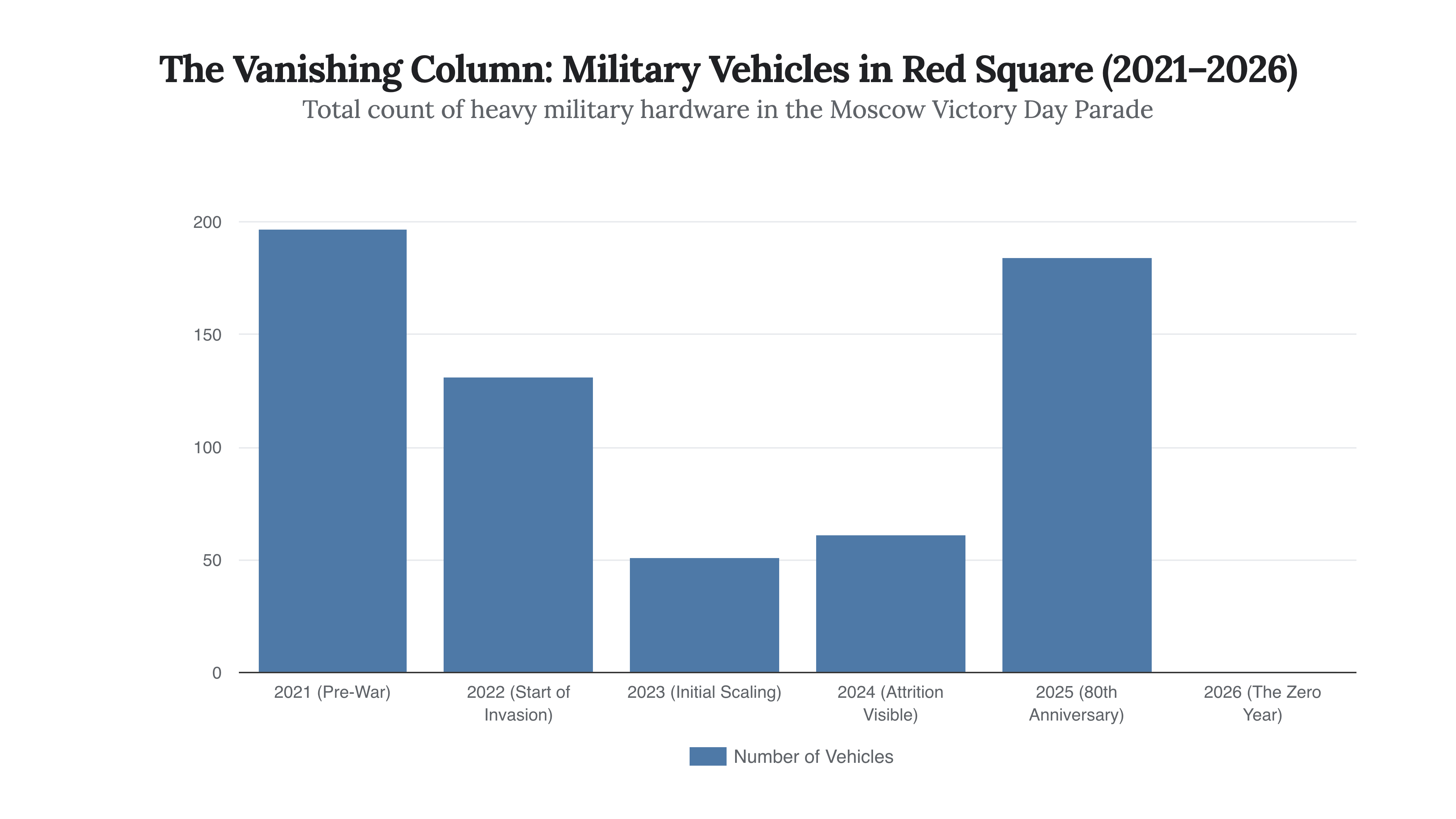
The 2026 Victory Day parade will be remembered as the year of the absolute zero. For the first time since 2008, the Russian Ministry of Defense removed all military hardware from the proceedings. There were no T-90M tanks, no S-400 batteries, and certainly no T-14 Armata main battle tanks, which have now been officially designated by Rostec as too expensive for active deployment. In their place stood only foot columns of infantry, cadets, and security forces.
This removal is not merely a logistical convenience; it is a forced response to two converging realities: the physical exhaustion of the Russian armor pool and the omnipresent threat of Ukrainian long-range strike capabilities. The 2026 decision to strip Red Square of every tank and missile is not a security precaution; it is a formal ledger entry acknowledging that the Russian Federation has exhausted its ceremonial surplus to feed the attritional furnace of the Donbas.
The Attrition Reality: 1.3 Million and the Vanishing Column
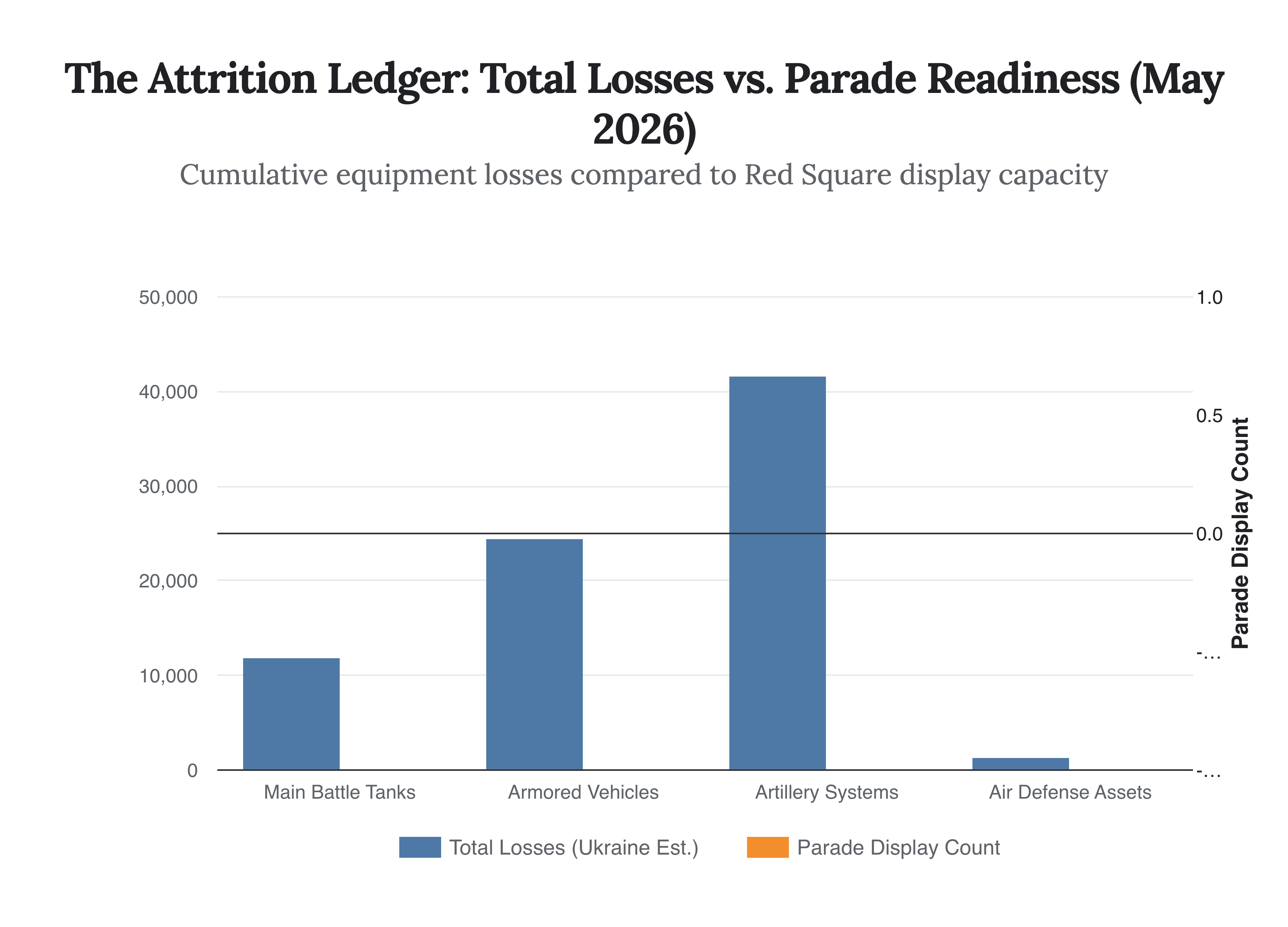
The data provided by the General Staff of the Armed Forces of Ukraine as of May 9, 2026, paints a stark picture of the trade-offs required to maintain the current front lines. Russia’s total estimated personnel losses have surpassed 1,340,270, with daily losses consistently exceeding 1,000 troops. More critically for the parade’s aesthetics, the loss of 11,920 tanks and over 24,000 armored combat vehicles has effectively deleted the Russian army’s ability to maintain a “parade-ready” reserve that doesn’t compromise active operations.
The 45-minute duration of the ceremony—the shortest in modern Russian history—reflects a state that is rushing through its own rituals. With a recorded duration of only 45 minutes, the 2026 parade was less a demonstration of continuity and more a sprint toward the finish line before a potential breach of the Kremlin’s electronic warfare bubble. The absence of the Suvorov and Nakhimov cadets, traditionally the face of the Russian military’s future, further suggests a demographic tightening, as the Kremlin prioritizes current combat readiness over the pageantry of potentiality.
Unlock deeper strategic alpha with a 10% discount on the annual plan.
Support the data-driven foresight required to navigate an era of radical uncertainty and join a community of institutional-grade analysts committed to the truth.
The Geopolitical Periphery: A Global South Facade
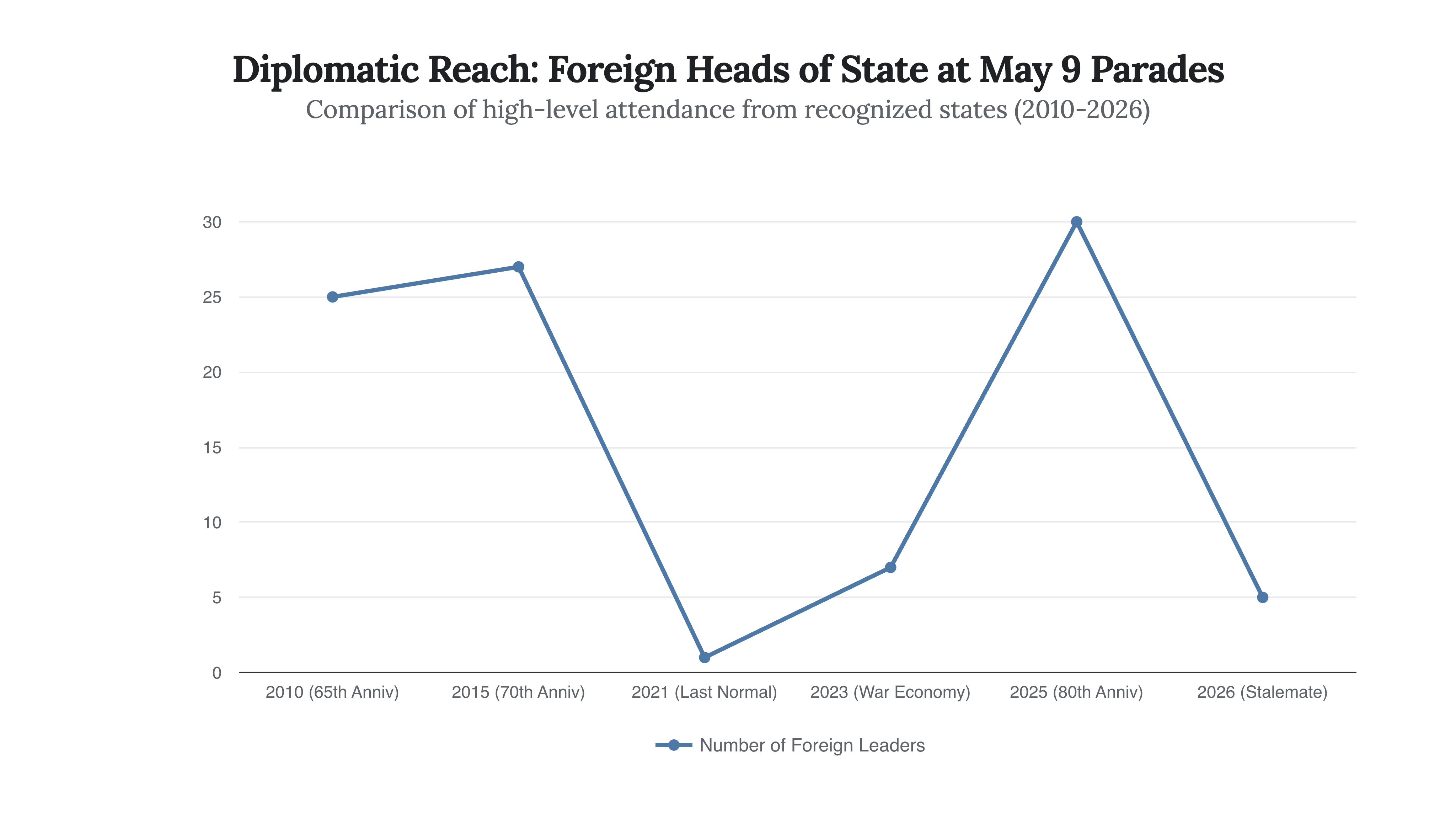
While the hardware was missing, the diplomatic guests were curated to project a narrative of “non-isolation.” The presence of Sultan Ibrahim of Malaysia and President Thongloun Sisoulith of Laos highlights Russia’s strategic pivot to the Global South as a source of legitimacy. However, the most significant data point in the guest list was the calculated choreography of Slovak Prime Minister Robert Fico. While Fico arrived in Moscow and met with Putin, he conspicuously avoided the parade itself, opting instead for a flower-laying ceremony at the Tomb of the Unknown Soldier.
The presence of a single NATO-member leader, Robert Fico, on the sidelines of the event—while skipping the parade itself—serves as the ultimate diplomatic Rorschach test for the fragmentation of European consensus. It signals that while some European factions are willing to engage in the trade of “historical truth,” they are unwilling to stand on a platform that formally celebrates the ongoing destruction of Ukrainian sovereignty. This bifurcated diplomacy shows a Russia that is increasingly reliant on semi-recognized entities like Abkhazia and South Ossetia to fill the seats once occupied by the G8.
The Technology Gap: Video Screens vs. Steel
In a surreal development for 2026, the Kremlin replaced the live movement of the mechanized column with a “greatest hits” video compilation displayed on massive LED screens around Red Square. This digital substitution of power is a second-order effect of the domestic insecurity felt by the Russian leadership. By broadcasting pre-recorded footage of nuclear-powered submarines and T-14 Armatas, the state is attempting to decouple its mythological strength from its current physical vulnerabilities.
The total shutdown of mobile internet in Moscow during the event—a measure taken to prevent the coordination of drone strikes or the spread of unapproved imagery—highlights the paradoxical nature of the Putin regime in 2026: it is a nuclear superpower that is terrified of a consumer-grade quadcopter. The “Zelensky Permit,” a sardonic decree issued by Kyiv claiming to “allow” the parade to proceed without interruption, underscored the shift in the balance of psychological agency. The fact that Moscow required a U.S.-brokered three-day ceasefire to ensure the safety of its most sacred national holiday is the clearest indicator of the Kremlin’s diminished deterrence.
The Strategic Outlook: Ritual as the Last Defense
As the 2026 parade concludes, the data reveals a regime that has traded its future for the preservation of its past. The military parade is no longer a tool of intimidation for the West, nor is it a source of genuine pride for a population suffering from “public fatigue” and a fifth year of total war. It has become a mandatory performance for an audience of one: Vladimir Putin. The transition from a 200-vehicle mechanized display in 2025 (the jubilee) to zero vehicles in 2026 is the most rapid ceremonial de-escalation in Russian history.
The second-order effect of this empty Red Square will be felt in the coming months as the Russian defense industrial base (DIB) continues to prioritize the repair of 1960s-era tanks over the innovation required for a modern battlefield. In 2026, the Russian army is no longer parading its strength because its strength is entirely consumed by its survival. The empty tarmac of Red Square is not a sign of peace; it is a sign of a state that has finally run out of things to show.