


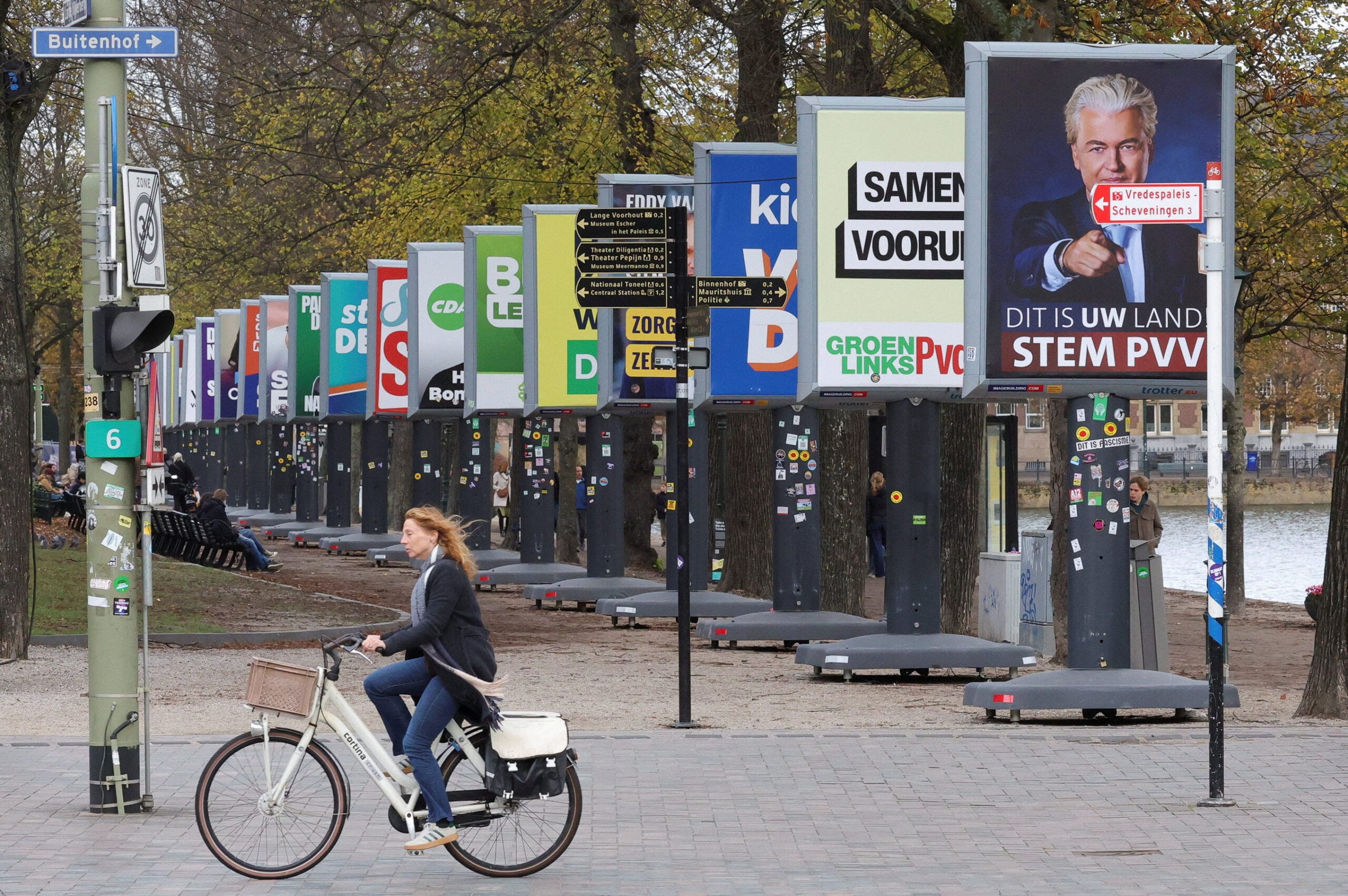
Just last night, the Netherlands rendered a political verdict as swift as it was stunning. Exit polls from the snap election on October 29, 2025, indicate a dramatic reversal of the populist wave that had shocked Europe less than two years ago. Geert Wilders’s Party for Freedom (PVV), which secured a landmark victory in November 2023, saw its support crumble, losing a third of its parliamentary seats. In its place, the progressive D66 party, led by Rob Jetten, surged to the top, signaling a decisive public rejection of the instability and hardline rhetoric that defined Wilders’s brief, chaotic stint at the center of Dutch power.
To understand the magnitude of this reversal, we must first look back to the political earthquake of 2023. Wilders’s PVV didn’t just win; it shattered the political consensus, becoming the largest party by a wide margin and positioning the perennial anti-establishment figure as the kingmaker of Dutch politics.
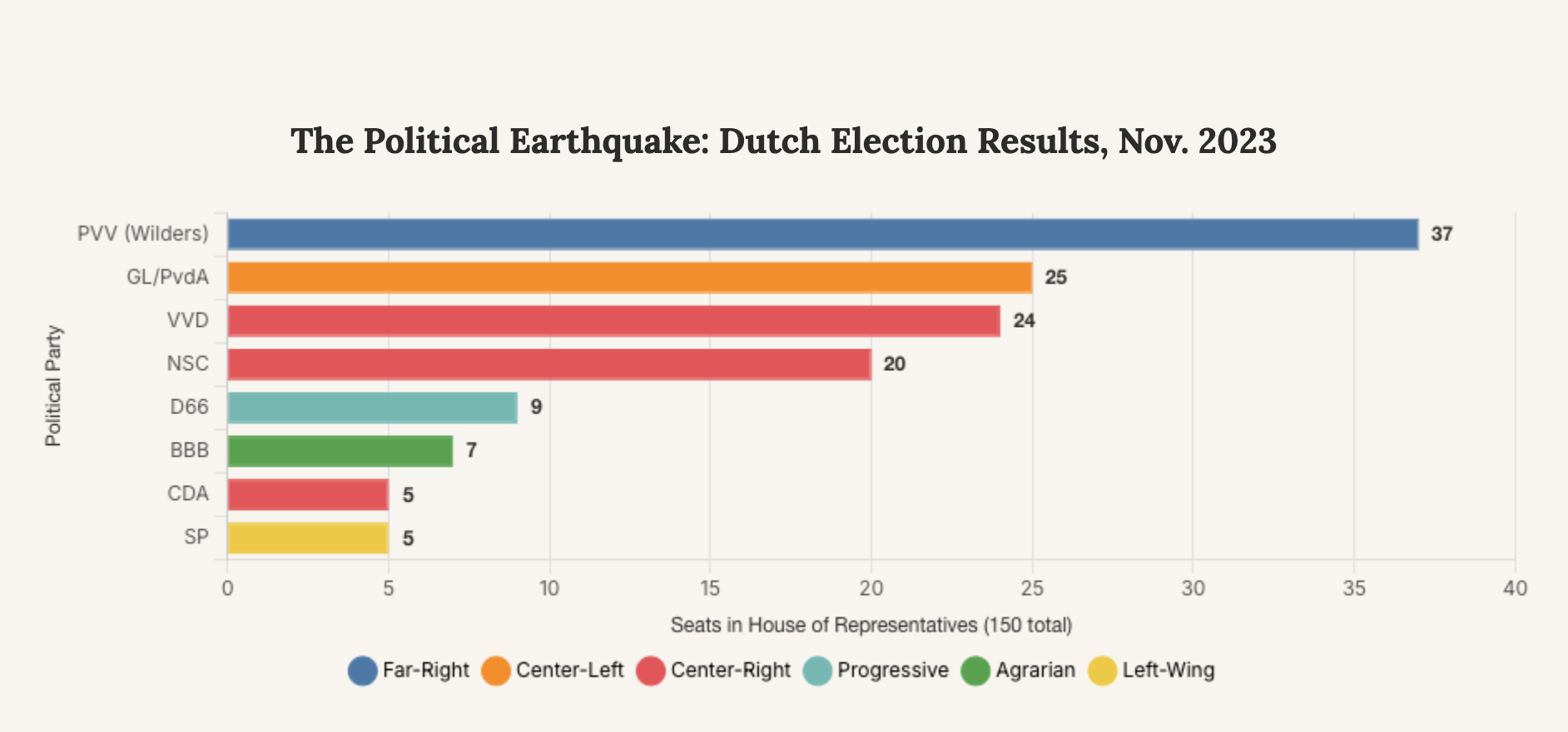
The November 2023 election saw Geert Wilders’s PVV become the dominant force in the Dutch parliament, creating a mandate that ultimately proved too volatile to sustain.
The path from that victory to a position of actual power was fraught. After months of tense negotiations, a right-wing coalition was formed between the PVV, VVD, NSC, and the agrarian BBB party. However, the other parties refused to accept Wilders as Prime Minister, forcing him to anoint a technocrat, Dick Schoof, for the top job. Wilders himself conceded he had to place many of his most controversial proposals—including a ban on the Qur’an and a referendum on leaving the EU—”in the freezer” to seal the deal.
“To join the coalition, he put his most extreme positions ‘in the freezer’, as he described it... Instead, he focused on curbing asylum migration from Muslim countries.”
But the compromises of coalition-building sat uneasily with Wilders’s populist identity. After just 11 months, citing frustrations over what he deemed an insufficiently hardline migration policy, he detonated his own government in June 2025, pulling the PVV from the coalition and triggering the very election that would seal his party’s fate. It was a monumental gamble that the Dutch electorate was not willing to reward. The results from yesterday’s vote paint a picture of a nation recoiling from the chaos.
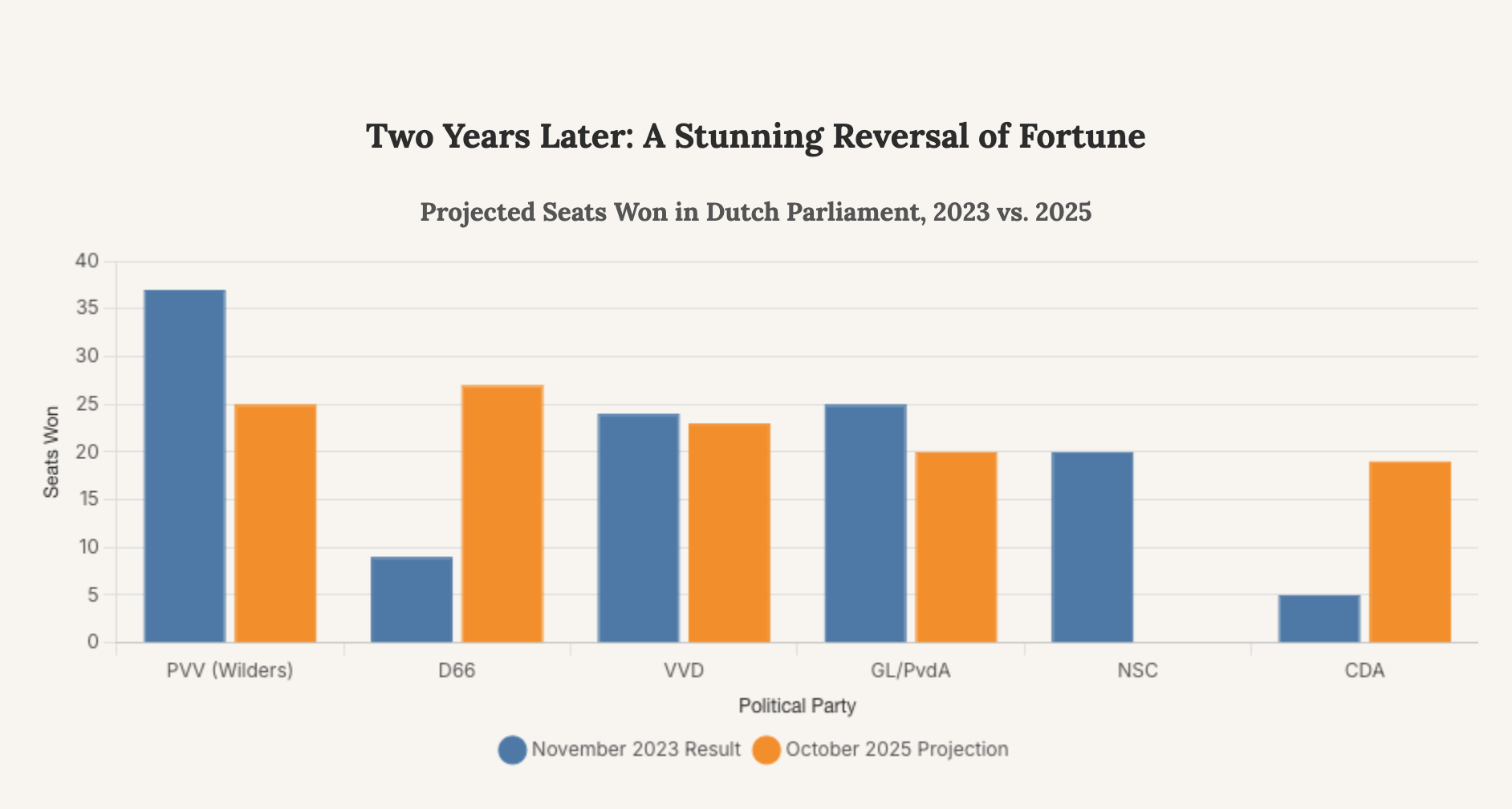
The October 2025 exit polls show a near-total collapse of the 2023 right-wing coalition’s support, with the PVV losing a third of its seats and the centrist D66 tripling its presence to become the new leading party.
The surge of D66, a socially liberal and pro-European party, represents more than just a shift in votes; it is a clear ideological counter-movement. In his victory speech, D66 leader Rob Jetten captured the national mood:
“Millions of Dutch people have turned a page. They have said goodbye to the politics of negativity, of hate, of ‘it can’t be done.’ They’ve chosen positive forces and a politics that will allow us to look ahead.”
The collapse of Wilders’s government exposed the immense difficulty of translating decades of populist opposition into a coherent and stable governing strategy. By forcing an election on his signature issue, he inadvertently reminded voters of the value of stability and consensus—qualities his brand was built to oppose. The shift in the electorate’s preference is not just about individual parties, but about the balance of power in the nation.
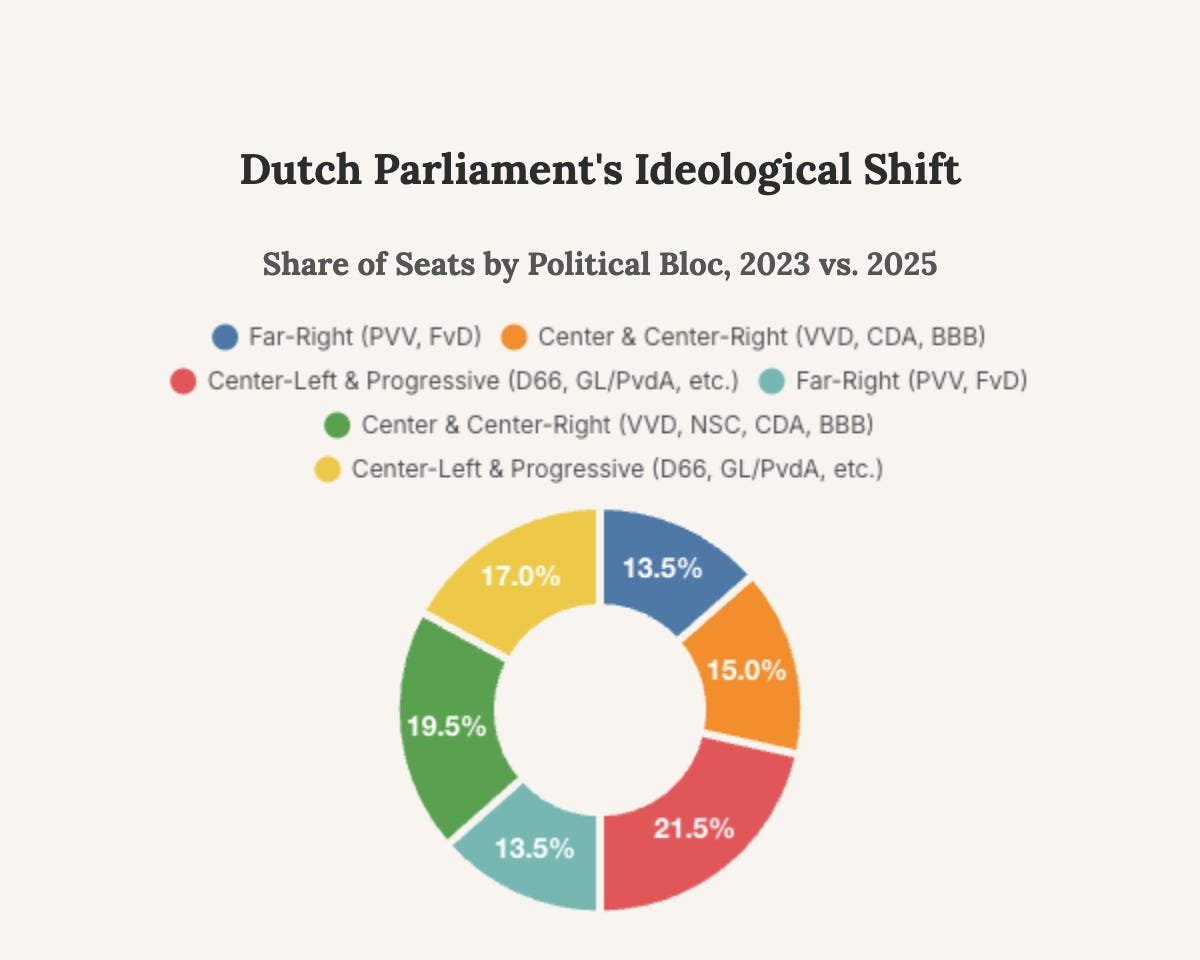
The new parliament shows a significant transfer of power from the center-right and far-right blocs toward a dominant progressive and center-left coalition, fundamentally altering the country’s governing calculus.
The Dutch experiment with a Wilders-led government appears to be over, at least for now. All major parties have ruled out forming a coalition with him, paving the way for Rob Jetten and D66 to lead the formation of a new, more centrist government. The story of the last two years serves as a stark lesson on the difference between winning an election and winning the peace. For Geert Wilders, the protest vote that carried him to the precipice of power was not a mandate for perpetual conflict, but a loan of trust from an anxious electorate. When that trust was broken by manufactured chaos, the voters swiftly and decisively foreclosed. The Dutch election reveals a crucial vulnerability for populism: voters may be drawn to the protest, but they will ultimately punish the inability to govern.