


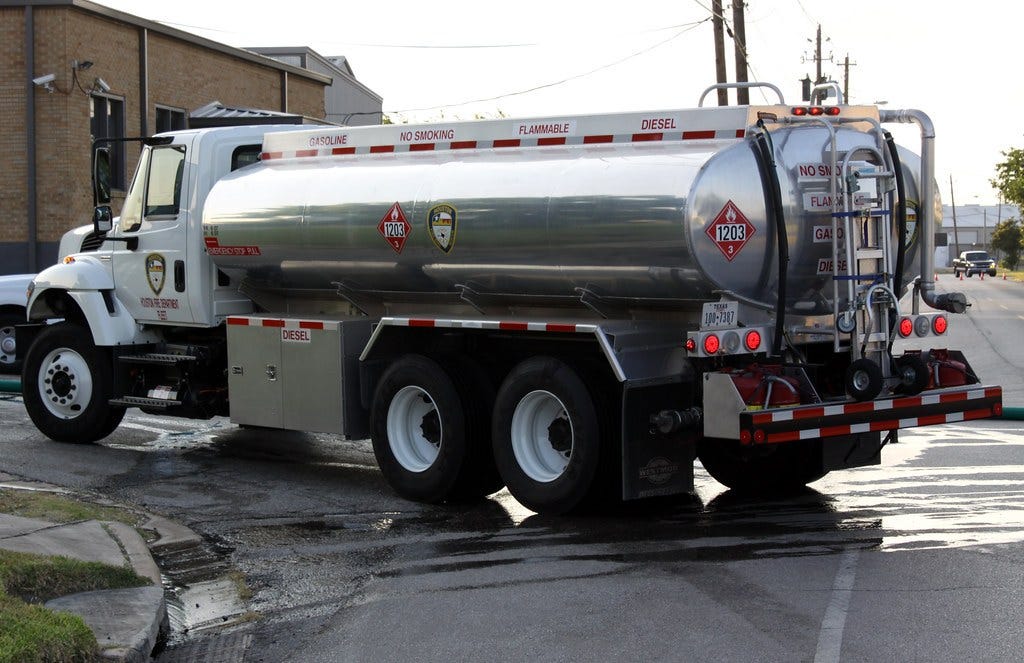
Bottom line up front. Russia shipped diesel and gasoil by sea at 144,000 barrels a day in September. At that pace, every cargo it sends for the licence’s full 180 days would cover about 72% of the 4.8 million tonnes promised. To get that uncertain volume, Washington spent the credibility of its new secondary-tariff threat, five days before the law’s first deadline, and we judge it very likely (85%) that no 100% tariff under the September law is imposed on any country before the 3 November midterms. The longer-run cost falls on Kyiv, whose refinery strikes now run against Washington’s stated top priority.
Why now
The licence came first. The law’s deadline comes next.
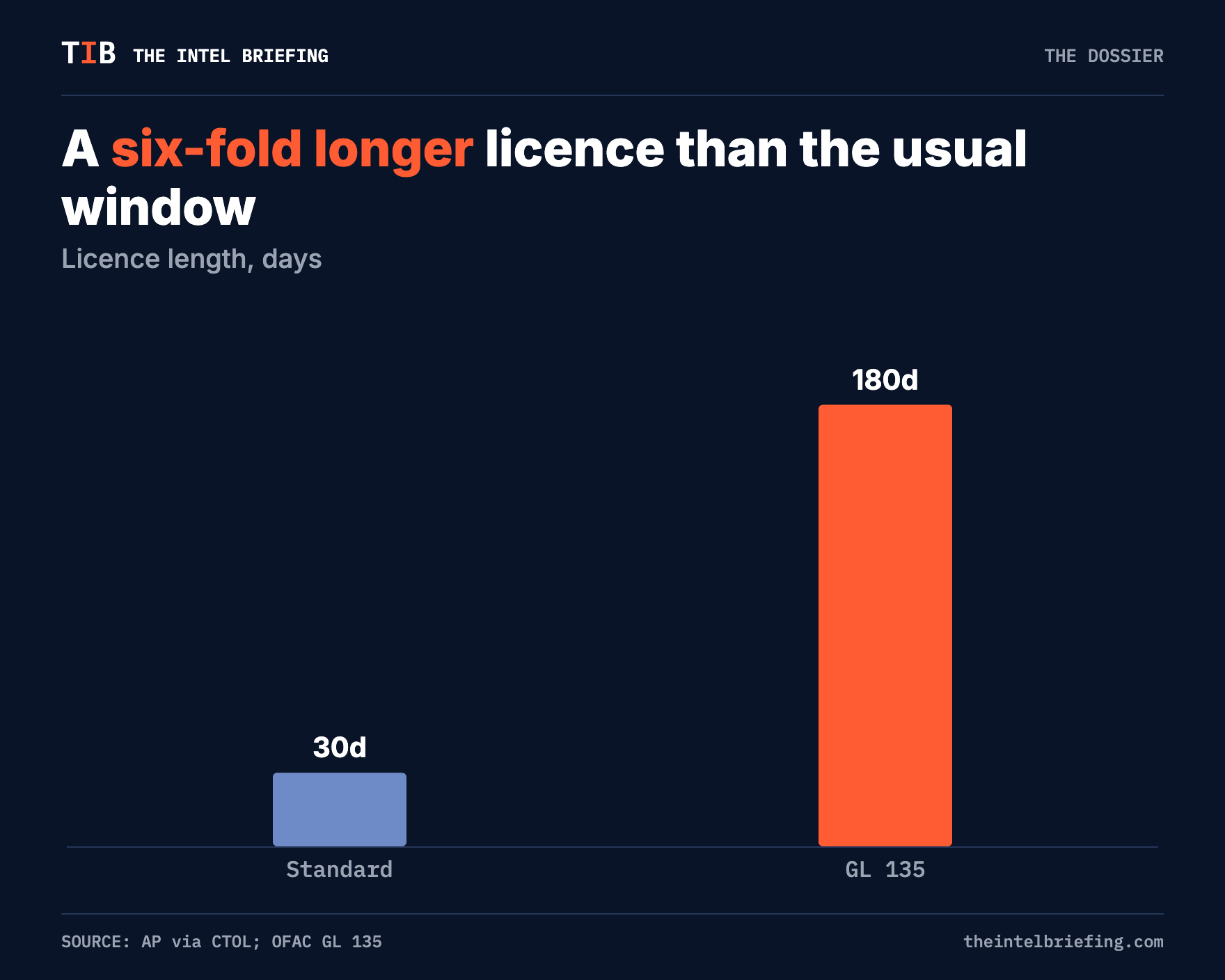
OFAC General License 135, issued on 9 October, authorises transactions prohibited under 31 CFR parts 587 and 589 that relate to “the sale, delivery, offloading, or importation” of Russian-origin diesel. It expires at 12:01 a.m. eastern time on 7 April 2027.
On Monday 19 October, five days from now, the Lindsey O. Graham Sanctioning Russia and Iran Act reaches its 30-day mark. By that date, Section 102 requires a first review of persons for blocking sanctions. Section 103 requires blocking sanctions on Sberbank, VTB and Gazprombank, and Section 105 bars US banks and broker-dealers from processing transfers for the Russian government.
The CSIS reading of the Act points to two other clauses. Section 113 authorises tariffs of up to 100% on major purchasers of Russian oil and gas. Section 115 gives the president broad authority to waive them.
Whatever the administration does on 19 October will be read against a licence it signed ten days earlier. That is why the delivery arithmetic matters this week.
The evidence
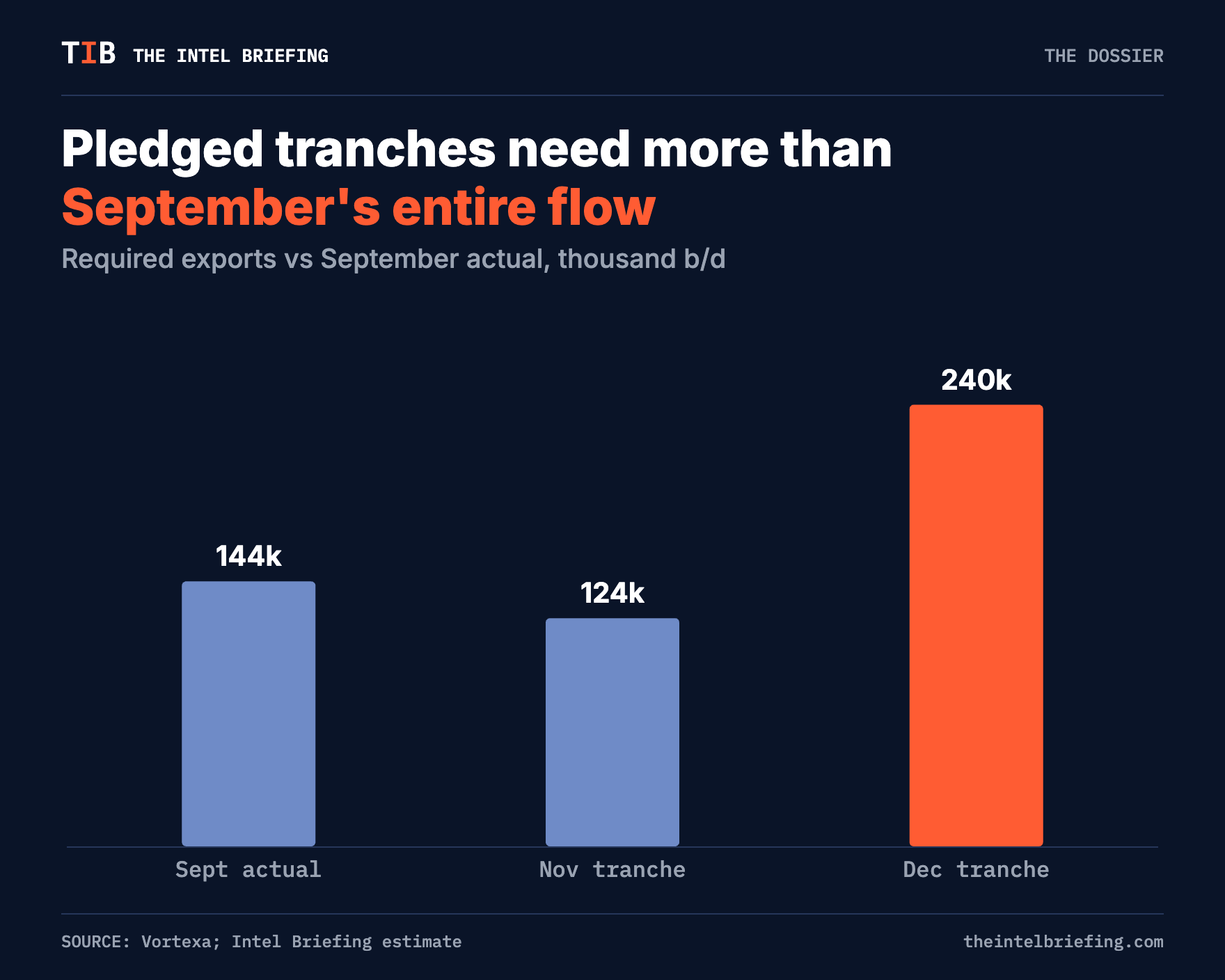
Russia’s diesel exports are a fraction of the pledge. Vortexa put September seaborne diesel and gasoil exports at 144,000 barrels a day, down 28% from August and the lowest in a decade. That is about 0.58 million tonnes a month, against roughly 2.5 million a month a year earlier by the traders’ estimates cited by CTOL, or 23% of normal (TIB estimate: 144,000 b/d × 30 days ÷ 7.45 barrels per tonne). Moving the November tranche of 500,000 tonnes needs about 124,000 b/d, which is 86% of September’s entire seaborne flow. The December tranche of 1 million tonnes needs about 240,000 b/d, 1.67 times September’s total (TIB estimate: tonnes × 7.45 ÷ days in the month).
The binding constraint is refining, not licensing. The Dallas Fed reports that Ukrainian strikes cut Russia’s refining capacity by as much as 60% over summer 2026. It cites IEA data showing Russian crude processing and product exports down 1.5 million b/d. The IEA puts Russian diesel output down about 30%. Reuters reporting cited by CTOL says half of the six largest diesel refineries cut or halted output in September: Kirishi was fully shut, and Volgograd and NORSI ran at about a quarter. Russia’s total seaborne product exports still rose to about 1.17 million b/d, with fuel oil and naphtha offsetting diesel. “Russia does not have an export problem. It has a refining problem,” Kpler’s Michelle Brouhard told the FT.
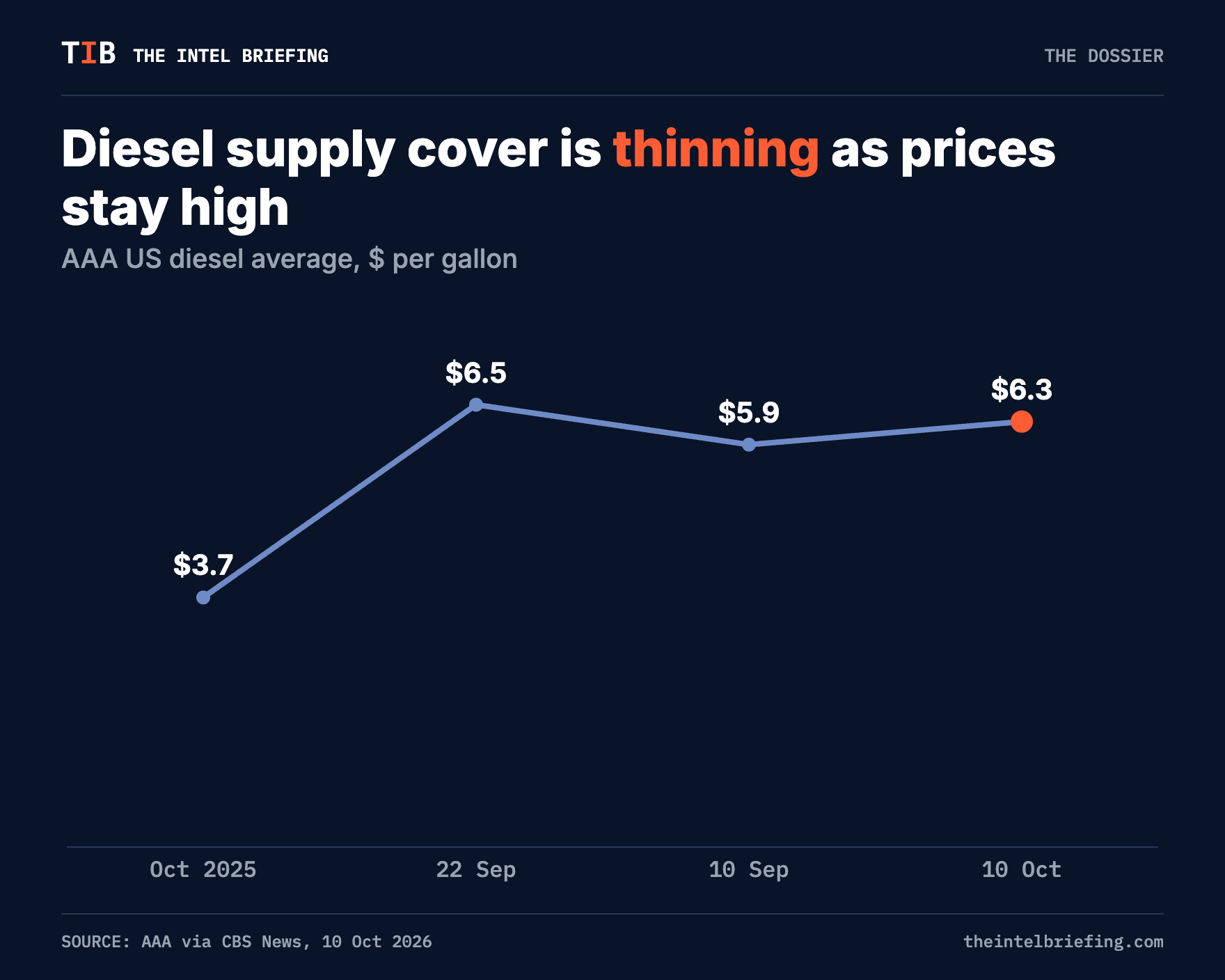
US buffers are thinning while the price sits near its record. AAA’s diesel average was $6.28 a gallon on 10 October, against $5.94 a month earlier, $3.68 a year earlier and a record $6.53 on 22 September. That is 71% higher than a year ago (TIB estimate). EIA’s distillate days of supply fell from 29.9 in the week to 11 September to 27.9 in the week to 2 October. The Strategic Petroleum Reserve held 284 million barrels in September, its lowest since 1982, and was draining at 1.2 million b/d, according to the Dallas Fed.
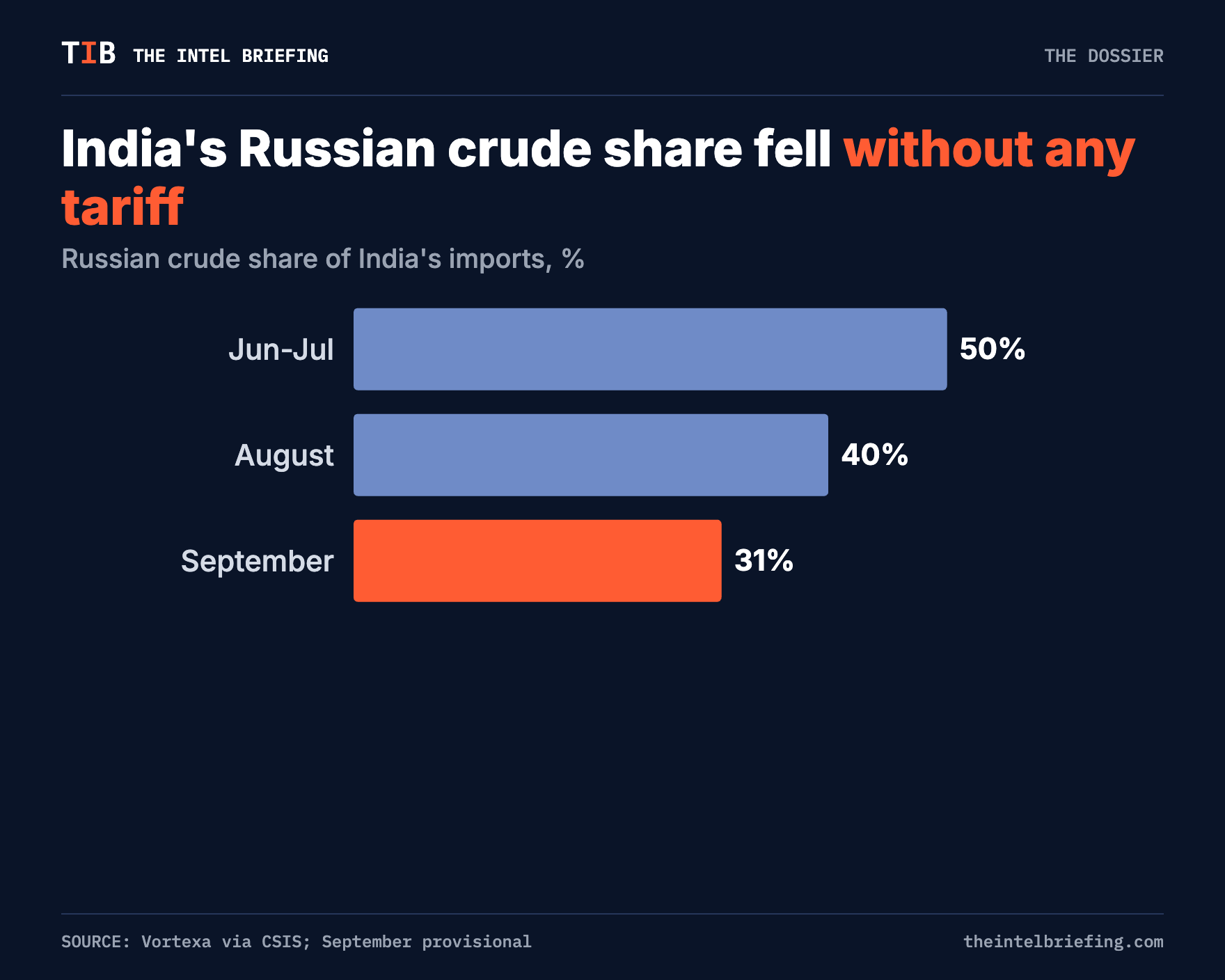
The tariff threat was working before it was traded. Vortexa data cited by CSIS show Russian crude made up more than half of India’s crude imports in June and July 2026. That share fell to about 40% in August and about 31% in September (provisional), with no tariff imposed. The law had already been cut from a 500% original to 100%. AP reports, via CTOL, that GL 135 is the first Treasury easing on diesel since the war began to run longer than the standard 30-day window. At 180 days it runs six times as long, sets no volume cap and names no company.
Below the line, members get five dated, resolvable Key Judgments (TIB-016 to TIB-020) and four scenarios for the deal’s winter, with probabilities. They also get six indicators with current values and triggers, the point most coverage has missed, and an exposure map of who stands to lose, by how much and through which clause. The section closes with dated decision points to 12 January, the threshold at each that moves our numbers, and what to do in each seat.

