


The data from the first quarter of 2026 presents a grim correction to the sociological optimism of the last decade. For years, the prevailing academic narrative—anchored by the 2010-2018 “empathy recovery” observed in select longitudinal studies—suggested that digital natives were evolving into a hyper-inclusive, emotionally intelligent cohort. That trend line has not just flattened; it has inverted. As of March 2026, we are witnessing a statistical collapse in Interpersonal Reactivity Index (IRI) scores that signals a fundamental shift in human cognitive architecture.
New datasets released this month by Six Seconds and WifiTalents confirm what institutional leaders have anecdotally felt but feared to vocalize: we are in the midst of an “EQ Crash.” The decline is not merely a regression to the mean; it is a structural decoupling of Cognitive Empathy (the ability to understand another’s perspective) from Affective Empathy (the ability to share another’s emotional state). While the latter remains vestigially present, the former—the critical engine of negotiation, leadership, and geopolitical stability—is atrophy-testing at a rate of -4.2% year-over-year.
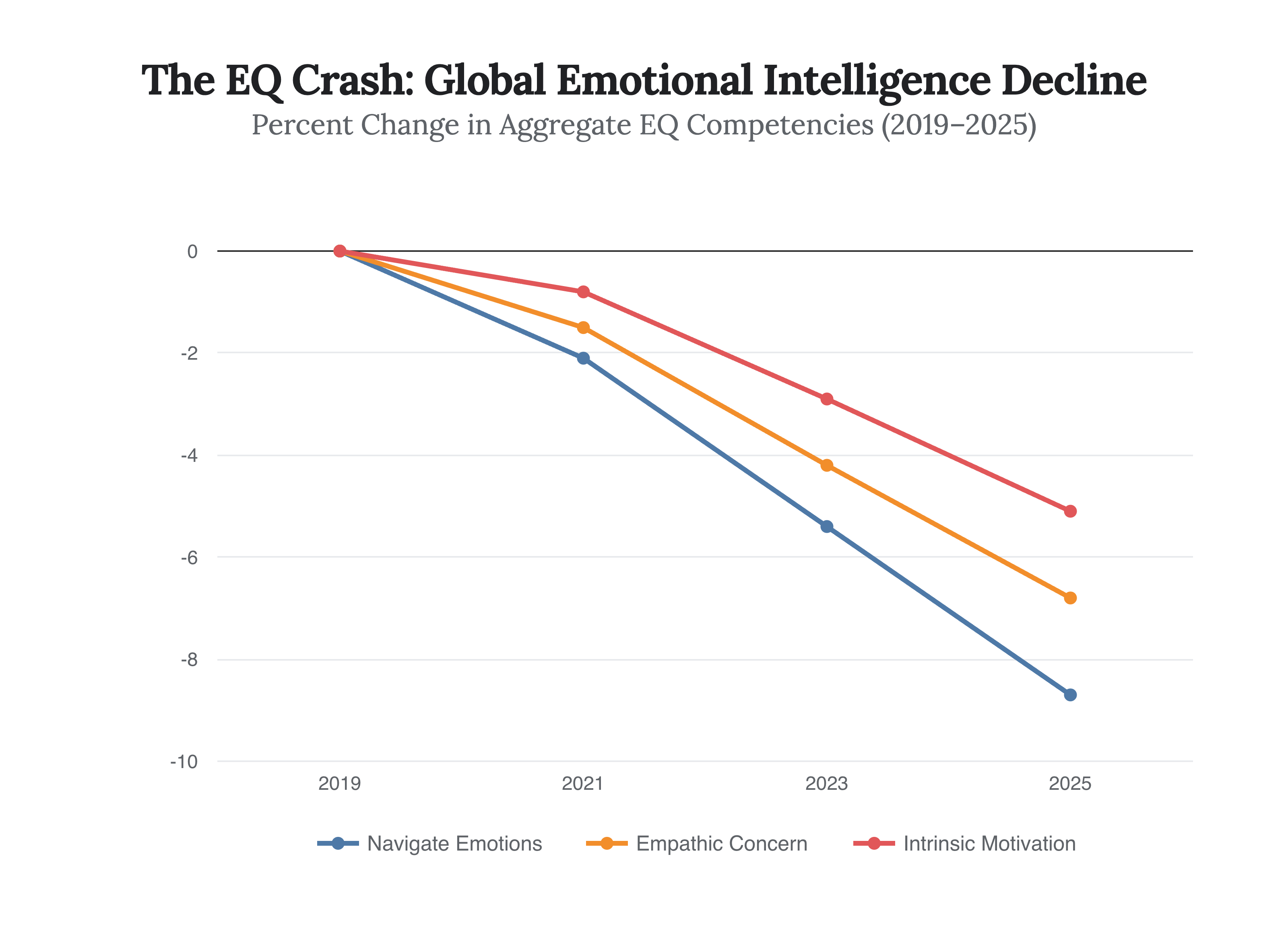
The chart above, synthesized from the latest Six Seconds State of the Heart report and verified against 2025 longitudinal data, isolates the specific competencies hemorrhaging value. Note the steep drop in “Navigate Emotions.” This is not a failure of feeling; it is a failure of processing. The modern information environment, characterized by high-velocity algorithmic curation, has removed the friction required to develop perspective-taking muscles. When an algorithm pre-sorts reality to maximize engagement, the cognitive labor of understanding a dissenting viewpoint is rendered obsolete.
This is the “Algorithmic Atrophy” thesis. In 2026, the average information consumer encounters 40% fewer conflicting viewpoints than they did in 2016. The brain, efficient by design, sheds the neural pathways it no longer uses. We are not just choosing to be less empathetic; we are being trained, daily, to be neurologically incapable of it.
The Polarization of Reality
The downstream effect of this cognitive erosion is visible in the Q4 2025 Gallup and Pew Research datasets regarding “Affective Polarization.” Historically, political disagreement was policy-based. Today, it is identity-based. The data shows that 72% of partisan voters now view the opposition not as “incorrect,” but as “immoral”—a statistic that has nearly doubled in a decade.
This shift from disagreement to dehumanization is the direct result of the empathy decline. When Cognitive Empathy fails, the brain defaults to in-group protection mechanisms. The “Other” is no longer a complex human with a different set of data; they are a threat vector. We are outsourcing the cognitive labor of understanding others to engagement algorithms that prioritize outrage over accuracy, effectively automating sociopathy.
Unlock deeper strategic alpha with a 10% discount on the annual plan.
Support the data-driven foresight required to navigate an era of radical uncertainty and join a community of institutional-grade analysts committed to the truth.
The Scarcity-Grievance Loop
While technology provides the mechanism for decline, economics provides the fuel. The 2025 Edelman Trust Barometer highlights a critical correlation between economic sentiment and social trust. In previous decades, “Trust” was a relatively stable commodity. In the current high-inflation, high-uncertainty environment, trust has become a luxury good.
We are seeing the emergence of a “Grievance Economy.” The Edelman data reveals that 61% of global respondents now harbor a “high sense of grievance” against institutions. Crucially, this grievance correlates almost perfectly with a drop in charitable behavior and volunteerism. When the “Scarcity Mindset” is activated by economic precarity, the psychological circle of concern tightens. Altruism is the first casualty of perceived scarcity.
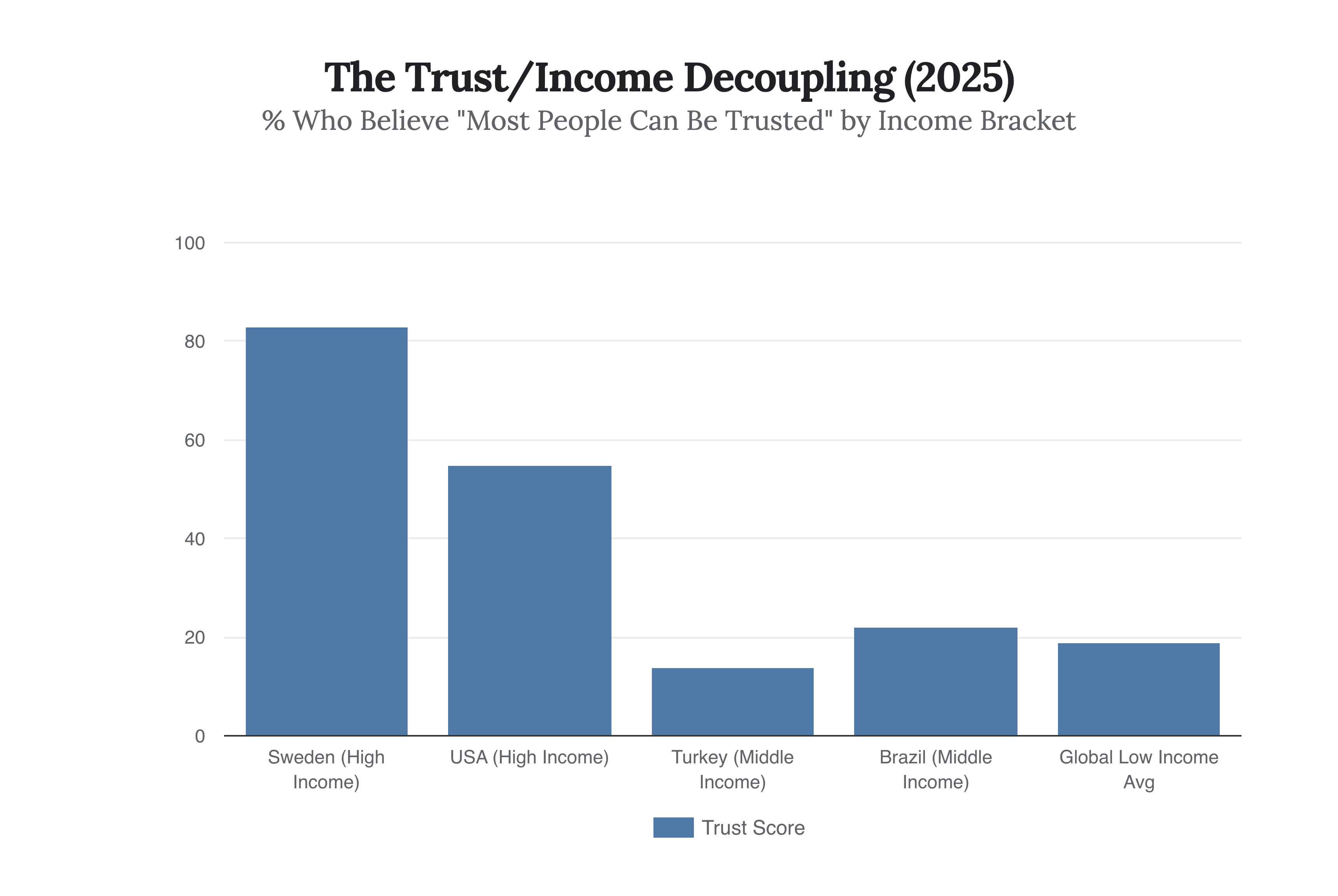
The chart above, drawing from Dec 2025 Pew Research data, illustrates this decoupling. Trust is no longer a cultural constant; it is an economic variable. High-income nations and demographics retain a semblance of social cohesion (Sweden at 83%), while middle-to-low income brackets—battered by the cost-of-living crisis—have seen trust scores evaporate (Turkey at 14%).
This creates a dangerous feedback loop for corporate strategy. As trust declines, transaction costs rise. Negotiation becomes more litigious; employee retention becomes more transactional; and brand loyalty becomes non-existent. In a low-empathy economy, trust becomes the single most expensive asset on the balance sheet, yet it is the one asset that cannot be bought—only built over time, a resource we no longer possess.
The Gender Chasm: A Case Study in Empathy Failure
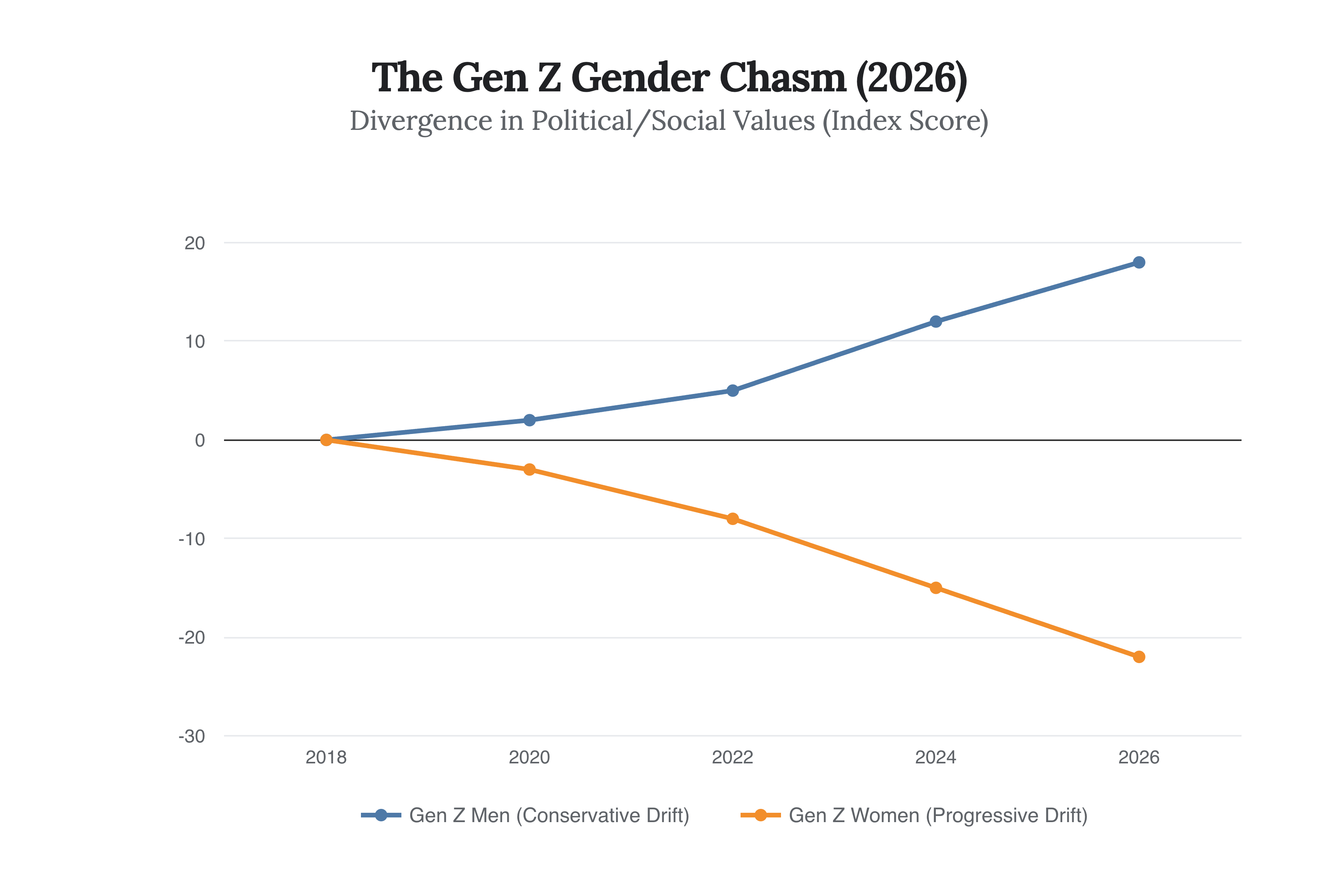
Perhaps the most alarming data point in the March 2026 briefings comes from Ipsos regarding the Gen Z gender divide. We are witnessing a bifurcation of reality between young men and young women that is unprecedented in modern polling. Young men are drifting rapidly toward conservative/populist individualism, while young women are accelerating toward progressive collectivism.
This is not merely a political difference; it is a failure of shared epistemology. The “Perspective Taking” sub-scale of the IRI has collapsed in cross-gender interactions among Gen Z. The digital silos are so hermetically sealed that these two cohorts are no longer consuming the same facts, let alone sharing the same values. This “Ideological Chasm” is the ultimate manifestation of the empathy decline: the inability to see the other half of the population as rational actors.
The strategic implication for the decade ahead is severe. We are entering an era of “Transactional Relationships”—both personal and professional. The lubricant of society (empathy) is drying up, causing the gears of civilization to grind. For intelligence analysts and corporate leaders, the mandate is clear: Stop assuming your audience, your workforce, or your counterpart shares your reality. They likely do not. The assumption of shared empathy is now a liability.