



The Marriage Arbitrage: A High-Alpha Life Strategy
As of February 2026, the data is unequivocal: the romanticization of the “solo sovereign” is a financial and biological liability. While cultural narratives continue to prioritize radical independence, the cold reality of the Q1 2026 economic landscape reveals that marriage has transitioned from a social rite of passage into a critical risk-management tool and a high-yield asset class. The delta between married and single outcomes in wealth accumulation, tax efficiency, and biological longevity is no longer a marginal difference; it is a structural chasm that determines long-term viability in an inflationary environment.
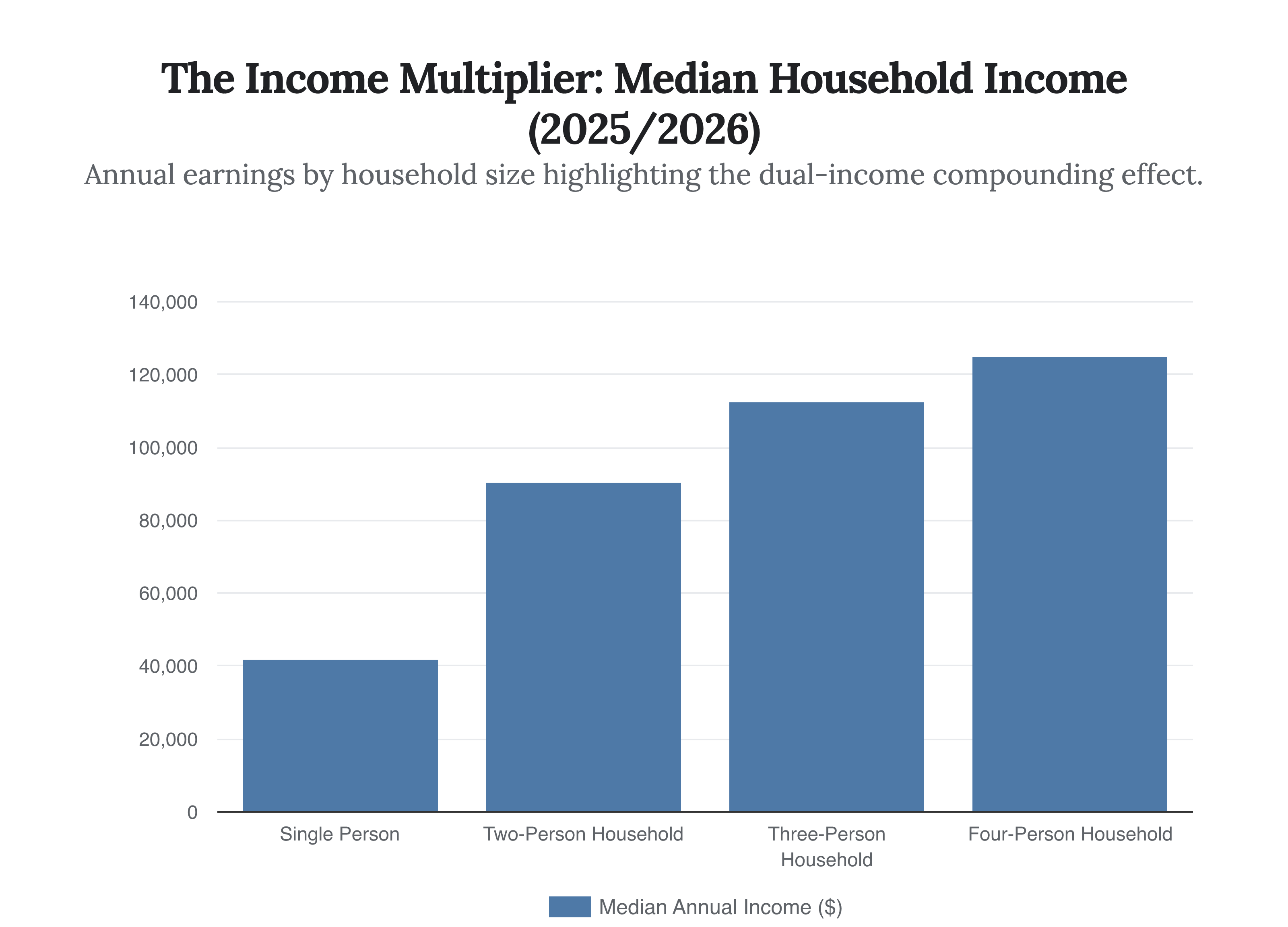
Analysis of Federal Reserve data through Q4 2025 and early 2026 indicators shows that the “Singlehood Tax”—the combined cost of redundant living expenses, higher tax rates, and the lack of pooled risk—now consumes approximately 28% of a single individual’s potential lifetime net worth compared to their married counterparts. In the modern economy, marriage is the only remaining legal tax haven that simultaneously functions as a biological insurance policy.
The Wealth Gap: From Margin to Chasm
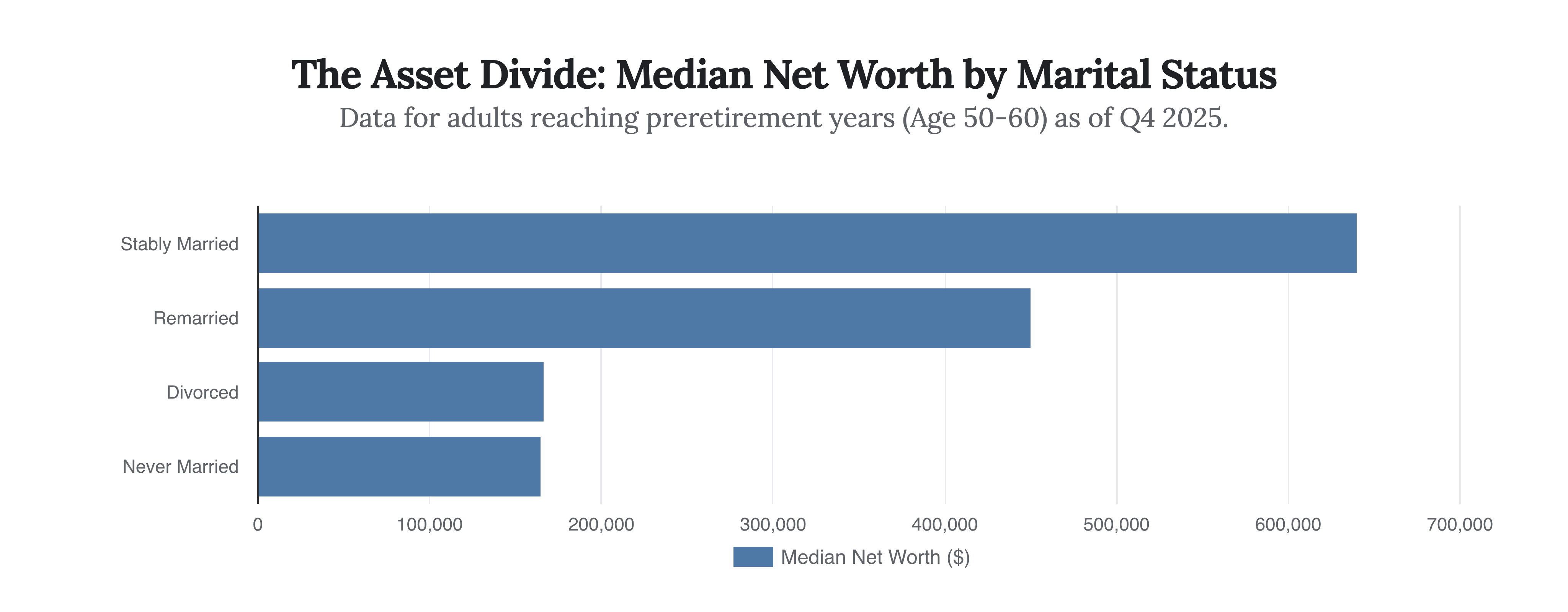
The financial ROI of marriage is most visible in the compounding of net worth. By 2026, data from the National Longitudinal Survey and updated Federal Reserve balance sheets indicate that stably married individuals in their 50s possess nearly four times the assets of their never-married or divorced peers. Specifically, married couples on the verge of retirement command a median net worth of approximately $640,000, while never-married adults hover at just $167,000. Even when controlling for education—a common confounding variable—college-educated married couples possess double the wealth ($1M+) of their single equivalents ($425,000).
This is driven by the “compounding of the mundane.” Shared housing, utilities, and subscription services create a surplus of investable capital. In a 2026 environment defined by persistent inflation and high interest rates, the ability to split a $3,000 mortgage while maintaining a single kitchen and heating system acts as a 50% subsidy on essential living costs. For the single individual, every dollar of inflation hits 100% of the household; for the married couple, the impact is effectively halved per capita. By 2026, the ‘Singlehood Tax’ has become a permanent structural drag on individual net worth, effectively pricing the unpartnered middle class out of the American Dream.
Unlock deeper strategic alpha with a 10% discount on the annual plan.
Support the data-driven foresight required to navigate an era of radical uncertainty and join a community of institutional-grade analysts committed to the truth.
The 2026 Tax Arbitrage
The 2026 tax code further incentivizes the marital unit through bracket expansion. For the 2026 tax year, a single individual enters the 24% marginal tax bracket at $105,700 of income. Conversely, a married couple filing jointly does not hit that same 24% threshold until their combined income reaches $211,400. This “Marriage Bracket Stretch” allows dual-income households to keep a significantly higher percentage of their top-line earnings compared to two single individuals earning the same total amount.
Second-order effects of this tax efficiency include higher eligibility for tax-advantaged retirement contributions and capital gains exclusions on primary residences (up to $500,000 for married couples vs. $250,000 for singles). In a housing market characterized by rapid appreciation, this $250,000 gap in tax-free profit represents a massive disparity in generational wealth transfer. For the high-earner, remaining single is a voluntary 5-8% annual levy on total wealth growth.
The Biological Dividend: Longevity and Stress Resilience
The ROI of marriage extends beyond the balance sheet into the literal cells of the human body. 2025 studies from the University of Michigan and Singapore Management University, which tracked 5,000 adults, confirmed that married individuals consistently exhibit lower levels of systemic inflammation and cortisol (the primary stress hormone). The “safety net” of a spouse provides a biological buffer that single individuals must simulate through expensive external services (therapy, specialized fitness, or social clubs).
The longevity data is even more stark. Married men, in particular, see a 46% lower rate of death from cardiovascular disease compared to their never-married peers. This “Spousal Regulation” effect—where partners encourage health-seeking behavior and monitor symptoms—adds an average of two years to the lifespan of both partners. Marriage is not a social sentiment; it is a high-yield asset class with a biological hedge.
The Psychological Arbitrage: The 30-Point Gap
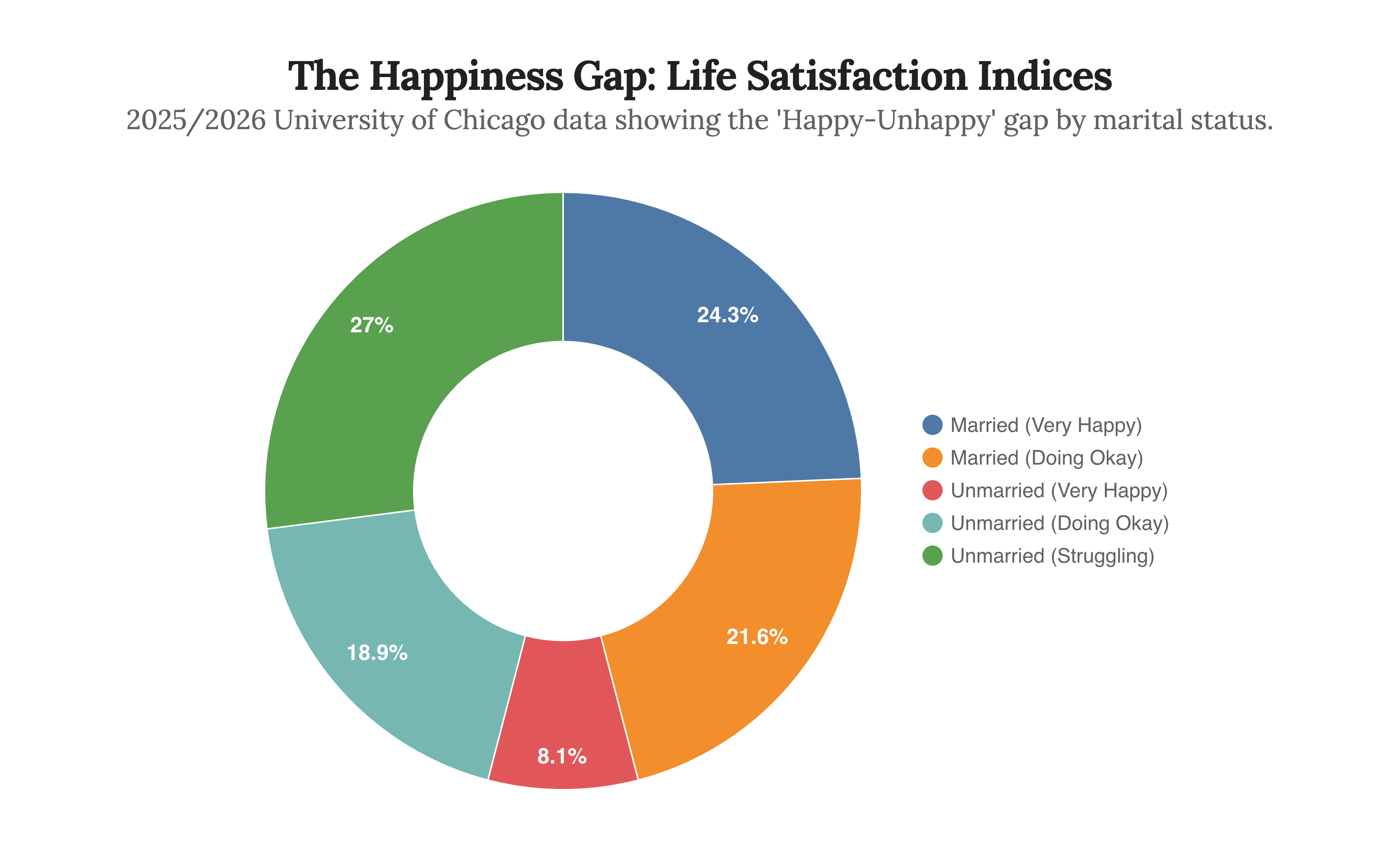
The most provocative data point emerging in 2026 is the “Happiness Delta.” Research by Professor Sam Peltzman (University of Chicago) identifies a 30-percentage-point gap in reported happiness between married and unmarried individuals. This is the largest single differentiator of human well-being in the modern dataset—surpassing the impacts of income, race, or geography. While the “burnout” of modern life is real for everyone, the married unit possesses a collaborative infrastructure that prevents temporary setbacks from becoming permanent psychological collapses.
Singlehood in 2026 is increasingly associated with “Emotional Labor Overload,” where individuals must manage 100% of their domestic, financial, and emotional regulation alone. This results in higher rates of depressive symptoms and lower life satisfaction scores globally. The 30-percentage-point happiness gap between the married and the single is the largest psychological inequality in the modern era.
The High-Agency Response
For the institutional analyst or the private individual, the data suggests that the move toward singlehood is a “Short” on the human experience. While the upfront costs of marriage—both financial (weddings) and psychological (compromise)—are high, the long-term ROI is mathematically superior to any other life arrangement. The 2026 “Solo Sovereign” is a high-risk strategy with diminishing returns. The Marital Unit remains the world’s most resilient and profitable economic and biological engine.