



The Click is Obsolete
The era of the “chatbot” effectively ended on Tuesday. With the release of GPT-5.4, OpenAI has not just iterated on a language model; they have fundamentally deprecated the graphical user interface (GUI) as the primary mode of digital interaction.
For the past decade, the “Intel Briefing” thesis has been that AI would eventually move from creation (generating text/images) to execution (performing actions). That day is today. GPT-5.4 is not a tool you talk to; it is a system you assign labor to. It is the realization of the “Level 3” autonomy promised during the rudimentary “Operator” launch in January 2025, but with a critical difference: Reliability has finally crossed the threshold of enterprise viability.
This is no longer about a smarter search engine. This is the beginning of the “Service-as-a-Software” economy, where you don’t buy a seat for a human to use software; you buy the outcome the software produces itself.
The Reliability Crossing: 58% to 96%
To understand the gravity of this launch, we must look at the data reality of the last 14 months. When OpenAI released the first “Operator” agent in early 2025, the excitement was palpable, but the utility was brittle. On the WebArena benchmarks, those early agents hovered around a 58% success rate. In a corporate environment, a tool that fails 4 times out of 10 isn’t an assistant; it’s a liability.
GPT-5.4 changes the calculus. By integrating the “System 2” reasoning architecture of the o3-series directly into the agentic loop, OpenAI has achieved a 96.7% success rate on multi-step telecom and complex workflow benchmarks.
This is the “Five Nines” moment for Agentic AI—the point where the cost of verifying the AI’s work drops below the cost of doing the work yourself.
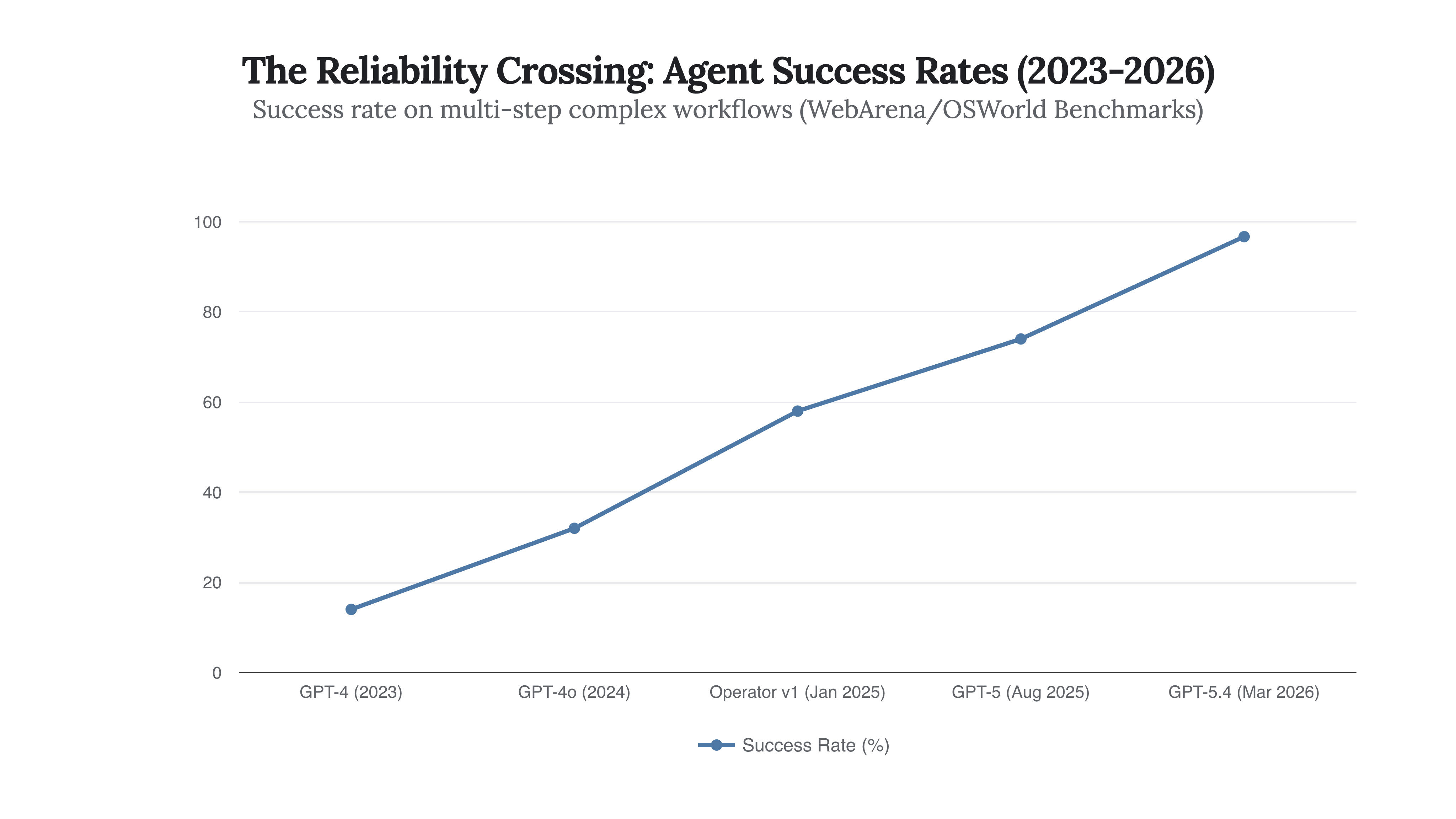
The strategic implication here is immediate. At 58% reliability, humans remain “in the loop” (checking every step). At 96%, humans move “on the loop” (managing exceptions). This shift effectively unlocks the 40% of enterprise applications that Gartner predicted would embed task-specific agents by the end of 2026.
Unlock deeper strategic alpha with a 10% discount on the annual plan.
Support the data-driven foresight required to navigate an era of radical uncertainty and join a community of institutional-grade analysts committed to the truth.
The Inference Crisis: The New Cost of Doing Business
However, this capability comes with a hidden economic shock. The narrative of 2023-2024 was about the exorbitant cost of training models ($100M+ runs). The narrative of 2026 is the crushing cost of inference.
GPT-5.4’s agentic capabilities rely on “test-time compute”—essentially allowing the model to “think” for seconds or minutes before acting. This explodes the computational cost per task. We are seeing a 15x multiplier: for every $1 spent on training, the market is now spending $15 on inference over the model’s lifecycle.
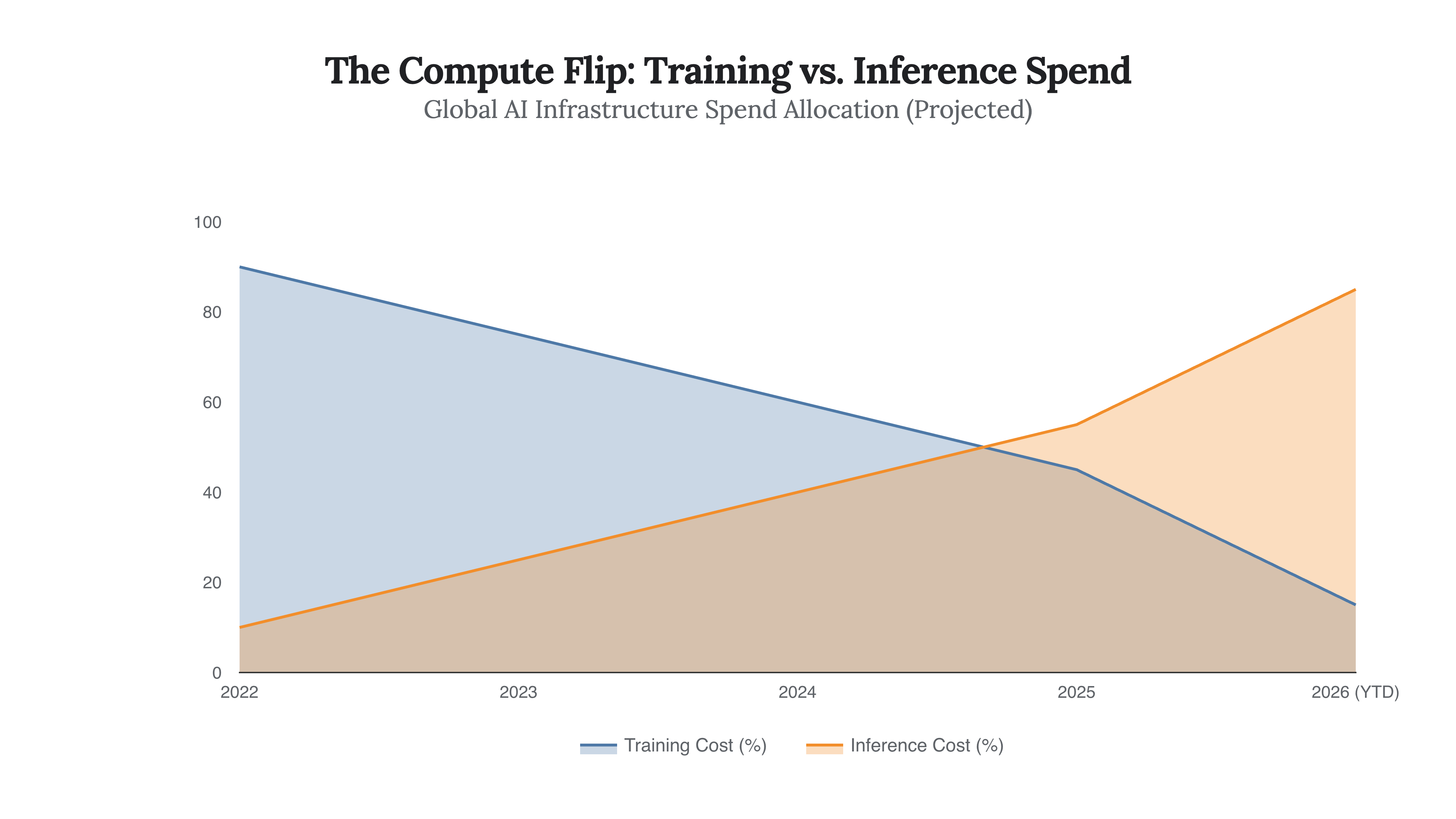
This reality forces a change in business models. The “flat rate” SaaS subscription is dying. If an agent performs 50 hours of labor for you, you cannot expect to pay $20/month. We are moving toward a “Compute-Metered Labor” economy, where companies will pay per cognitive step, not per user seat.
The Data Reality: Displacement by Vertical
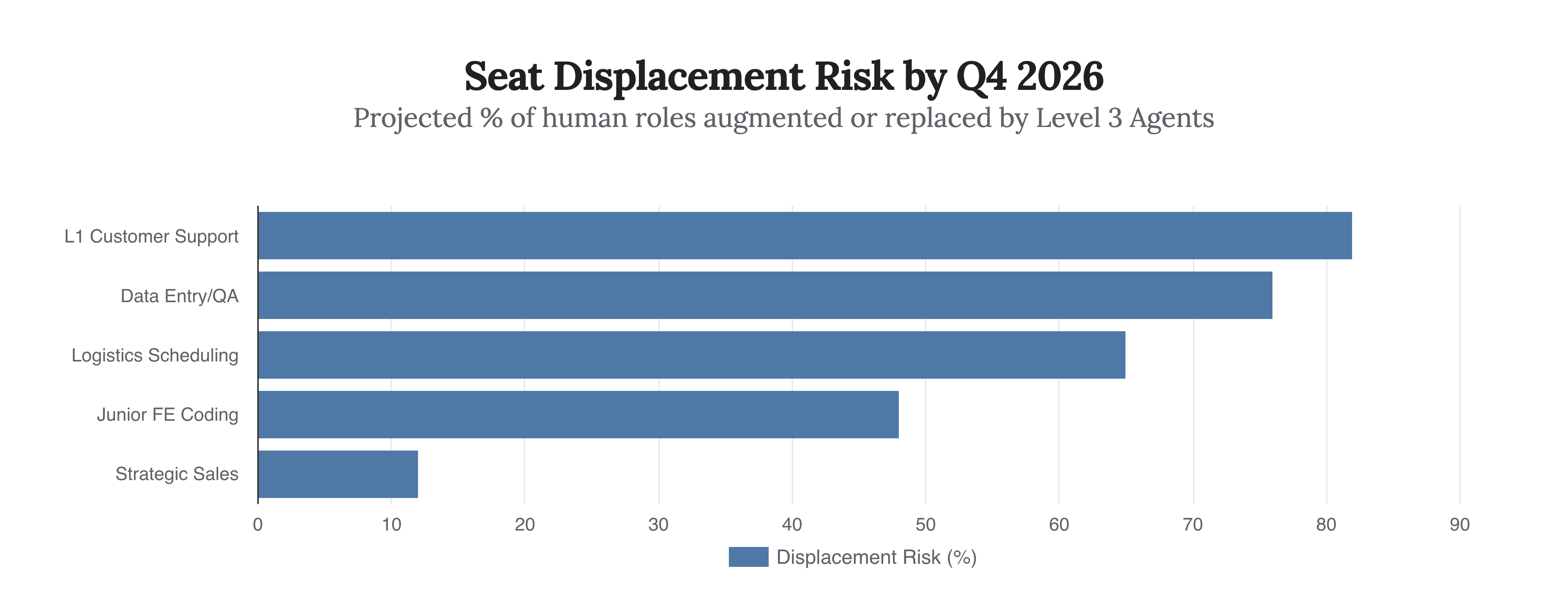
Where does GPT-5.4 land first? The data suggests a jagged deployment. While creative industries focus on generation, the action-oriented architecture of 5.4 is targeting high-volume, low-context transactional workflows.
We are currently tracking a massive divergence in “Seat Displacement”—the metric of how many human software licenses are being swapped for agentic API keys.
The Second-Order Effect
The release of GPT-5.4 is not just a software update; it is an organizational stress test. Companies that have spent the last two years building “Chatbots” that simply retrieve information are now obsolete. The value is no longer in retrieval (RAG); it is in action (Agents).
The interface of the future is not a screen; it is a permission set. You will not “use” GPT-5.4. You will authorize it.
I don't think UI's are going away anytime soon. I believe the future is UI that generates itself in the moment, shaped around what each person actually needs, right when they need it. You don't always want to chat with an AI. Sometimes pressing a single button is just more convenient.
The future is arriving blink by blink fast!