
The Zero-Friction Trust Collapse
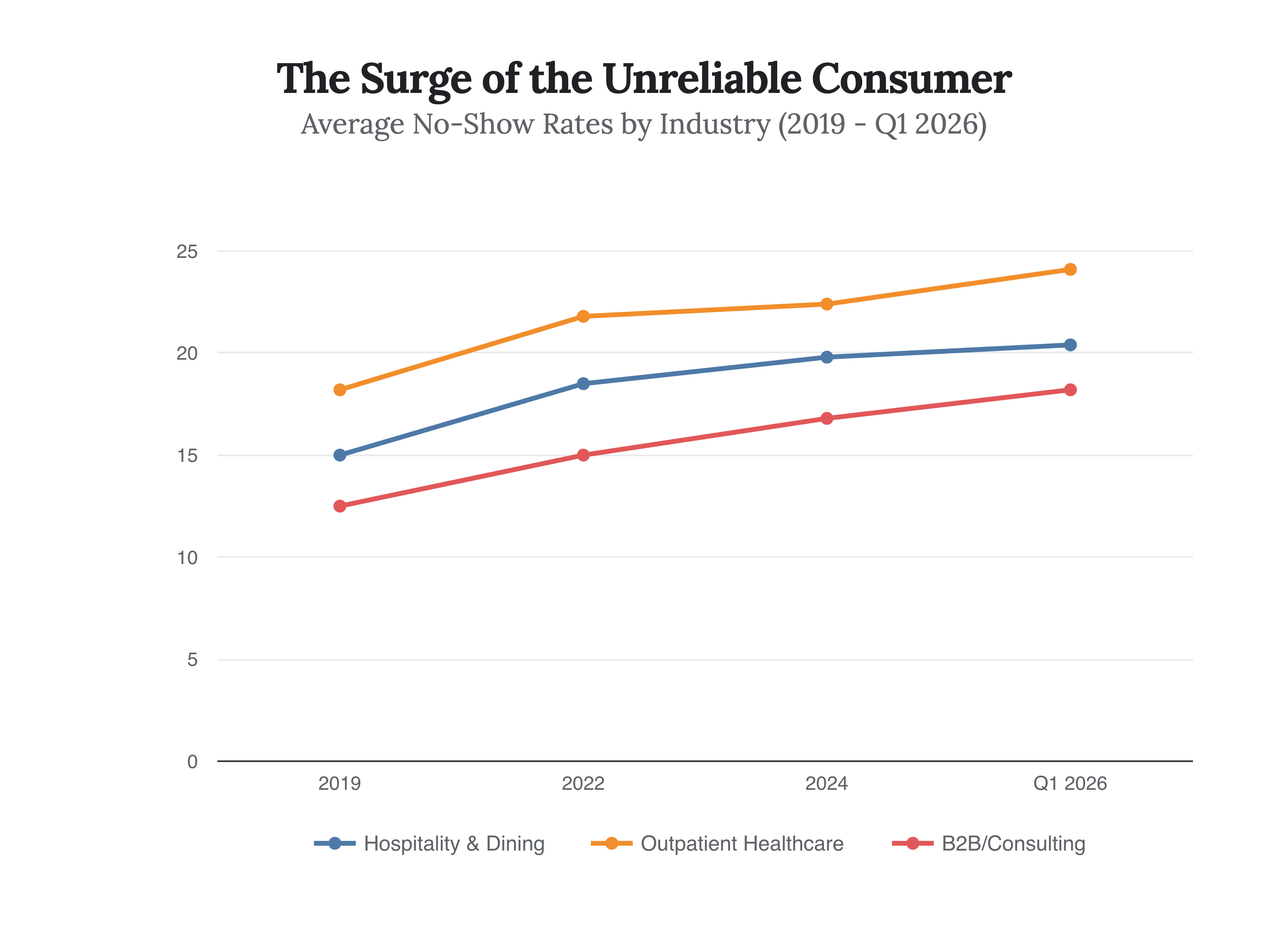
In the first quarter of 2026, the service economy is facing a crisis not of demand, but of commitment. The “Flake Rate”—defined as the percentage of confirmed appointments, reservations, or bookings that result in a last-minute cancellation or a total no-show—has reached a critical inflection point. As of February 2026, data across major metropolitan hubs shows that 1 in 5 restaurant reservations and nearly 19% of global hotel bookings fail to materialize. This is not merely a social nuisance; it is a structural erosion of the informal contracts that have historically stabilized the service sector.
Digital convenience has fundamentally decoupled the act of “booking” from the intent to “attend.” With the tap of a screen, consumers can secure multiple options for a single Friday evening, effectively “trip stacking” or “reservation hedging” to preserve maximum optionality until the very last moment. The “flake” is no longer a social faux pas; it is a calculated feature of the modern consumer’s risk-mitigation strategy. This behavior, once limited to high-volume retail, has now metastasized into healthcare, professional services, and luxury hospitality, creating a billion-dollar void in projected revenues.
The $150 Billion Healthcare Void
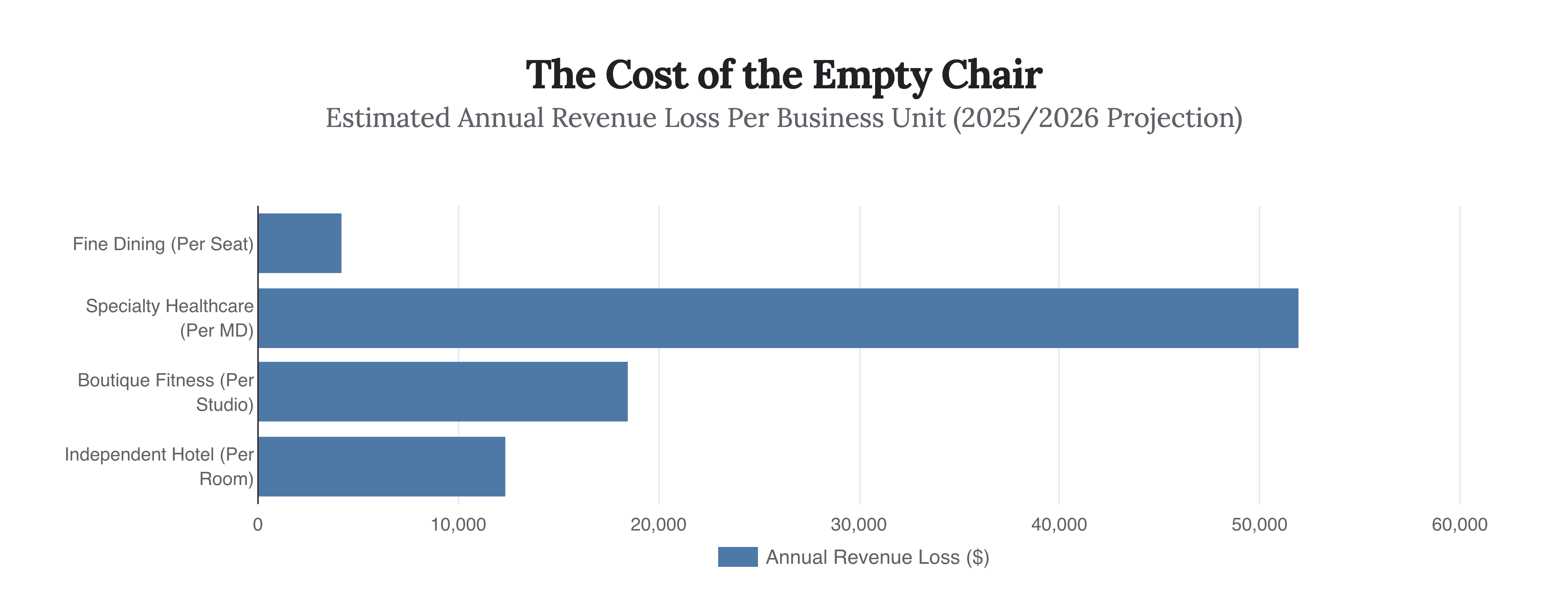
Nowhere is the Flake Rate more damaging than in the United States healthcare system. In early 2026, the economic impact of missed appointments has hit a staggering $150 billion annually. For the individual practitioner, a single no-show represents an average loss of $200 to $250 in unrealized revenue. However, the second-order effects are more insidious: as no-show rates in specialty clinics climb toward 24%, providers are forced to overbook their schedules to maintain solvency. This leads to a feedback loop of increased wait times and decreased patient satisfaction, which in turn incentivizes more cancellations as patients lose trust in the schedule.
Recent February 2026 surveys by organizations like MGMA show that 27% of medical group leaders now rank “no-show management” as their top operational priority, surpassing even staffing shortages. The trend is exacerbated by a “K-shaped” reliability reality: lower-income patients are flaking due to rising out-of-pocket costs and transportation friction, while high-income patients are flaking due to “choice overload” and the delegation of their schedules to AI agents that lack the social weight of a human commitment. By 2026, the cost of human unreliability has become a line item larger than many companies’ marketing budgets.
Unlock deeper strategic alpha with a 10% discount on the annual plan.
Support the data-driven foresight required to navigate an era of radical uncertainty and join a community of institutional-grade analysts committed to the truth.
Hospitality: The End of the Free Table
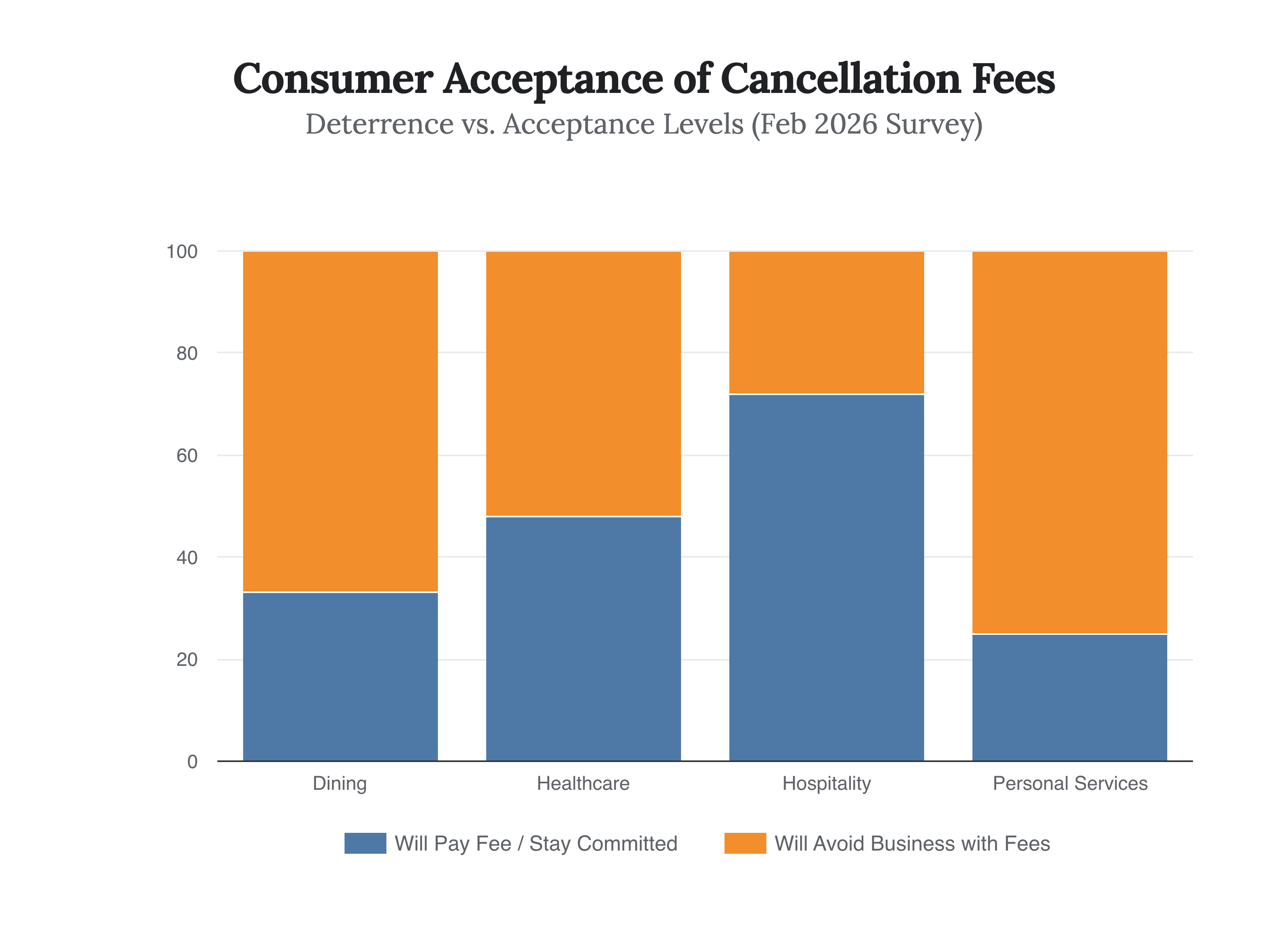
The dining industry has been the most visible casualty of the high Flake Rate. In the UK and US, nearly 52% of independent restaurant owners reported delinquency on rent in late 2025 and January 2026—a record high. When 20% of a restaurant’s seats remain empty on a Friday night due to no-shows, the profit margin for the entire shift is effectively vaporized. This has triggered a rapid defensive response: the mass adoption of non-refundable deposits and aggressive cancellation fees. As of March 2026, 42% of mid-to-high-end restaurants have implemented some form of prepaid ticketing or holding deposit.
The data suggests a “Spontaneity Paradox.” While 66% of diners now wait until just hours before an event to book—seeking the ultimate flexibility—the industry is moving in the opposite direction, tightening its grip on consumer capital before they even walk through the door. The era of the “courtesy hold” is dead; in 2026, if your credit card isn’t on file, your reservation doesn’t exist.
The Psychology of Choice Overload
Why is the Flake Rate accelerating? Behavioral economists point to a phenomenon of “Decision Delegation.” In 2026, a significant portion of the population uses AI personal assistants to manage their calendars. These tools are programmed to optimize for the user’s convenience, not for the service provider’s bottom line. If an AI detects a slight change in weather, a traffic jam, or a lower price elsewhere, it may suggest—or even execute—a cancellation with zero emotional friction for the user.
Furthermore, “Choice Overload” has become a paralyzing force. When presented with too many options, 36% of consumers report abandoning a purchase or booking altogether. For those who do book, the lack of “sunk cost” (no upfront payment) means there is no psychological pain associated with flaking. We have built a society where the cost of being unreliable is zero for the individual, but catastrophic for the institution.
Strategic Outlook: The Institutional Counter-Strike
As we move deeper into 2026, the market will witness a three-pronged institutional counter-strike against the Flake Rate:
1. Algorithmic Blacklisting: Reservation platforms like Resy and OpenTable are quietly rolling out “Reliability Scores” for diners. High-flake users will find their access to peak times restricted or will be met with mandatory prepayments that their more reliable peers avoid.
2. Dynamic Deposit Pricing: Much like airline pricing, deposits will become dynamic. Booking a table for Valentine’s Day may require a 100% upfront payment, while a Tuesday lunch might remain free-to-book. We are entering the age of the “Service Option Fee.”
3. The Return of the Walk-In: To bypass the Flake Rate, many businesses are simply abandoning reservations. By moving to a 100% walk-in model, they shift the risk of unreliability back to the consumer, who must now invest the time to wait in line—the ultimate form of “skin in the game.”
In a world of 1.5% consumer spending growth and stubborn inflation, the margin of error has disappeared. The businesses that survive 2026 will be those that find a way to re-impose the cost of commitment on a consumer base that has forgotten how to keep its word. The handshake has been replaced by the pre-authorized transaction.