



The Signal: The Inversion of Emotional Capital
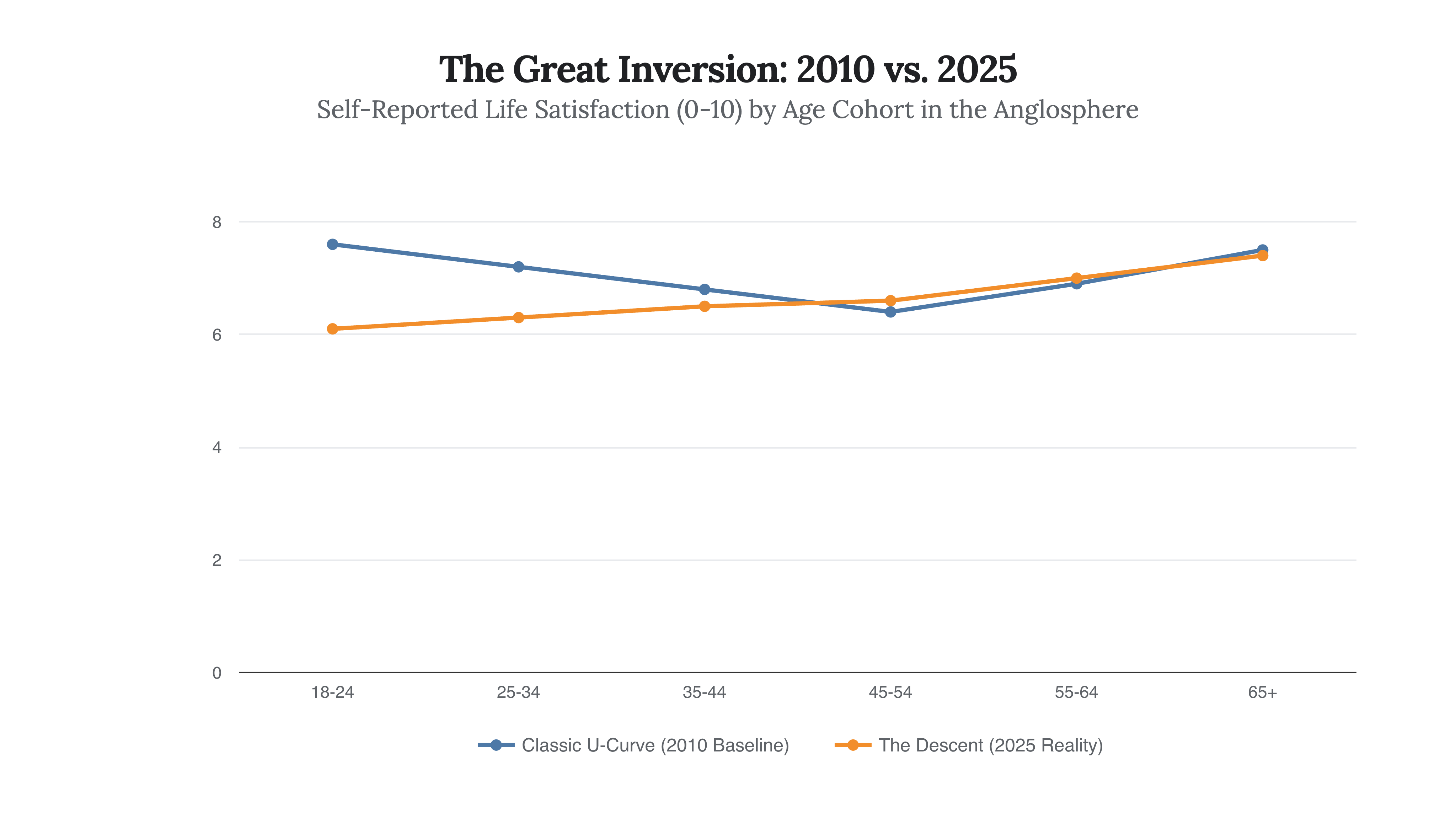
For nearly half a century, the “U-Curve of Happiness” was one of the few iron laws of social science. Established by economists David Blanchflower and Andrew Oswald, the data was consistent across 80+ nations: humans start adulthood happy, hit a deeper trough of misery in their late 40s (the “midlife crisis”), and rebound into a high-satisfaction “golden age” post-60.
As of Q1 2026, that reality has been deleted.
New datasets emerging from the World Happiness Report 2025 and Gallup’s State of the Global Workplace 2025 confirm a structural break in the Anglosphere. The U-curve has not merely flattened; in the United States, United Kingdom, and Canada, it has inverted into a descending slope of despair. The midlife crisis is no longer a biological inevitable; it has been displaced by a youth despair crisis that is structural, not hormonal.
This is not a human interest story. It is a frightening leading indicator for workforce productivity, healthcare solvency, and political stability in the West.
Data Reality: The 18-25 Collapse
The latest intelligence from the Blanchflower & Twenge 2025 study (PLOS One, August 2025) isolates the exact moment of fracture: 2013, accelerating violently post-2020. By 2024, the United States fell out of the top 20 happiest nations for the first time in history—a drop driven exclusively by the collapse in well-being among the under-30 demographic.
The specific data points are damning:
The Gender Gap: Young women (18-25) in the U.S. now report “despair” at rates nearly double that of young men (10.5% vs. 7.5%), creating a labor force entry cohort that is psychologically fragile before their first day of work.
Clinical Escalation: Primary care data from late 2025 indicates a 65.9% increase in psychiatric diagnoses for adolescents (ages 13-17) compared to pre-2020 baselines, driven largely by anxiety disorders.
The Happiness Deficit: In the West, the young are now less happy than the old. This “satisfaction gap” has widened to over 1.0 points on the Cantril Ladder in North America, effectively reversing the intergenerational social contract.
For the first time in modern economic history, the demographic with the highest physical potential possesses the lowest psychological capital.
Unlock deeper strategic alpha with a 10% discount on the annual plan.
Support the data-driven foresight required to navigate an era of radical uncertainty and join a community of institutional-grade analysts committed to the truth.
Second-Order Effects: The Productivity Drag
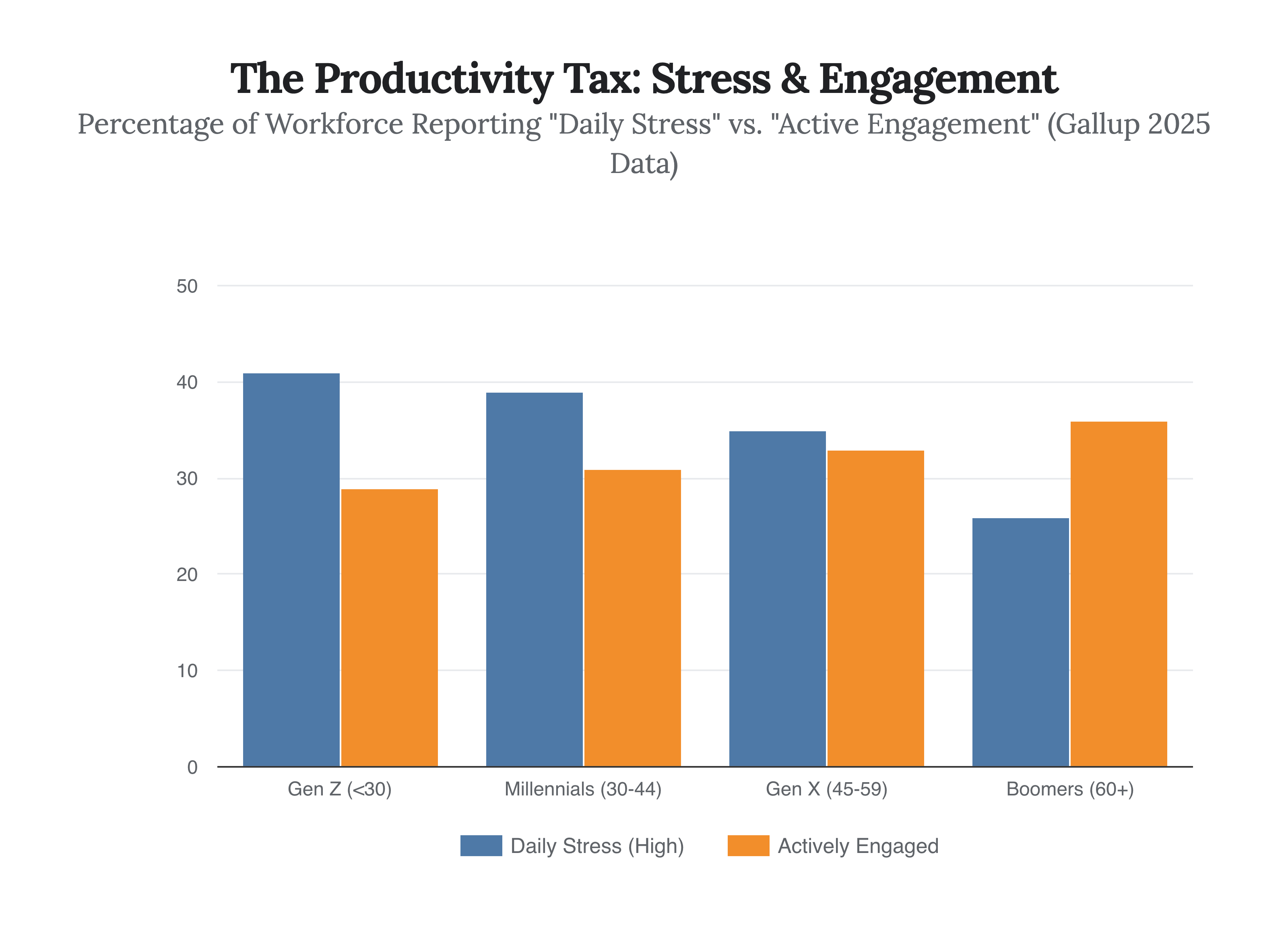
Why does a broken U-curve matter to the balance sheet? Because misery is expensive. The Gallup State of the Global Workplace 2025 report estimates that disengagement and low well-being now cost the global economy $9.6 trillion in lost productivity—roughly 9% of global GDP.
The “Young Misery” phenomenon is creating a pincer movement on corporate efficiency:
The Entry-Level Void: Gen Z workers are entering the workforce with higher rates of burnout pre-loaded. They require more management overhead, more mental health support, and have higher turnover rates than any previous generation.
The Managerial Squeeze: The classic “midlife trough” hasn’t disappeared for managers; it has just been compounded. Managers aged 35-55 are now squeezing between caring for aging parents and managing a crisis-prone junior workforce. Gallup data shows manager engagement plummeted to just 27% in 2025.
Geopolitical Divergence: The East-West Split
The most critical insight for 2026 is that the U-curve collapse is not global. It is a distinctly Western pathology.
In transition economies and parts of the Global South, the classic U-curve still holds, or even tilts in favor of youth. In Lithuania, Serbia, and Romania—nations often dismissed by Western analysts—the under-30s are the happiest demographic in the world. In China, despite high youth unemployment, the “optimism gap” regarding future national trajectory remains positive compared to the deep pessimism of American and British youth.
Western economies are effectively running on a depreciating asset: the mental resilience of their future workforce. Meanwhile, competitors in Central Europe and Asia are cultivating a generation that—while economically pressured—retains the psychological capacity for risk-taking and innovation.
The Projection
We are witnessing the early stages of a “Despair Drag” on GDP. As the 2025 data solidifies into 2026 trends, expect the following:
Healthcare Inflation: The 65.9% rise in youth psychiatric diagnoses will translate into a permanent elevation in employer healthcare premiums.
Innovation Stagnation: A risk-averse, anxious youth cohort is less likely to found startups. We are already seeing a decline in “high-impact” entrepreneurship among the under-25s in the US.
Political Volatility: Unhappy cohorts do not vote for continuity. The breaking of the U-curve predicts radical political swings as the “misery bloc” gains voting power.
The U-Curve was a sign of a stable society that allowed youth to dream and elders to rest. Its destruction is the loudest alarm bell currently ringing in the social sciences.