



In 2024, the global economy didn’t just lose money to inflation or supply chain shocks; it lost $438 billion to a ghost. This specific figure, identified in recent global workforce analyses, represents the incremental loss in productivity directly attributable to a sudden, sharp decline in employee engagement and the rise of “performative work.” It is the price tag of a strategic failure that has been building for decades: the belief that if something cannot be measured, it does not exist.
We have entered the era of the Metric Monoculture. From the C-suite to the laboratory, the obsession with quantifiable proxies—clicks, citations, hours logged, lines of code—has decoupled metrics from the meaning they were meant to represent. This is not merely an HR issue or an academic debate; it is a systemic risk that is corrupting decision-making at the highest levels. As algorithms optimize for engagement over truth and efficiency over effectiveness, we are witnessing the real-time validation of Goodhart’s Law on a planetary scale: When a measure becomes a target, it ceases to be a good measure.
This briefing dissects the three critical arenas where this quantification curse is currently causing the most damage: the corporate “productivity paranoia” gap, the industrial-scale fraud in scientific publishing, and the hidden data gravity of algorithmic management.
The Productivity Paranoia: A Crisis of Confidence
The most immediate manifestation of the Metric Monoculture is the widening chasm between how work is performed and how it is perceived. Despite a proliferation of sophisticated surveillance tools, corporate leadership has never been more blind to the reality of their own organizations.
The 85% Blind Spot
Recent intelligence from 2024 reveals a startling paradox. While 87% of employees report high productivity levels—backed by rising output metrics in many sectors—only 12% of leaders express confidence that their teams are actually productive. This 75-point confidence gap is not a data problem; it is a trust problem masquerading as a data problem.
In response, organizations have doubled down on digital surveillance. In 2024, nearly 96% of remote-first employers reported using some form of employee monitoring software, up from less than 30% pre-pandemic. Yet, this deluge of data has not yielded clarity. Instead, it has birthed a culture of “productivity theater,” where employees optimize for visibility (e.g., active mouse movements, green status lights) rather than value creation. The result is a hollow economy where activity metrics soar while actual strategic output stagnates.
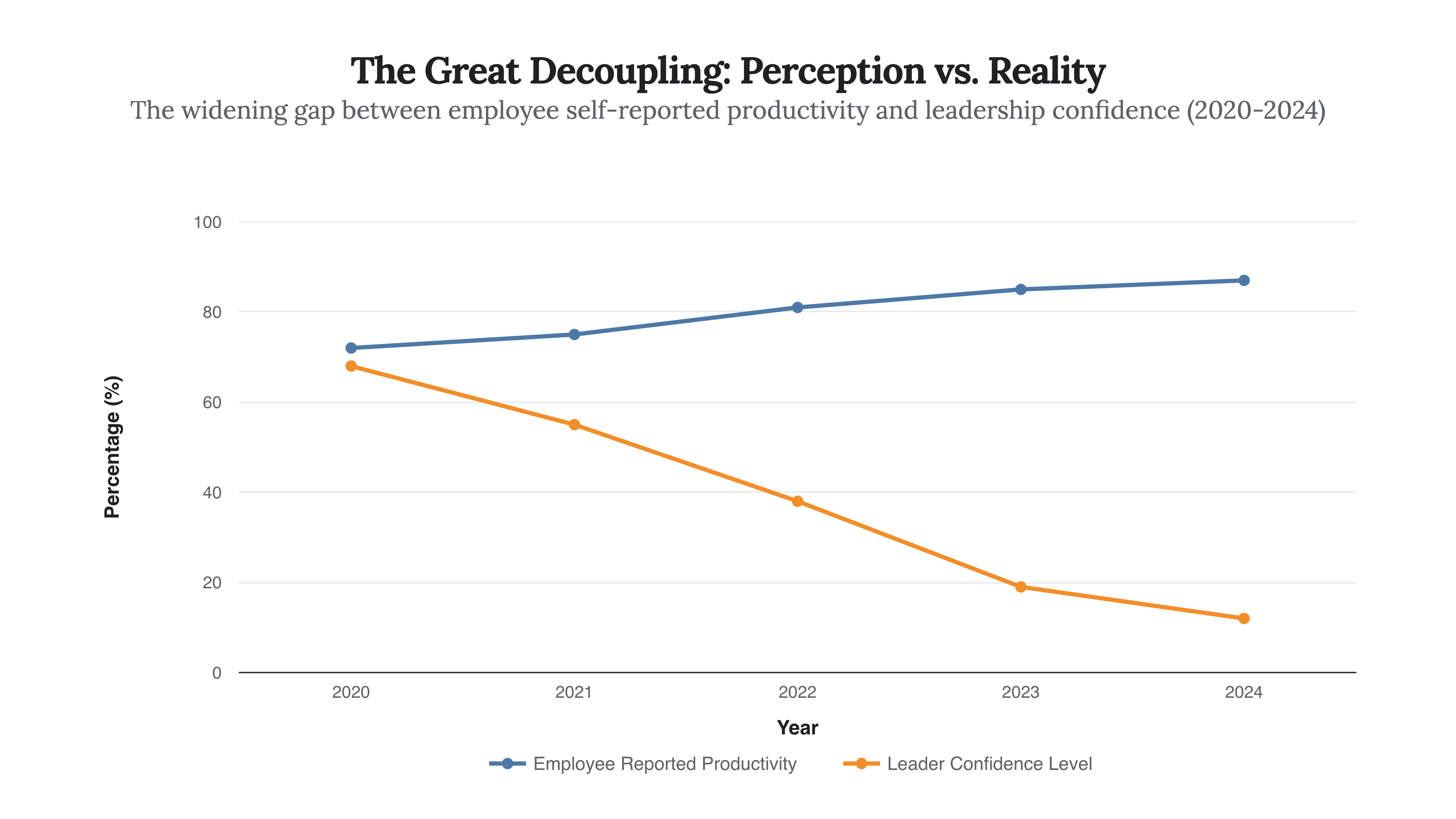
The chart above illustrates the collapse of trust. As leadership relies more heavily on abstract dashboards to “see” work, their actual visibility into the nuances of value creation vanishes. This disconnect is the primary driver of the $438 billion loss—capital wasted on managing the appearance of work rather than the work itself.
The Corruption of Knowledge: Science for Sale
If the corporate sector is suffering from a crisis of trust, the scientific community is facing a crisis of truth. The pressure to quantify academic output—“publish or perish”—has created a perverse incentive structure that is now threatening the foundation of global R&D.
The 10,000-Paper Illusion
In 2023 and continuing into 2024, the scientific community hit a grim milestone: over 10,000 research papers were retracted in a single year, shattering all previous records. This is not a statistical anomaly; it is the industrialization of fraud. The rise of “paper mills”—organizations that manufacture fake scientific papers for a fee—has flooded journals with junk data. Major publishers like Wiley have been forced to shutter entire journals after discovering they had been completely captured by these cartels.
The metric at fault here is the Impact Factor. By tying funding and tenure almost exclusively to citation counts and publication volume, the system has optimized for quantity over quality. The cost is not just academic; it represents billions in wasted R&D funding allocated based on fraudulent foundations. In fields like biomedicine, where new drug development relies on prior literature, this “pollution of the commons” slows down life-saving innovation.
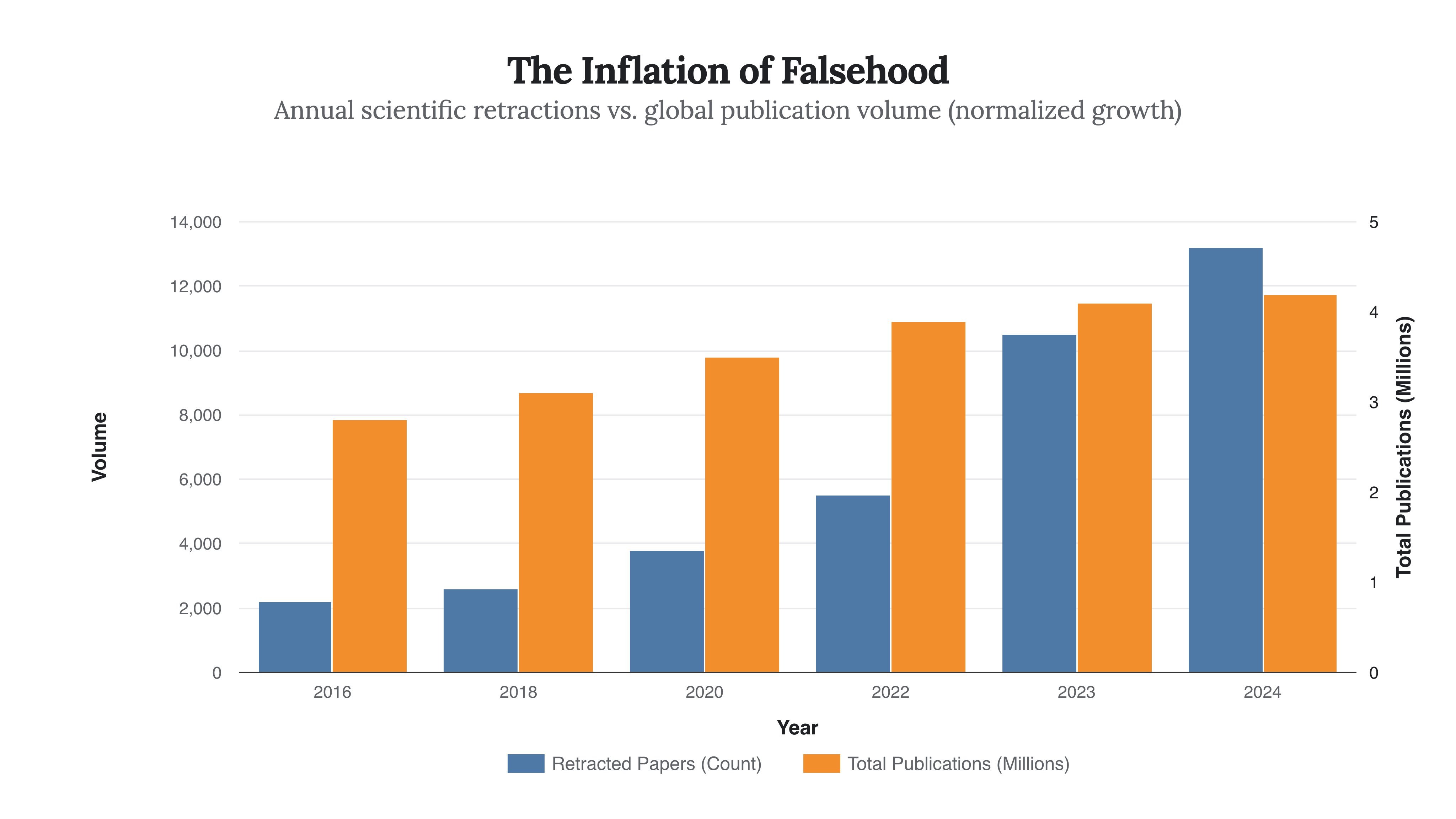
As the chart demonstrates, the rate of retraction is accelerating far faster than the rate of publication. We are producing more “science” than ever, but a rapidly growing percentage of it is functionally toxic waste. This is the ultimate outcome of metric fixation: a library full of books that no one can trust.
The Algorithmic Black Box: Optimizing for Misery
The third pillar of this crisis is the application of algorithmic management to human behavior. Nowhere is this more evident than in the burgeoning “Healthcare Gamification” market, which is projected to grow from $4.02 billion in 2023 to over $110 billion by 2035.
The premise is seductive: use game mechanics (points, badges, leaderboards) to incentivize healthy behavior. However, recent 2024 data suggests a dark side. By reducing health to a set of competitive metrics, these systems often encourage obsession and burnout rather than genuine wellness. In the workplace,
