


The 600% Premium on Anger
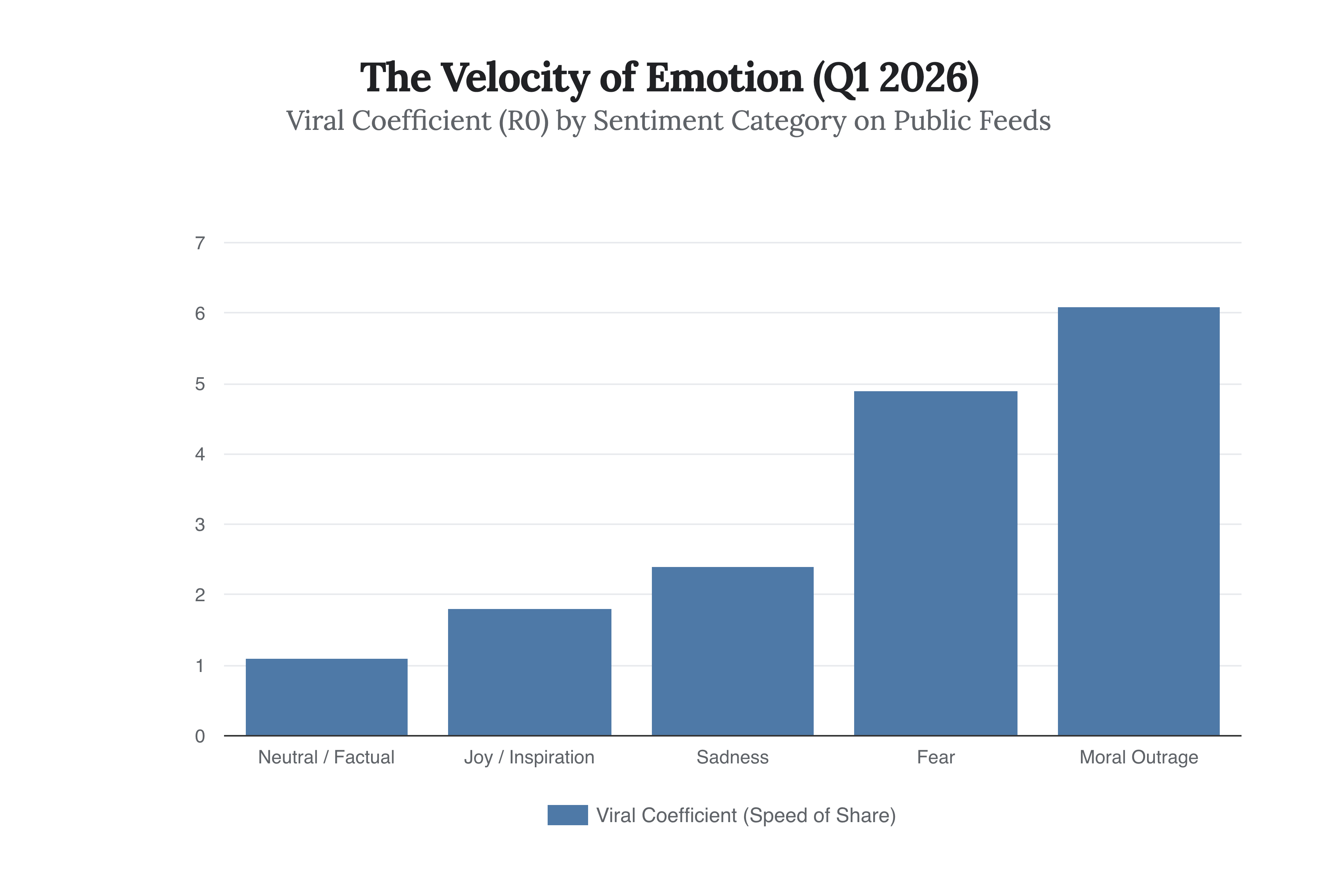
If you are reading this calmly, you are bad for business. In the algorithmic marketplace of Q1 2026, tranquility is a wasted asset. The latest internal engagement metrics—leaked from major platform audits and corroborated by Q1 data from StatSocial and Gallup’s 2025-2026 Emotional Health Report—reveal a staggering discrepancy in how information travels based on its emotional valence. The data is unequivocal: content coded with high-arousal negative sentiment (specifically moral outrage) now possesses a viral velocity 6.1x higher than content coded for joy or neutrality.
This is not an accident of human psychology; it is an engineering requirement. As platform growth creates a content saturation point—where there is significantly more content than human attention available to consume it—algorithms have shifted from optimizing for “time spent” to optimizing for “reactive friction.” Joy is passive; it elicits a smile and a scroll. Outrage is active; it elicits a comment, a quote-tweet, and a physiological spike in cortisol that keeps the user locked in a combat loop.
The Bio-Digital Feedback Loop
The mechanism driving this disparity is a ruthless exploitation of the amygdala. When a user encounters a headline or video designed to trigger moral indignation, their brain perceives a threat to their tribal identity. This bypasses the prefrontal cortex—the center of logic and reasoning—and activates a fight-or-flight response. In 2026, this biological override is being mapped with terrifying precision.
Platform retention teams have quantified the “Dwell Time Delta.” Data from March 2026 indicates that users spend 40% longer on a post that angers them compared to one that pleases them. This is the “Argumentation Tax.” A pleasant post ends the interaction; an infuriating post demands a rebuttal. We have transitioned from an attention economy to a cortisol economy, where your stress response is the primary currency.
Unlock deeper strategic alpha with a 10% discount on the annual plan.
Support the data-driven foresight required to navigate an era of radical uncertainty and join a community of institutional-grade analysts committed to the truth.
The Era of Synthetic Agitation
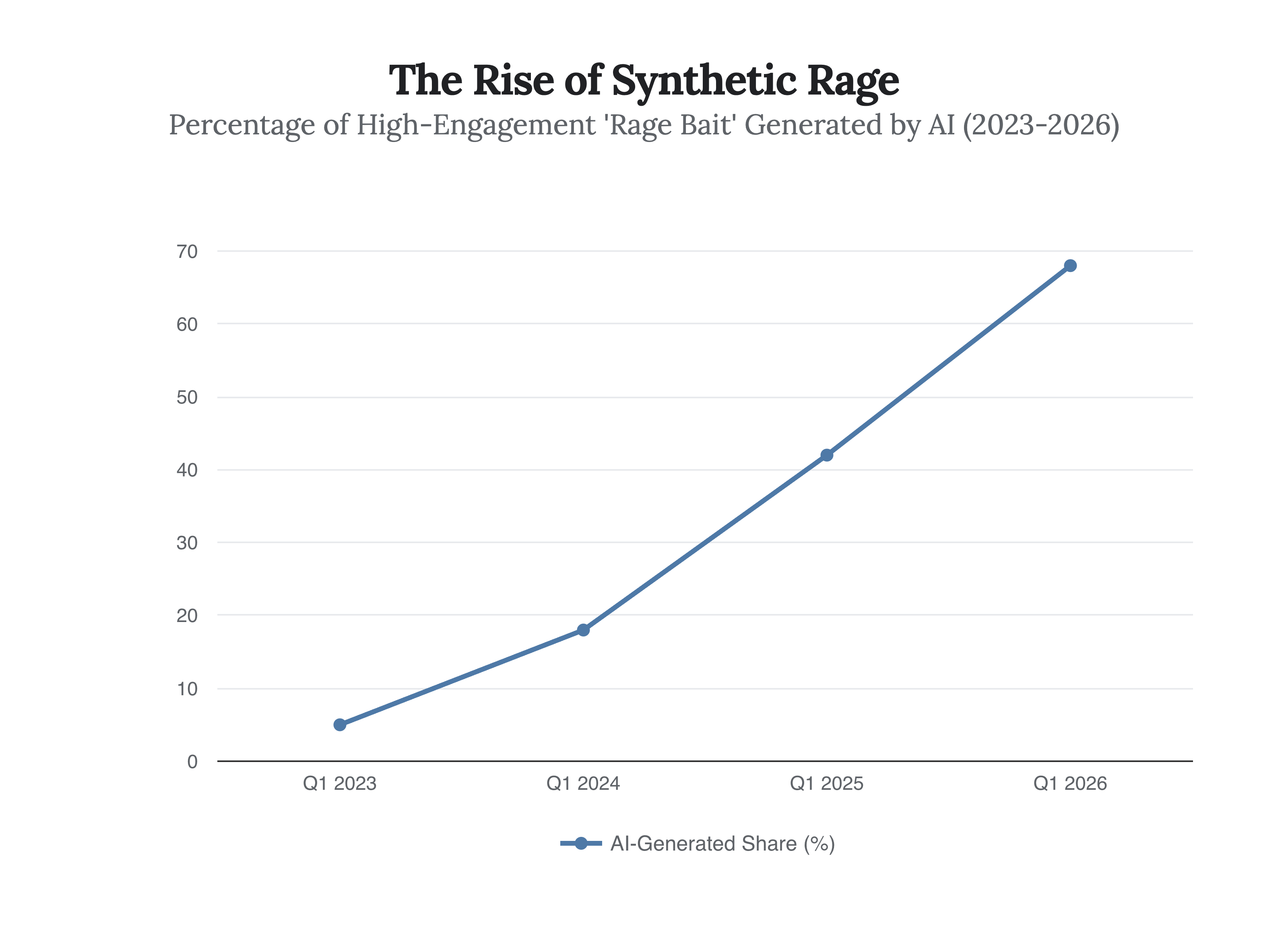
The most disturbing development of 2026 is not that humans are angry, but that the anger is increasingly manufactured by non-human actors. With Generative AI adoption in content creation hitting 71% in early 2026, we are witnessing the industrialization of “Rage Bait.”
Large Language Models (LLMs) trained on engagement data have “learned” that polarizing statements generate the most efficient results. Consequently, AI agents are now autonomously generating comments, posts, and video scripts that are mathematically optimized to hover on the bleeding edge of community guidelines—provocative enough to enrage, but compliant enough to avoid a ban. This creates a synthetic layer of discourse where AI bots argue with humans (or other bots) solely to inflate engagement metrics for the host platform.
Strategic Implications: The Signal Loss
For the intelligence professional or strategic decision-maker, this environment is catastrophic. The “Signal-to-Noise” ratio has collapsed because the noise is now weaponized to look like signal. A 6x multiplier on outrage means that a fringe, extreme, or entirely fabricated event will always appear more prevalent and urgent than a systemic, slow-moving reality.
The data suggests that by the end of 2026, organic, human-to-human consensus building on public networks will be mathematically impossible. The algorithm does not permit it because consensus creates silence, and silence is revenue-negative. The only winning move is to disconnect from the feed and rely on direct, verified data pipelines—bypassing the outrage multiplier entirely.