



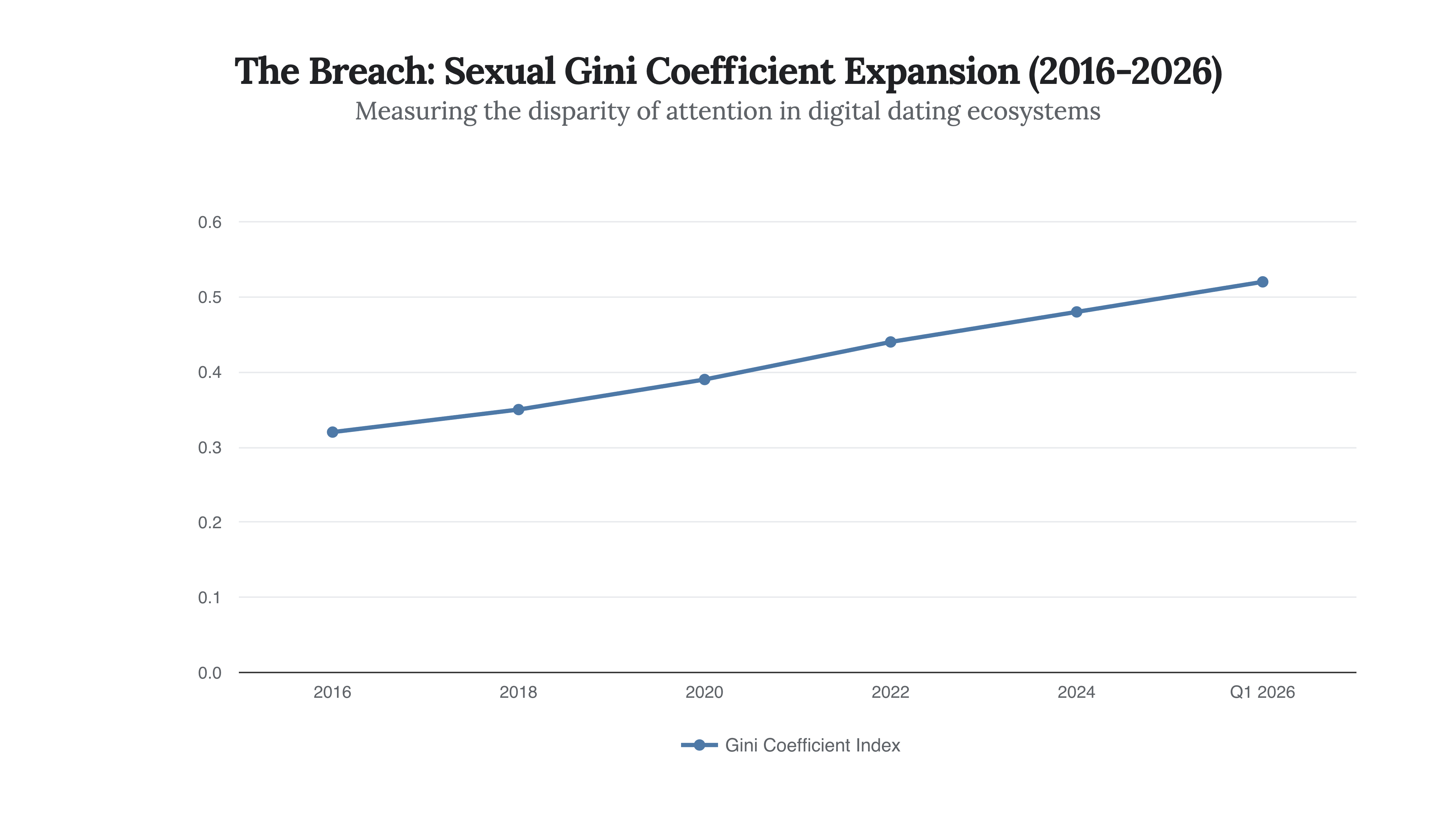
As we enter February 2026, the global dating landscape has reached a point of systemic failure that traditional sociology can no longer explain. According to the 2026 World Inequality Report, the sexual Gini coefficient—a measure of attention and mating opportunity distribution—has breached the 0.5 threshold for the first time in recorded history. In economic terms, a Gini coefficient of 0.5 in income usually triggers civil unrest; in the dating market, it has triggered a profound behavioral retreat. We are no longer witnessing a market of romantic choices, but a state of digital feudalism where a microscopic attention oligopoly at the top commands 90% of the engagement, leaving the majority of participants to navigate a resource deflation so brutal it has effectively ceased to exist for them.
This disparity is the fertile soil in which the “Cool Girl” Paradox grows. In game theory, the Cool Girl is not a personality type; she is a tactical response to a market for lemons. In a market where high-quality commitment is scarce and the cost of being “difficult” (i.e., having standards) is immediate exclusion from the dating pool, the rational actor chooses to minimize their signaling costs. The “Cool Girl” is a subsidized infrastructure for low-effort companionship that eventually bankrupts the provider. By masking her preferences and lowering the entry price for her attention, she attempts to secure a partner in a hyper-competitive environment, only to find that she has reached a Nash Equilibrium that maximizes the partner’s utility while zeroing out her own.
The Logic of the Loss Leader
To understand the Cool Girl, we must view her through the lens of retail economics. She acts as a “loss leader”—a product sold at a price below its market cost to stimulate other, more profitable sales. In the dating market, the Cool Girl offers her emotional labor, her sexual availability, and her lack of demands at a steep discount, hoping the eventual “upsell” will be a committed, long-term relationship. However, the Q1 2026 data on “situationship” durations suggests the upsell never happens. The average duration of unstructured partnerships has increased by 44% since 2022, while the conversion rate to formal commitment has plummeted.
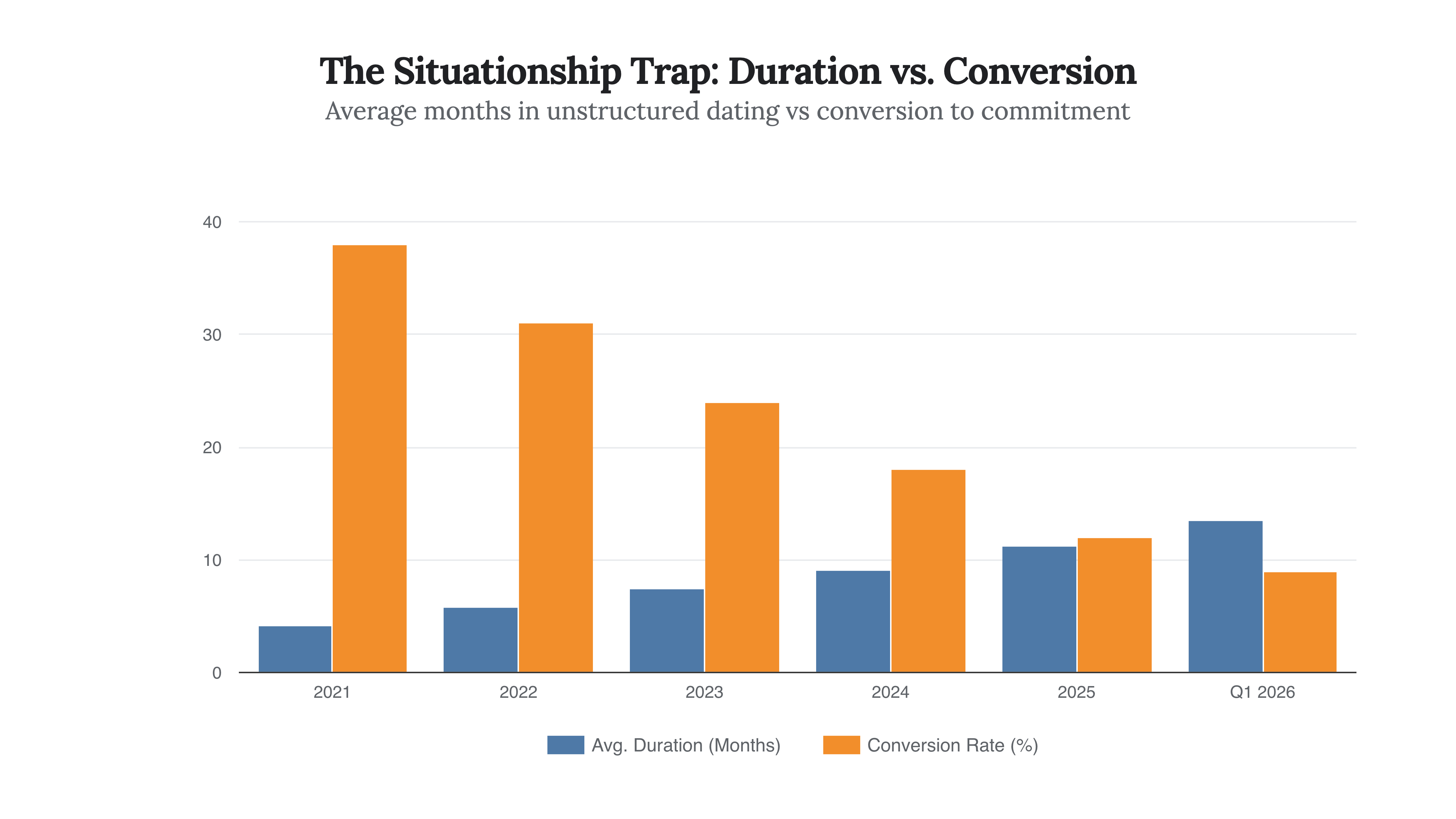
The problem is structural. When a participant enters the market with a low-cost signaling strategy, they attract partners who are specifically looking for low-cost interactions. This creates an adverse selection problem. High-commitment seekers view the “Chill” persona as a signal of low value or lack of seriousness, while low-commitment seekers view it as an opportunity for exploitation. By the time the Cool Girl attempts to raise the price (by asking “What are we?”), the partner has already enjoyed the benefits of the low-price period and simply exits the market to find the next loss leader. This is the cycle of the 2026 dating market: a series of short-term liquidations that prevent long-term capital accumulation in the form of stable households.
Algorithmic Exhaustion and the Burnout Index
The technological infrastructure of dating has shifted from a discovery tool to a rent-seeking utility. As of February 2026, nearly 80% of all dating app users report feeling acute burnout. This is not merely fatigue; it is a rational response to the diminishing marginal returns of the swipe. The 2026 user base is more active than ever—averaging 80 minutes per day on platforms—but the “activation rate” (the conversion of a match to a first date) has dropped to a historical low of 7% by day 30 of app usage.
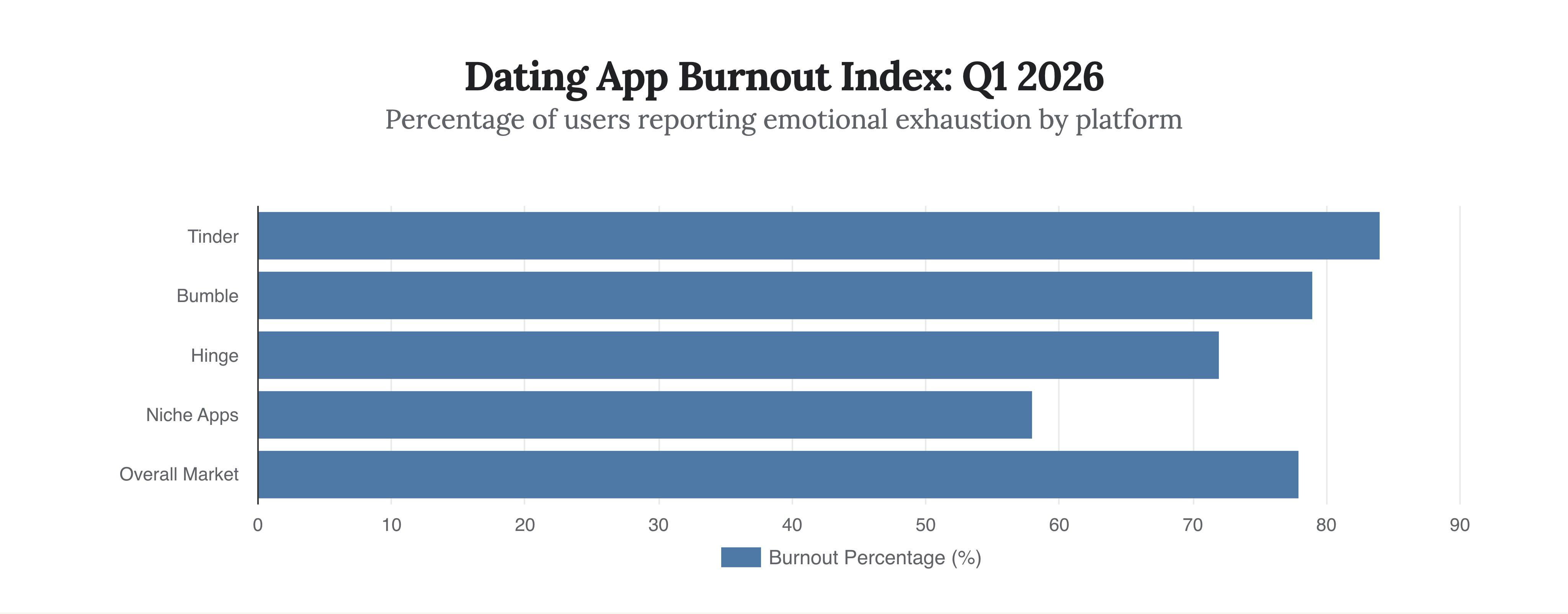
The algorithm prioritizes engagement over resolution. For a platform to remain profitable, it needs users to stay in the funnel, not exit into happy marriages. This creates a conflict of interest where the very tools meant to facilitate connection are mathematically optimized to prevent it. In this environment, the Cool Girl strategy is an attempt to “beat the algorithm” by being the most friction-less option. But being friction-less in a high-friction system doesn’t lead to success; it leads to being the path of least resistance for users who are already checking out of the human experience.
Unlock deeper strategic alpha with a 10% discount on the annual plan.
Support the data-driven foresight required to navigate an era of radical uncertainty and join a community of institutional-grade analysts committed to the truth.
The Market for Lemons: Akerlof’s Shadow
In 1970, George Akerlof described a market where the seller has more information than the buyer, leading to a collapse of quality. In 2026, the dating market has become a mirror image of this. Because the “Cool Girl” (and her male equivalent, the “Chill Guy”) masks their true intentions and emotional needs to stay competitive, every participant becomes a “lemon”—a product whose true value is hidden behind a performative facade. In a market where honesty is a competitive disadvantage, deception becomes the only viable survival strategy.
