


The debate over privacy is effectively over. The data from the close of 2025 has settled the argument: we have not merely accepted surveillance; we have internalized it as a condition of economic survival. As we enter February 2026, the metrics of the “Observer Effect”—the theory that observation alters behavior—are no longer theoretical. They are the dominant force shaping global labor markets, digital discourse, and the pricing of personal liberty.
Two critical data sets finalized last month paint a stark picture of this new reality. First, the global employee monitoring software market has officially crossed the saturation point, with adoption rates in the tech and finance sectors hitting a projected 82% as of Q1 2026. Second, and perhaps more disturbingly, the “Digital Chilling Index”—a composite measure of online discourse variance—has hit a decade low. We are witnessing the wholesale standardization of human behavior, driven not by authoritarian decree, but by the subtle, crushing weight of algorithmic compliance.
I. The Glass Cage: The Productivity-Innovation Divergence
The narrative sold to the C-suite in 2024 was simple: visibility equals viability. The promise was that algorithmic management tools—colloquially known as “bossware”—would optimize workflows and eliminate inefficiency. The reality of 2026, however, reveals a dangerous divergence.
According to finalized 2025 year-end reports, the employee surveillance market grew at a staggering 17.7% CAGR, valuing the sector at nearly $4 billion. However, this ubiquity has birthed a phenomenon analysts are calling the “Productivity/Innovation Decoupling.” While task-completion metrics (keystrokes, active hours, ticket resolutions) have risen by approximately 15-20% in heavily monitored sectors, high-value creative output (patent filings, novel code commits, strategic risk-taking) has plummeted.
The mechanism is psychological. When every micro-action is scored, employees optimize for the metric, not the outcome. They perform “theater of work” behaviors that satisfy the algorithm while avoiding the messy, unquantifiable processes required for genuine innovation. Risk aversion has become the primary survival strategy of the digital workforce.
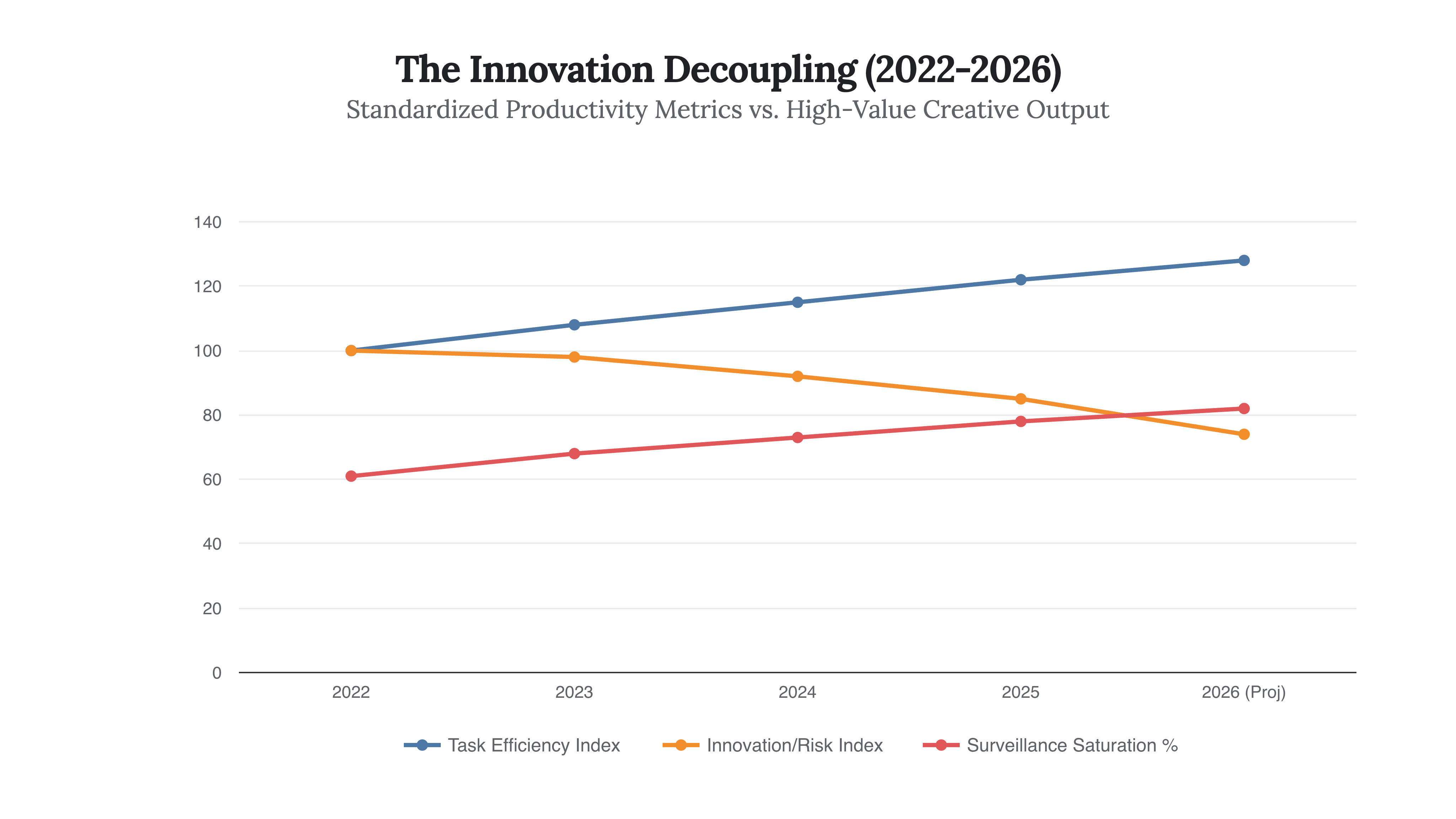
The chart above visualizes this divergence. As surveillance saturation (the grey line) approaches the 82% threshold, the gap between efficiency (blue) and innovation (red) widens. We are building a workforce of hyper-efficient bureaucrats who are terrified to color outside the lines. The tragedy of the algorithmic workplace is that it creates perfect compliance at the cost of the very creativity required to solve non-linear problems.
Unlock deeper strategic alpha with a 10% discount on the annual plan.
Support the data-driven foresight required to navigate an era of radical uncertainty and join a community of institutional-grade analysts committed to the truth.
II. The Quantified Spiral of Silence
The “Chilling Effect”—a legal concept describing the inhibition of free speech due to fear of penalty—has transitioned from a vague sociopolitical theory to a hard economic metric. In 2026, we can now quantify the “Spiral of Silence.”
Recent behavioral data indicates that 66% of internet users now self-censor their search queries and digital communications, acting under the assumption that they are being monitored by either state actors, corporate data brokers, or employer-mandated security suites. This is not paranoia; it is pattern recognition. With the biometric market valued at over $51 billion entering this year, the integration of identity and activity is total.
This self-censorship manifests as a collapse in “Search Query Variance.” People are searching for safer topics, using neutral language, and avoiding exploratory intellectual risks. The digital public square is becoming a hall of mirrors where everyone repeats the safe, consensus opinion to avoid being flagged by a sentiment analysis bot.
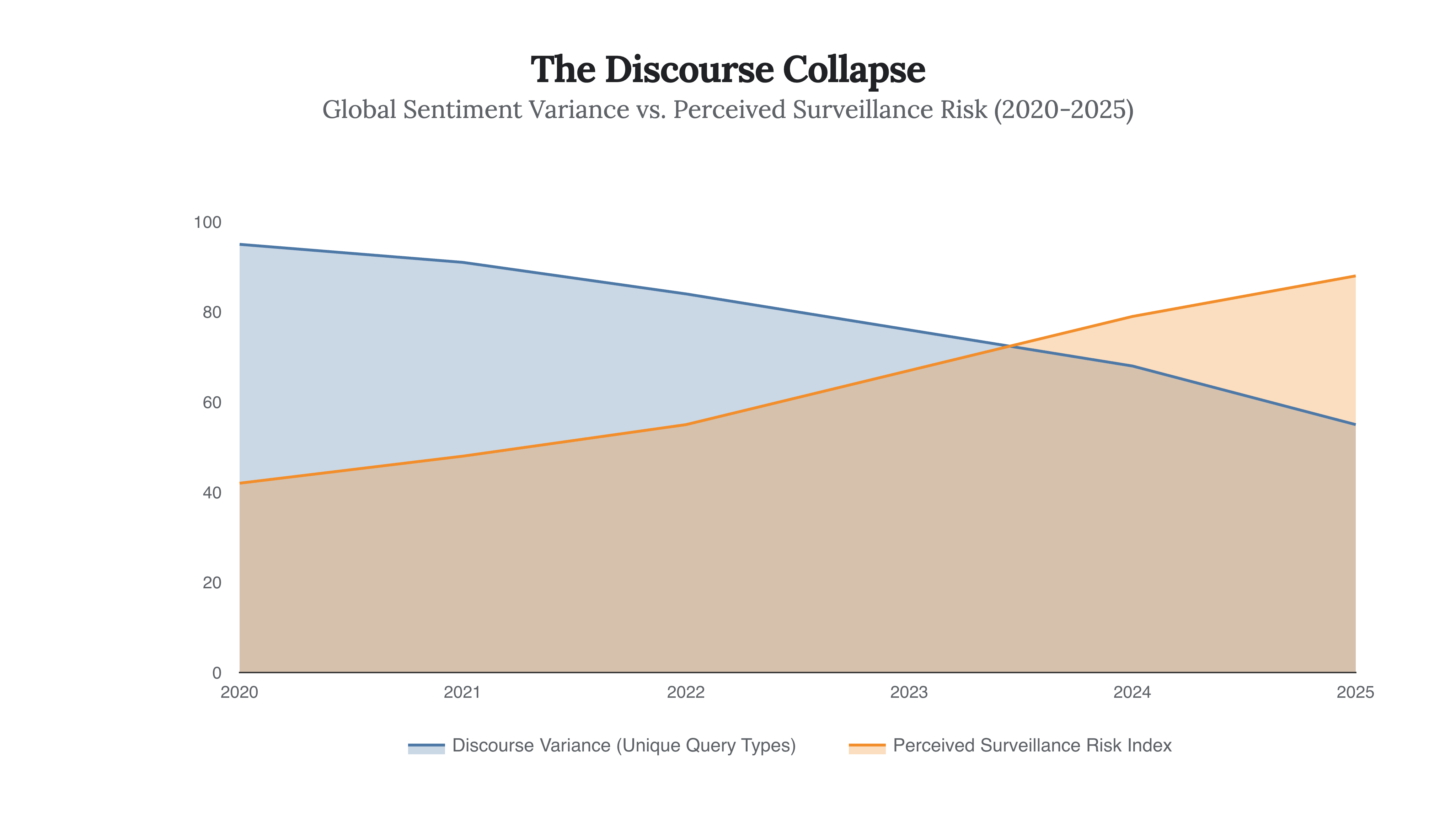
The implications for social stability are profound. When a population cannot safely explore dissenting ideas or access non-consensus information without fear of being “scored,” the capacity for societal course-correction atrophies. We have traded the chaotic resilience of free speech for the sterile stability of the filtered feed.
III. The Privacy Premium: The New Class Divider
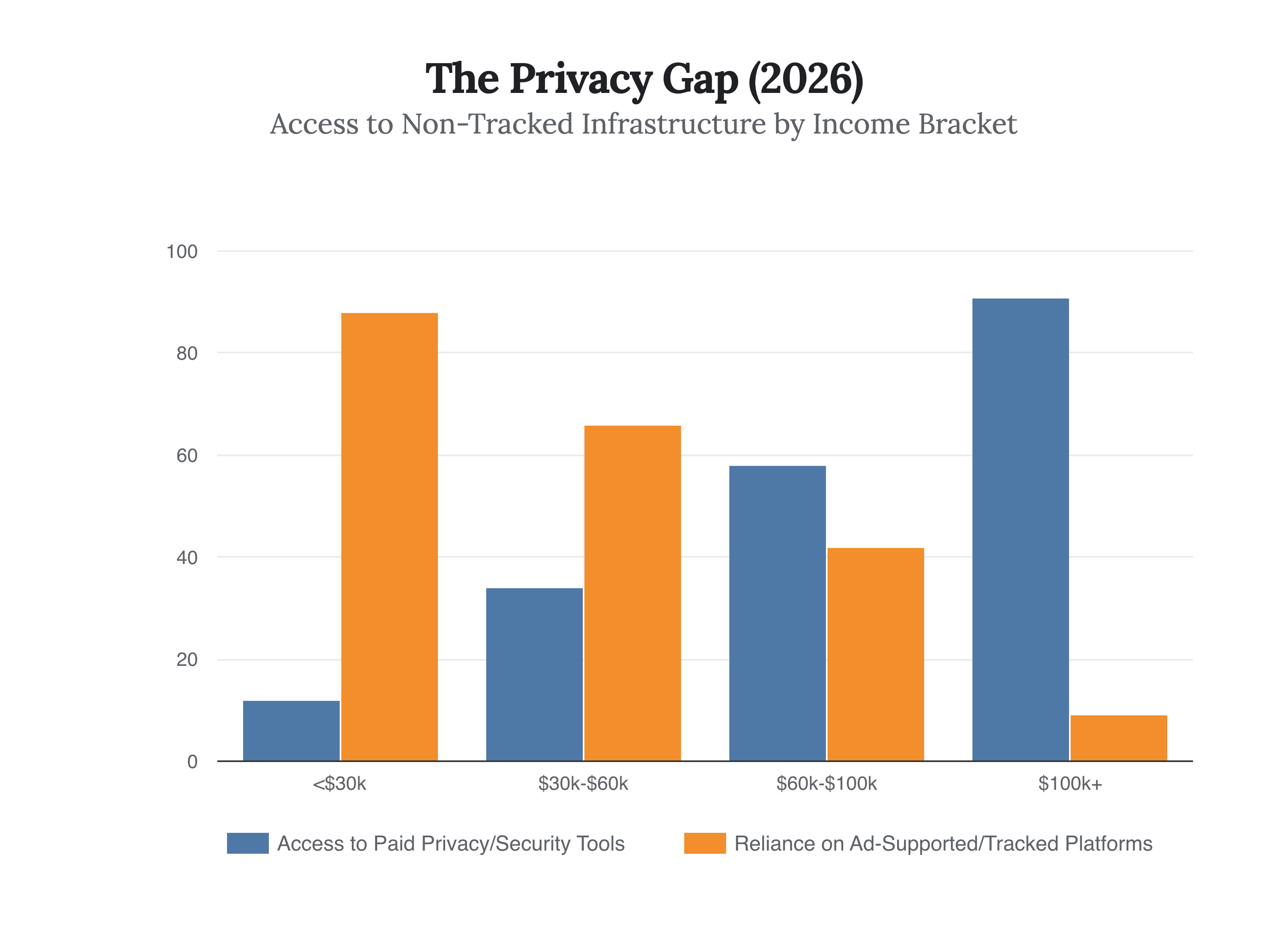
Finally, we must address the economic stratification of privacy. In 2026, privacy is no longer a right; it is a luxury asset class. The “Digital Divide” has mutated. It is no longer just about who has access to the internet, but who has the financial power to be invisible on it.
Data from late 2025 highlights a stark “Privacy Premium.” High-net-worth individuals (>$100k income) utilize end-to-end encrypted paid services, private servers, and obfuscation tools at a rate of 95%, while low-income populations (<$30k) are forced onto ad-subsidized, data-harvesting platforms where their behavior is the product. The cost of cybercrime—projected to hit $10.5 trillion annually by the end of 2025—falls disproportionately on those who cannot afford the “security tax.”
This creates a two-tier reality. The wealthy enjoy the privilege of private thought and unmonitored experimentation, while the working class operates in a digital panopticon where every click, step, and transaction is monetized and judged. The insurance premiums of the future will not be based on actuarial tables, but on your “Compliance Score,” derived from the very devices you are forced to wear.
As we navigate 2026, the strategic imperative for any leader is to recognize that data is no longer neutral. It is a modification tool. The organizations and individuals who will thrive in this era are not those who collect the most data, but those who can foster pockets of “unobserved space”—sanctuaries where innovation can occur without the paralyzing fear of the algorithm.