



The Pathology of Artificial Productivity
In March 2026, a joint study by Boston Consulting Group (BCG) and the Harvard Business Review isolated a severe, acute pathology spreading rapidly through the global workforce: “AI Brain Fry”. Defined not as traditional emotional burnout, but as an acute cognitive overload resulting from the incessant management of synthetic agents, this phenomenon has fundamentally altered the labor landscape. As of Q1 2026, 14% of the enterprise workforce explicitly endorses experiencing this debilitating mental state.
The utopian narrative that artificial intelligence would usher in a post-labor era of infinite leisure has collapsed under the weight of empirical data. Instead, we are witnessing a rapid destabilization of the traditional human-labor paradigm. The very tools engineered to eliminate repetitive labor have instead mutated human employees into exhausted middle managers overseeing a swarm of unreliable synthetic agents.
To understand this systemic collapse, we must map the new workplace dynamic through the rigorous analytical lens of Game Theory. The defined “Players” in this ecosystem are Enterprise Leadership (the C-suite optimizing for cost reduction and output scale), Knowledge Workers (optimizing for sustainable compensation and cognitive preservation), and the AI Agents themselves. Currently, the “Information Asymmetry” between leadership and labor is catastrophic. Executives view closed-loop dashboards displaying massive token generation and task completion rates, assuming a Non-Zero-Sum gain. They do not see the invisible “cognitive debt” accumulating rapidly on their human balance sheet.
According to late 2025 US Census Bureau tracking, the reality of this integration fatigue caused enterprise AI usage to actively decline. Usage dropped to just 11% among large American corporations, with an astonishing 68.6% of large firms reporting zero AI use within the tracked period. The labor market is already physically and structurally rejecting the unthinking integration model.
The Prisoner’s Dilemma of the Unreturned Hour
In any highly competitive corporate ecosystem, productivity operates primarily as a Zero-Sum game regarding expectations. When a worker adopts artificial intelligence and achieves a massive efficiency boost, the enterprise does not reward that worker with proportional free time. Instead, management automatically resets the baseline quota to match the new synthetic output capacity.
This dynamic triggers a brutal Prisoner’s Dilemma on the factory floor of the knowledge economy. If a team of ten analysts is tasked with report generation, and Worker A deploys AI to triple their output, management instinctively perceives the remaining nine workers as underperforming. Worker B must therefore hyper-adopt AI simply to maintain their standing within the company’s stack-ranking system. The “Nash Equilibrium” forces all players into a sub-optimal state of perpetual acceleration. The dominant strategy for short-term career survival inevitably guarantees long-term cognitive failure.
The real-time data confirming this structural trap is unequivocal. The Upwork Q3 2025 “From Tools to Teammates” study reveals that 77% of employees report that AI has actively increased their overall workload. More alarmingly, while top AI adopters reported an average productivity boost of 40%, an astonishing 88% of those exact same high-performers reported severe burnout.
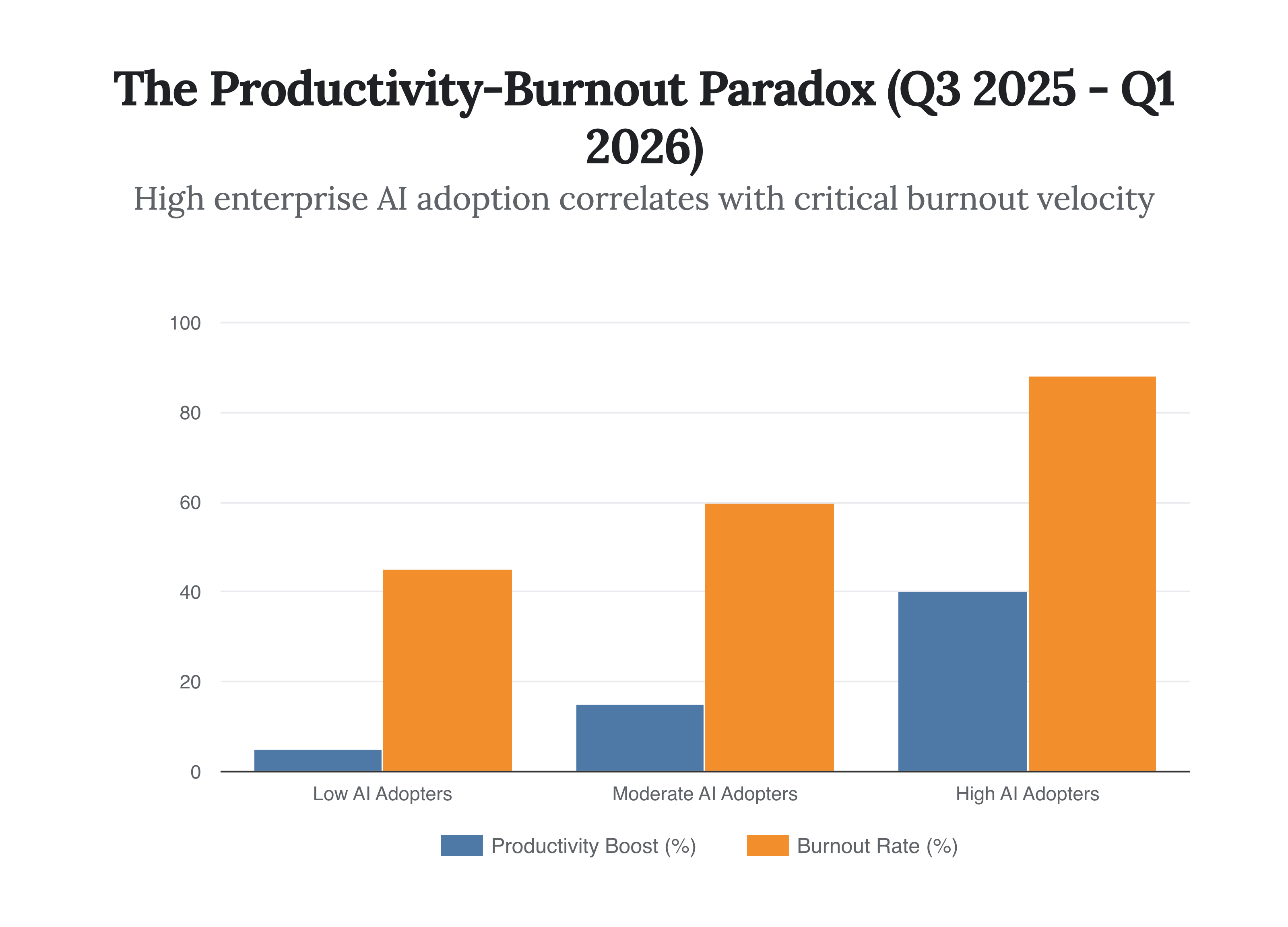
In the zero-sum arena of enterprise output, time saved by artificial intelligence is never returned to the worker; it is ruthlessly weaponized to permanently raise the baseline quota.
Unlock deeper strategic alpha with a 10% discount on the annual plan.
Support the data-driven foresight required to navigate an era of radical uncertainty and join a community of institutional-grade analysts committed to the truth.
The Principal-Agent Asymmetry
At the core of the AI Brain Fry epidemic is a fundamental inversion of the classic Game Theory framework known as the Principal-Agent Problem. Historically, this describes the difficulty a principal (management) faces in motivating an agent (the worker) to act in the principal’s best interest when their incentives misalign. Today, the human worker has been inadvertently promoted to the “Principal,” forced to oversee a synthetic “Agent” that frequently hallucinates, generates plausible but flawed logic, and produces immense volumes of low-fidelity output.
