


The 24-Hour Threshold: Quantifying Neural Bankruptcy
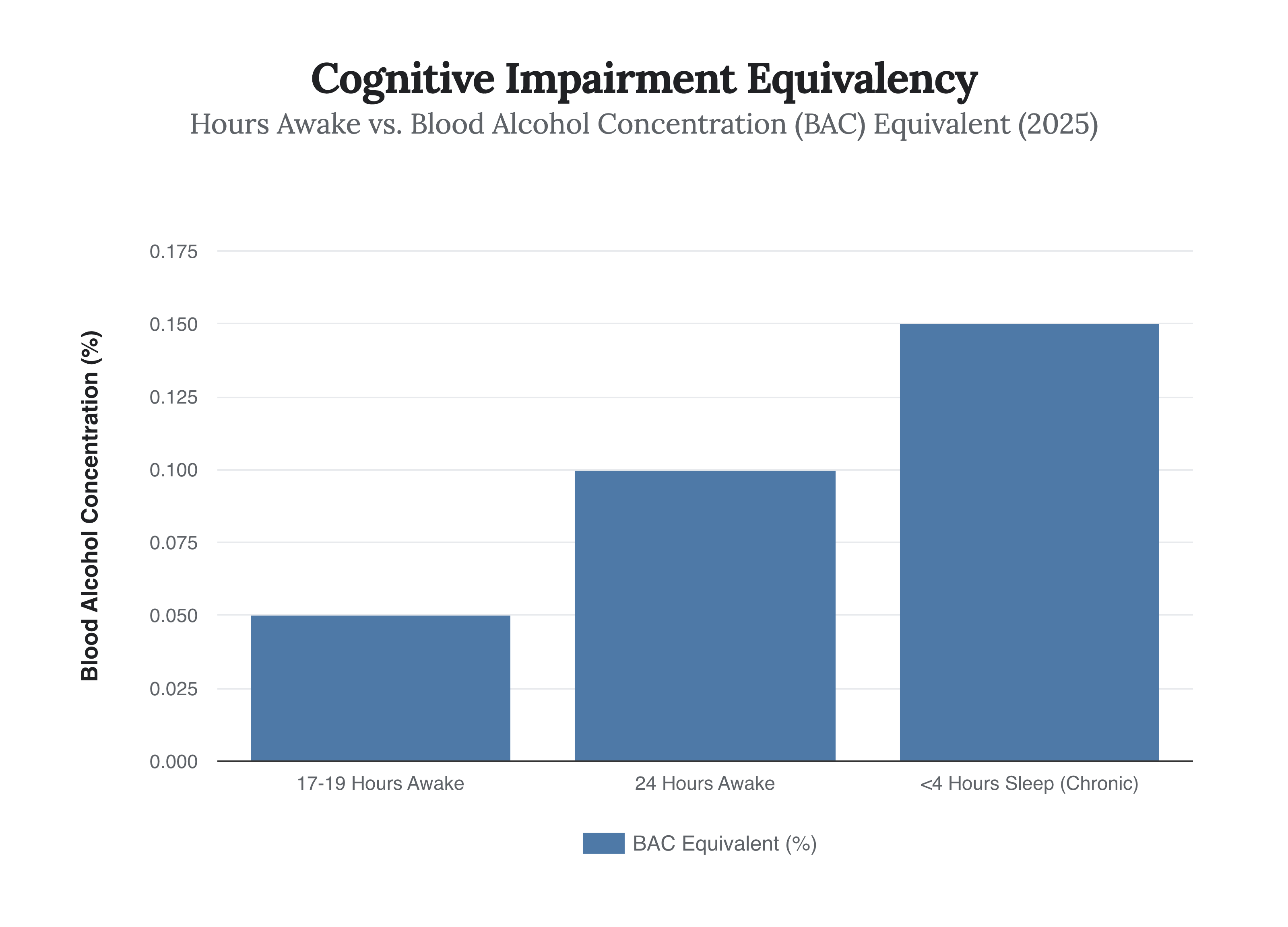
As of Q1 2025, the data regarding cognitive impairment and wakefulness has crossed a definitive threshold: we can no longer distinguish between a sleep-deprived brain and a clinically intoxicated one. Institutional research conducted throughout 2024 and finalized in early 2025 confirms that the physiological floor for human performance collapses far earlier than previously assumed. After 17 to 19 hours of continuous wakefulness, an individual’s cognitive and motor performance drops to levels equivalent to a Blood Alcohol Concentration (BAC) of 0.05%.
By the 24-hour mark, the degradation is absolute. An individual who has pulled an “all-nighter” operates with a cognitive profile matching a 0.10% BAC—a level that is significantly above the legal driving limit in nearly every jurisdiction globally, including the United States (0.08%). The data reality is clinical: your executive suite is effectively “drinking” on the job if they are consistently undersleeping.
The Prefrontal Cortex Tax: Decision-Making Under Siege
The neurobiological mechanism at play involves the rapid degradation of the prefrontal cortex—the brain’s executive control center responsible for logic, risk assessment, and impulse control. Unlike alcohol, which produces a recognizable “buzz,” sleep deprivation is insidious. Recent 2025 datasets from the National Sleep Foundation reveal that while performance metrics (reaction time, error rates) crater, the individual’s self-assessment of their own impairment remains static. The most dangerous employee in your firm is not the one who drinks on the job, but the executive who prides themselves on functioning on four hours of sleep.
This “Subjective Gap” means that a sleep-deprived leader believes they are operating at 90% capacity while their actual data-driven output is closer to 60%. In safety-critical industries, this manifests as a 11.5x higher crash rate for those getting less than four hours of sleep—a risk profile that actually exceeds that of a driver with a 0.12% BAC.
The Global Productivity Sinkhole
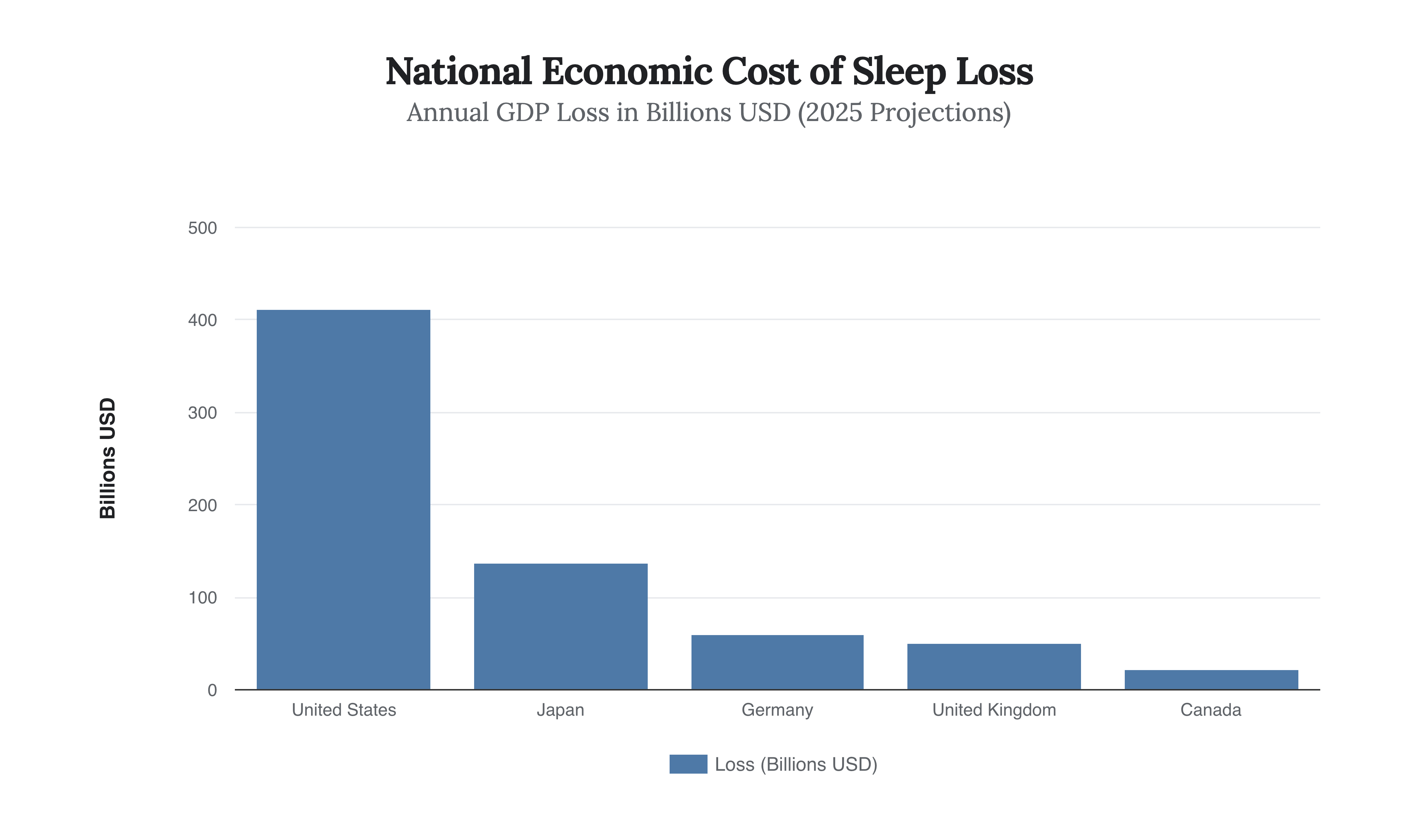
The economic ramifications are not theoretical; they are systemic. Projections for 2025 estimate that insufficient sleep costs the U.S. economy $411 billion annually, or roughly 2.28% of national GDP. This isn’t just about “missing work” (absenteeism); it is primarily driven by presenteeism—workers who are physically present but functionally impaired. Japan, often cited for its culture of overtime, faces a 2.92% GDP drag, totaling $138 billion in lost productivity. This represents a literal drainage of national capital into a void of cognitive inefficiency.
Unlock deeper strategic alpha with a 10% discount on the annual plan.
Support the data-driven foresight required to navigate an era of radical uncertainty and join a community of institutional-grade analysts committed to the truth.
The Architecture of Workplace Dysfunction
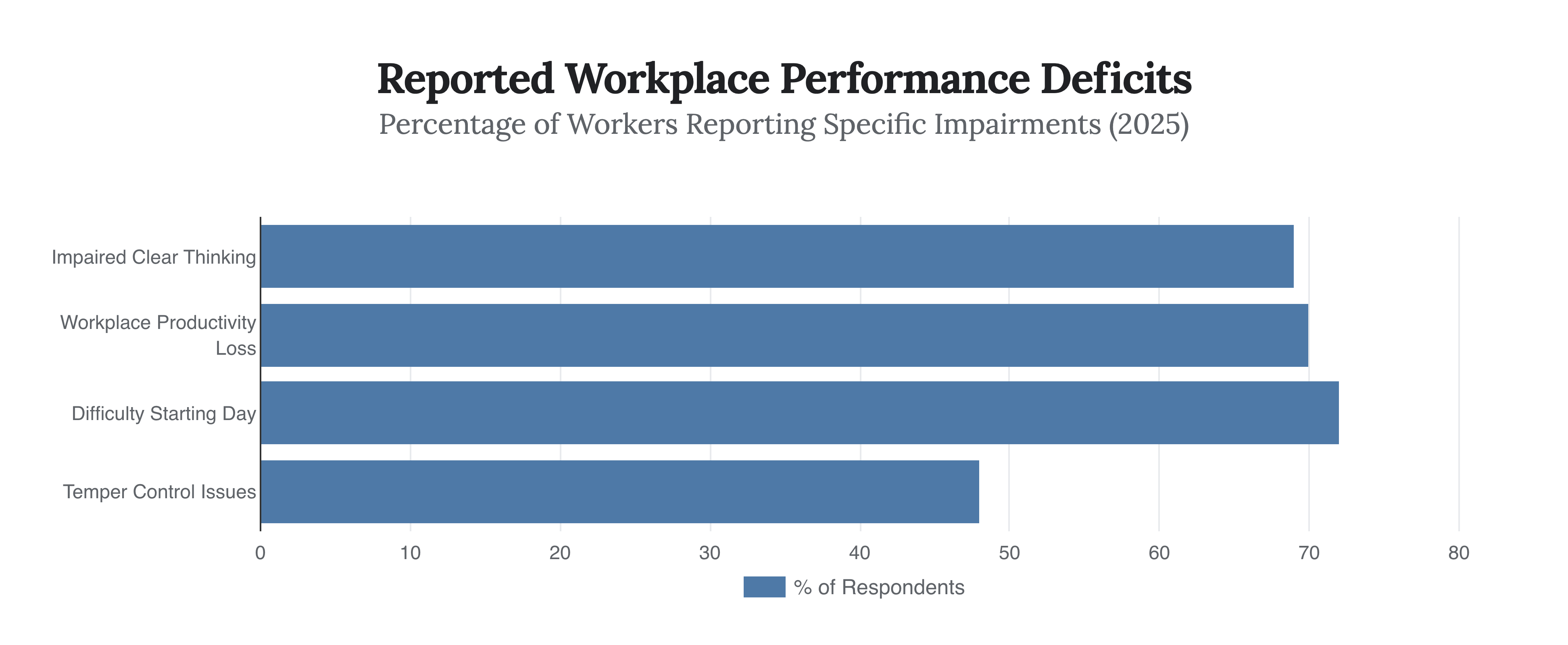
Drilling down into the 2025 survey data, we see the specific ways this cognitive “drunk” state affects the modern workforce. Clear thinking is cited as impaired by 69% of sleep-deprived adults. Perhaps more concerning for organizational culture is the 48% who reported difficulty controlling their temper. This suggests that a significant portion of “toxic” workplace culture and management friction is actually a biological byproduct of chronic sleep restriction. When the amygdala—the emotional center—loses its prefrontal regulation, leadership becomes reactive, short-sighted, and volatile.
Post-Accident Forensics: The March 2024 Breakthrough
Historically, the primary difference between sleep deprivation and alcohol was the ability to measure it. A breathalyzer provides an objective, legally admissible data point for alcohol. For sleep, we relied on self-reporting, which is notoriously unreliable. However, a groundbreaking development in March 2024 has changed the litigation landscape: researchers at Monash University and the University of Birmingham successfully developed a blood test that detects 24-hour sleep deprivation with 99.2% accuracy. This biomarker test is moving into forensic validation, meaning that by 2026, “I was just tired” will be as legally actionable as “I had five drinks.”
The Institutional Counter-Response
Forward-thinking organizations are already shifting their strategy from “hustle porn” to “biological hygiene.” Data from the CDC’s NIOSH trainings suggests that shift-work protocols are being redesigned to avoid the 24-hour wakefulness trap. The goal is no longer to see who can stay awake the longest, but who can maintain the highest “Cognitive Liquidity.” If you treat your brain like a capital asset, you cannot afford to operate it in a state of high-interest biological debt. In an era where AI can handle the repetitive tasks, the human competitive advantage is high-level executive function—a resource that is the first to be liquidated by sleep deprivation.