



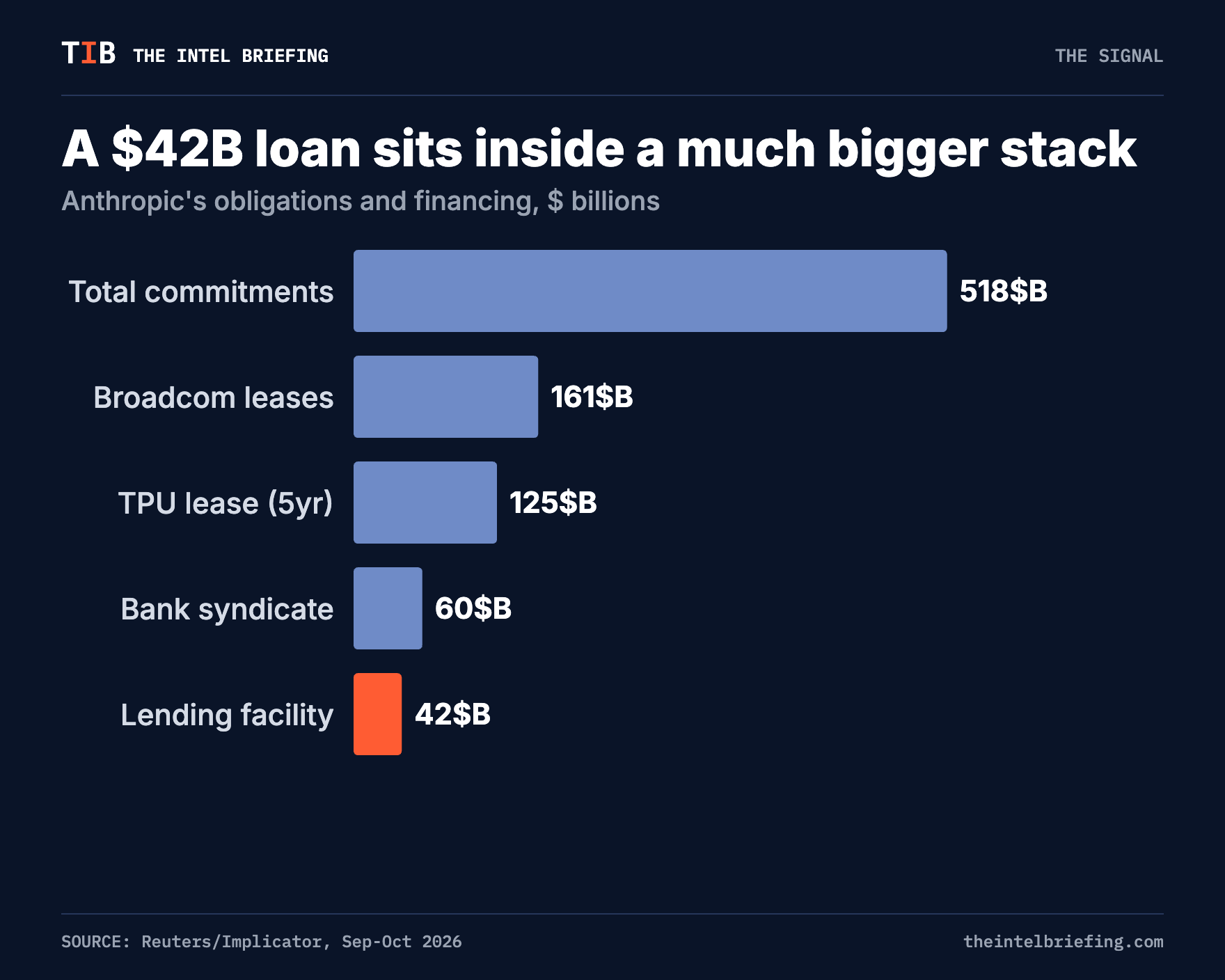
Anthropic’s prospectus lists $518 billion of compute commitments, about 80% non-cancelable, against $4.59 billion of 2025 revenue. This week the company that supplies the chips started lending the money to pay for them. A chipmaker, a $42 billion loan, and a $60 billion bank syndicate now sit between AI demand and AI credit.
What changed
On 28–29 September, Anthropic’s leaked IPO prospectus showed $518 billion in multi-year compute obligations, roughly 80% of them non-cancelable, alongside $161.2 billion of Broadcom-related equipment lease obligations.
On 1 October, CNBC and Reuters reported, citing a Broadcom filing, that Broadcom will lend Anthropic up to $42 billion in convertible notes, usable only to pay for leasing the chips Broadcom helps design. Implicator’s read of the 10-Q puts that facility at roughly a third of Anthropic’s $125.2 billion, five-year TPU lease commitment.
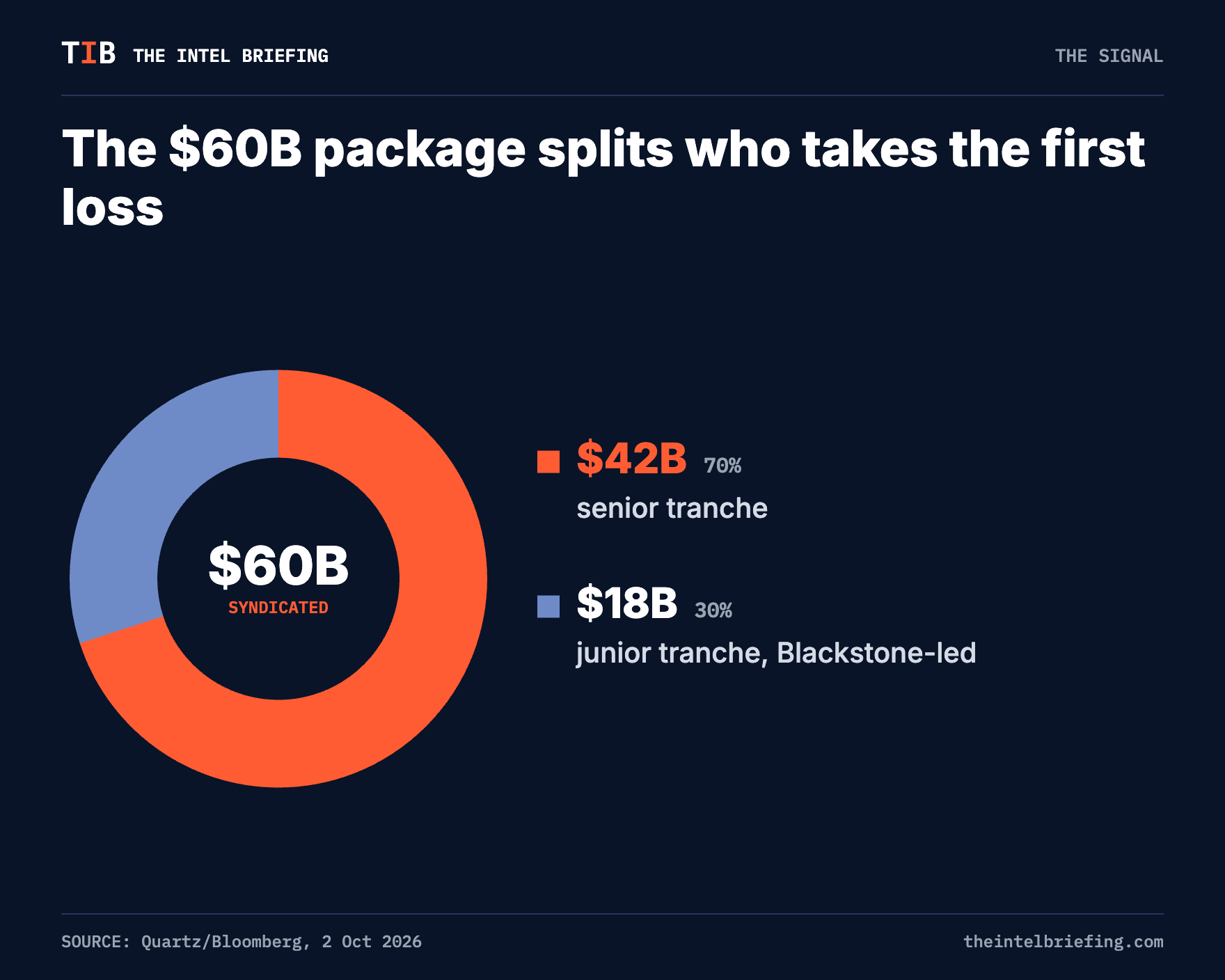
On 2 October, Quartz, citing Bloomberg, reported that banks have begun syndicating $60 billion behind the facility: a $42 billion senior-secured tranche and an $18 billion junior tranche led by Blackstone, which is putting in $9 billion of its own capital.
The second-order effect
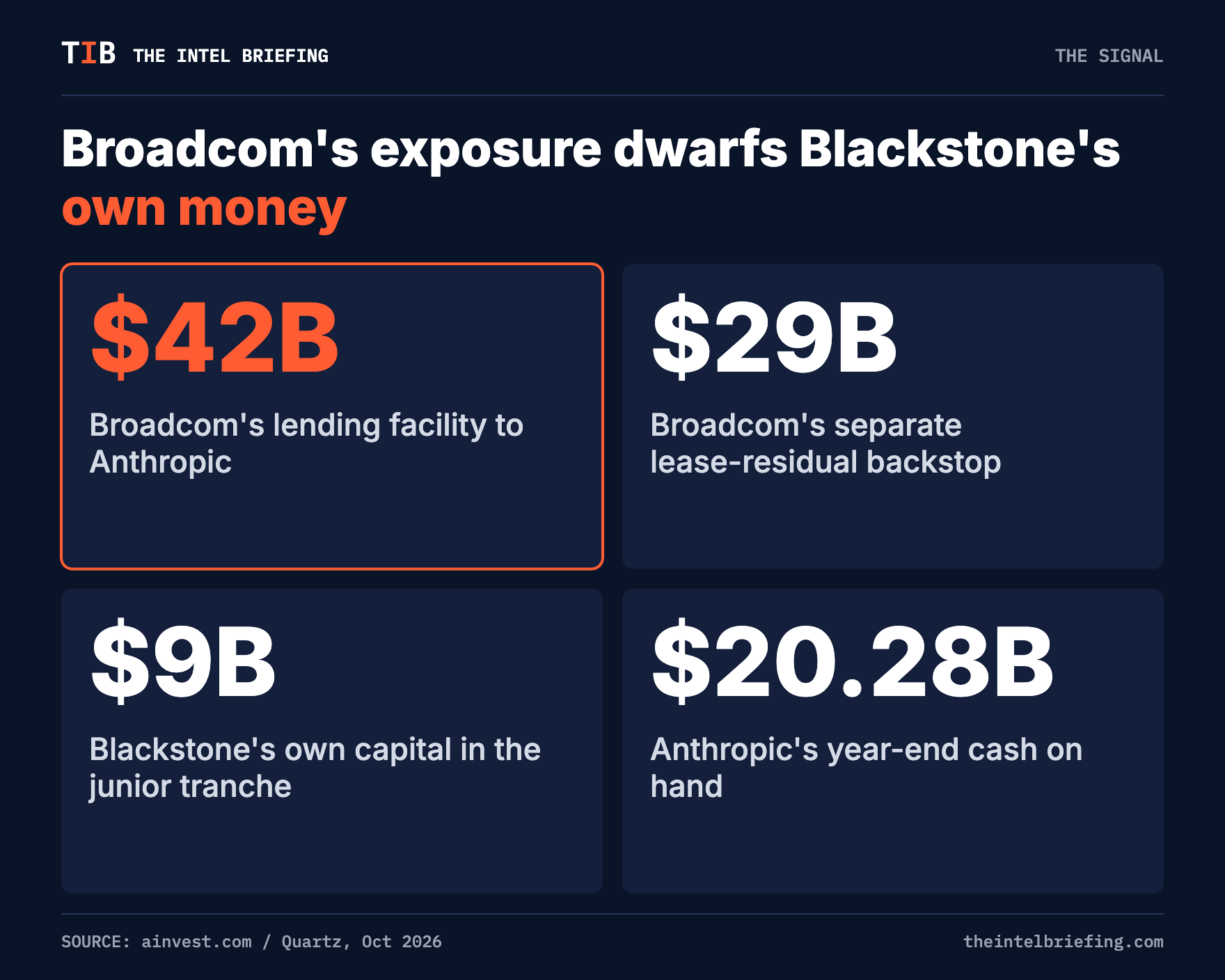
Follow one dollar. Broadcom lends Anthropic (or a leasing vehicle) the cash. Anthropic uses it to lease racks built around Google’s TPU chips, which Broadcom helped design and which Broadcom is now separately on the hook for: an ainvest.com report describes a lease-residual backstop capped at about $29 billion once all the racks are deployed. The same filing that discloses the $42 billion lending facility also discloses the $29 billion guarantee.
Banks and private credit then buy pieces of the $60 billion package, taking on the credit risk that was previously Broadcom’s alone. Premia Advisors notes the $60 billion syndication figure should not simply be added to the $42 billion lending facility, since the two overlap; the point is who ends up holding the paper, not the raw sum.
The effect: chip demand and chip credit risk now move on the same curve. If Anthropic’s revenue — $11.5 billion in Q2 2026, up from $4.59 billion for all of 2025 — slows before the lease payments are due, the shortfall shows up first as a loan problem at Broadcom, then as a mark on the senior and junior tranches now being sold to banks and Blackstone.
Who pays, who gains
Broadcom carries up to $42 billion of lending exposure to one customer, plus a separate $29 billion lease-residual backstop, according to its 10-Q as reported by ainvest.com. In return, Anthropic is expected to become Broadcom’s largest compute customer in 2027.
Blackstone is putting $9 billion of its own capital into an $18 billion junior tranche, per Quartz/Bloomberg — the layer that absorbs losses first if the structure underperforms, in exchange for the higher yield private credit charges for that position.
Anthropic carries $161.2 billion of Broadcom-related lease obligations inside its $518 billion total, per the prospectus as reported by Reuters, against $20.28 billion of year-end cash and a 2025 revenue base where two customers supplied nearly a quarter of the total. The prospectus separately lists commitments of $111.1 billion with Google and $110 billion with Amazon, among the six partners behind the $518 billion figure — two counterparties that are, at once, Anthropic’s cloud provider, its customer and its investor.
Senior lenders in the $42 billion tranche get first claim on repayment if the structure goes wrong; the banks’ fee income from arranging a $60 billion syndication is the near-term gain, before any of that risk is tested by a real shortfall.
What to watch
Anthropic’s implied 2027 capex and lease schedule, as it surfaces around Microsoft’s 27 Oct and Alphabet/Amazon’s 27–28 Oct earnings calls. Current baseline: $518 billion in total commitments, 80% non-cancelable. Threshold: any downward revision to the pace of spend, or new language narrowing “non-cancelable,” is the signal to watch.
Pricing on the $60 billion syndication as banks market the $42 billion senior tranche. Current baseline: terms not yet public as of 2 October. Threshold: a spread wide enough to signal lenders are pricing in customer-concentration risk, not just chip-supply risk.
Whether a second chipmaker adopts the lend-to-lease structure. Current baseline: one facility, one chipmaker, one customer. Threshold: a second vendor-financing deal of comparable size would turn this from a bilateral arrangement into a sector-wide credit channel.
On Wednesday
The Dossier asks the question this post deliberately leaves open: if Anthropic’s revenue growth slows before its lease payments come due, who absorbs the loss first — Broadcom, the senior lenders, or Blackstone’s junior tranche — and under what covenant. Members get the scenario odds, the base rate for vendor-financing structures in prior tech cycles, and the specific thresholds in the filings that would move our call.
Sources: CNBC/Reuters · Quartz/Bloomberg · Implicator — $518B commitments · Implicator — $42B facility · ainvest.com · Reuters — prospectus · Global Money Index · sabr-labs · Konsulteer · Premia Advisors · Trefis