


The $136 Billion Pivot
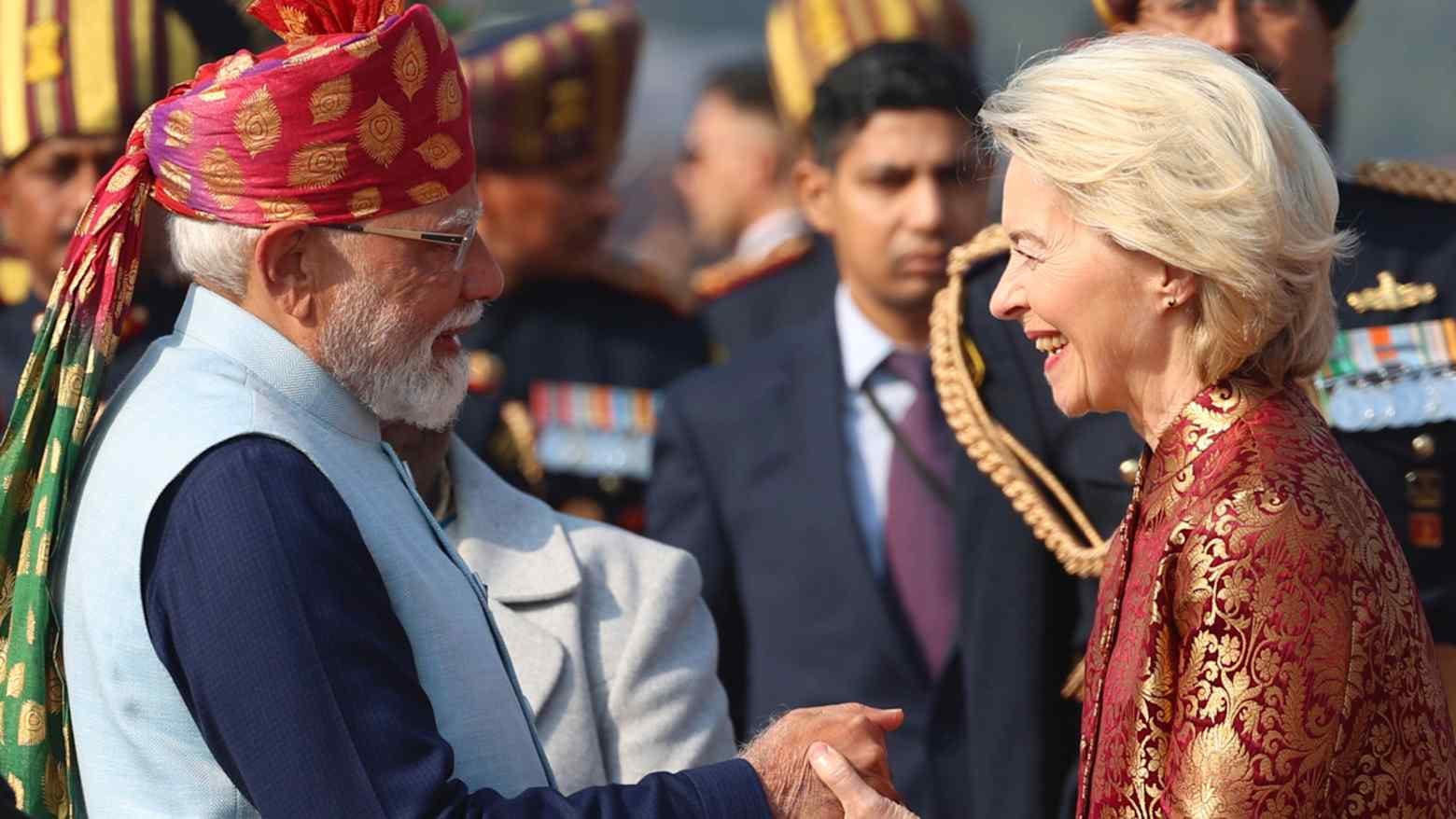
The ink is barely dry on the January 27, 2026 announcement concluding the India-EU Free Trade Agreement, yet the victory laps in Brussels and New Delhi obscure a more complex reality. While Commission President Ursula von der Leyen calls this the “Mother of All Deals,” the data suggests this is less about economics and more about survival.
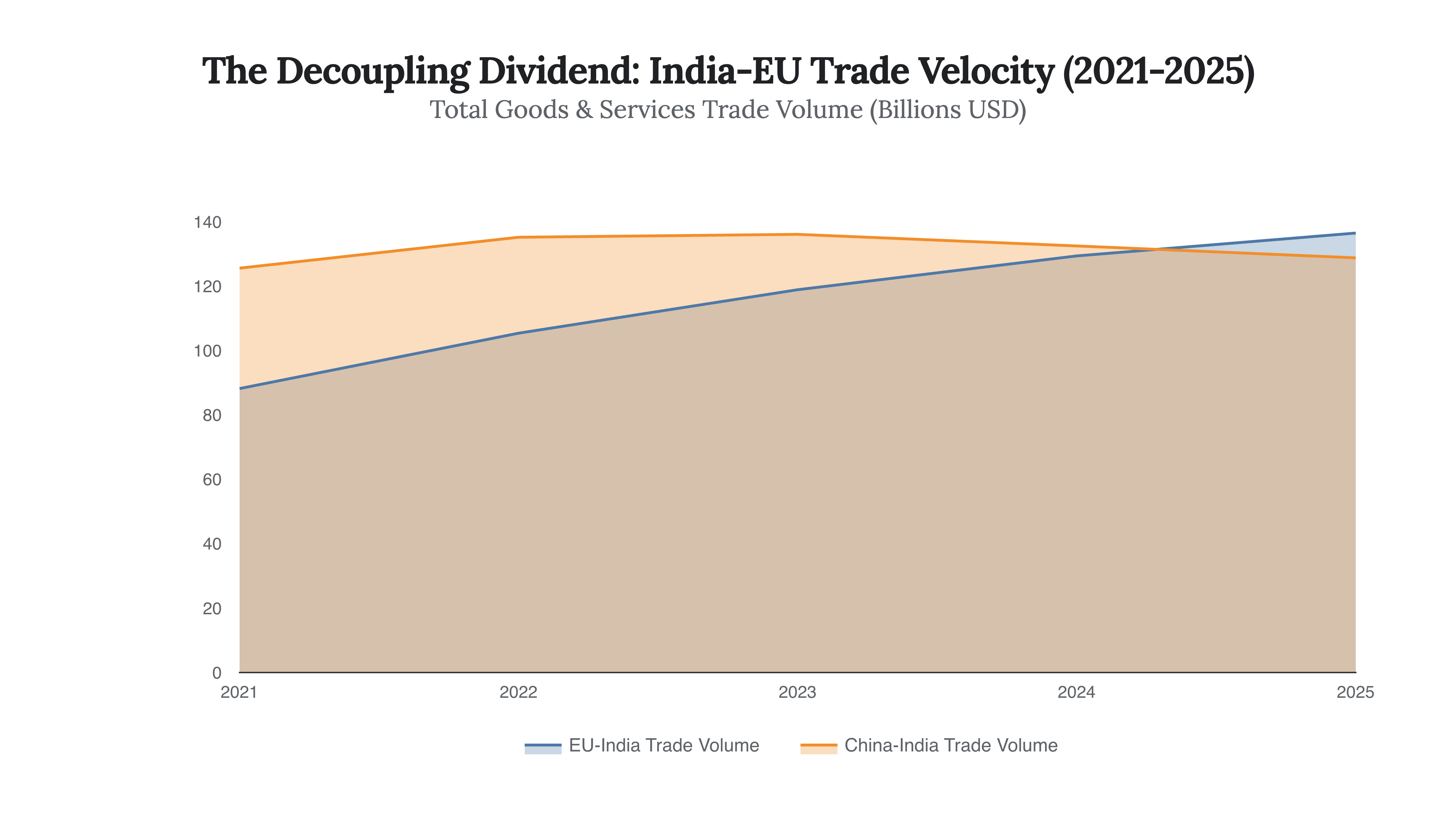
The headline figures are staggering. Bilateral goods trade for FY 2024-25 hit $136.5 billion, cementing the EU as India’s largest trading partner. But the signal here isn’t the volume; it’s the velocity. Since the post-pandemic reset, trade velocity between the two blocs has outpaced India-US growth, signaling a structural realignment of supply chains. Europe is not just diversifying; it is aggressively effectively paying a premium to exit the Chinese orbit.
The chart below visualizes this surge. Note the acceleration in 2024-2025 as the Trade and Technology Council (TTC) frameworks began to harden into actual purchase orders.
The strategic implication is unambiguous: Europe is trading market access for geopolitical insurance, effectively underwriting India’s industrial rise to prevent a Sinocentric Asia. This is not free trade; it is a defensive industrial policy disguised as a tariff reduction schedule. The EU has granted tariff cuts on 96.6% of goods—including the sensitive automotive sector—because the alternative (continued reliance on Shenzhen and Shanghai) has become an existential risk to European sovereignty.
The Carbon Wall: The New Iron Curtain
Here lies the second-order effect that the press releases ignored. As of January 1, 2026, the EU’s Carbon Border Adjustment Mechanism (CBAM) shifted from its “reporting phase” to its “payment phase.” This is the friction point that threatens to neutralize the tariff gains of the FTA before they even materialize.
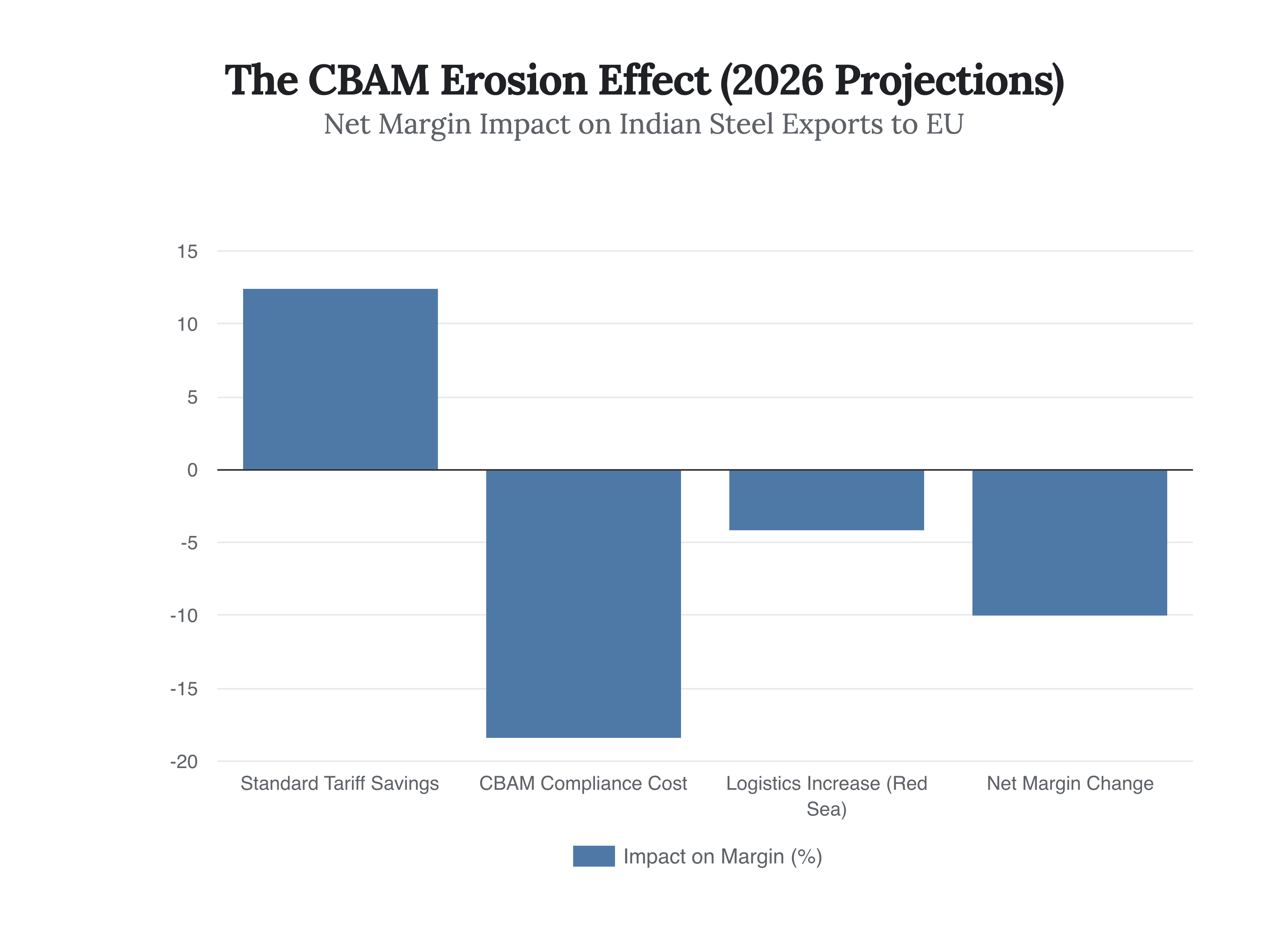
Indian steel and aluminum exporters are now facing a margin compression event of historic proportions. While the FTA eliminates customs duties, CBAM imposes a carbon levy that acts as a de facto 20-30% tariff on dirty industrial inputs. The data reality for Q1 2026 is brutal: Indian exporters, particularly in the Blast Furnace-Basic Oxygen Furnace (BF-BOF) steel routes, are seeing their price competitiveness erode in real-time.
Unlock deeper strategic alpha with a 10% discount on the annual plan.
Support the data-driven foresight required to navigate an era of radical uncertainty and join a community of institutional-grade analysts committed to the truth.
The Global Trade Research Initiative (GTRI) models that Indian exporters will need to cut prices by 15-22% just to maintain current market share in the EU. This creates a bifurcated market: clean steel for Europe, dirty steel for domestic consumption or the Global South. The “Green Wall” is effectively forcing a capital expenditure cycle on Indian industry that local balance sheets cannot support without European FDI.
This dynamic creates a specific vulnerability. While diplomats toast the FTA in Delhi, Indian steel mills are staring at a 22% margin compression that tariff cuts can’t fix—the Carbon Wall is the new Iron Curtain.
The Investment Pivot: Capital as a Weapon
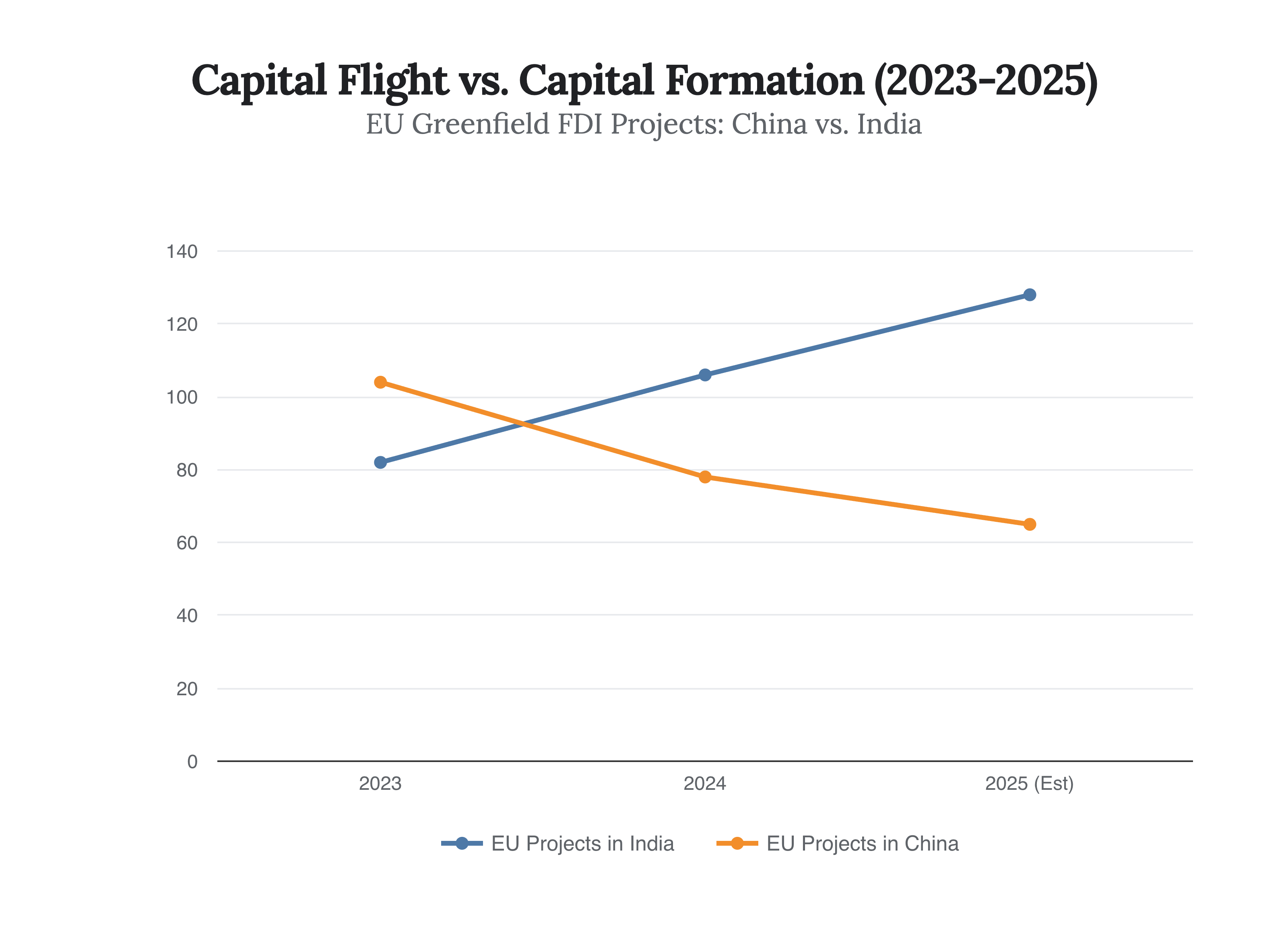
If goods trade is the battlefield, Foreign Direct Investment (FDI) is the supply line. The data from 2024-2025 shows a sharp divergence. As capital flees the volatility of the Chinese real estate crisis and the opacity of Beijing’s regulatory crackdowns, it is finding a home in India’s PLI (Production Linked Incentive) sectors.
Cumulative EU FDI into India reached nearly $117.4 billion by late 2024. But look at the composition: it has shifted from traditional FMCG (Fast-Moving Consumer Goods) to high-value manufacturing—electronics, green hydrogen, and automotive components. The second meeting of the Trade and Technology Council (TTC) in February 2025 accelerated this, creating a “white-list” for technology transfers that were previously restricted.
This is the “China Plus One” strategy moving from boardroom slides to balance sheet reality. European capital is now funding the very infrastructure India needs to overcome the CBAM hurdle. The €500 million committed for India’s green transition is a drop in the ocean, but the private capital following it—estimated at €12 billion over the next three years—is the real signal.
The Forecast
The completion of the FTA negotiations in Jan 2026 is a watershed moment, but not for the reasons the mainstream press suggests. It does not guarantee smooth sailing. Instead, it inaugurates a period of high-friction integration.
Expect the next 12 months to be defined by “Regulatory Warfare.” The EU will use CBAM and the Deforestation Regulation (EUDR) to force Indian regulatory alignment. India will counter with non-tariff barriers on European digital services. However, the trajectory is locked in. The geopolitical cost of failure is too high for Brussels.
The Reality: The EU has realized it cannot re-industrialize alone. It needs Indian labor and scale to compete with Chinese overcapacity. India has realized it cannot grow on domestic consumption alone. It needs European technology to avoid the middle-income trap. The FTA is the marriage contract; CBAM is the pre-nuptial agreement that ensures the relationship remains on European terms.