


The Bank of England’s Monetary Policy Committee (MPC) finds itself in a precarious position, navigating the treacherous crosscurrents of persistently elevated inflation and a decelerating economy. After a series of aggressive rate hikes to tame the post-pandemic surge in prices, the Bank has pivoted to a more cautious easing cycle, reducing the Bank Rate to 4.0% in a series of finely balanced decisions.
However, with inflation still stubbornly above the 2% target and growth forecasts showing signs of fragility, the path forward is fraught with uncertainty. This briefing deconstructs the key drivers shaping the MPC’s decisions, analyzes the divisions within the committee, and provides a forward-looking assessment of the strategic challenges and potential trajectory for UK interest rates into 2026.
The Inflation Conundrum: A Shifting Battlefield
The primary mandate of the Bank of England is to maintain price stability, defined by a 2% inflation target. The recent past has seen a dramatic battle against a multi-decade high in inflation, which peaked at 11.1% in October 2022. While the headline rate has fallen significantly, it remained at 3.8% in September 2025, nearly double the target. This persistence is forcing the MPC to maintain a restrictive monetary policy stance, even as the economy weakens.
The Stickiness of Services and Wages
A key area of concern for the MPC is the stickiness of services inflation and wage growth. While goods inflation has cooled, the domestically-driven services sector continues to exhibit price pressures. This is closely linked to the labor market, where average weekly earnings growth, though moderating, remains elevated. The MPC is wary of a wage-price spiral, where higher wages feed into higher prices, which in turn leads to demands for even higher wages. The Bank’s cautious approach to rate cuts is a direct consequence of this risk. Analysts expect pay growth to slow to around 3.5% by the end of 2025 and 3% by mid-2026, a development the MPC will be monitoring closely.
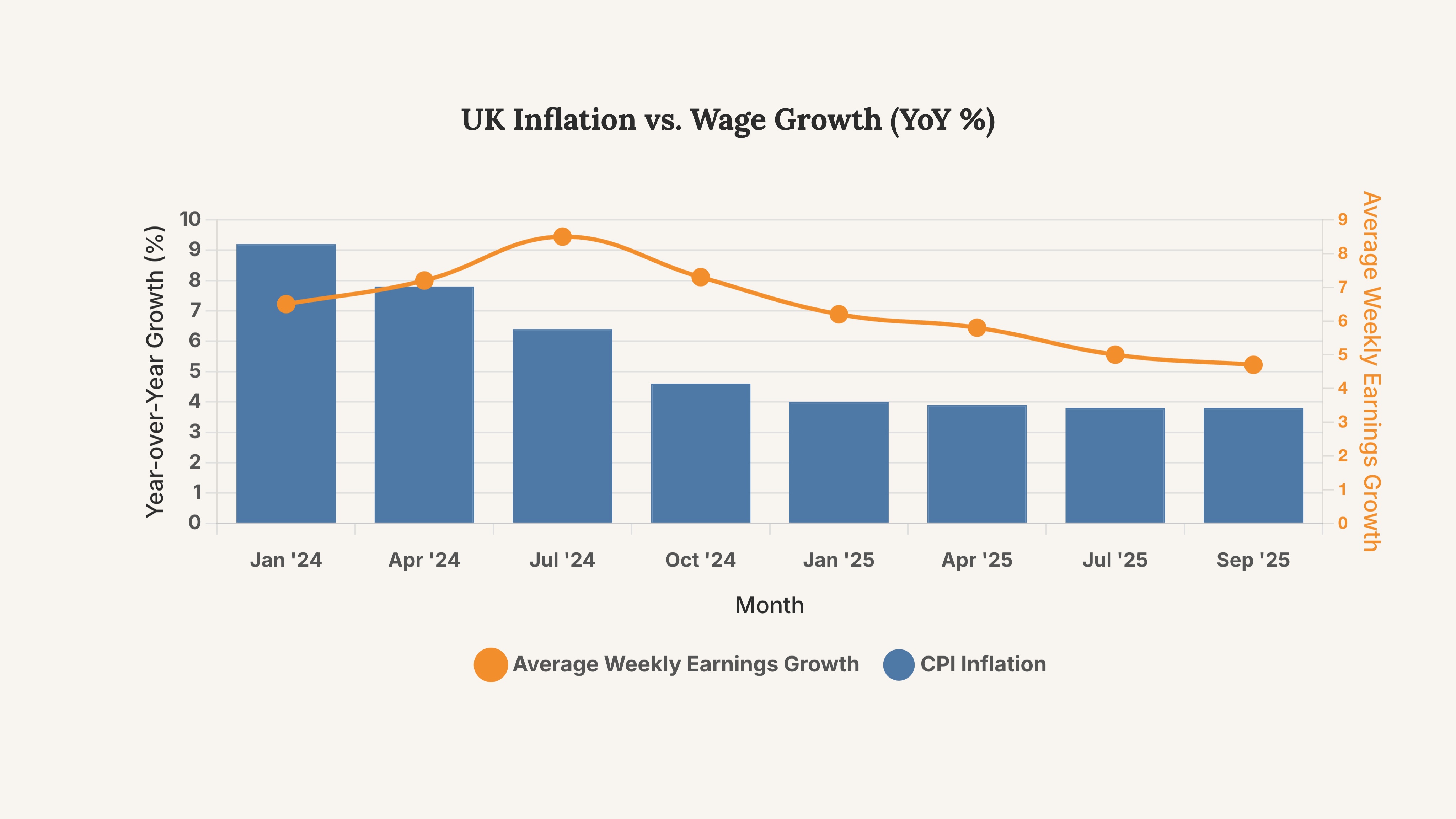
This chart illustrates the narrowing but still positive gap between wage growth and inflation, a key indicator for the Bank of England in assessing domestic inflationary pressures.
“We set monetary policy in a forward-looking manner to return inflation to the 2% target sustainably over the medium term. That sometimes means that we will be able to look through developments that we think are unlikely to last.” - Governor Andrew Bailey, August 2025
External Shocks and Geopolitical Risks
Global factors continue to pose an upside risk to the inflation outlook. Disruptions to global trade and volatile energy prices remain a concern. Furthermore, the geopolitical landscape adds another layer of complexity. The Bank must consider the potential inflationary impact of international events on the UK economy. These external pressures complicate the MPC’s task of bringing inflation back to target without unduly stifling economic activity.
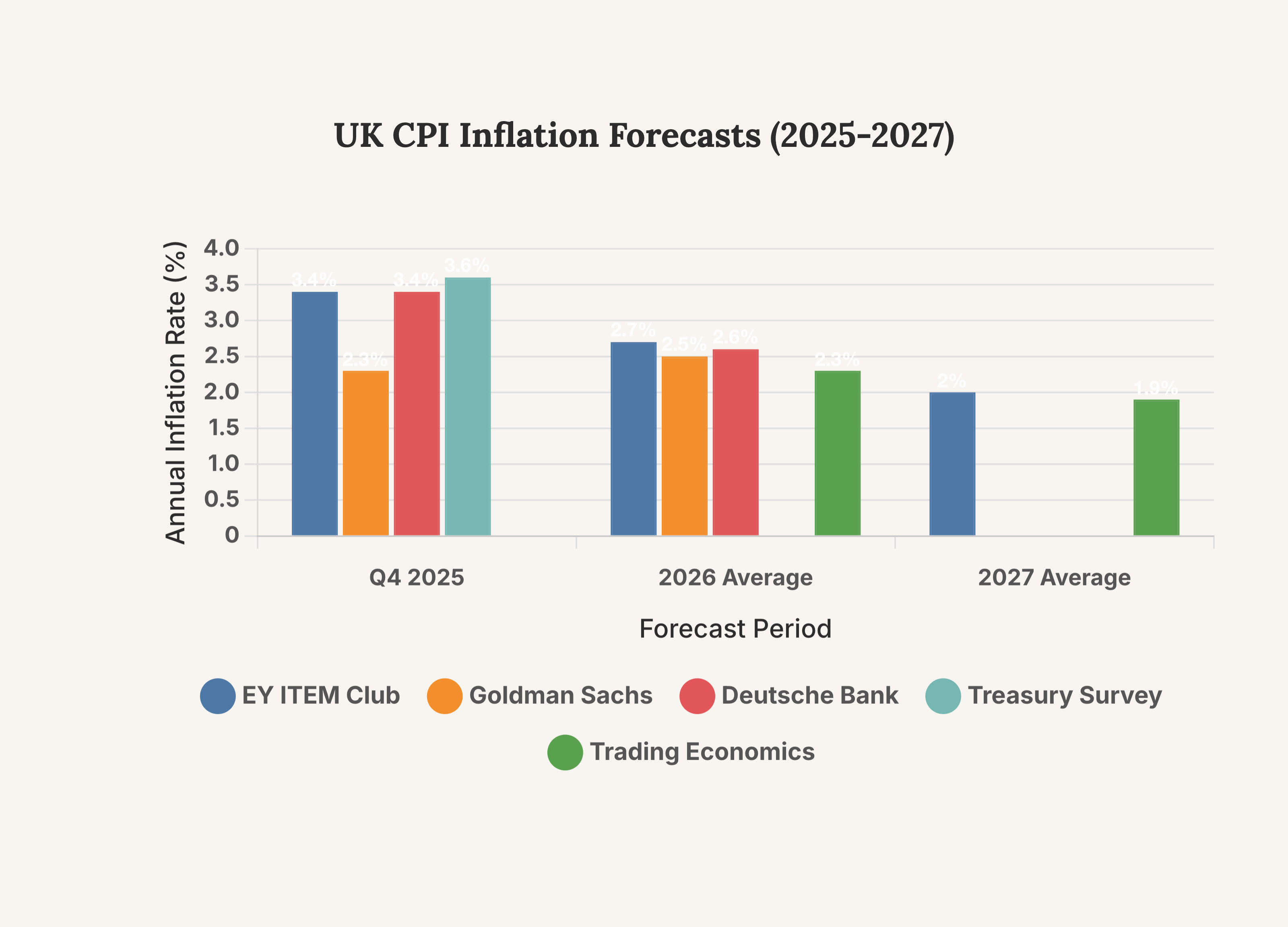
This chart compiles inflation forecasts from various institutions, showing a consensus that inflation will trend downwards but may not reach the 2% target until 2027.
The Growth Imperative: A Slowing Engine
While battling inflation, the Bank of England is also contending with a sluggish economy. While the UK has avoided a deep recession, growth prospects remain subdued. The EY ITEM Club upgraded its 2025 GDP growth forecast to 1.5%, but anticipates a slowdown to 0.9% in 2026. This reflects the impact of tighter fiscal policy and the lagged effects of previous interest rate hikes.
Consumer and Business Headwinds
Higher borrowing costs are weighing on both consumers and businesses. While a slight rise in household consumption is expected as energy price pressures fade, overall consumer spending remains modest. Business investment, a key driver of long-term growth, is also forecast to slow significantly in 2026. The combination of these factors points to a period of below-trend growth for the UK economy, increasing the pressure on the MPC to consider further rate cuts to support activity.
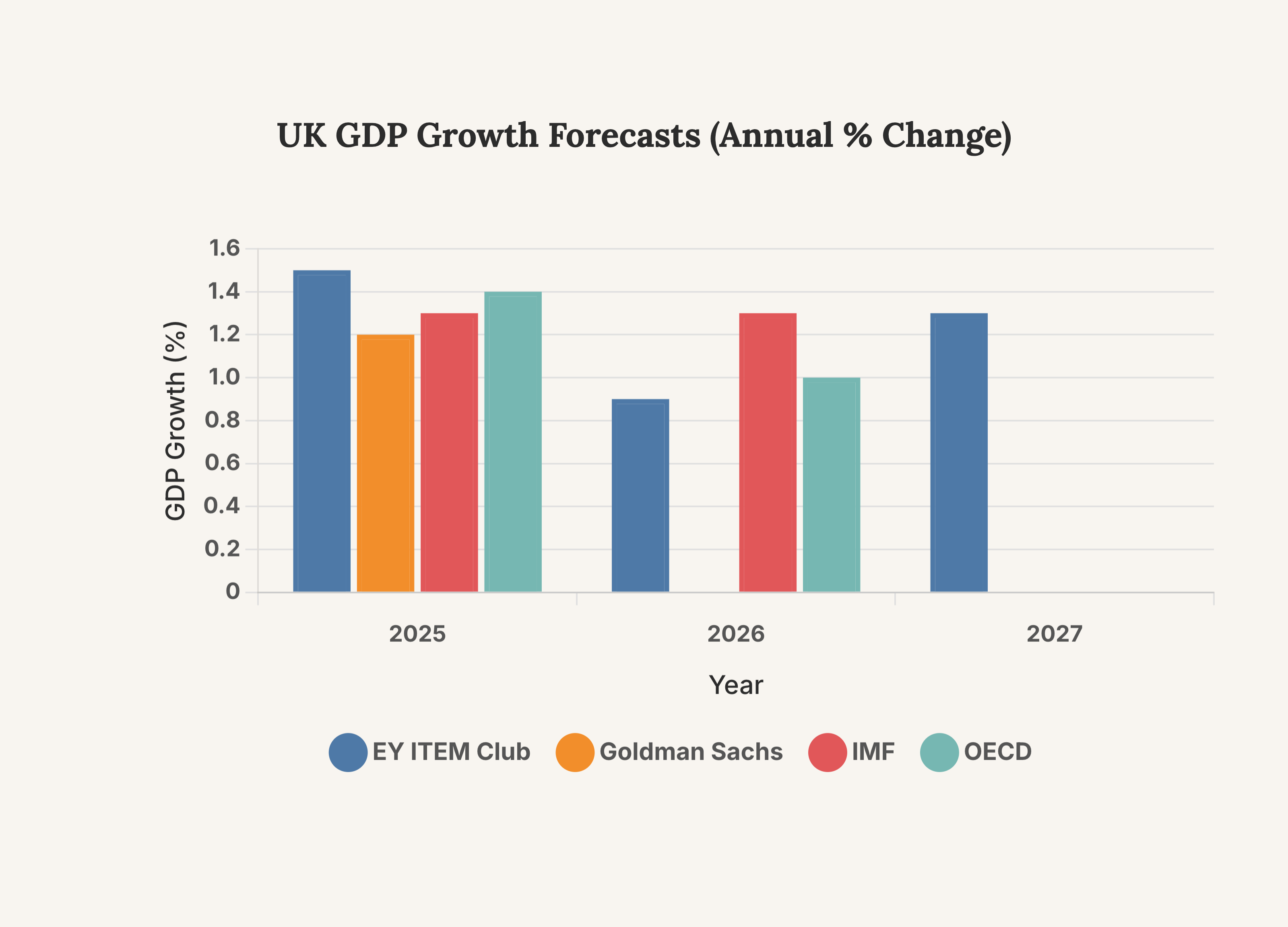
This chart compares GDP growth forecasts, highlighting the expected slowdown in 2026 and the differing views on the pace of the UK’s economic expansion.
A Divided Committee: Doves, Hawks, and the Deciding Vote
The challenge of balancing inflation and growth has created clear divisions within the Monetary Policy Committee. Recent interest rate decisions have been characterized by split votes, reflecting the diverse views on the appropriate path for monetary policy. Some members, often referred to as ‘doves’, have argued for earlier and more significant rate cuts, citing the risks to growth and a loosening labor market. Others, the ‘hawks’, remain more concerned about the persistence of inflation and have voted to hold rates steady.
“The decision will be close, as there are still also arguments to look for a hold. MPC commentary since the September meeting has remained cautious with respect to near-term rate cuts.” - Goldman Sachs Economists, November 2025
The August 2025 meeting, which saw a rate cut to 4.0%, was particularly notable for its drama. An initial 4-4-1 stalemate, with one member voting for a larger 50-basis-point cut, required a historic second vote to reach a decision. This highlights the fine margins on which these decisions are being made and the pivotal role of Governor Andrew Bailey in forging a consensus. The composition of these votes in upcoming meetings will be a critical indicator of the Bank’s future direction.
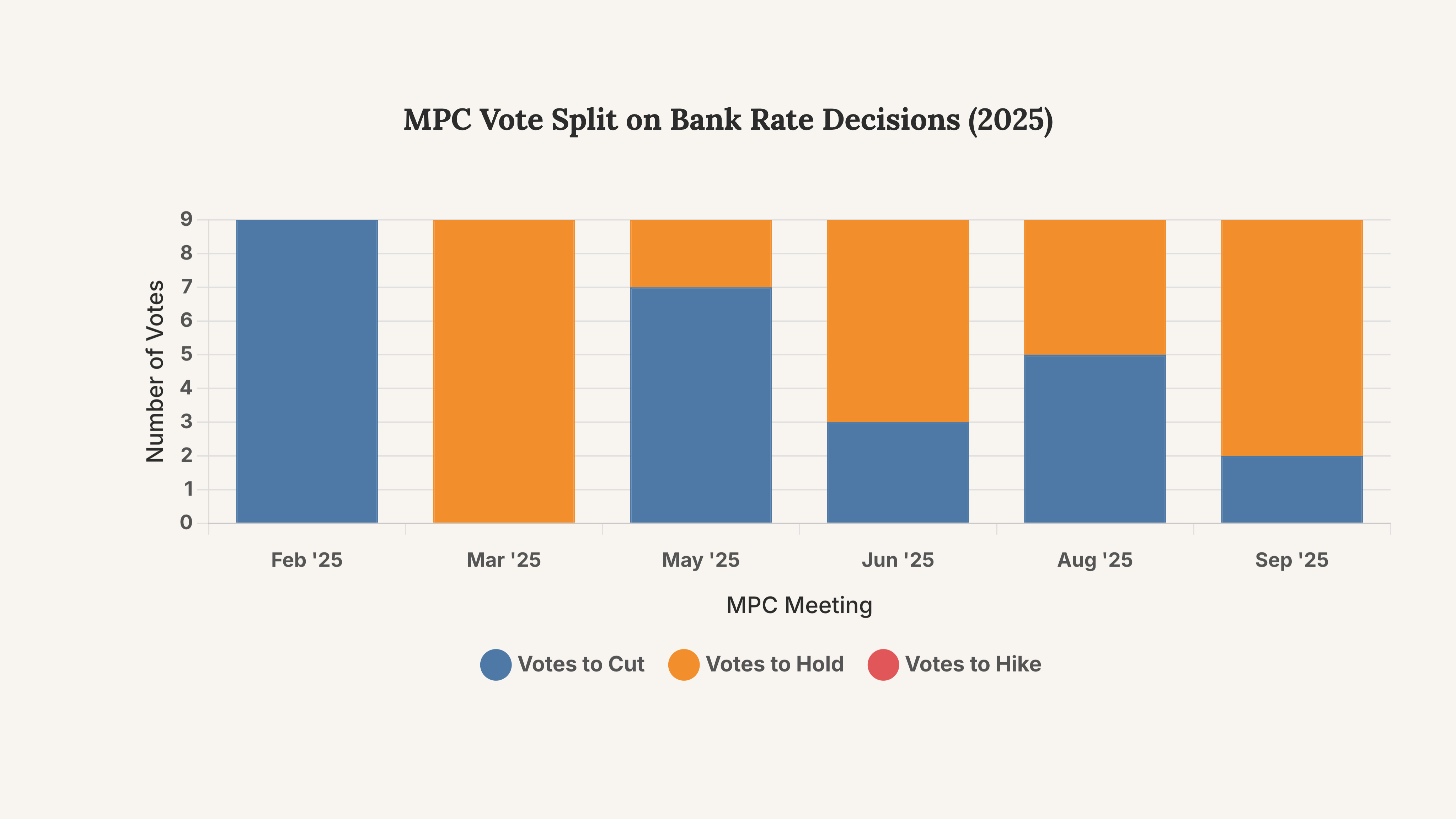
This chart visualizes the evolving split within the Monetary Policy Committee, showing a growing but still contested consensus for easing monetary policy.
The Strategic Path Forward: A Gradual and Cautious Easing
Looking ahead, the Bank of England is expected to continue its gradual and data-dependent approach to monetary easing. The timing and pace of future rate cuts will be contingent on the evolution of key economic indicators, particularly inflation, wage growth, and the labor market.
Signposts to Watch
Investors and policymakers should closely monitor the following signposts:
Services Inflation: A sustained decline in services inflation is a prerequisite for more significant rate cuts.
Wage Growth Data: The MPC will need to see further evidence of a cooling in wage pressures to be confident that inflation is on a sustainable path back to 2%.
Labor Market Slack: A continued loosening of the labor market, indicated by a rising unemployment rate, could give the MPC more room to cut rates.
The Chancellor’s Budget: Fiscal policy decisions will have a significant impact on the economic outlook and will be a key input into the Bank’s forecasts and policy deliberations.
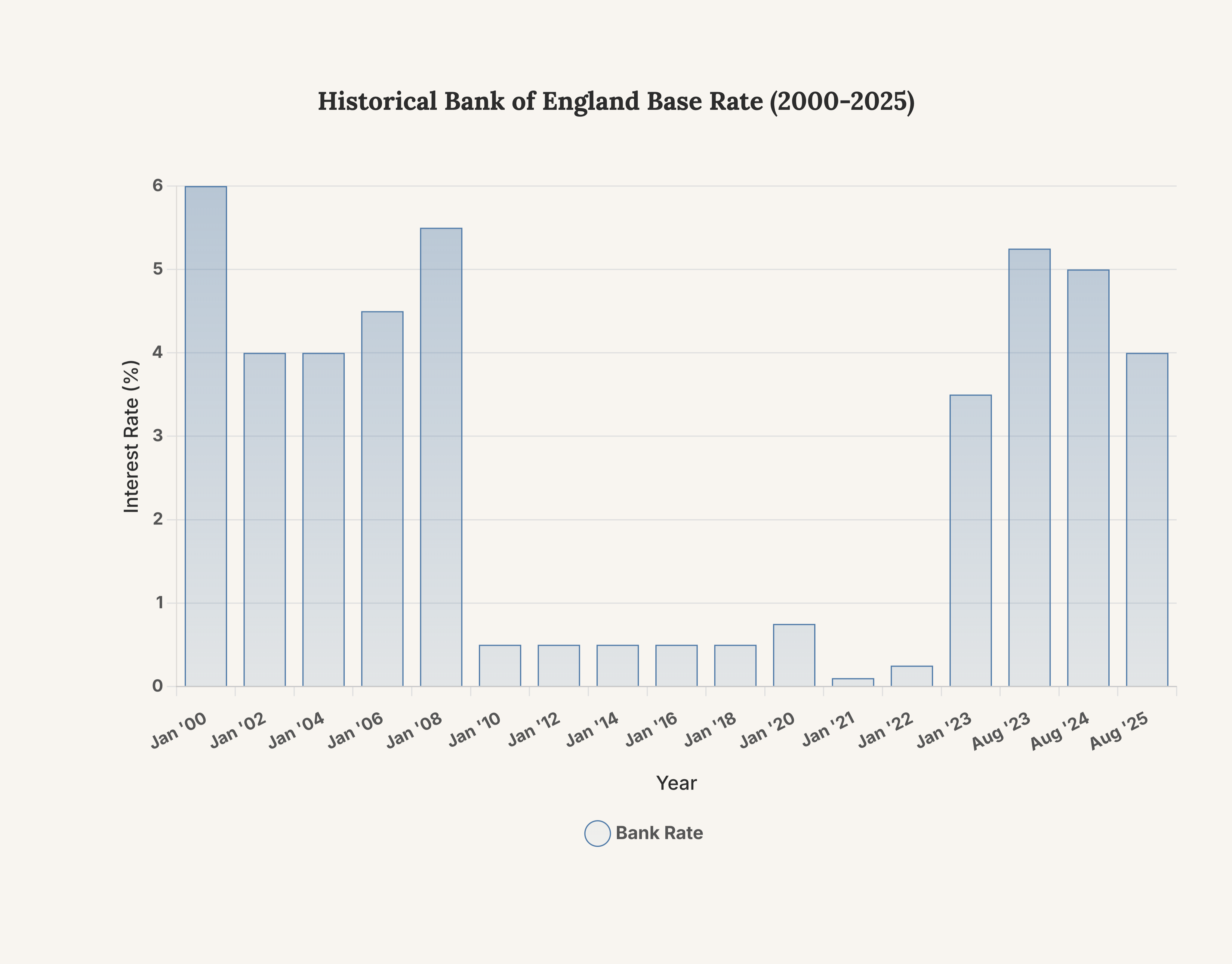
This chart provides historical context, showing the recent dramatic hiking cycle and the beginning of the current easing phase in relation to the past two decades.
Future Scenarios
Two plausible scenarios exist for the Bank Rate’s trajectory. The central scenario, anticipated by most market participants, involves a slow and steady reduction in the Bank Rate, potentially reaching around 3% by 2026. However, a more ‘hawkish’ scenario could see rates held higher for longer if inflation proves more persistent than expected. Conversely, a ‘dovish’ scenario could see more rapid cuts if the economy slows more sharply than currently forecast. The finely balanced nature of the MPC’s recent decisions suggests that both alternative scenarios remain distinct possibilities.
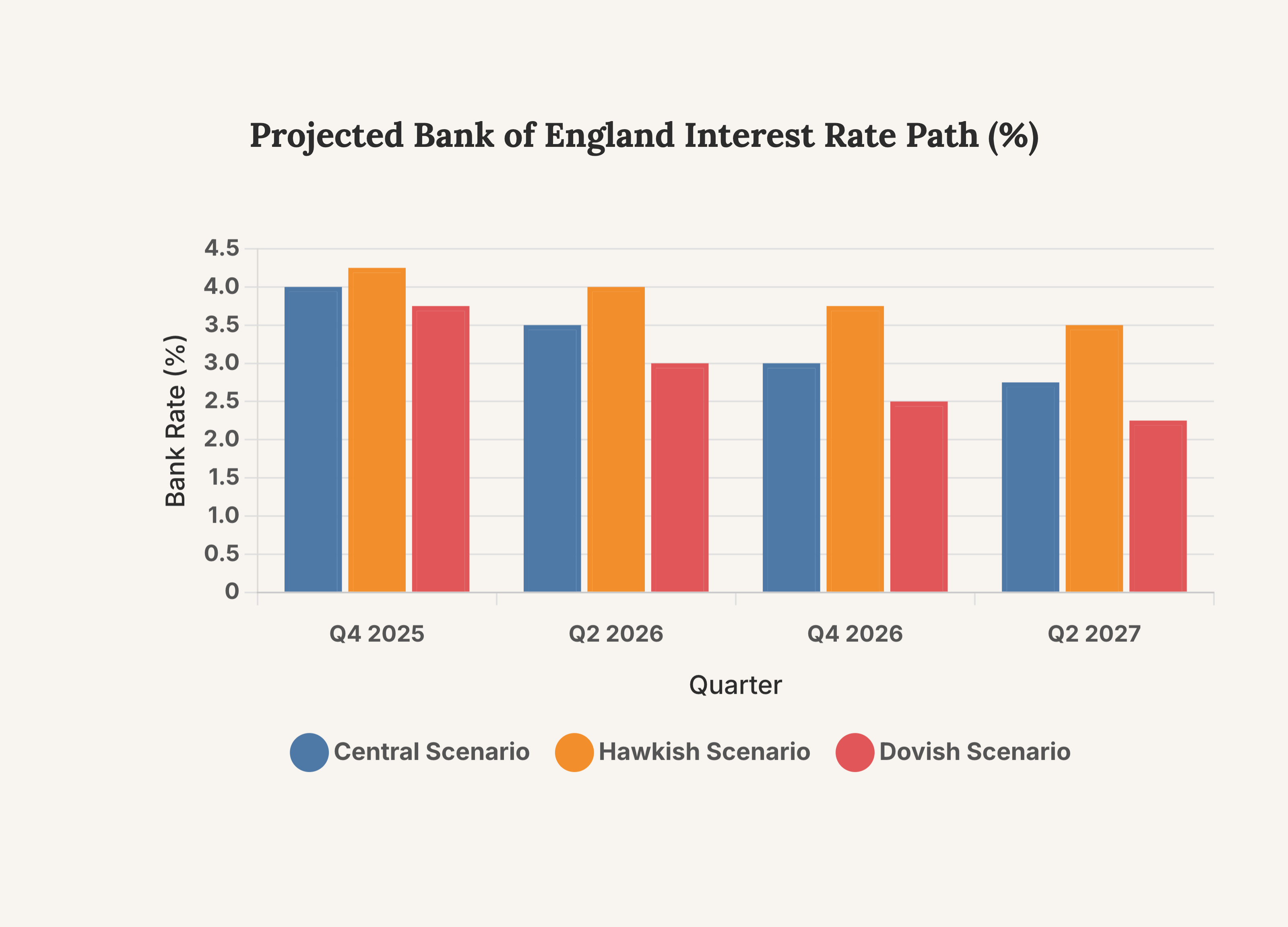
This chart outlines potential future paths for the Bank of England’s interest rate, illustrating the range of possibilities depending on economic developments.
The Bank of England is walking a monetary policy tightrope. The need to bring inflation sustainably back to target must be carefully balanced against the risk of triggering a more pronounced economic downturn. The path of interest rates will be dictated by the incoming data, but the divisions on the MPC and the uncertain economic outlook suggest that the journey will be far from smooth. For now, the prevailing strategy is one of extreme caution, with each decision scrutinized for its impact on the delicate equilibrium between inflation and growth. The era of decisive, aggressive monetary policy is over; the era of the finely balanced, contentious decision has begun.