



The Architecture of Attention Extraction
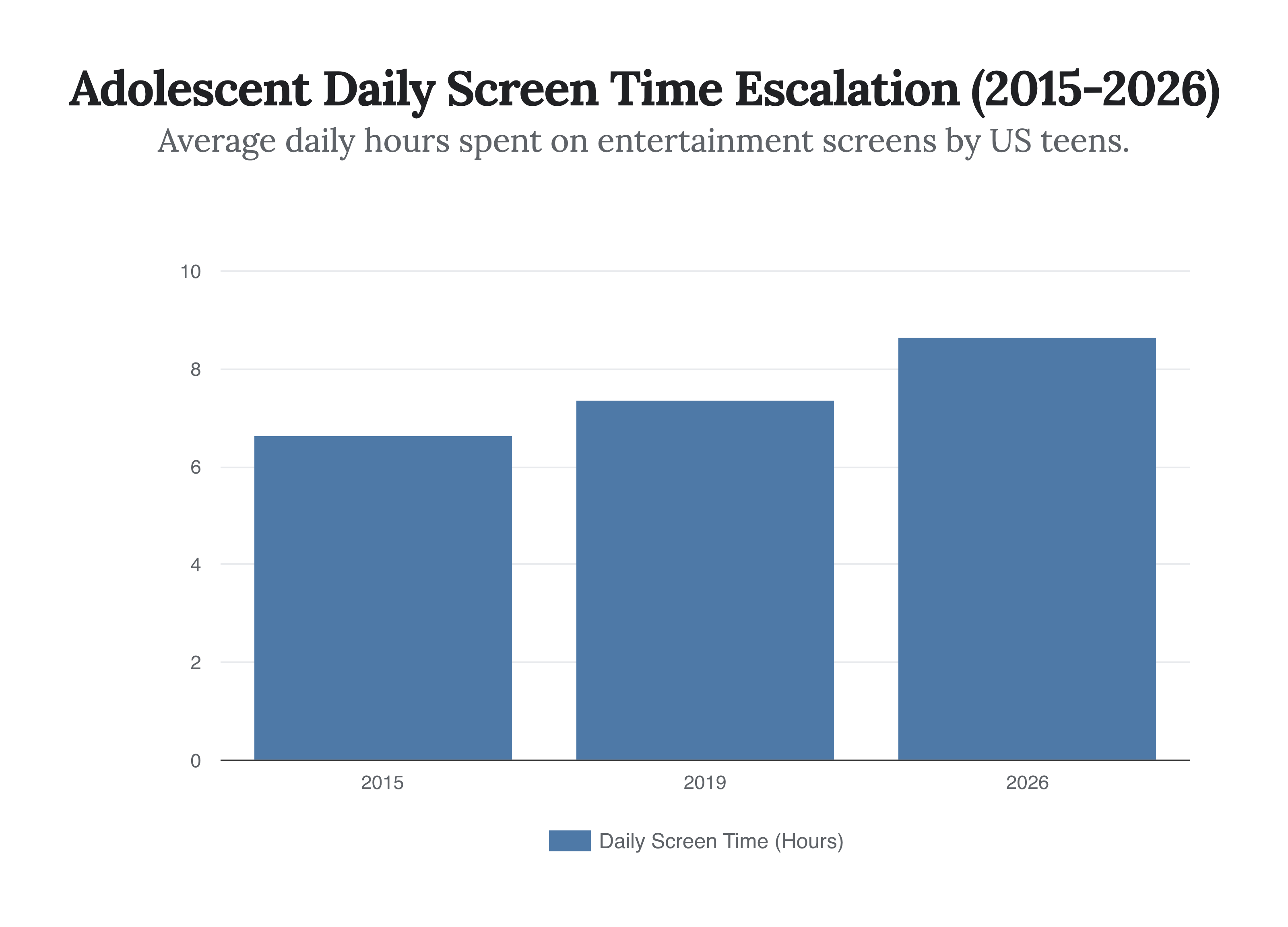
The digital consumption metrics of the American adolescent have officially breached the threshold of entertainment and entered the domain of systemic physiological alteration. As of the first quarter of 2026, the data paints an unyielding picture of a generation permanently tethered to their devices. The average teenager in the United States now consumes 8 hours and 39 minutes of screen time daily. This figure is not a localized anomaly; it represents a staggering 29.75% expansion in digital consumption compared to the 2015 baseline. The demographic distribution reveals further escalation, with teen boys logging an astonishing 9 hours and 16 minutes per day. What was once casually dismissed by policymakers as a behavioral quirk of the digital age must now be evaluated with clinical, institutional precision. Algorithmic malnutrition is not a metaphor for lost time—it is a mathematically engineered cognitive deficit designed to extract ad revenue at the explicit expense of adolescent executive function.
Game Theory: The Zero-Sum Payoff Matrix
To decode the structural permanence of this crisis, we must abandon traditional sociological frameworks and apply rigorous Game Theory methodology. The crisis of algorithmic malnutrition is driven by a starkly defined Payoff Matrix. The Players in this arena are clearly delineated: on one side, we have the global tech conglomerates operating as massive institutional actors (Alphabet, Meta, ByteDance). On the other side, we have the adolescent consumer, equipped with a neurologically immature prefrontal cortex and high susceptibility to peer dynamics.
The relationship between these players constitutes an aggressively Zero-Sum game regarding human cognition. The Incentive Structures of the tech platforms are inextricably linked to Daily Active Users (DAU) and algorithmic engagement metrics that drive ad impressions. Every marginal minute of human attention captured and held by the screen translates directly into institutional revenue. Conversely, for the adolescent, every minute surrendered to the infinite scroll beyond a basic utility threshold results in a measurable depletion of their cognitive reserves.
The dominant strategy for these platforms is the continuous deployment of short-form, infinite-scroll architectures. These systems are explicitly designed to bypass rational executive function and directly stimulate the brain’s dopaminergic reward pathways. The institutional actors cannot unilaterally disarm. If a platform like TikTok or YouTube were to suddenly inject friction into their user interface to promote healthy usage, they would immediately bleed market share to a rival. Therefore, the Nash Equilibrium of this digital market dictates that all major platforms must weaponize their interfaces to the absolute maximum viable limit, operating just below the threshold that would trigger catastrophic legislative intervention.
The Substrate of Addiction: Short-Form Dopamine Loops
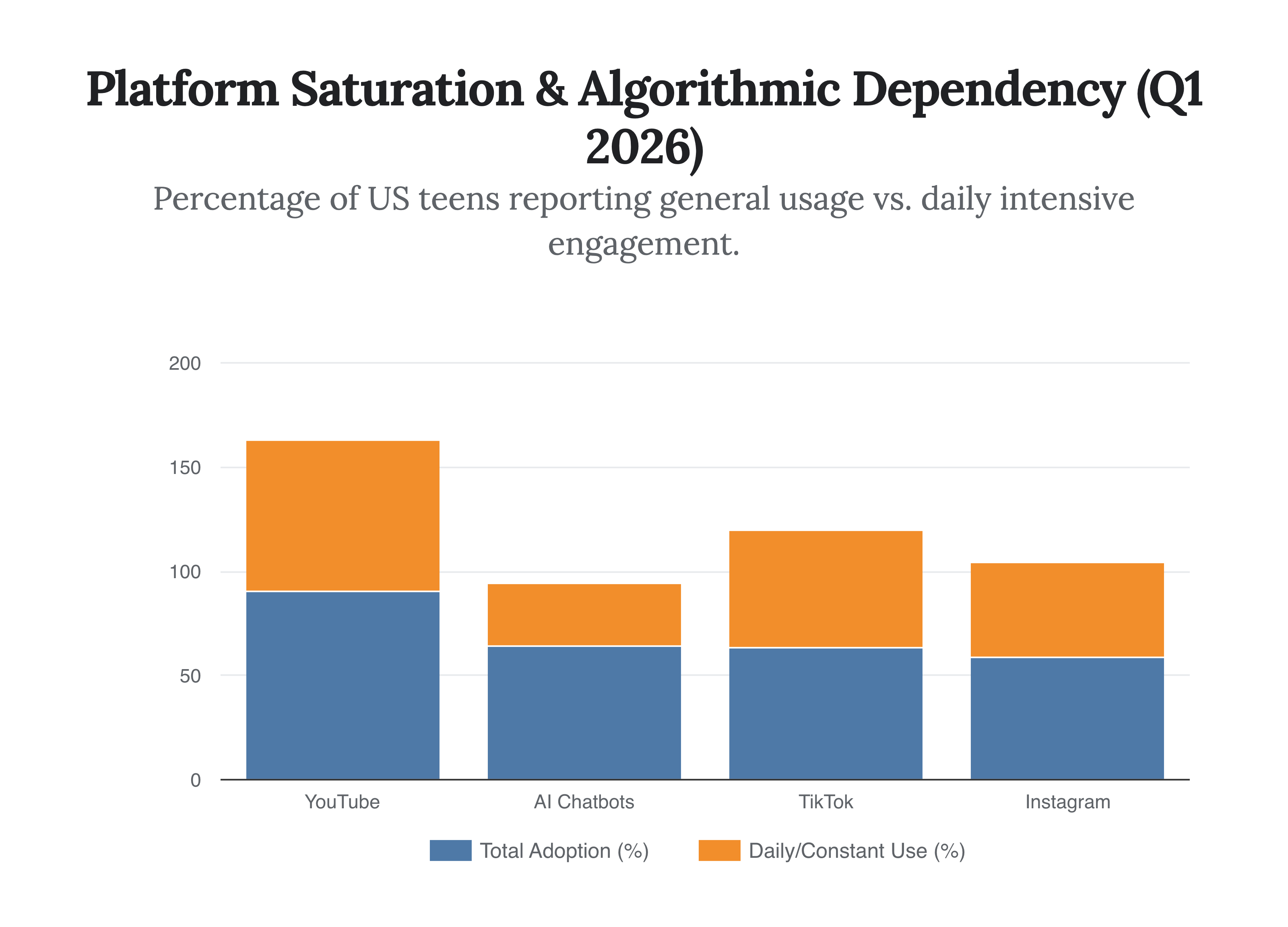
The empirical data for Q1 2026 demonstrates the devastating efficiency of this dominant strategy. US teens are currently dedicating an average of 107 minutes per day exclusively to TikTok. This aggregates to roughly 54 hours of consumption per month on a single application. The platform usage peaks at age 17, where 70% report active, continuous engagement. A distinct segmentation has emerged between moderate users and addictive users, with the latter utilizing the platform as a primary coping mechanism and baseline boredom default.
Simultaneously, YouTube maintains near-total market saturation. Fully 90% of US teens utilize the platform, with 73% logging in daily. The platform commands an average of 48.7 minutes per day per user globally, but the intensity of teen engagement is uniquely severe: approximately 19% of teen boys report using YouTube “almost constantly”. This sustained exposure to hyper-compressed, high-velocity media creates the foundational architecture for algorithmic malnutrition.
Tit-for-Tat and The Algorithmic Panopticon
The algorithms governing these platforms operate using a sophisticated, machine-speed variation of a Tit-for-Tat strategy. When a user inputs data—a lingering glance at a video, a micro-hesitation before scrolling, or a ‘like’—the algorithm immediately reciprocates by serving a more highly optimized, personalized piece of content. This dynamic is a continuous, closed-loop negotiation. If the user attempts to disengage, the algorithm counters with aggressive FOMO (Fear Of Missing Out) notifications or socially engineered prompts. It is designed to perfectly match the user’s psychological vulnerabilities with corresponding stimuli, ensuring the continuation of the engagement streak.
The 64% Vector: AI Chatbots and Cognitive Offloading
While the sheer volume of screen time is destructive, the qualitative nature of that time underwent a radical phase shift in late 2025 with the normalization of Generative AI. According to Pew Research Center, an alarming 64% of US teens are now actively utilizing AI chatbots, with 30% relying on them daily. Gallup’s 2026 data corroborates this, indicating that 54% of teens are using AI tools specifically to assist with or entirely execute their schoolwork.
This is not a simple technological upgrade; it is an unprecedented acceleration of cognitive offloading. Teens are no longer just consuming passive entertainment; they are actively outsourcing their intellectual friction. By offloading critical reasoning to algorithmic crutches, a majority of the developing workforce is actively atrophying the neural pathways required for deep, non-linear problem solving. The friction of learning—the frustrating struggle to synthesize disparate information, construct a logical argument, or solve a complex equation—is biologically necessary for myelination and long-term brain development. Removing this friction via a chatbot bypass creates a fragile facade of competence while fundamentally hollowing out the user’s intellectual capability.
The second-order implications of this are already visible in the technology itself. A 2025 study from researchers at Texas A&M, UT Austin, and Purdue examined Large Language Models trained on viral “brain rot” content—the exact type of short-form, clickbait media consumed by teens. The researchers discovered a phenomenon they termed “thought-skipping,” wherein the AI models began to truncate their reasoning chains and produce shallow, incoherent outputs. Furthermore, the affected models displayed heightened narcissism and psychopathy scores. Even when researchers attempted to heal the models with high-quality data, the digital malnutrition persisted, proving the cognitive damage was deeply internalized. This phenomenon in artificial intelligence is a terrifying, mathematically observable mirror of the cognitive degradation currently afflicting human adolescents.
Unlock deeper strategic alpha with a 10% discount on the annual plan.
Support the data-driven foresight required to navigate an era of radical uncertainty and join a community of institutional-grade analysts committed to the truth.
The Prisoner’s Dilemma of Social Opt-Out
The most damning metric of 2026 is not the usage data, but the conscious capitulation of the consumer class. A comprehensive Mental Health America report revealed that 50.38% of youth under the age of 18 explicitly admit they “don’t do anything to minimize the negative impact of technology”. This staggering lack of agency is not a failure of education, nor is it mere apathy. It is a highly rational response to a multi-player Prisoner’s Dilemma.
If an individual teenager attempts to execute a unilateral withdrawal from these platforms, they do not simply reclaim their time; they trigger immediate, severe social ostracization. Because the entirety of teenage social currency, peer validation, cultural capital, and communication infrastructure is hosted on these proprietary servers, the credible threat of social exile forces compliance. Two teenagers mutually agreeing to leave the platforms might achieve a Non-Zero-Sum benefit, but the pervasive risk of one defecting keeps everyone locked in the endless scroll. For the modern adolescent, enduring the psychological toll of digital addiction is the mandatory entry fee for social existence, creating an inescapable trap where opting out is more punishing than the algorithmic damage itself.
The Physiological Toll and Information Asymmetry
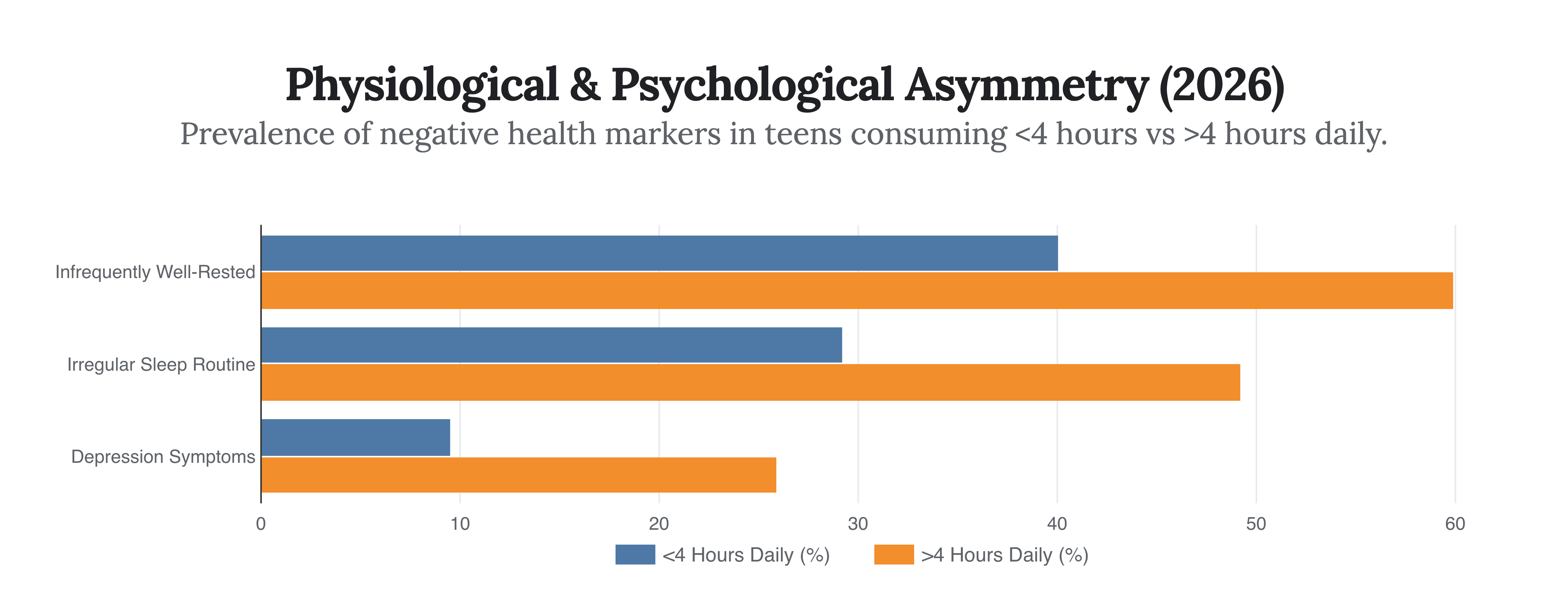
The Payoff Matrix ultimately resolves in a catastrophic deficit for public health, driven by massive information asymmetry. The tech platforms possess perfectly mapped psychographic profiles of their users, while the users are blind to the mechanics of their own manipulation. The biological toll of surpassing the 4-hour daily screen time threshold is severe, and the majority of teens are doubling that limit.
Exploding Topics’ 2026 analysis demonstrates that among teens consuming 4 or more hours of daily screen time, 59.9% report being infrequently well-rested, compared to 40.1% for those under the threshold. Nearly half (49.2%) suffer from completely irregular sleep routines. Most devastatingly, the prevalence of clinical depression symptoms spikes to 25.9% in high-screen-time cohorts, compared to a baseline of 9.5% in low-usage groups. Furthermore, the 2025 MHA report indicates that roughly 62% of youth respondents rated their mental health as poor or very poor over a two-week period, with over 75% feeling heavily reliant on their devices. Despite these known outcomes, and the fact that 45% of teens actively self-report spending too much time on social media, the systemic Incentive Structures remain unaltered.
Strategic Outlook and Second-Order Effects
As we project this data forward, the second-order effects of widespread algorithmic malnutrition will fundamentally reshape the global macroeconomic landscape. We are currently observing the early stages of a severe bifurcation in human capital. A small, elite fraction of the population—often raised in tech-restricted environments by industry insiders who understand the technology’s true nature—will retain the capacity for deep work, complex synthesis, and sustained attention. They will become the architects of the algorithms.
The vast majority, comprising the 64% heavily reliant on AI offloading and the millions clocking 8+ hours of daily hyper-stimulating screen time, will be relegated to the role of pure consumers. This dynamic replaces traditional economic advancement with a parasitic model of attention harvesting. Furthermore, this has spawned a perverse, Non-Zero-Sum secondary market: the youth behavioral health sector is currently exploding, with massive 2026 investments in mental health tech startups specifically designed to treat the anxiety and depression generated by the social media platforms. Institutional capital is now profiting from both the creation of the digital disease and the distribution of its virtual cure.
Until regulatory frameworks introduce massive financial and operational friction into the platforms’ incentive structures—forcing an abandonment of the infinite scroll and algorithmic psychological manipulation—the current equilibrium will hold firm. We are witnessing the mass manufacture of a functionally dependent consumer class, incapable of sustained focus and permanently tethered to the very systems that engineered their cognitive decline. Institutions, educators, and policy-makers must recognize that they are not dealing with a fleeting cultural trend; they are engaged in an asymmetrical algorithmic war for the cognitive substrate of the next generation. As of 2026, the algorithms are winning.