



The investment landscape of Q2 2026 continues to be irrevocably shaped by the fallout of the generative artificial intelligence boom. However, what was initially categorized as a speculative gold rush has rapidly transitioned into a period of intense regulatory scrutiny and strict criminal liability. The consumer electronics showcase at CES in January 2026 demonstrated the absolute apex of “AI-washing”—a systemic phenomenon where legacy hardware capabilities are deceptively repackaged under the guise of synthetic intelligence [1.1.3]. Major technology conglomerates, including Samsung, LG, and Lenovo, universally adopted “AI-first” marketing strategies, effectively rebranding standard image processing and basic thermostatic controls as autonomous AI functions. This saturation of “ingredient marketing,” which relies heavily on simply wrapping products around existing foundational models like the GPT API, has reached critical mass, rendering the terminology practically meaningless to both consumers and institutional capital allocators. We are witnessing the terminal phase of the AI hype cycle, where the gap between marketed capability and technical reality can no longer be bridged by venture capital subsidies.
The transition from aggressive marketing to prosecutable fraud was definitively established with the parallel civil and criminal charges filed by the SEC and Department of Justice in April 2025 against the founder of Nate Inc. This landmark case, marking the first criminal AI washing prosecution under the current administration, highlighted a disturbing trend: startups raising tens of millions of dollars by claiming sophisticated neural network capabilities while actually relying on offshore human contractors in the Philippines and Romania to simulate algorithmic output. The deliberate obfuscation of rules-based logic as autonomous artificial intelligence has transitioned from a permissible venture capital marketing tactic to a federally prosecutable securities crime. This regulatory escalation, coupled with the SEC levying $400,000 in penalties against investment advisers for misleading AI claims, signifies a permanent structural shift in corporate governance. Boards of directors navigating the current funding cycle are now operating in an environment where exaggerating software capabilities no longer just risks a down-round, but triggers existential legal and criminal liabilities.
Capital Misallocation & Regulatory Drag
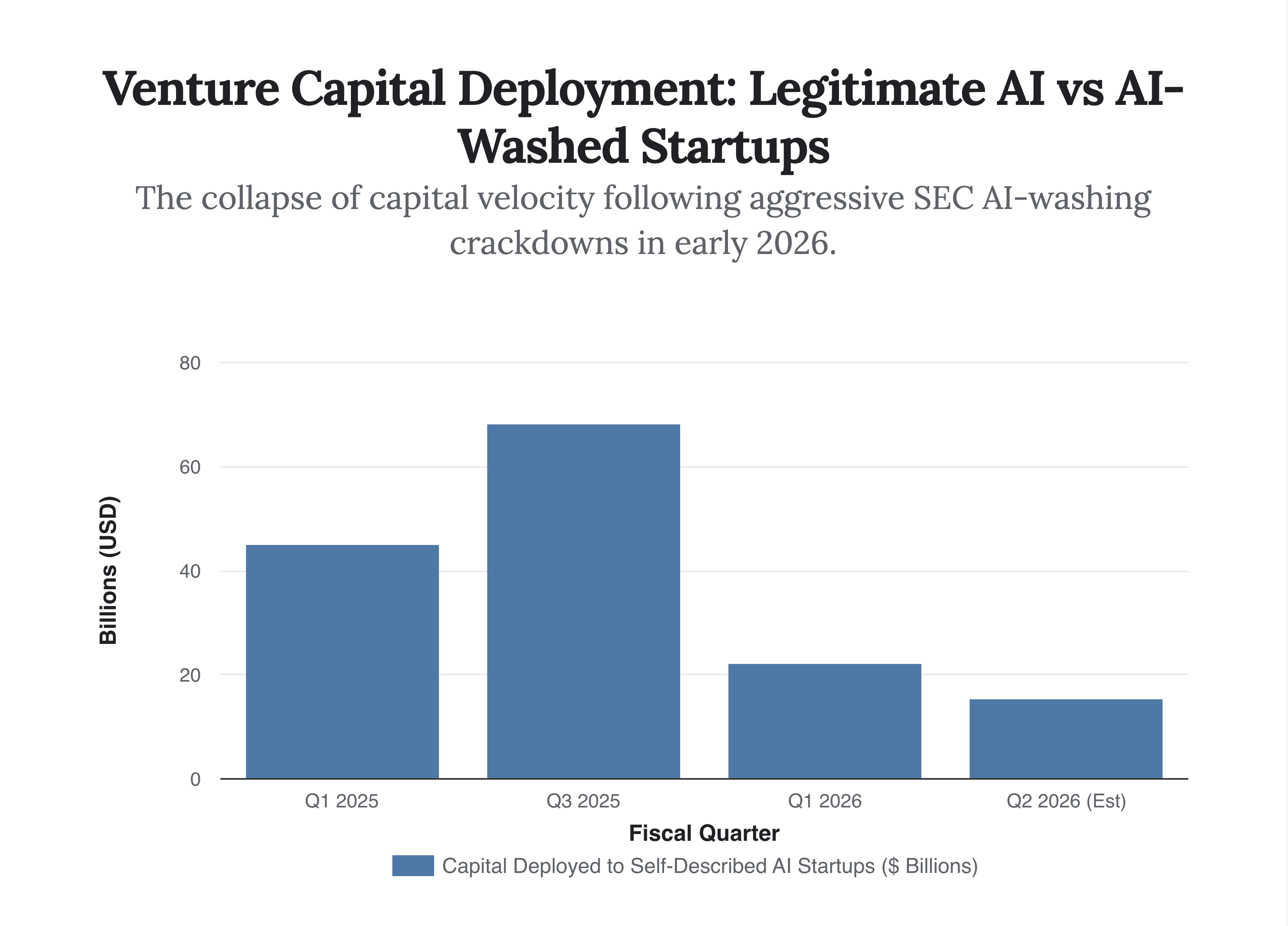
The macroeconomic consequences of the AI washing epidemic extend far beyond individual corporate liabilities; they represent a catastrophic and systemic misallocation of venture capital. Throughout the preceding quarters, billions of dollars were diverted from legitimate infrastructural and deep-tech innovations into organizations whose primary competitive advantage was a superficially engineered AI narrative. This dynamic not only victimizes limited partners and innocent retail investors, but it actively impedes the progression of genuine artificial intelligence research by creating systemic skepticism among top-tier capital allocators. The resulting environment is one of extreme caution, where technical due diligence has become an adversarial, forensic process designed to unearth hidden manual workflows or outsourced labor masking as autonomous agents. Institutional investors are demanding source code audits and verifiable compute utilization metrics before deploying capital, severely extending the timeline from pitch to funding.
Compounding this crisis of confidence is the impending enforcement of the European Union’s AI Act, slated to become fully effective in August 2026. The legislation imposes stringent transparency requirements and threatens unprecedented fines—up to 7% of annual global turnover—for misleading AI claims. This regulatory framework is forcing a massive rebranding effort across the tech sector, as companies scramble to quietly downgrade their product descriptions from “AI-driven” to more accurate, legally defensible terms like “machine-assisted” or “automated.” By flooding the zone with synthetic intelligence claims, predatory startups have effectively blinded institutional capital to legitimate infrastructural breakthroughs, artificially deflating the velocity of genuine technological progress. The intersection of heightened SEC enforcement and the EU’s sweeping regulatory apparatus ensures that the back half of 2026 will be characterized by a significant contraction in AI-related capital deployments, forcing a painful but necessary market correction that will separate authentic technical moats from sophisticated marketing facades.
The Strait of Hormuz Chokepoint & Demand Destruction
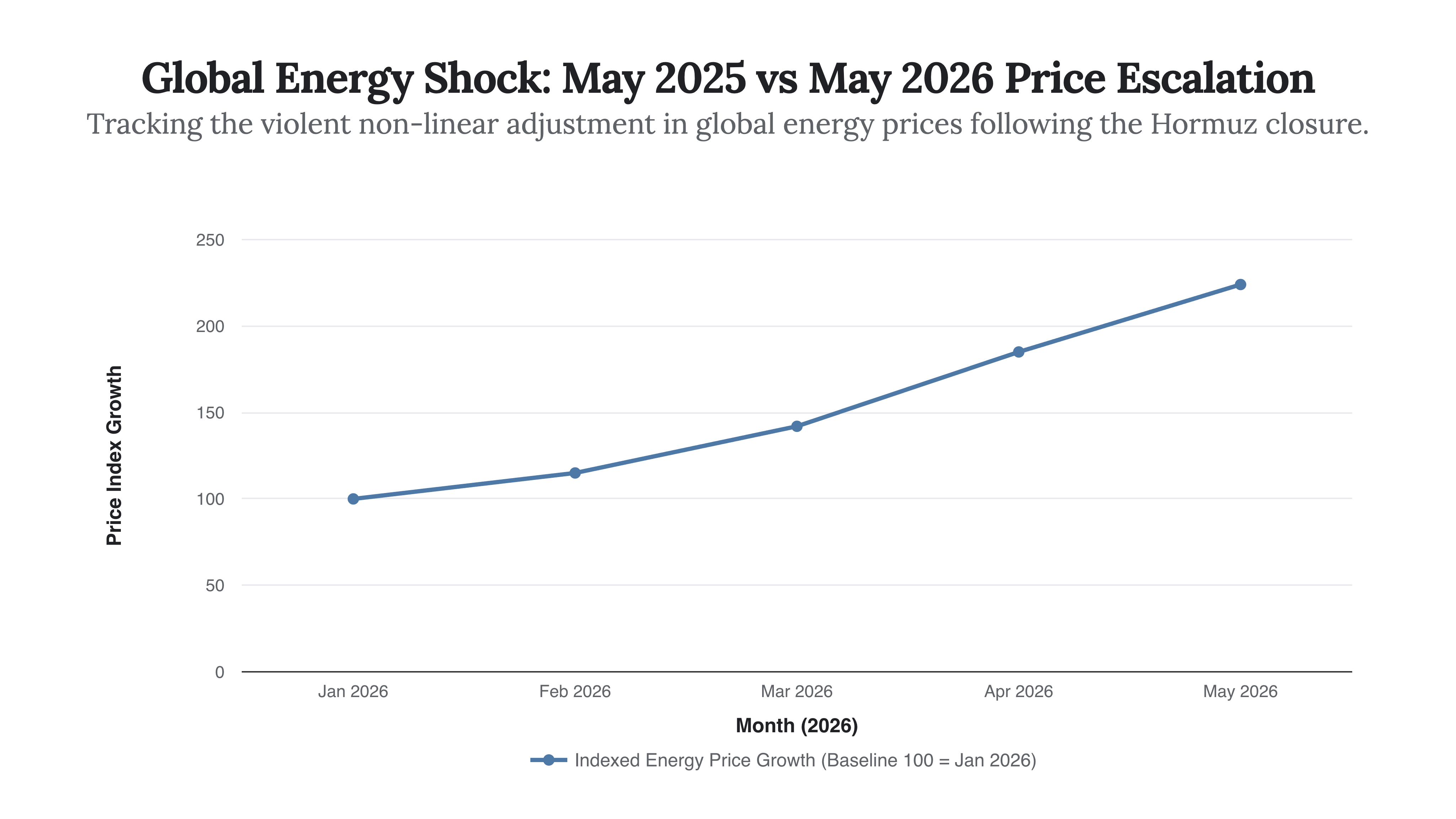
Moving from the digital abstraction of AI to the physical reality of global commodities, the international energy architecture has entered a state of profound vulnerability, catalyzed by the geopolitical fallout of the 2026 Iran War. Following the closure of the Strait of Hormuz—a vital maritime chokepoint historically responsible for facilitating approximately one-third of the global seaborne crude oil trade—energy markets have been thrust into a state of structural chaos. Despite coordinated strategic oil reserve releases and desperate attempts to reroute Gulf production via overland pipelines, the fundamental arithmetic of global supply remains severely impaired. By late May 2026, spot market prices for crude had experienced a rapid $100 bounce from pre-conflict baselines, signaling a market transitioning from an uneasy stasis toward a highly volatile non-linear adjustment phase. The International Energy Agency (IEA) has explicitly identified this dynamic as the most significant energy security challenge in history, noting that global commercial oil inventories are being depleted at record, unsustainable rates.
Perhaps the most alarming metric hidden within the broader energy complex is the unprecedented distortion in refining margins. The jet fuel crack spread—the critical differential between the price of refined jet fuel and unrefined crude oil—has surged to a staggering $80 per barrel in May 2026, easily eclipsing the previous peak observed during the 2022 market shocks. Because a standard barrel of crude yields significantly less aviation fuel compared to gasoline, this extreme margin is cannibalizing global refinery capacity, actively pulling production away from consumer fuels to chase astronomical aviation and military logistics margins. This mechanical distortion guarantees severe gasoline and diesel supply constraints at the retail level. Energy markets are rapidly approaching a non-linear adjustment phase where supply constraints will force violent, systemic demand destruction across the Western consumer economy. The resulting fuel shortages and panic buying, already acutely observable in emerging markets, serve as a direct, empirical preview of the supply shock currently cascading toward advanced industrial economies.
Secondary Inflationary Waves & The Summer CPI Threat
The immediate physical consequences of the Strait of Hormuz closure are rapidly metastasizing into a secondary, and far more insidious, macroeconomic threat: a devastating secondary inflationary wave. The World Bank’s May 2026 commodity outlook provides a stark, uncompromising assessment: global energy prices are projected to rise by 24% over the course of the current fiscal year. This initial shock is not isolated; it acts as a highly efficient transmission mechanism for broader commodity inflation, with overall commodity indices expected to surge by 16%, reaching levels unseen since the initial escalations of 2022. The agricultural sector is particularly vulnerable, as the disruption in natural gas and petroleum products directly impacts the production cost and physical availability of urea and other critical fertilizers. This creates a compounding, devastating crisis: energy inflation rapidly transforms into persistent food inflation, eroding household purchasing power and directly threatening global food security. We are witnessing the weaponization of the baseline cost of human survival.
The macroeconomic implications of this dynamic will become devastatingly clear in the forthcoming economic data releases. The retail pump pain experienced throughout May 2026 is mathematically guaranteed to translate into severe upward pressure on the July and August Consumer Price Index (CPI) and Personal Consumption Expenditures (PCE) readings. The sovereign bond market has already begun pricing in this grim reality, with the 30-year U.S. Treasury yield soaring to its highest levels since the 2008 global financial crisis. This rapid tightening of financial conditions fundamentally alters the cost of capital, driving up corporate borrowing rates and exacerbating the cost of financing sovereign debt. The current geopolitical premium baked into crude oil is not a temporary aberration but a permanent structural tax on global liquidity. Central banks, previously positioned for a dovish easing cycle, are now trapped in an impossible paradox between the dual mandates of suppressing a supply-driven inflation resurgence and preventing a steep, prolonged recession induced by forced energy demand destruction.
Algorithmic Interference in Holyrood
While global markets grapple with physical resource scarcity, the cognitive architecture of Western democracies is simultaneously under assault. The May 7, 2026, elections for the Scottish Parliament provided a grim, empirical baseline for the impact of advanced computational propaganda on sovereign democratic processes. While previous electoral cycles were characterized by targeted demographic advertising and relatively crude disinformation campaigns, the Holyrood campaign demonstrated a sophisticated, industrial-scale integration of artificial intelligence and deepfake technology designed explicitly to fracture public consensus. A highly visible example emerged prior to the election when Reform UK utilized a heavily subsidized social media campaign to distribute selectively edited, synthetic media concerning Scottish Labour leader Anas Sarwar. This content, which easily generated over a million impressions, utilized advanced manipulation to falsely portray policy priorities, highlighting how the tools of digital deception have become alarmingly accessible, cheap, and effective for domestic political operatives.

The saturation of the information environment with algorithmic hallucinations and synthetic narratives forces a fundamental, necessary reevaluation of electoral integrity. Traditional journalistic fact-checking mechanisms are structurally incapable of matching the velocity, scale, and volume of automated robotic networks that post, share, and amplify fabricated content at a rate documented to be six times faster than authentic news.
