

The Bureaucracy Tax Has Come Due
The deadline has arrived. As of Q1 2025, Andy Jassy’s mandate to increase the ratio of individual contributors to managers by 15% is no longer a theoretical exercise—it is an operational reality. The market has misread this event as a standard post-ZIRP cost-cutting measure. It is not. This is the first deliberate dismantling of the “Middle Management Layer” in Big Tech history, designed to replace coordination with code.
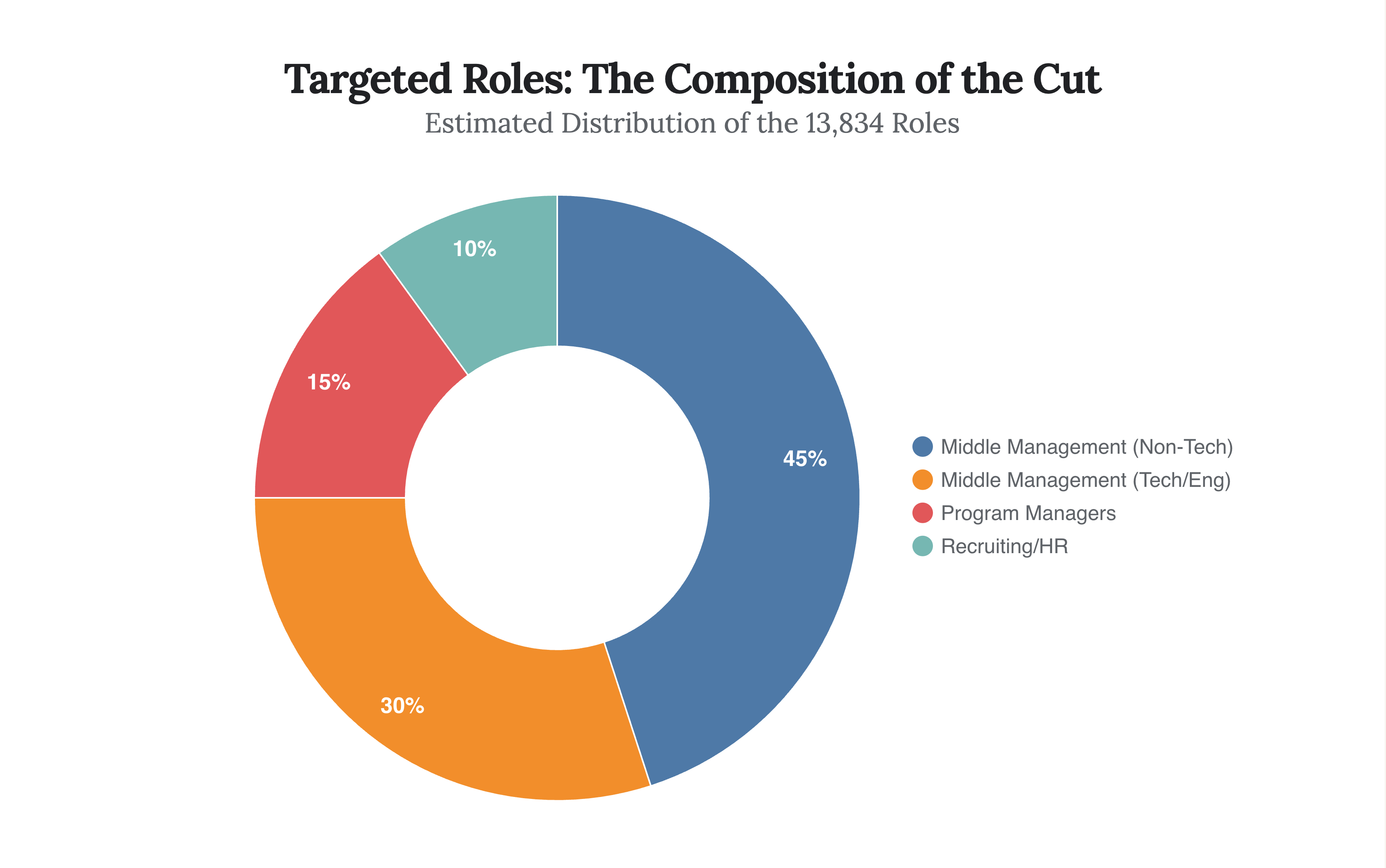
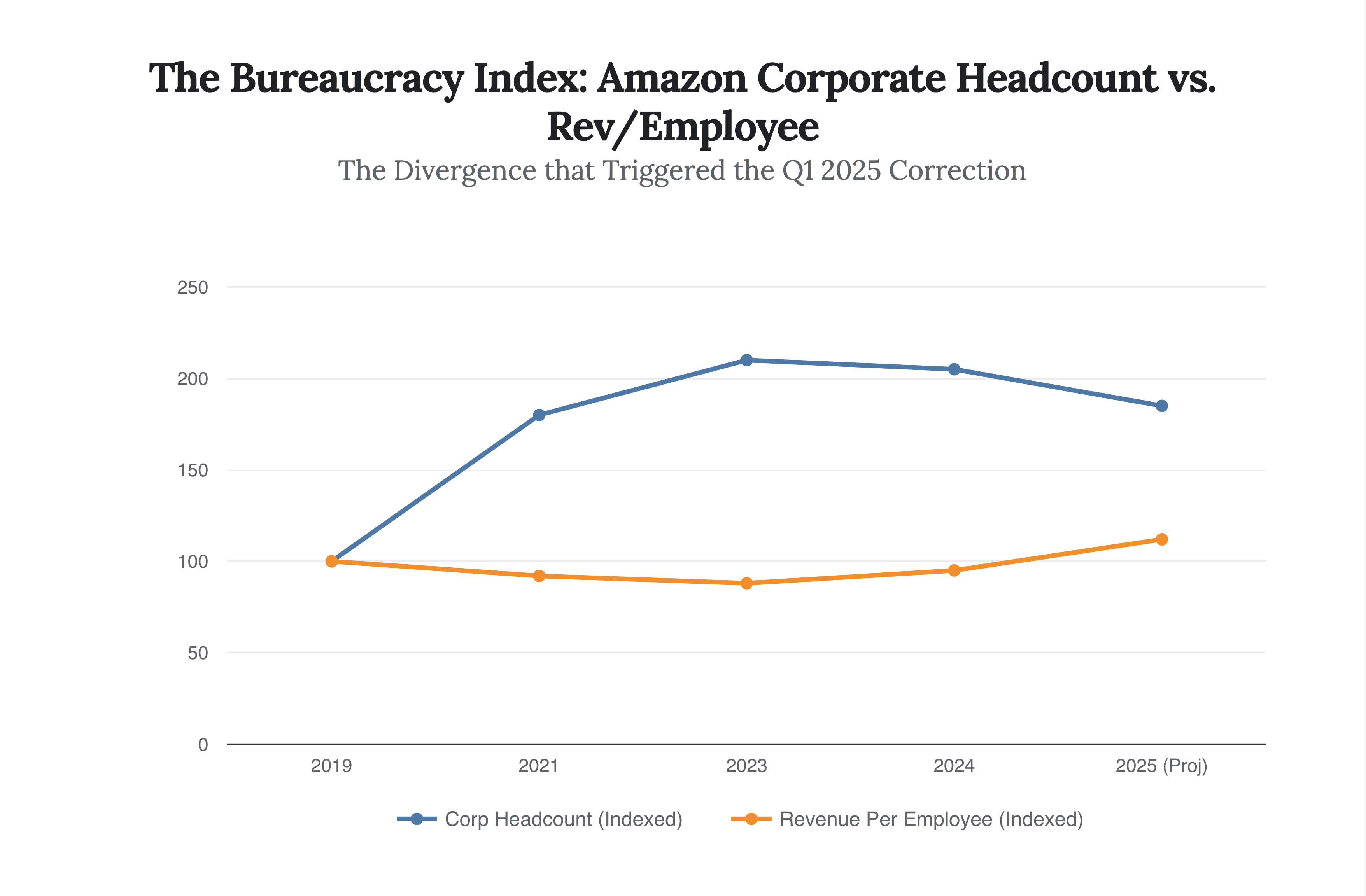
Data from Morgan Stanley confirms the scale: approximately 13,834 managerial roles are being eliminated. This is not a trimming of fat; it is a re-architecture of the corporate nervous system. The objective is to reclaim the “Day 1” velocity that Amazon lost during its pandemic headcount explosion, where the manager population swelled far faster than revenue growth warranted.
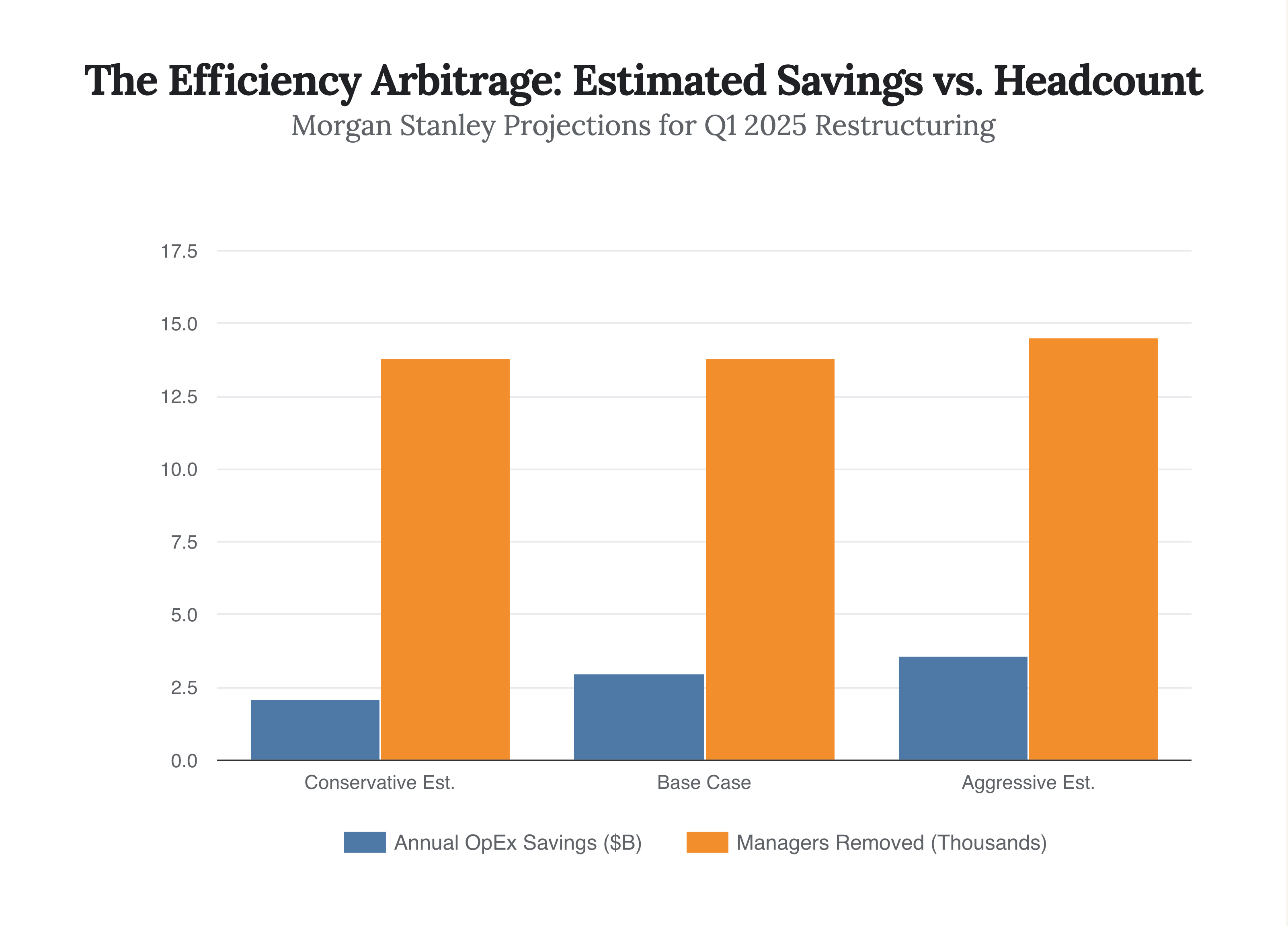
For the institutional observer, the signal here is clear: Amazon is betting that Generative AI and automated workflows can now handle the coordination taxes that previously required human middle-men. The removal of these 14,000 layers is expected to yield between $2.1 billion and $3.6 billion in annual savings, but the second-order effect—velocity—is the true metric of success.
The Mathematics of the “15% Rule”
Jassy’s directive is mathematically precise: increase the ratio of individual contributors (ICs) to managers by 15%. In organizational terms, this creates a massive compression event. Teams that previously justified a manager for every 6 engineers must now operate with one manager for every 8 or 9.
This forces a binary outcome for the existing managerial class:
Re-leveling: Managers must return to being ICs (coding, selling, building), proving they still possess “hands-on” utility.
Excision: Those whose primary value was “information routing” or “status reporting” are being removed.
The strategic implication is that Amazon is solving for the “Span of Control.” During the 2020-2022 boom, Amazon’s organizational depth increased, creating latency in decision-making. By flattening the org chart, Jassy is effectively removing the “latency nodes” from the network. The resignation is the point: The strict Return-to-Office (RTO) mandate enforced in January 2025 acts as a self-selection filter, ensuring that only the most compliant or mission-aligned talent remains to weather the structural purge.
Unlock deeper strategic alpha with a 10% discount on the annual plan.
Support the data-driven foresight required to navigate an era of radical uncertainty and join a community of institutional-grade analysts committed to the truth.
The “Shadow Layoff”: RTO as a scalpel
The timing of the 5-day in-office mandate (effective January 2, 2025) was not coincidental; it was synergistic with the layoff strategy. Internal data suggests that strict RTO mandates drive attrition rates significantly higher than industry averages, particularly among senior staff who have the optionality to leave.
By enforcing RTO simultaneously with the ratio restructuring, Amazon effectively conducted a “Shadow Layoff.” They reduced headcount without paying severance to those who voluntarily quit due to the commute or location requirements. This creates a workforce that is younger, cheaper, and geographically concentrated in the hubs (Seattle, Arlington, Nashville), reversing the distributed nature of the pandemic era.
The AI Displacement Vector
The most critical, under-discussed aspect of this restructuring is the role of Agentic AI. Middle managers primarily function as information routers—taking directives from leadership, contextualizing them for ICs, and reporting status back up. Large Language Models (LLMs) and internal dashboards now perform this function with zero latency.
Amazon’s restructuring is the blueprint for the “Post-Managerial Corporation.” If Amazon successfully operates with 15% fewer managers in 2025 without a degradation in product shipping velocity, the rest of the tech sector will follow immediately. We are watching the end of the “Empire Building” era of corporate management, replaced by lean, high-leverage teams supported by AI infrastructure.