


I am writing this from the train back to Zurich, watching the snow-capped peaks of the Graubünden recede into the distance. The mood in the carriage is quieter than usual. There is no clinking of champagne glasses, no boisterous exchanging of business cards. Just the soft tapping of thumbs on glass screens and the collective exhaustion of a global elite that has finally realized: the party is over.
For five days, under the ironic banner of “A Spirit of Dialogue,” nearly 3,000 of the world’s most powerful people gathered to mourn the world they built. If Davos 2025 was about denial, Davos 2026 was about acceptance.
The headline story, of course, was the return of Donald Trump and the massive U.S. delegation, clashing openly with the new European guard—German Chancellor Friedrich Merz and Canadian PM Mark Carney. But the real story wasn’t in the speeches; it was in the data. The numbers coming out of the Congress Centre paint a picture of a world rapidly reorganizing itself into fortified blocs.
The Vibe Shift: From Cooperation to Confrontation
For decades, the World Economic Forum preached that global risks were shared problems requiring shared solutions. Climate change, pandemics, cyberattacks—these were enemies without borders. This year, the Global Risks Report flipped that script. The enemy is no longer borderless; the enemy is the guy sitting across the table.
For the first time in the report’s history, Geoeconomic Confrontation has overtaken environmental collapse as the singular most severe short-term threat. The chart below visualizes this stark inversion of priorities.
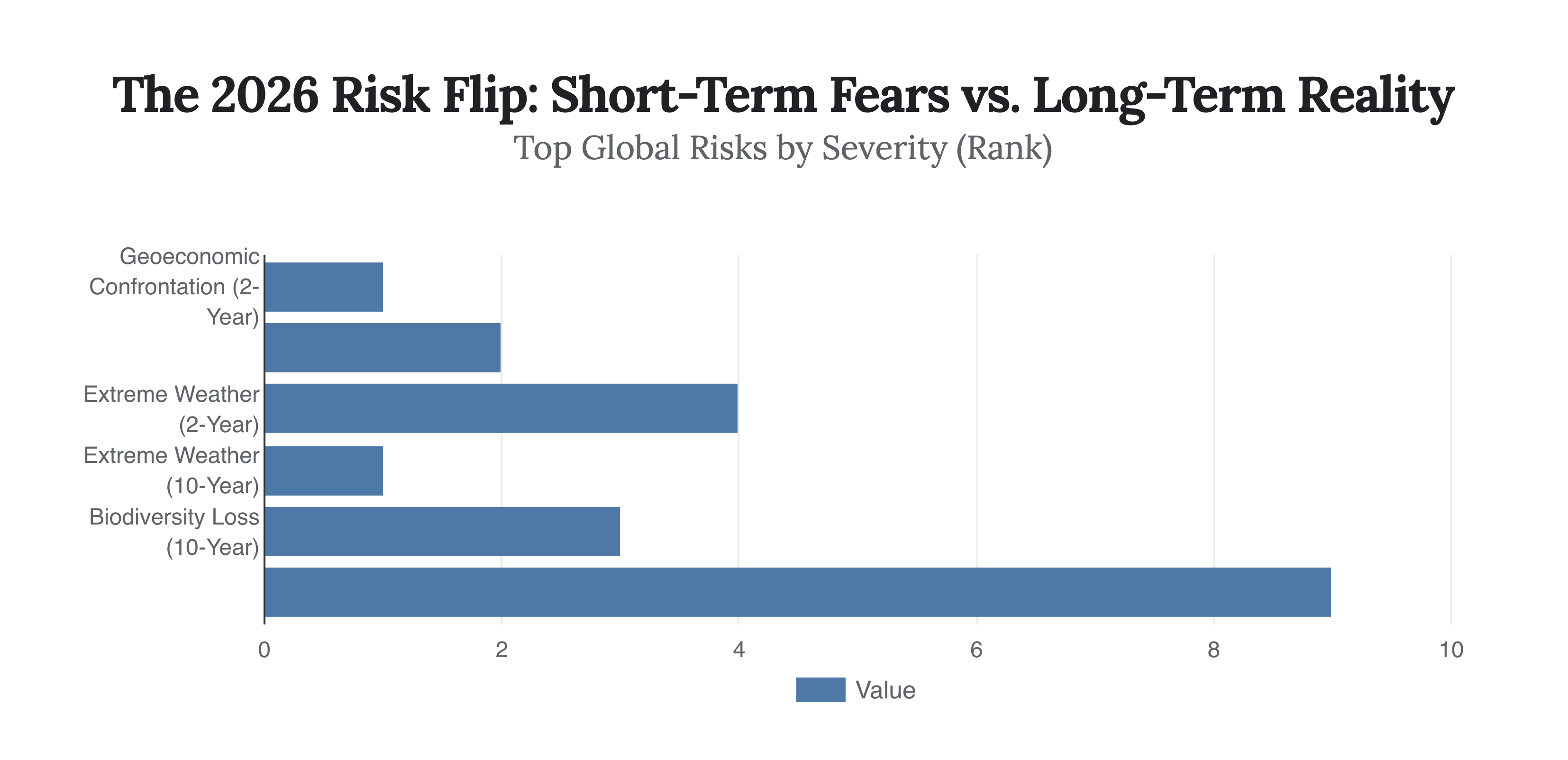
Notice the gap. In the 10-year outlook, environmental risks still reign supreme. But in the 2-year outlook—the timeline that actually drives CEO bonuses and election cycles—climate has slipped to 4th place, displaced by trade wars and information warfare. The elite are no longer worried about the ice caps melting; they’re worried about their assets freezing.
The Politicization of the Magic Mountain
Another telling metric was the composition of the attendees. Historically, Davos was a business conference with a sprinkling of politicians. This year, it felt like a UN Security Council meeting with a better dress code.
We saw a record 400 top political leaders, including over 60 heads of state. The ratio of “Suits” (CEOs) to “Flags” (Government officials) has shifted dramatically. Business leaders are no longer driving the agenda; they are reacting to the regulatory and geopolitical fences being erected by the people in the chart below.
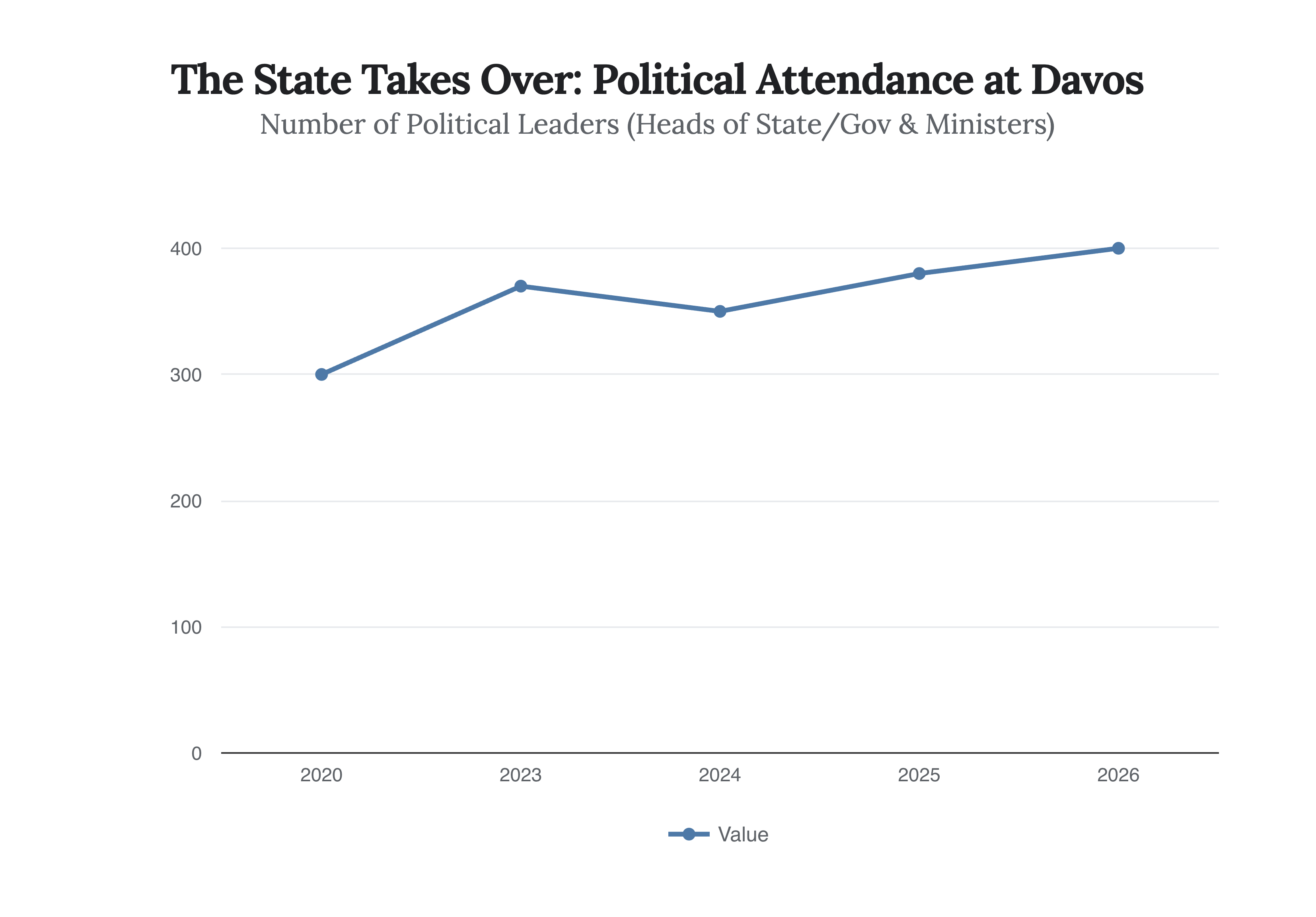
This surge in political attendance confirms the thesis: the era of laissez-faire globalization is dead. The state is back, and it is hungry. Every CEO I spoke to privately admitted their primary strategy for 2026 isn’t innovation—it’s compliance, lobbying, and supply chain “friend-shoring.”
The AI Tsunami: A Divergent Reality
While the politicians argued over tariffs and Greenland, the economists were staring at a different kind of abyss. IMF Managing Director Kristalina Georgieva dropped the most sobering statistic of the week: 60% of jobs in advanced economies are now “highly exposed” to AI.
This isn’t just about automation replacing workers; it’s about a fundamental decoupling of labor markets between the Global North and South. Advanced economies face a massive disruption (and potential productivity boom), while emerging markets—lacking the infrastructure to harness AI—risk being left behind entirely.
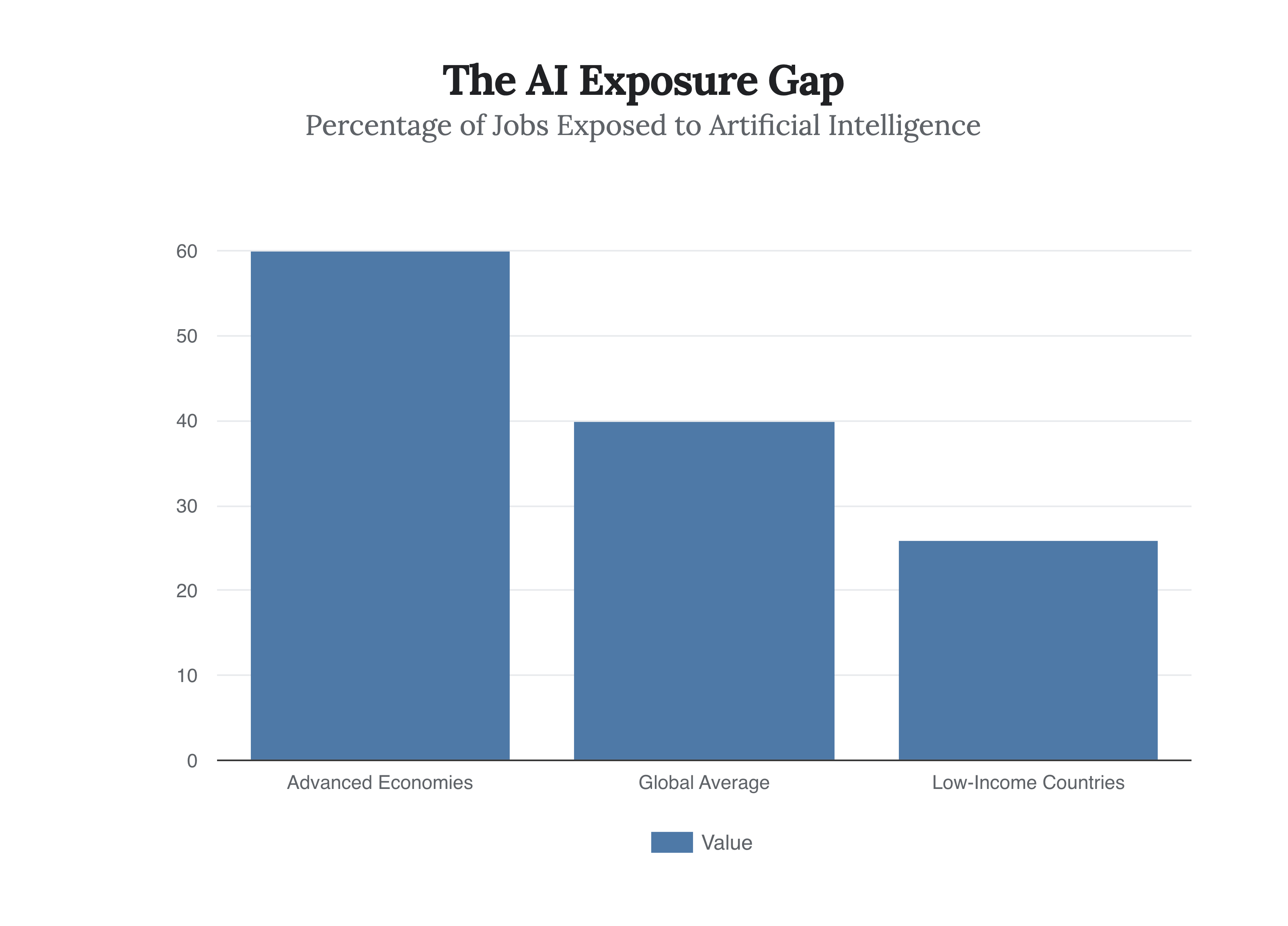
This data point was the elephant in every room. If the Global North captures all the AI productivity gains while the Global South eats the climate costs, the “Spirit of Dialogue” will very quickly become the “Spirit of Riot.”
The Mood Music: Turbulence Ahead
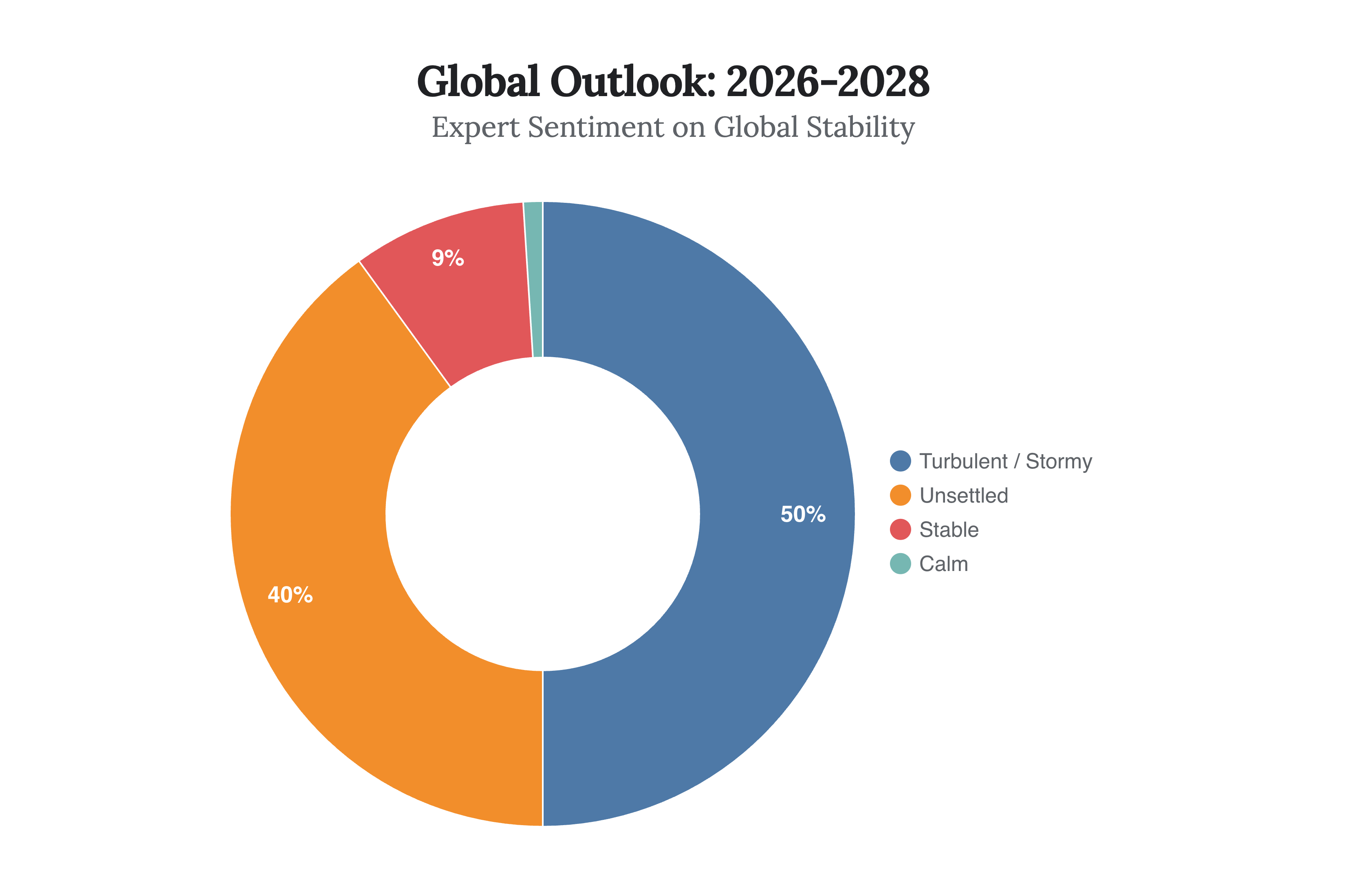
Finally, we have to talk about sentiment. The World Economic Forum surveys its community of experts on their outlook for the world. The optimism of the early 2020s—the belief that we could “Build Back Better”—has evaporated.
When asked to describe the global outlook for the next two years, the consensus was brutally negative. Only 1% of respondents anticipate calm. 1%. Let that sink in.
Davos 2026 will be remembered not for what was solved, but for what was admitted. The Global Village has been subdivided. The walls are going up. And for the first time in a long time, the people inside the Congress Centre didn’t pretend to have the keys to unlock them.