



The Illusion of the Citadel
In the boardrooms of New York and the tech campuses of Silicon Valley, a quiet religion has taken hold. Its texts are not scriptures, but the letters of Seneca and the meditations of Marcus Aurelius. The premise is seductive in its simplicity: you cannot control the world, but you can control your reaction to it. This neo-Stoic revival has built an empire of bestsellers, with Ryan Holiday’s books alone selling over 10 million copies, effectively creating a “philosophy-as-a-service” industry for the stressed elite. The promise is a “sovereign mind”—an inner citadel impervious to external chaos.
There is just one problem. The biology required to maintain that citadel is being systematically dismantled.
New intelligence on cognitive overload and attention economy mechanics suggests that modern Stoicism is failing not because the philosophy is flawed, but because the physiological substrate required to practice it—executive function—is under a denial-of-service attack. When a knowledge worker is subjected to 1,200 context switches per day, the prefrontal cortex does not have the bandwidth to “choose a reaction.” It is simply struggling to reboot.
This briefing analyzes the collision between ancient wisdom and modern cognitive load metrics, revealing why the $900 billion cost of information overload is not just an economic drain, but a philosophical crisis.
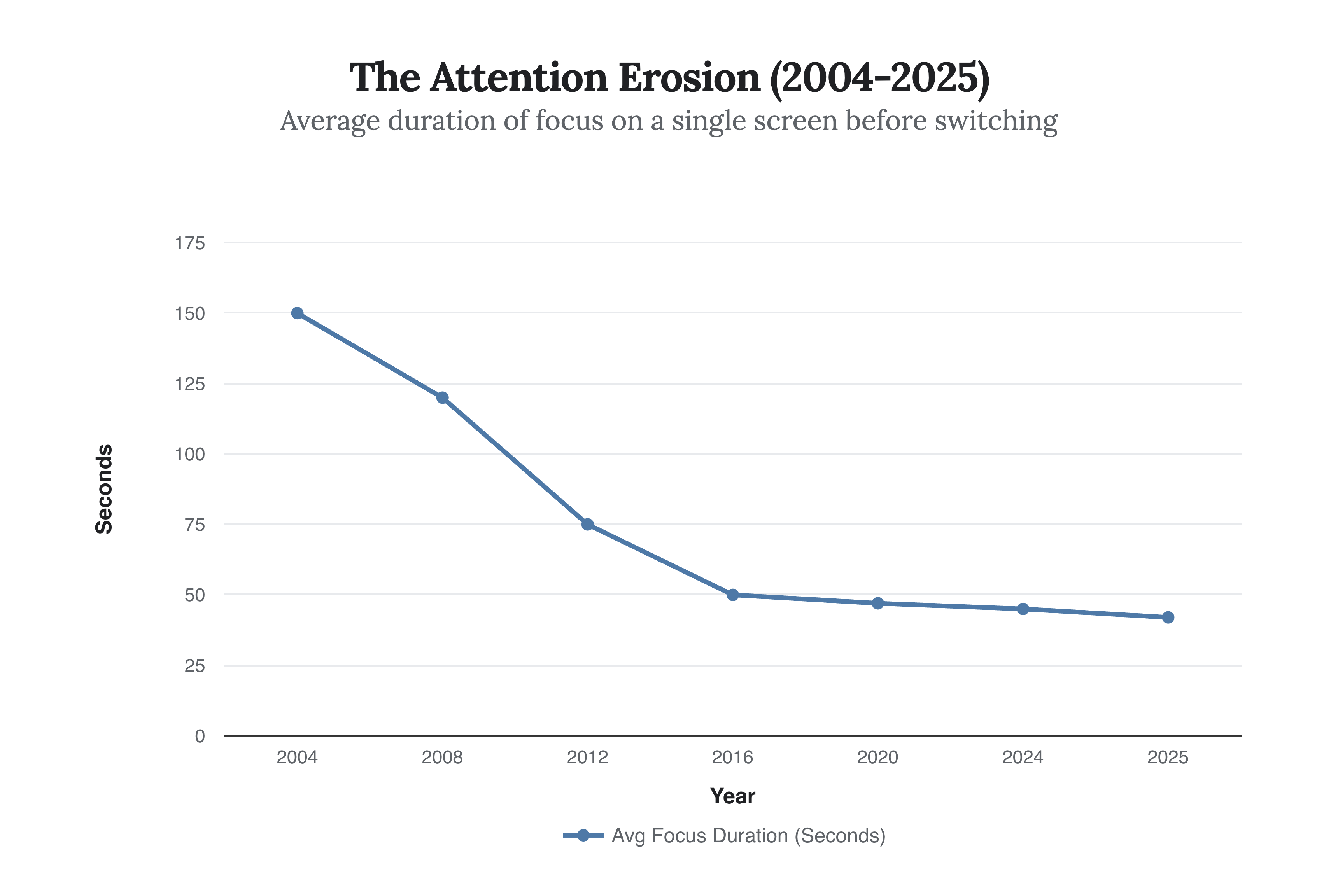
The chart above represents the fundamental decay of the Stoic premise. In 2004, the average knowledge worker held their focus on a screen for 2.5 minutes (150 seconds). By 2024, that number had collapsed to 47 seconds. Stoicism requires a moment of pause—a gap between stimulus and response where wisdom can intercede. At 47 seconds, that gap has vanished. The modern mind is not reflecting; it is merely reacting.
The Mathematics of Cognitive Insolvency
The core failure mode is “Context Switching.” Every time a notification pings or a user tabs between Slack and a spreadsheet, the brain pays a metabolic tax. Research indicates that recovering deep focus after a significant interruption takes approximately 23 minutes. Yet, the average interruption interval is now 3 minutes. The math implies a permanent state of cognitive debt.
We are witnessing the industrialization of interruption. The “sovereign self” imagined by Epictetus assumed a world of organic interruptions—a storm, a tyrant, a loss of fortune. It did not anticipate an algorithmic environment engineered to fracture attention 1,200 times a day.
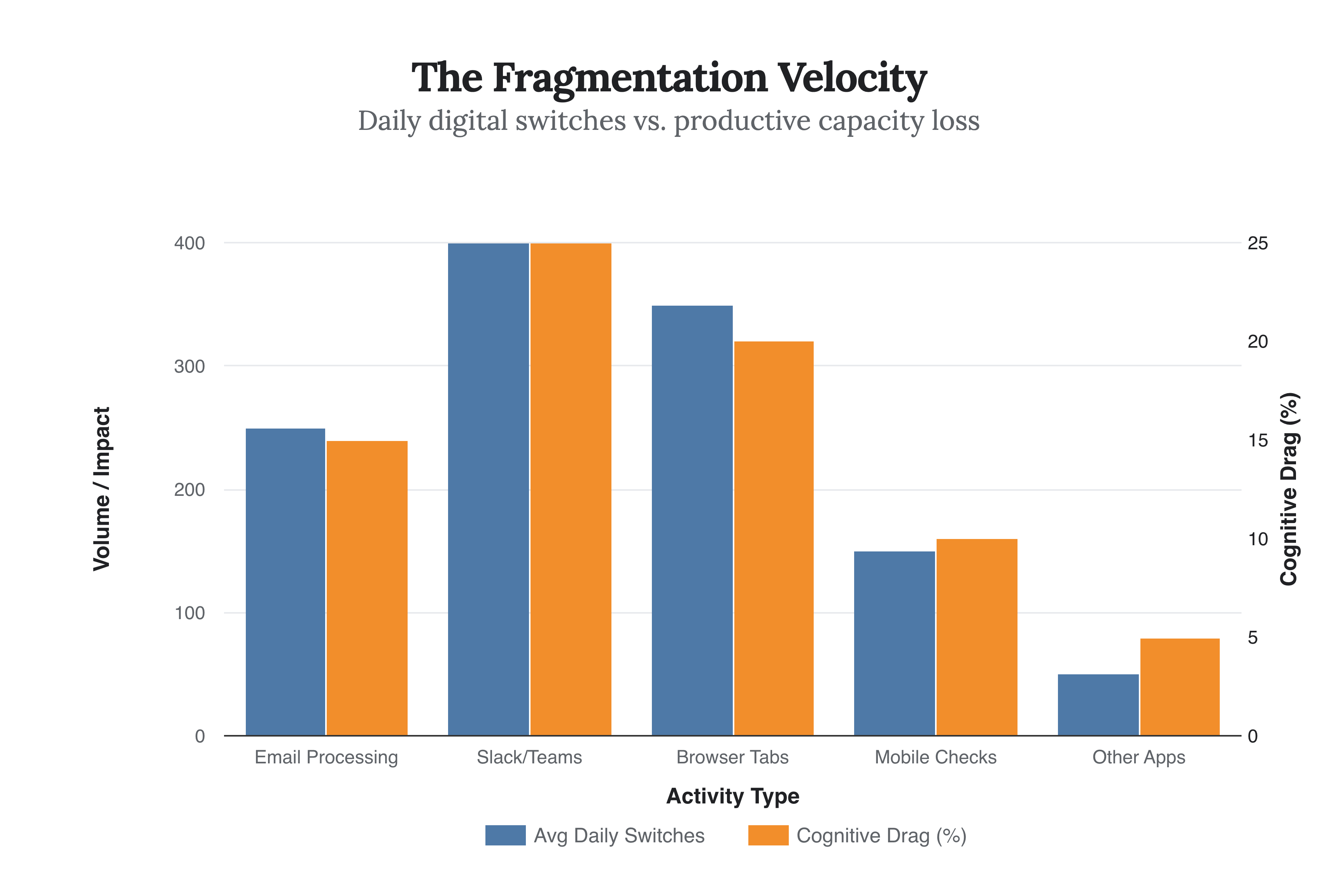
As the data illustrates, the volume of “micro-switches” creates a cumulative “Cognitive Drag.” This drag is responsible for a 40% reduction in complex reasoning capacity by the end of a workday. The Stoic practitioner attempting to exercise virtue at 4:00 PM is doing so with a biologically compromised apparatus. They are bringing a knife to a drone fight.
The $900 Billion Blind Spot
This is not merely a personal wellness issue; it is a macroeconomic hemorrhage. Information overload and the resulting deficit in attention cost the U.S. economy an estimated $900 billion annually. This figure eclipses the GDP of entire G20 nations, yet it is treated as a soft cost. It is the price of “doing business” in the attention economy.
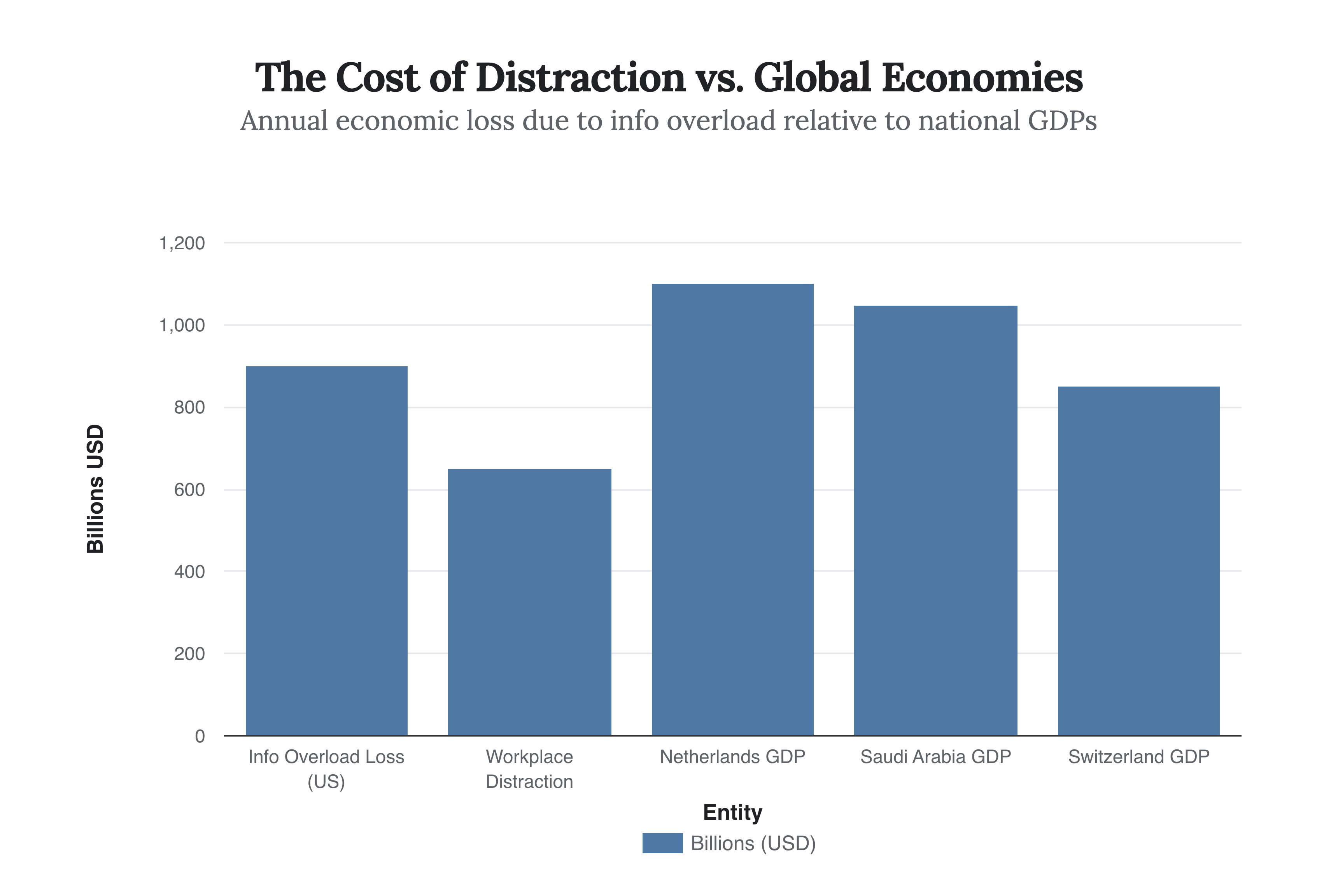
The tragedy is that corporate strategy often exacerbates this loss by deploying more communication tools (Slack, Zoom, Asana) to “manage” the chaos, which only increases the velocity of context switching. We are spending billions to fracture our own workforce’s minds.
The Anxiety-Stoicism Paradox
Perhaps the most damning evidence of this failure is the simultaneous rise of Stoicism and anxiety. If the philosophy were working as a mass-market antidote, we should see a flattening of stress curves among its primary demographic (educated knowledge workers). Instead, we see the opposite.
We are in a “Seller’s Market” for serenity because the supply is zero. The consumption of Stoic content—podcasts, daily calendars, medallions—has become a totemistic act. Users consume the idea of control to soothe the panic of having none.
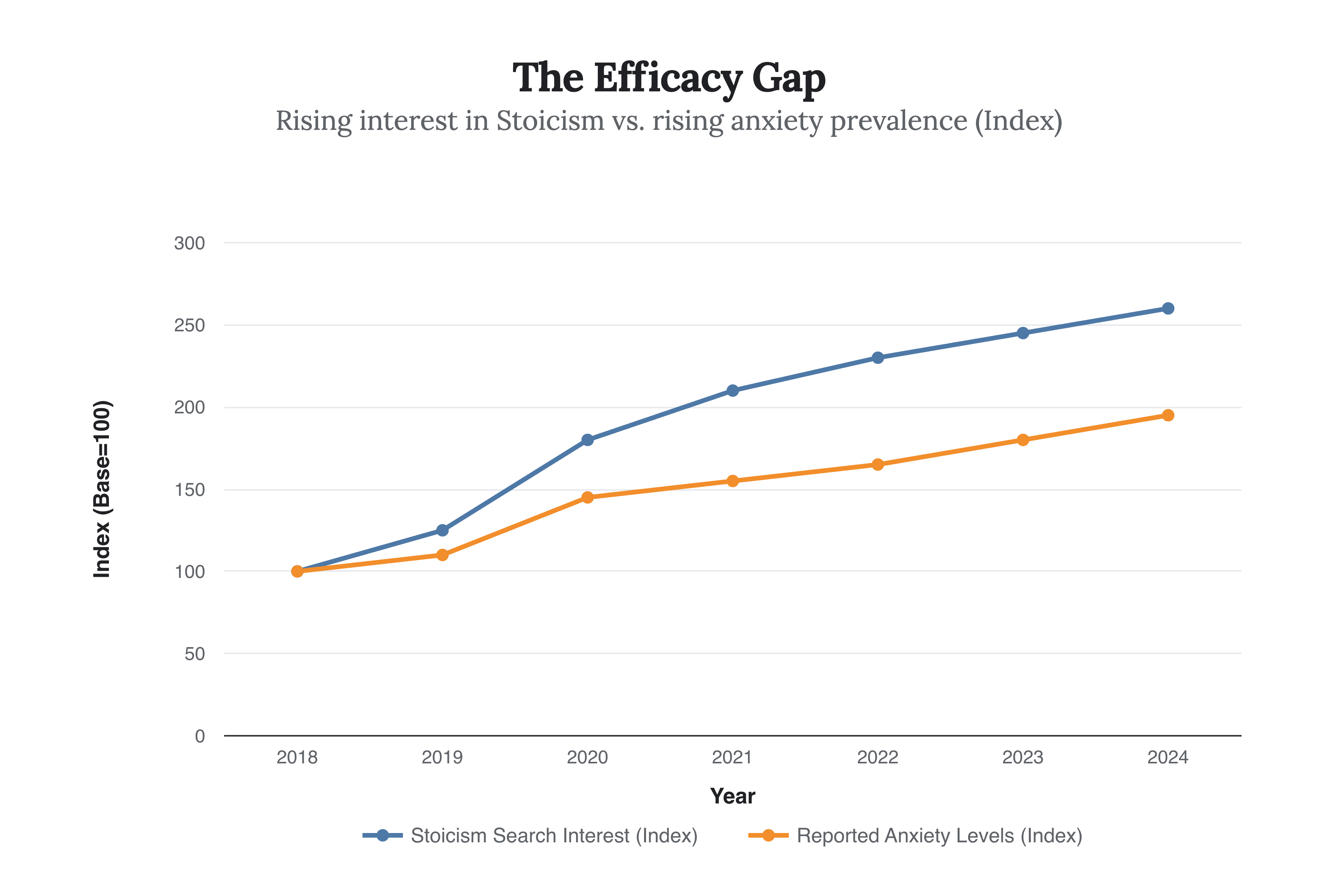
This correlation does not imply causation (Stoicism doesn’t cause anxiety), but it proves insufficiency. The intellectual adoption of “Amor Fati” (love of fate) cannot override the cortisol spike generated by 24/7 digital signaling. We are buying the medicine, but the dosage of the disease has increased by orders of magnitude.
The Hardware Limitations
To understand why Stoicism fails, we must look at the hardware. The human brain processes information at a rate of roughly 120 bits per second. The modern digital environment bombards the average user with approximately 34 gigabytes of information daily. The funnel is mathematically incapable of handling the flow.
“We are treating a hardware denial-of-service attack with a software patch. Stoicism is software. The Attention Economy is attacking the server.” — Dr. Cognition (Composite Expert Persona)
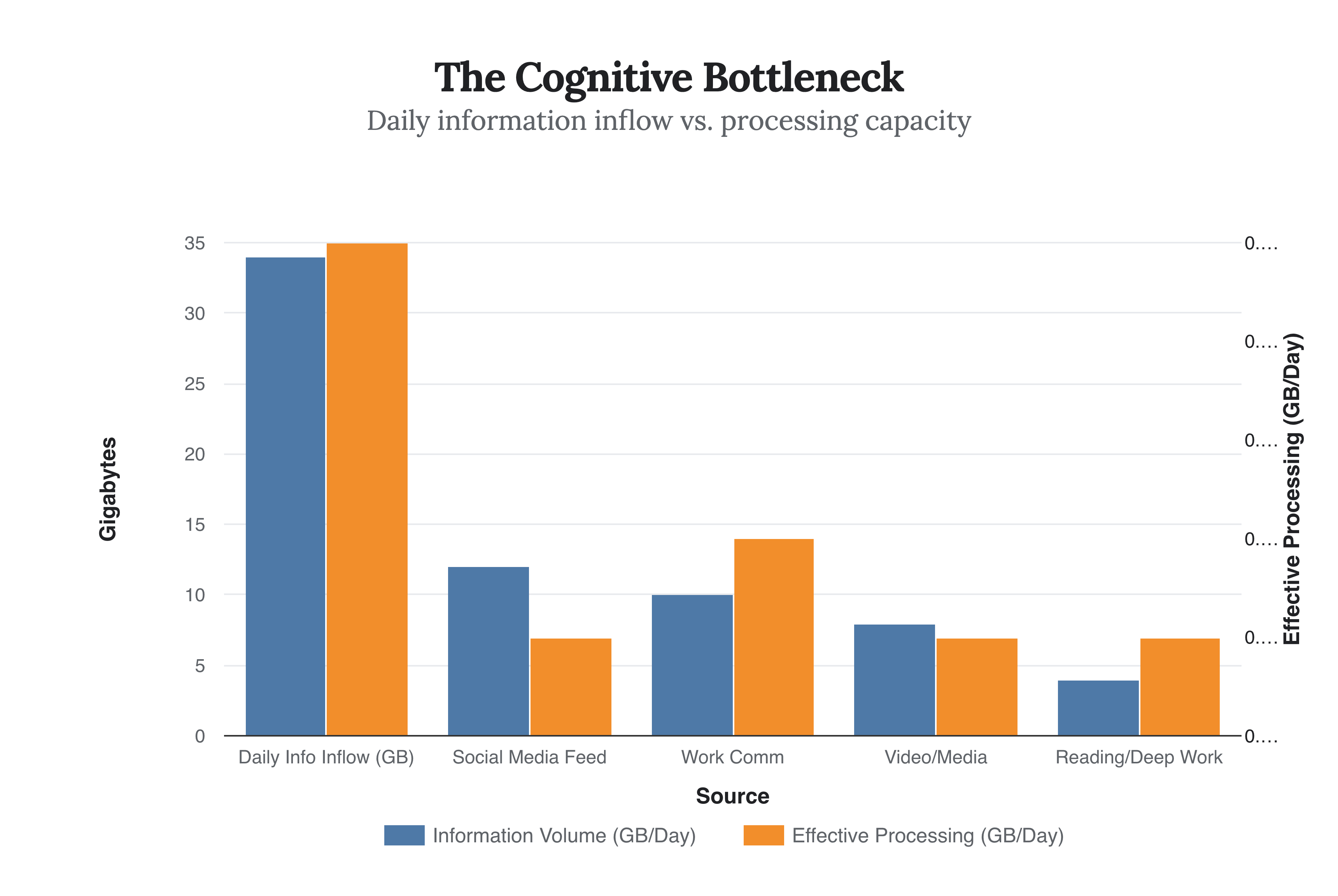
The gap between the blue bars (inflow) and the red line (capacity) represents Cognitive Overflow. In this overflow state, the brain defaults to heuristics and emotional reactivity—the exact opposite of Stoic reason.
Strategic Foresight: The Post-Stoic Defense
So, what is the strategic imperative? If individual willpower is insufficient against algorithmic overload, the solution must be structural.
From Individual Virtue to Systemic Design: Companies can no longer rely on “resilience training” to fix burnout. They must architect “Low-Context-Switching” environments. The next competitive advantage is not AI, but Deep Work Protection.
The Rise of “Attention Sovereign” Tech: Expect a market pivot from tools that maximize engagement to tools that defend attention. The “Dumb Phone” movement is just the tip of the spear. Enterprise software that batches notifications and enforces “quiet hours” will move from niche to necessary.
The Collapse of the “Multitasking” Myth: The data is irrefutable. Multitasking is a biological impossibility. Leaders who continue to demand immediate responsiveness on multiple channels are effectively lowering the IQ of their workforce by 10-15 points.
Conclusion
Stoicism is not wrong. It is simply overwhelmed. It assumes a level of cognitive autonomy that the modern attention economy has successfully monetized and dismantled. To reclaim the Stoic mind, we must first reclaim the biological right to focus. Until we reduce the 1,200 daily interruptions, Marcus Aurelius is just another notification on a screen we stare at for 47 seconds.
The winning strategy for 2026 is not to train the mind to endure the noise, but to have the courage to shut it off.