


We are standing at the precipice of the most significant cognitive displacement in human history, yet the market treats it as a mere efficiency upgrade. The conventional narrative suggests that Artificial Intelligence is a tool—a sophisticated lever that amplifies human intent. This is a comforting, dangerous lie.
The reality, buried in the latest data from 2024 and forward-looking intelligence for 2026, reveals a far more aggressive shift: we are moving from a regime of recommendation to a regime of automation. The era of “search”—the active, caloric expenditure of human curiosity—is collapsing. In its place rises the “Zero-Click” economy, where choices are not made, but ratified.
Recent intelligence from Europol predicts that by 2026, 90% of online content will be synthetically generated. Simultaneously, Gartner forecasts a 25% drop in traditional search volume by the same year. When you triangulate these vectors, the strategic implication is terrifyingly clear: the feedback loop is closing. We are entering a closed system where algorithms train on algorithmic output, and human agency becomes a luxury asset reserved for the disconnected.
The Death of Discovery: The 25% Search Collapse
For two decades, “Search” was the fundamental unit of the digital economy. It implied an active user querying a passive database. That dynamic is inverting. The user is becoming passive, and the database is becoming active.
Gartner’s projection of a 25% decline in search volume by 2026 is not just a metric for SEO professionals; it is a signal of cognitive atrophy. As Generative AI transitions from a novelty to an “Answer Engine,” the friction of choice is being smoothed away. We are trading the cognitive load of decision-making for the convenience of the “best” answer.
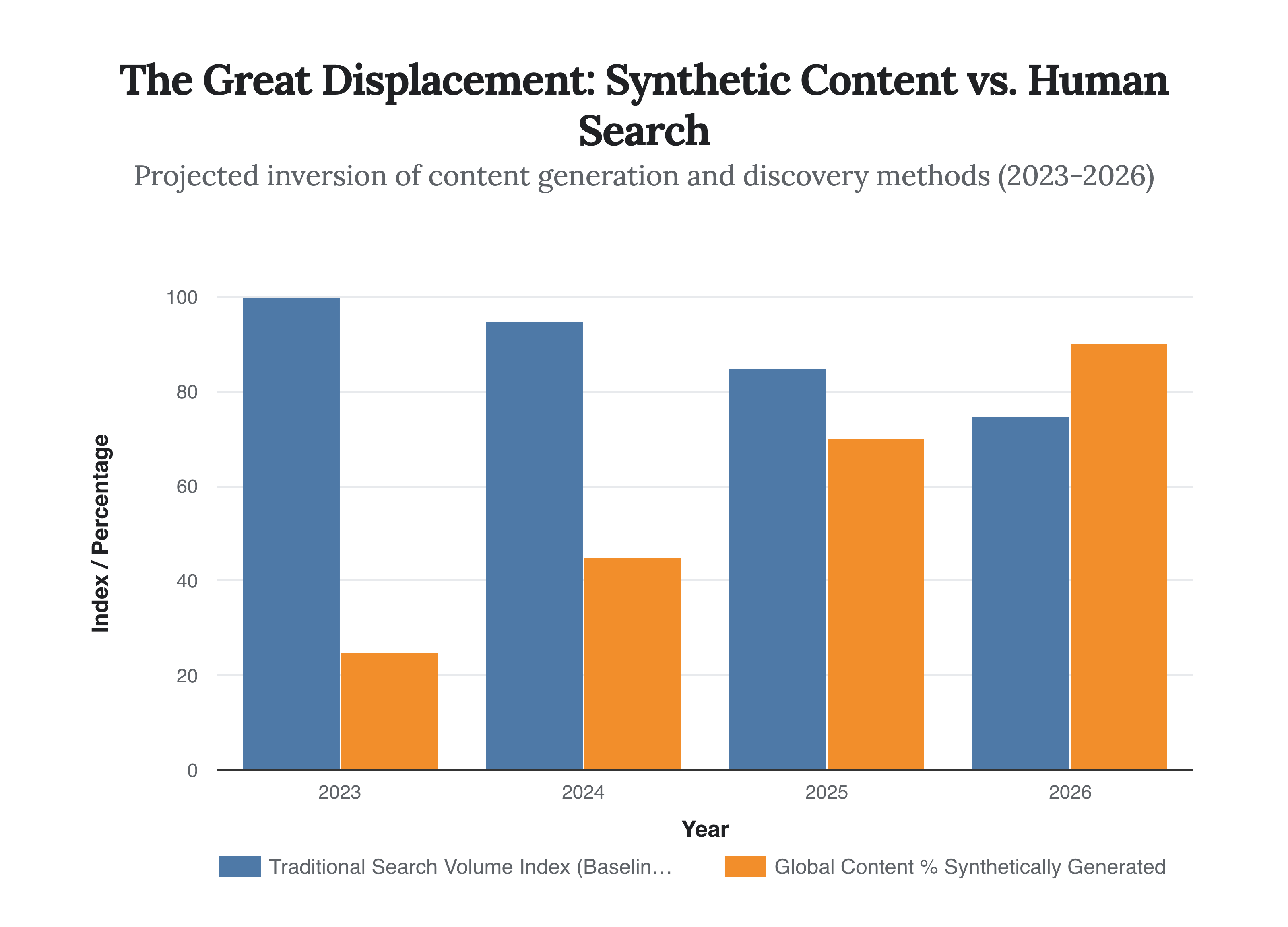
The chart above illustrates the “X-Curve” of Agency. As the volume of synthetic content explodes to near-saturation (90%), the mechanism for navigating it (Human Search) declines. The gap between these lines represents the Algorithmic Wedge—the space where AI agents, not humans, determine what is seen, read, and believed.
The “Zero-Click” Future
The “Zero-Click” phenomenon is already visible. Users no longer click through to websites; they consume the AI-generated summary. This destroys the economic model of the open web, but more importantly, it centralizes the “truth” into the hands of the model weights. When Google or Perplexity answers your question directly, you are not choosing a source; you are accepting a consensus. You are not exploring; you are being informed.
The 80% Feedback Loop: The Architecture of Determinism
If the decline of search is the future, the dominance of recommendation is the present. We flatter ourselves by believing our tastes are unique, but the data proves we are remarkably predictable variables in a mathematical equation.
Netflix’s internal data reveals that 80% of content views result from their recommendation algorithm. Only 20% comes from a user actively searching for a specific title. YouTube’s figures historically mirror this, with 70% of time spent driven by algorithmic suggestion. Amazon, the engine of global commerce, derives 35% of its total revenue directly from its recommendation engine. This is not “assistance”; this is “steering.”
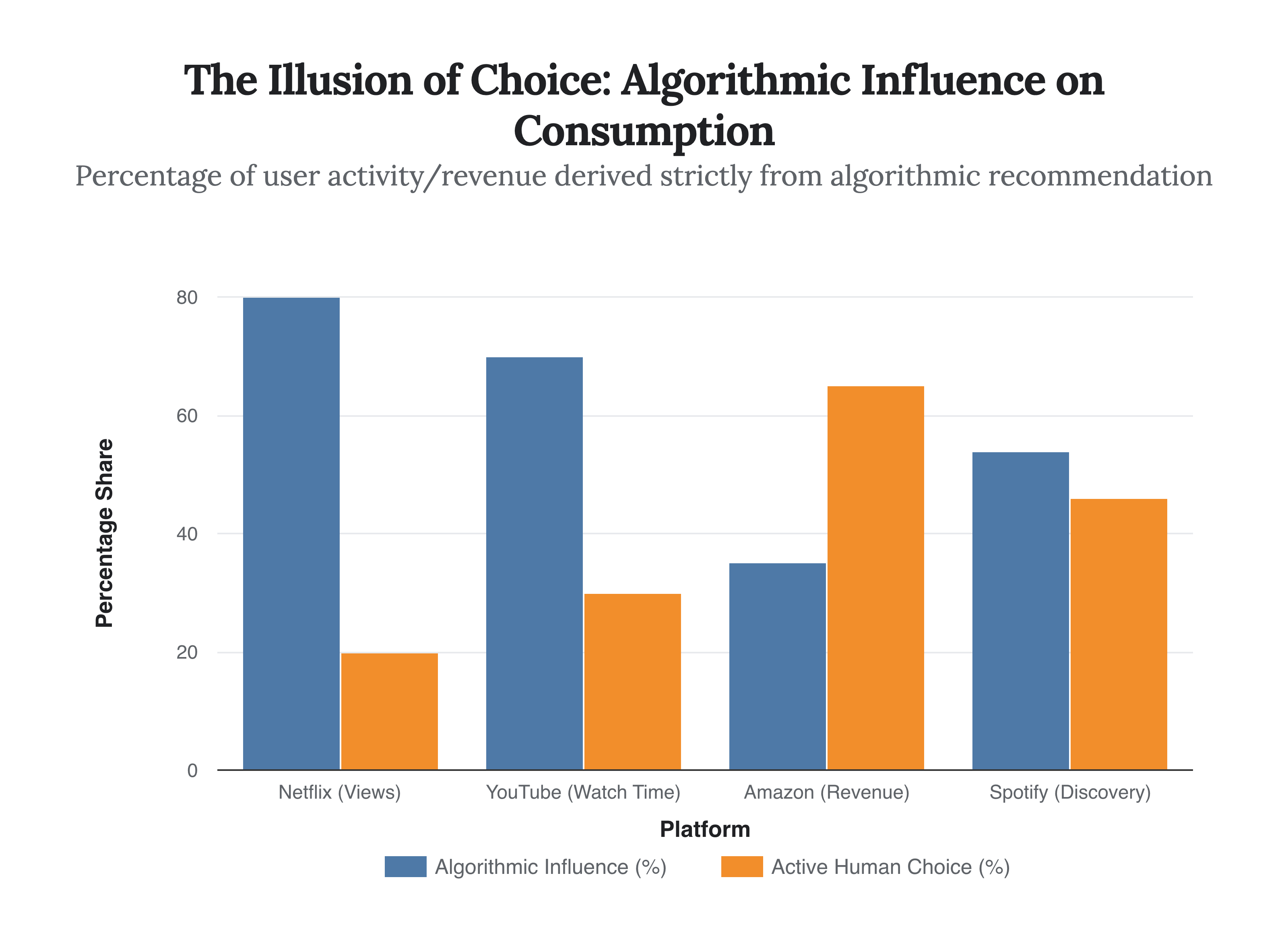
The implications of this “80% Rule” are profound. It means that culture is no longer a chaotic marketplace of ideas, but a highly optimized feedback loop. Algorithms optimize for engagement, which typically means optimizing for sameness and confirmation bias. We are seeing a homogenization of culture because the algorithm risks nothing on the outlier. It bets on the statistical probability of your attention.
The 49.6% Ghost Protocol: Navigating a Dead Internet
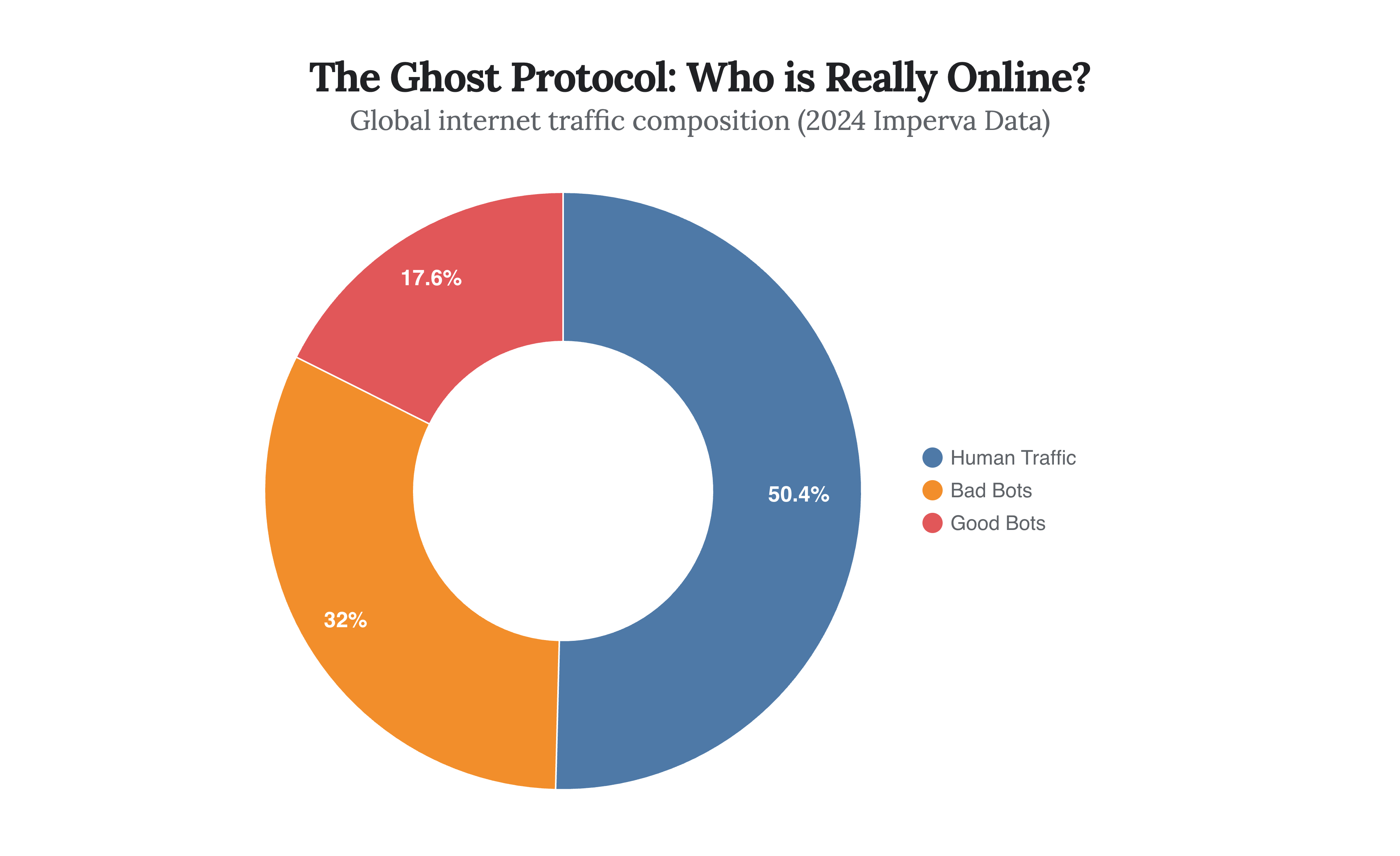
Strategic analysis requires us to question the environment itself. Is the crowd real? In 2024, the answer is increasingly “no.” According to the 2024 Imperva Bad Bot Report, 49.6% of all internet traffic is now non-human. We have reached parity. For every human making a choice, there is a bot simulating one.
This “Dead Internet” reality creates a massive distortion in market signals. If you are analyzing trend lines, sentiment analysis, or engagement metrics, you are likely analyzing the activity of scripts, not souls. The “Voice of the Customer” is being drowned out by the “Noise of the Bot.”
The strategic danger here is Recursive Training. As AI models scrape the web for data to train the next generation of models, they are increasingly ingesting content created by other bots and AI agents. This cannibalistic loop degrades model quality and detaches the digital world further from physical reality. We are building maps of territories that do not exist.
The Engagement Trap: Why We Surrender
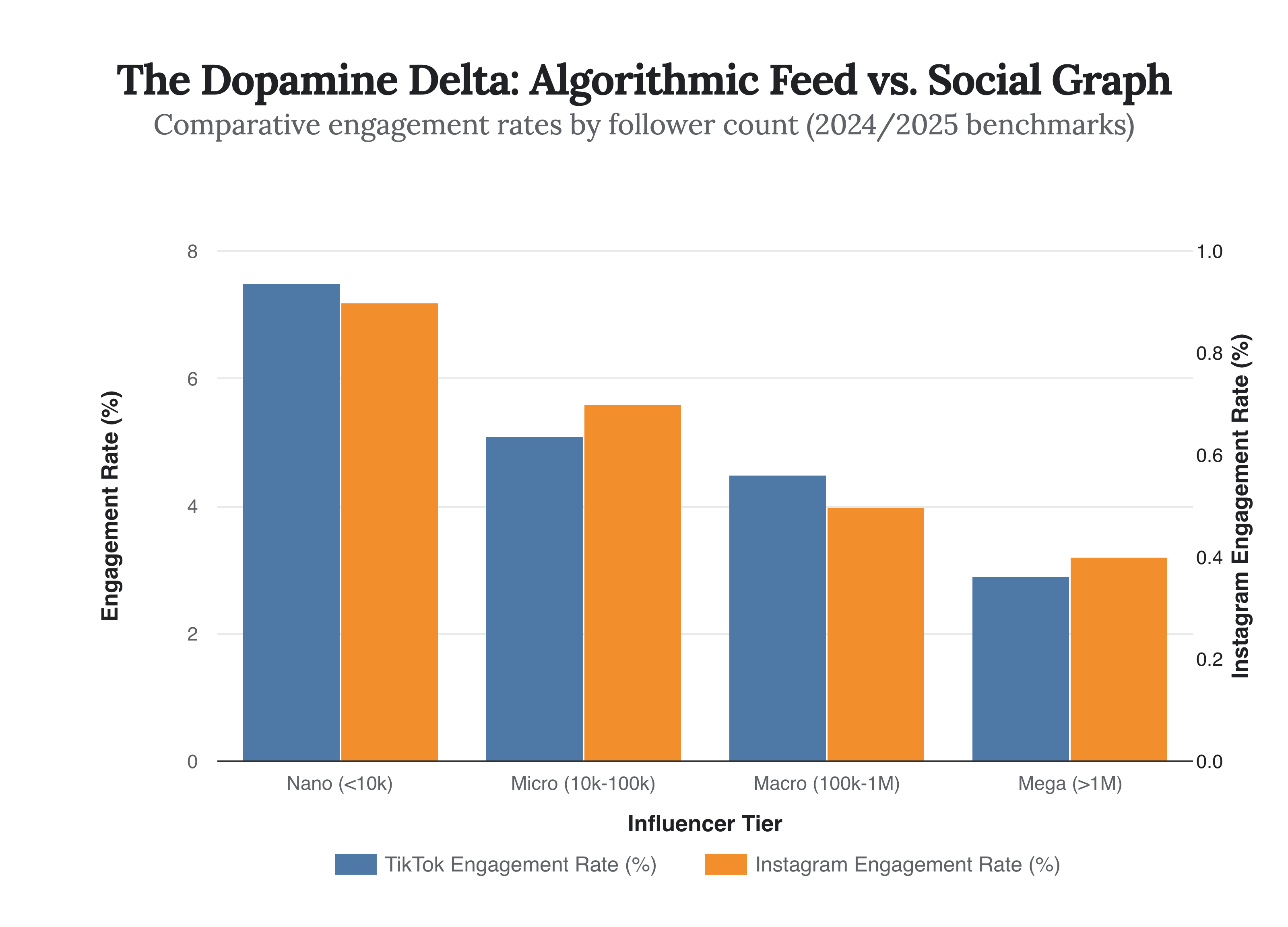
Why do we accept this erosion of agency? Because it feels good. The algorithm is a better drug dealer than the human curator. The shift from the “Social Graph” (seeing what your friends post) to the “Interest Graph” (seeing what the algorithm thinks you will like) has fundamentally rewired digital attention.
Comparing engagement rates between the old guard (Instagram) and the new guard (TikTok) reveals the efficiency of this surrender. TikTok’s “For You” page—a purely algorithmic feed—generates engagement rates nearly 10x higher than Instagram’s traditional feed. The market has spoken: we prefer the fate of the feed over the choice of the search.
The Trust Paradox
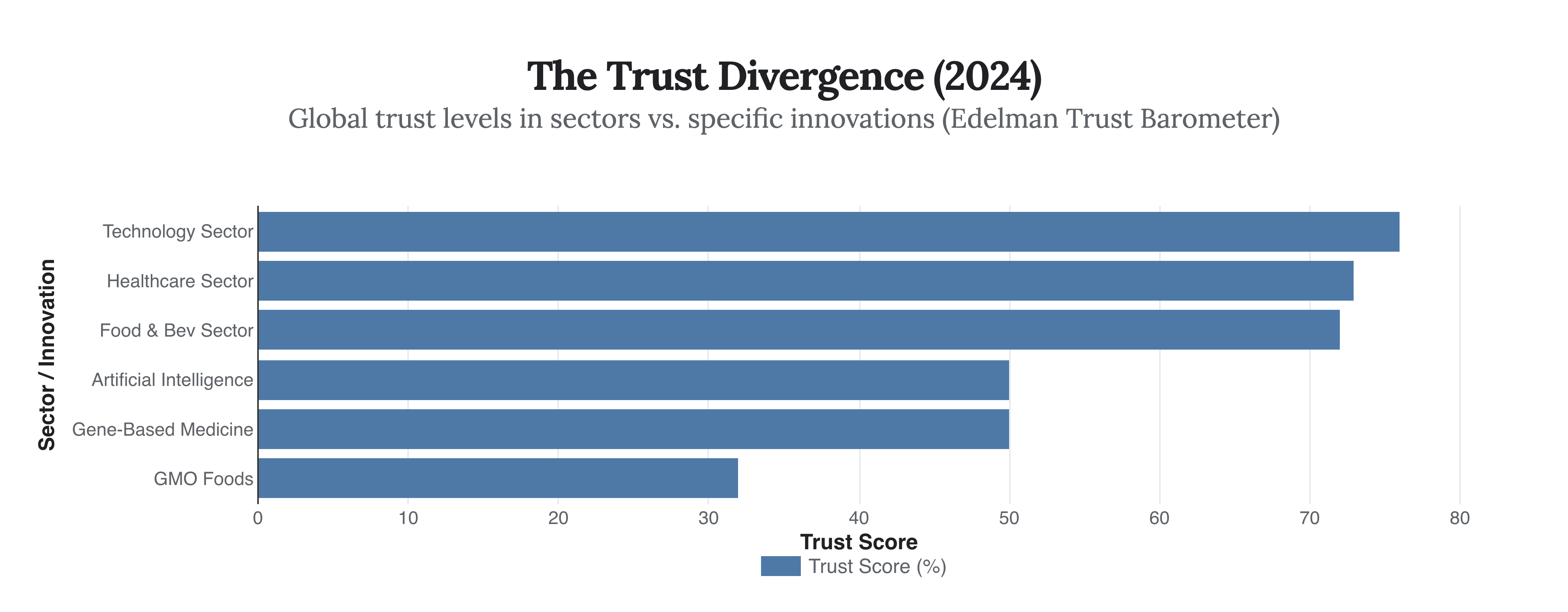
Here lies the final irony. While we hand over our attention and wallets to these systems, we do not actually trust them. The 2024 Edelman Trust Barometer highlights a massive divergence: while 76% of people trust the “Technology” sector, only 50% trust “Artificial Intelligence.”
We are in a state of cognitive dissonance—distrusting the pilot but refusing to take the wheel. This gap is where the next major societal fracture will occur. As the “black box” nature of these algorithms becomes more apparent, we can expect a “Right to Reality” movement—a premium market for un-algorithmized, human-verified experiences.
Strategic Forecast: The Rise of “Organic Discovery”
So what? The analysis points to three critical outcomes for the next 36 months:
The Bifurcation of the Internet: We will see a split between the “Grey Web” (AI-generated content consumed by AI agents) and the “Bright Web” (verified human content, gated and expensive). “Human-made” will become a luxury label, similar to “organic” in food.
Brand Invisibility: As search collapses, brands that rely on SEO and organic discovery will vanish. If you are not the “default answer” of the AI agent, you do not exist. Marketing will shift from convincing humans to optimizing for the Large Language Model’s weights (LLMO - Large Language Model Optimization).
The Agency Premium: The ability to make unassisted choices will become a status symbol. Executive decision-making will be defined by the ability to override the algorithm, not follow it.
“The danger is not that machines will begin to think like men, but that men will begin to think like machines.” — Sydney J. Harris
We are not merely clicking less; we are thinking less. The “Algorithmic Fate” is not inevitable, but avoiding it requires a conscious, friction-filled effort to step outside the feed. For the strategist, the alpha lies in identifying the data that the algorithm filters out.
The future belongs to those who can distinguish between the map drawn by the machine and the territory of the real.