



The artificial intelligence revolution, for all its world-changing promise, is built on a foundation that is beginning to crack. The relentless, exponential growth in compute demand for training and running advanced AI models is driving an unprecedented surge in the construction of terrestrial data centers. These sprawling complexes are consuming energy and water at a rate that is alarming environmentalists, straining power grids, and creating new geopolitical flashpoints over resource scarcity.
Projections show global AI data center power demand could quintuple by 2030, a trajectory that is fundamentally unsustainable. Into this looming crisis, Google has revealed its most audacious strategic pivot in a generation: Project Suncatcher. This is not an incremental improvement; it is a ‘moonshot’ to relocate the very heart of AI infrastructure into low-Earth orbit. By building constellations of solar-powered satellites equipped with its proprietary AI chips, Google is betting it can sidestep terrestrial constraints entirely, harnessing solar energy that is up to eight times more productive than on Earth. This briefing deconstructs the strategic, economic, and technical calculus behind Google’s orbital gambit, analyzing the profound second-order effects for investors, competitors, and the future of global technology infrastructure.
The Terawatt Gauntlet: AI’s Looming Energy Bottleneck on Earth
The core driver behind Google’s radical push into space is a problem of physics and economics here on Earth. The demand for AI compute is outstripping the capacity of our planet’s infrastructure to support it cleanly and affordably. Modern data centers are already colossal consumers of power and water for cooling, and the next generation of AI-focused facilities will be orders of magnitude more demanding. This insatiable appetite is creating a strategic vulnerability for every hyperscaler and government banking on an AI-powered future.
An Exponential Hunger for Power
Current global data center capacity stands at approximately 60 GW, but the explosion in AI workloads is projected to drive this figure to nearly 300 GW by 2030 in a high-growth scenario. This fivefold increase in just five years presents a monumental challenge, not only in generating the requisite power but in securing the land, water, and regulatory approvals to build the necessary facilities. The chart below illustrates the stark reality of this demand curve, forming the entire strategic predicate for exploring off-world alternatives.
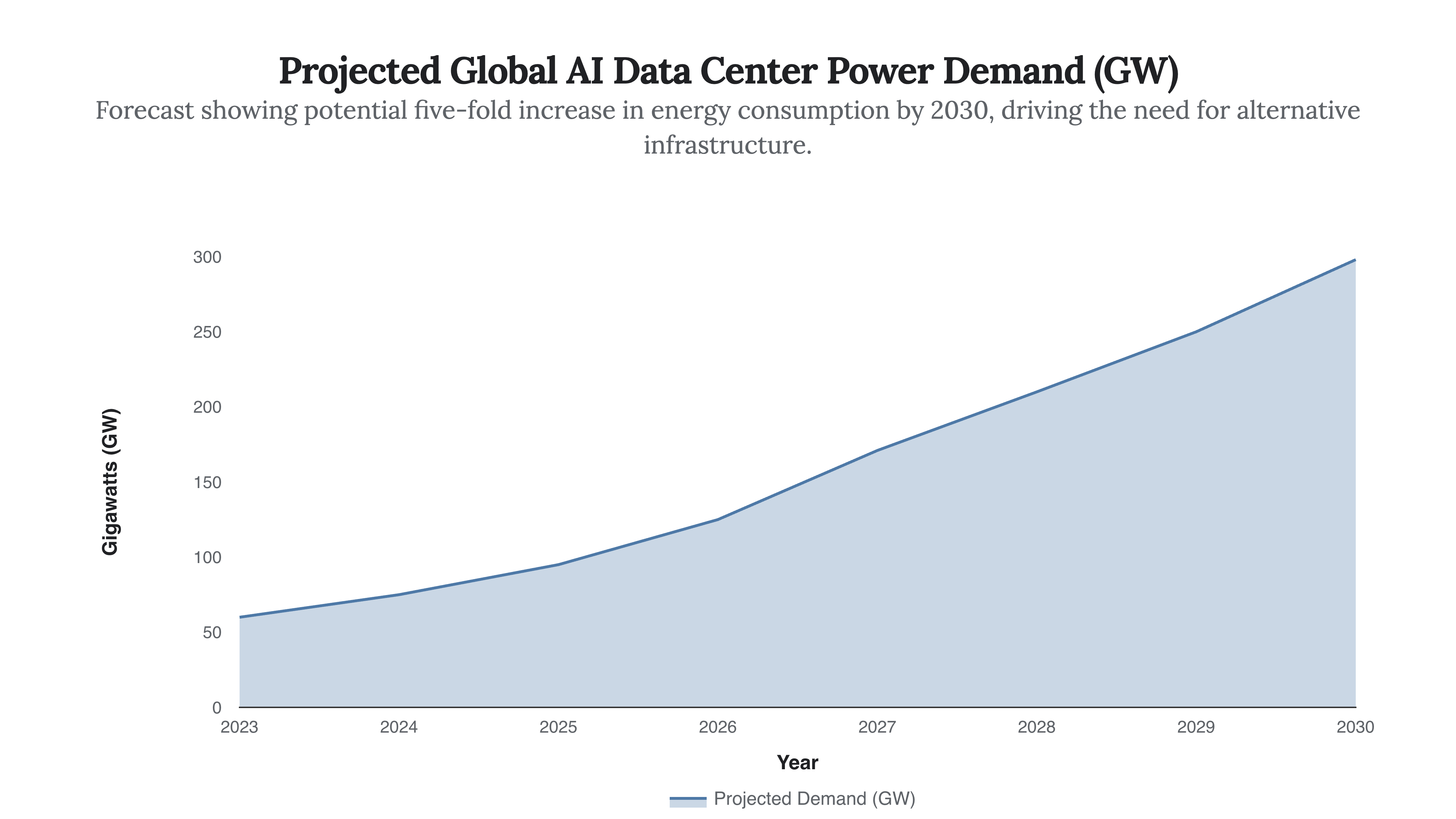
Caption: The projected growth in power consumption by AI data centers highlights the escalating unsustainability of a purely terrestrial approach, creating the strategic imperative for initiatives like Project Suncatcher.
“In the future, space may be the best place to scale AI compute. In the long run it may be the most scalable solution, with the additional benefit of minimizing the impact on terrestrial resources such as land and water.”
Project Suncatcher: Deconstructing Google’s Orbital Gambit
Announced in late 2025, Project Suncatcher is Google’s formal research initiative to design and deploy a scalable AI infrastructure in space. The vision is a network of tightly-packed satellite constellations orbiting approximately 400 miles above the Earth, each equipped with solar arrays, Google’s custom Tensor Processing Units (TPUs), and advanced cooling systems. Data is transmitted between the satellites using high-bandwidth optical laser links, creating a distributed, orbiting data center powered by near-constant sunlight.
The Economic Tipping Point: The Race to $200/kg
The entire economic viability of Project Suncatcher hinges on a single, critical variable: the cost of launching mass into orbit. Historically, high launch costs made such concepts prohibitively expensive. However, the advent of reusable rockets, spearheaded by companies like SpaceX, is fundamentally altering the equation. Google’s research indicates that once launch prices fall below $200 per kilogram—a milestone projected to be achievable by the mid-2030s—the cost of launching and operating a space-based data center becomes comparable to the energy costs alone for an equivalent terrestrial facility. This is the economic tipping point that transforms orbital data centers from science fiction into a strategic inevitability.
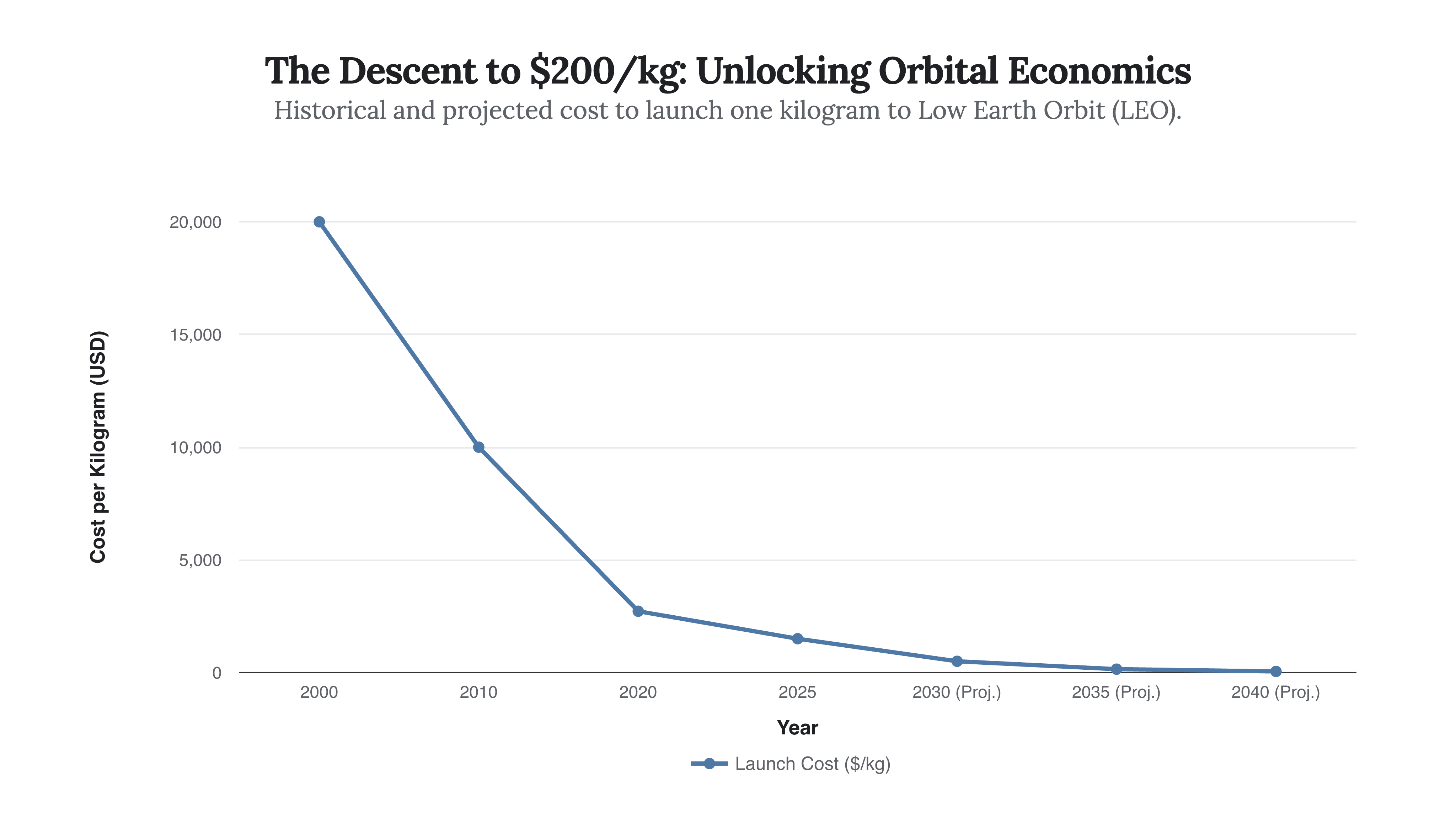
Caption: The dramatic reduction in launch costs, driven by reusable rocket technology, is the primary enabler of Google’s space-based infrastructure strategy. The projected sub-$200/kg price point in the 2030s represents the key threshold for economic competitiveness.
Currently, deploying a small 2MW data center in orbit could cost over $70 million, nearly three times its terrestrial counterpart. However, as launch costs plummet with the maturation of next-generation vehicles like SpaceX’s Starship, this gap not only closes but reverses, giving orbital deployments a structural cost advantage by eliminating the need for land, water, and terrestrial power grids.
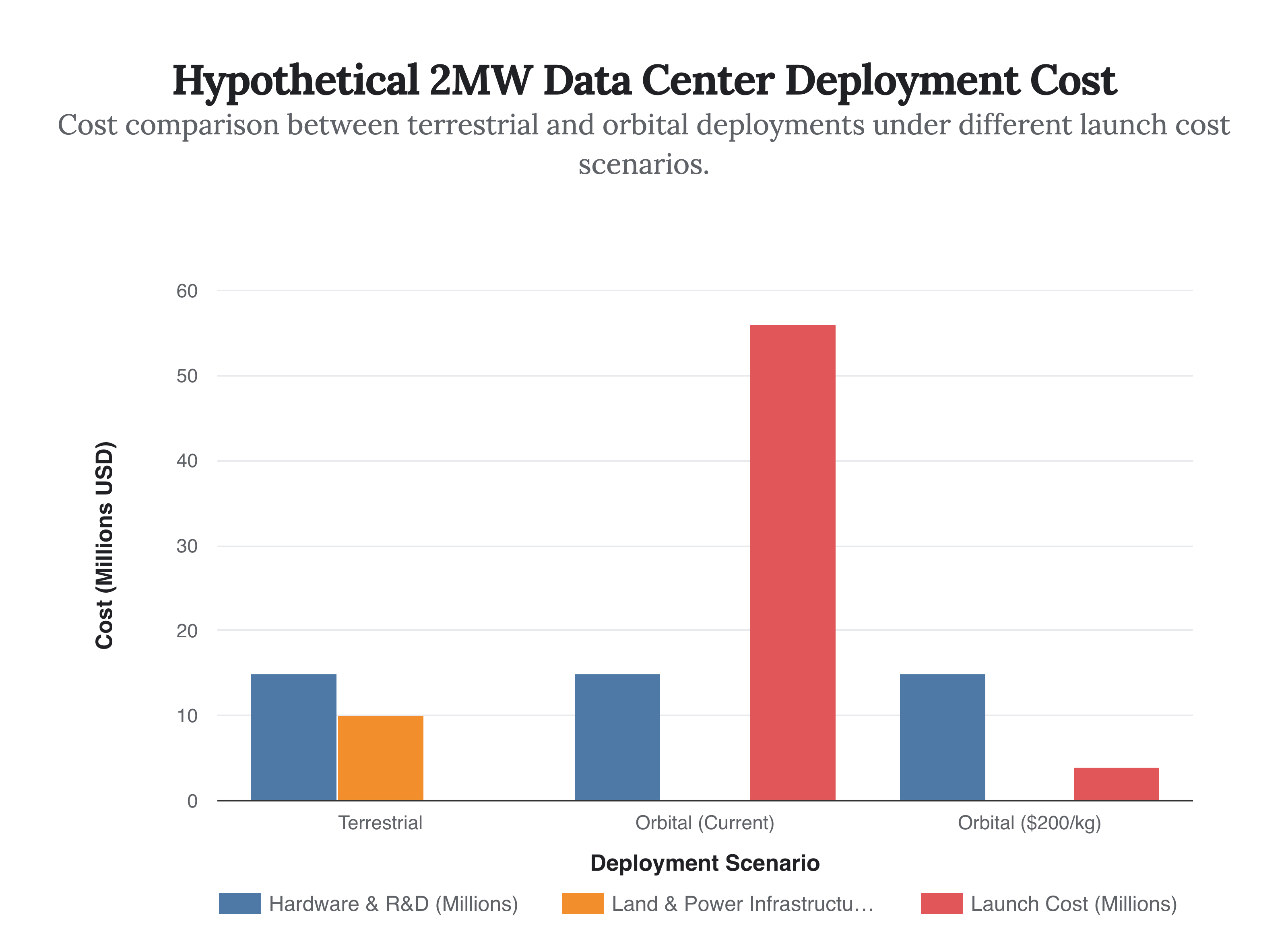
Caption: This chart illustrates how future launch cost reductions could make orbital data centers cost-competitive with terrestrial facilities, shifting the primary expenditure from physical infrastructure to launch services.
The Unmatched Energy Advantage
The most compelling strategic driver for Project Suncatcher is energy. By operating in a sun-synchronous orbit, Google’s satellite arrays are exposed to near-constant sunlight, uninterrupted by nightfall or weather. This allows a solar panel in space to be up to eight times more productive than the same panel on Earth. This dramatic increase in energy efficiency eliminates the need for massive battery storage and frees AI scaling from the constraints of Earth’s overburdened power grids.
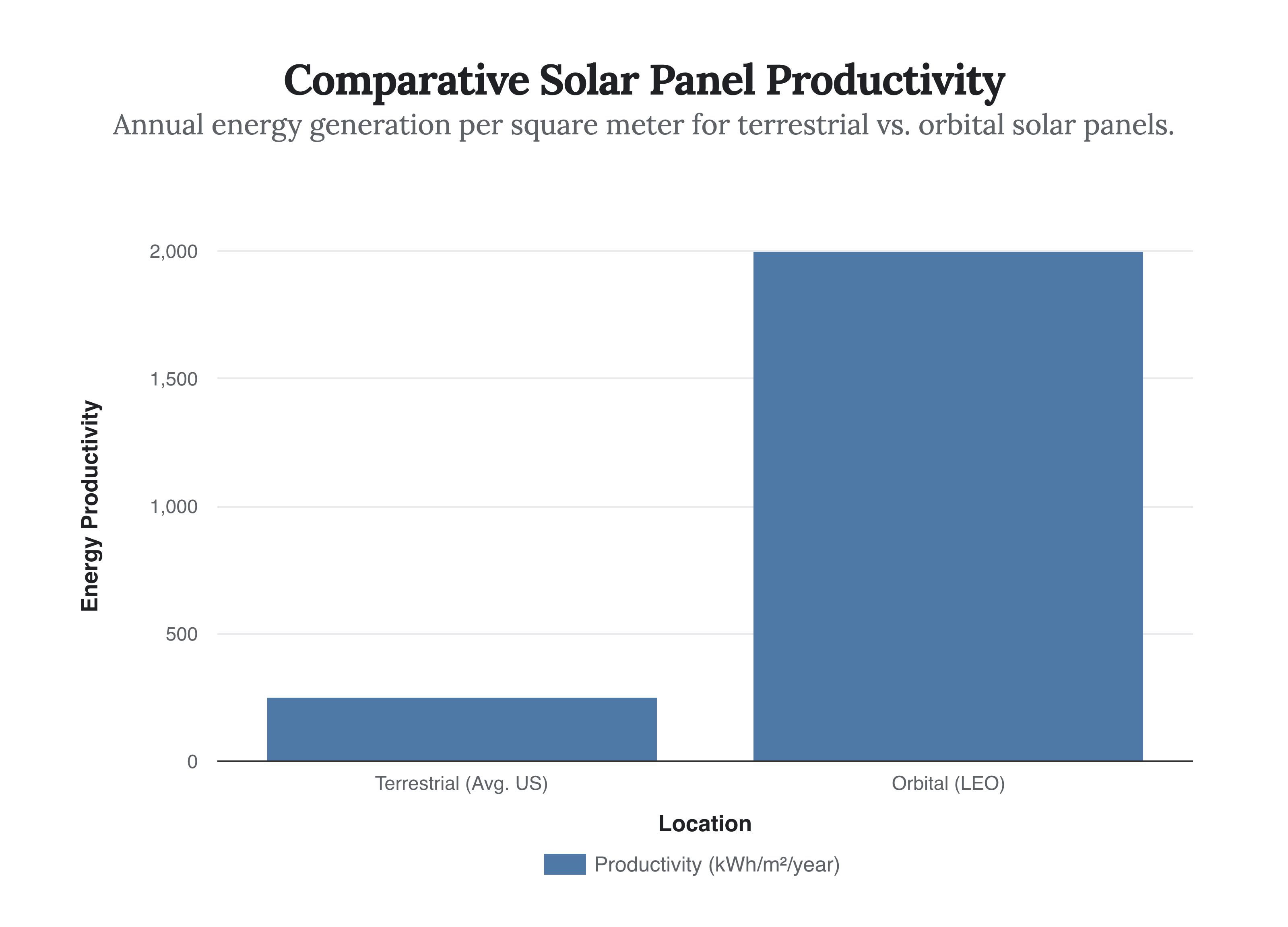
Caption: The 8X productivity advantage of orbital solar panels is a primary justification for Project Suncatcher, offering a path to power AI workloads that is decoupled from terrestrial energy constraints.
The Orbital Cloud Race: Mapping the Competitive Cosmos
Google is not alone in recognizing the strategic potential of space-based infrastructure. A new competitive arena is taking shape in low-Earth orbit, with tech giants and agile startups alike vying for a foothold. While Project Suncatcher is arguably the most ambitious vision for orbital AI compute, the ecosystem is rapidly evolving.
The Emerging Players
The competitive landscape includes established aerospace players and a new breed of space-native cloud companies:
SpaceX: Elon Musk has publicly stated ambitions for Starlink to evolve into an orbital data processing network, leveraging its massive constellation and future Starship launch capacity.
Amazon/Blue Origin: Jeff Bezos has also predicted that heavy industry and data centers will migrate to space. Amazon’s AWS already has a dedicated space division, Azure Space, signaling clear intent.
Startups (e.g., Starcloud, Axiom Space): A number of venture-backed startups are pursuing niche aspects of the market, from orbital data storage to edge computing for in-space applications. Starcloud has already launched a test satellite with an Nvidia GPU.
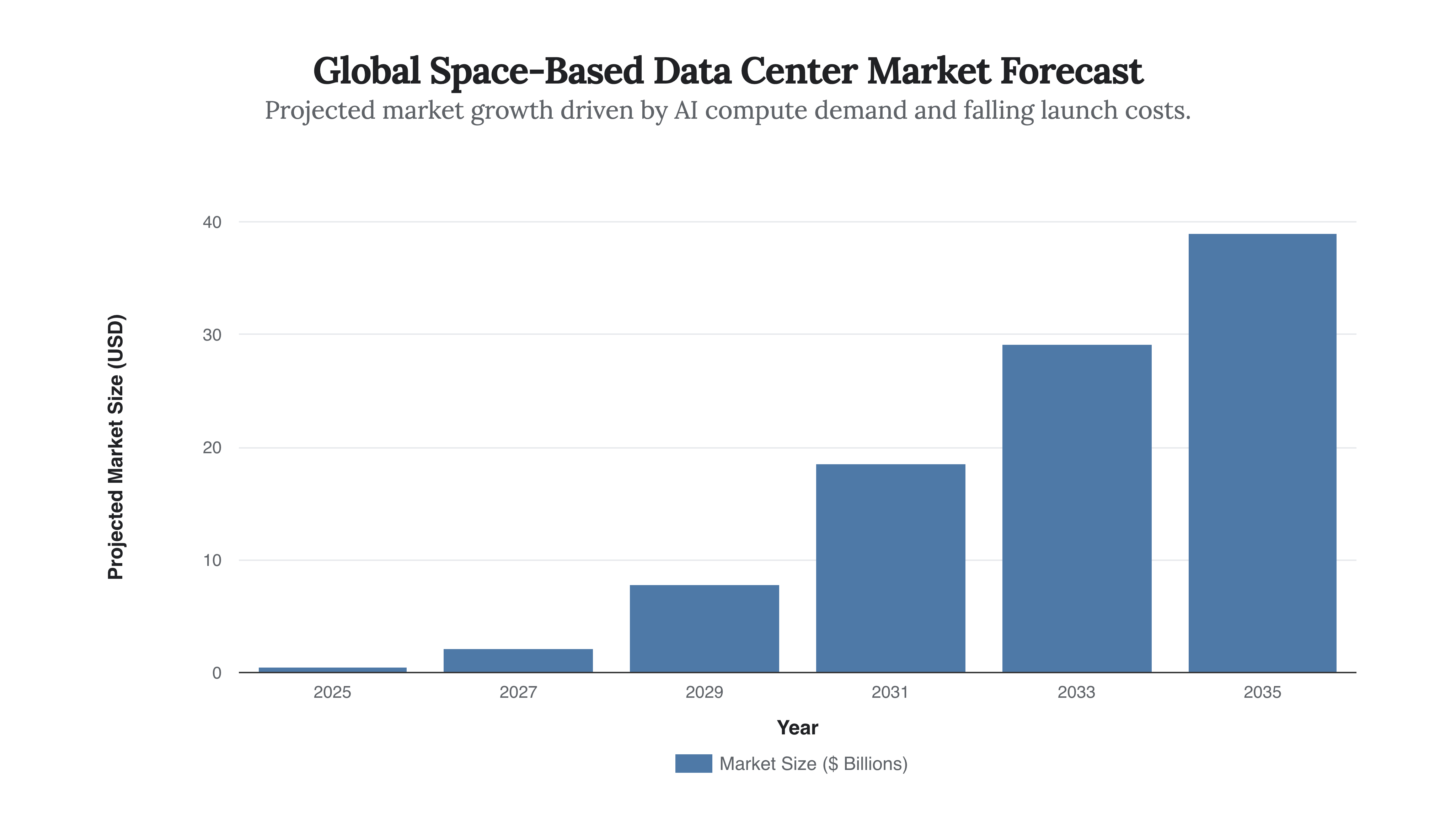
Caption: Analysts project the orbital data center market to grow exponentially, reaching nearly $40 billion by 2035, indicating a significant emerging sector in the tech and space industries.
“Data centers in space will help expedite many use cases. The time from seeing something to taking action is very, very important for national security and for some scientific applications as well.” - Jason Aspiotis, Axiom Space
Strategic Foresight: Hurdles, Timelines, and Second-Order Effects
While the strategic logic is compelling, the path to gigawatt-scale orbital data centers is fraught with immense engineering and logistical challenges. Google’s planned prototype launch with Planet Labs in early 2027 will be a critical first test of the core technologies.
Engineering the Impossible in a Vacuum
Beyond launch costs, Google must solve several formidable technical problems. Thermal management is paramount; without air for convection, heat from the TPUs must be dissipated through complex radiator systems. Hardware must be hardened to withstand the constant bombardment of solar radiation, and the entire satellite constellation must maintain precise formation flying to enable the high-bandwidth optical links. These challenges represent the primary execution risks to Google’s timeline.
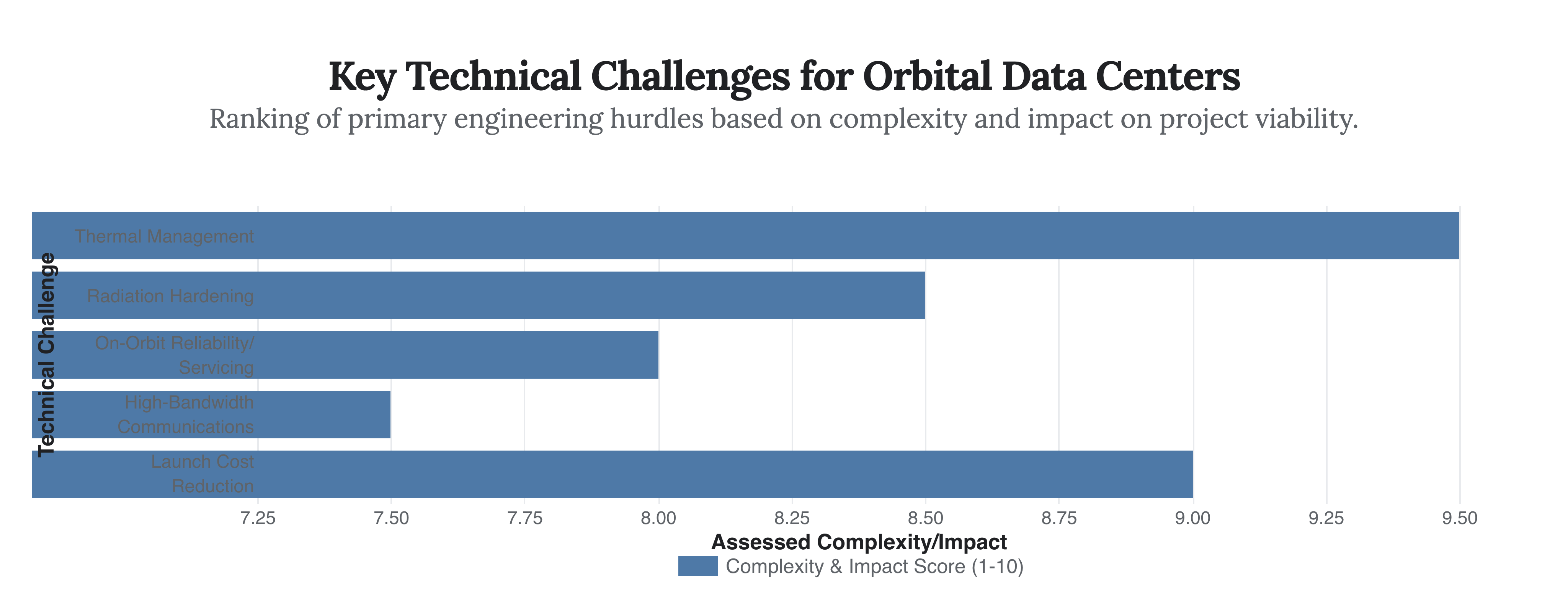
Caption: A qualitative assessment of the major engineering hurdles. While launch costs are a key economic enabler, solving for thermal management and long-term reliability in the vacuum of space are the most complex technical challenges.
Winners, Losers, and Geopolitical Shockwaves
The successful deployment of orbital data centers will create a new set of winners and losers. Launch providers, manufacturers of space-hardened electronics, and robotics companies specializing in on-orbit servicing stand to benefit enormously. Conversely, the value of terrestrial land for data centers could decline, and traditional utility providers will face a future where their largest customers are migrating to an off-planet power source. The geopolitical implications are also profound, raising new questions about data sovereignty, orbital weaponization, and the regulation of extra-terrestrial commercial activity.
Project Suncatcher represents more than a search for cheaper electricity; it is a fundamental reimagining of the physical limits of computation. By decoupling AI’s growth from Earth’s finite resources, Google is attempting to build a moat of infrastructure that may be impossible for terrestrial-bound competitors to cross. The 2027 prototype launch is the key signpost to watch; its success or failure will signal whether the next chapter of the cloud wars will be fought not on land or at sea, but in the cold, sunlit vacuum of space.
For the first time in history, a leading technology firm is building critical infrastructure on the assumption that the future of scaled computation does not reside on Planet Earth.