


We have reached the terminal velocity of human choice. For decades, the prevailing economic orthodoxy was simple: more options equal more freedom, and more freedom equals more well-being. This assumption has now collapsed under the weight of its own data. We are no longer navigating a market of abundance; we are drowning in a “Paralysis Economy” where the sheer volume of optionality is not just annoying—it is measurably destroying value, stalling corporate strategy, and eroding mental health at a population level.
The latest intelligence is alarming. In 2024, the friction of decision-making has transitioned from a psychological nuisance to a massive financial liability. Retailers are projecting nearly a trillion dollars in returns—not because products are defective, but because consumers are hedging their bets against an overwhelming array of choices. In the C-suite, the situation is even more dire: a stunning majority of business leaders are so crippled by “decision distress” that they are willing to abdicate their primary function—making choices—to algorithms. This briefing dissects the paradox of infinite choice, quantifying the cost of our cognitive overload and forecasting the rise of a new strategic imperative: Constrained Curation.
The Neuroeconomics of Overload: The 10x Decision Spike
The human brain was not architected for the modern data environment. According to a landmark study by Oracle, 74% of people report that the number of decisions they make every day has increased 10x over the last three years. This is not a gradual incline; it is a vertical wall of cognitive load. The result is a phenomenon I call “Cognitive Insolvency”—where the demand for executive function exceeds the brain’s available supply.
This insolvency manifests as “Decision Distress,” a state of perpetual anxiety, regret, and guilt over potential suboptimal choices. It is no longer about choosing the best option; it is about the terror of choosing the wrong one. The data below illustrates the severity of this psychological tax on the modern workforce.
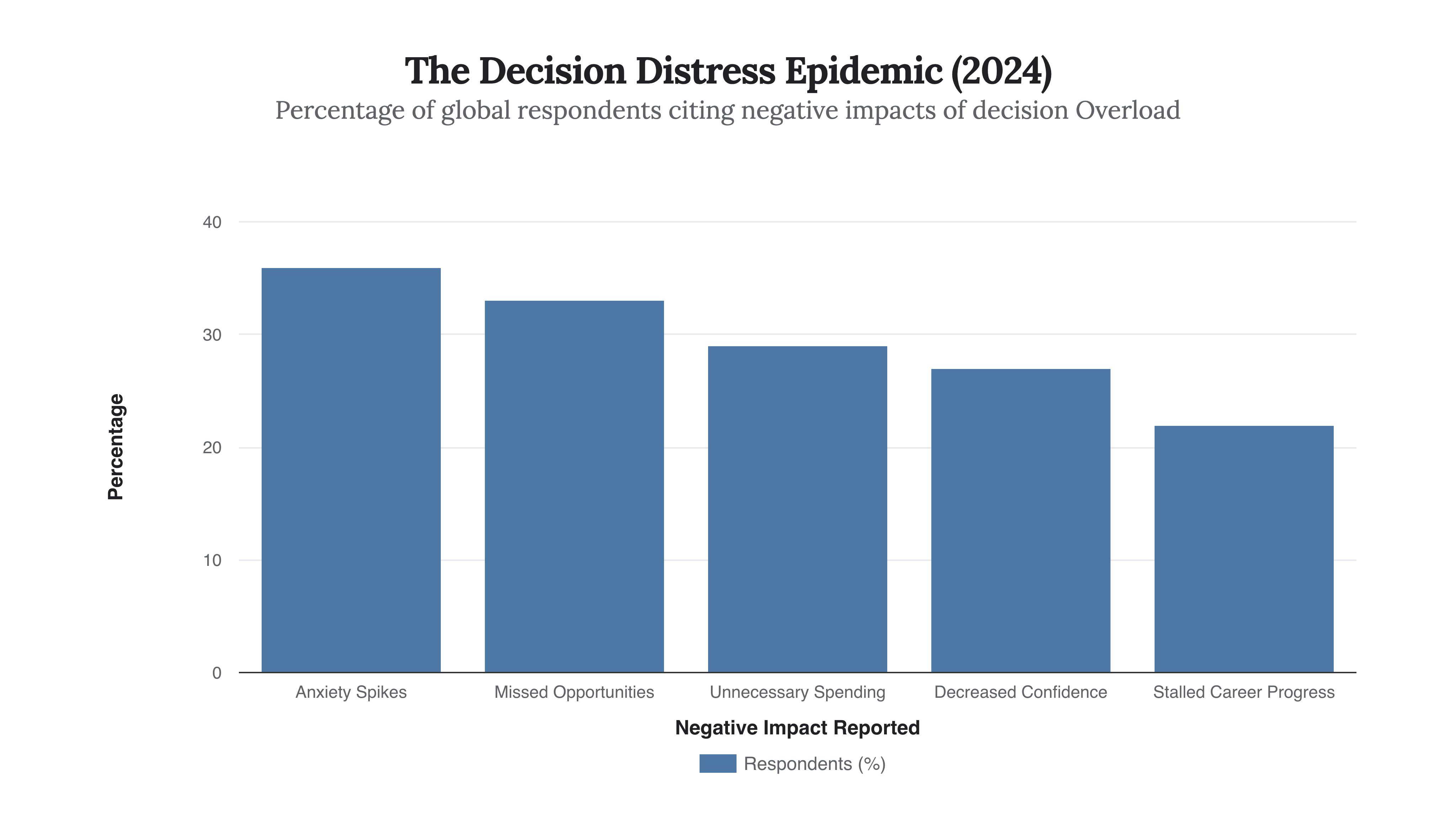
The strategic implication here is profound: Decision fatigue is now a key driver of inflation. The “Unnecessary Spending” metric (29%) suggests that nearly a third of consumers and B2B buyers are throwing money at problems simply to make the decision go away, rather than optimizing for value. In a high-interest-rate environment, this inefficiency is a hidden drag on balance sheets.
The $890 Billion “Bracketing” Bubble
Nowhere is the cost of infinite choice more tangible than in the retail sector. As e-commerce platforms expanded their SKUs to “endless aisle” proportions, they inadvertently trained consumers to adopt a behavior known as “bracketing”—purchasing multiple versions of the same item (different sizes, colors, brands) with the explicit intent to return most of them.
This is the physical manifestation of analysis paralysis. Unable to decide based on digital information alone, the consumer defers the decision until the physical goods arrive. The National Retail Federation (NRF) projects that total returns will hit $890 billion in 2024. To put that in perspective, the “Indecision Tax” paid by retailers is roughly equivalent to the GDP of Saudi Arabia.
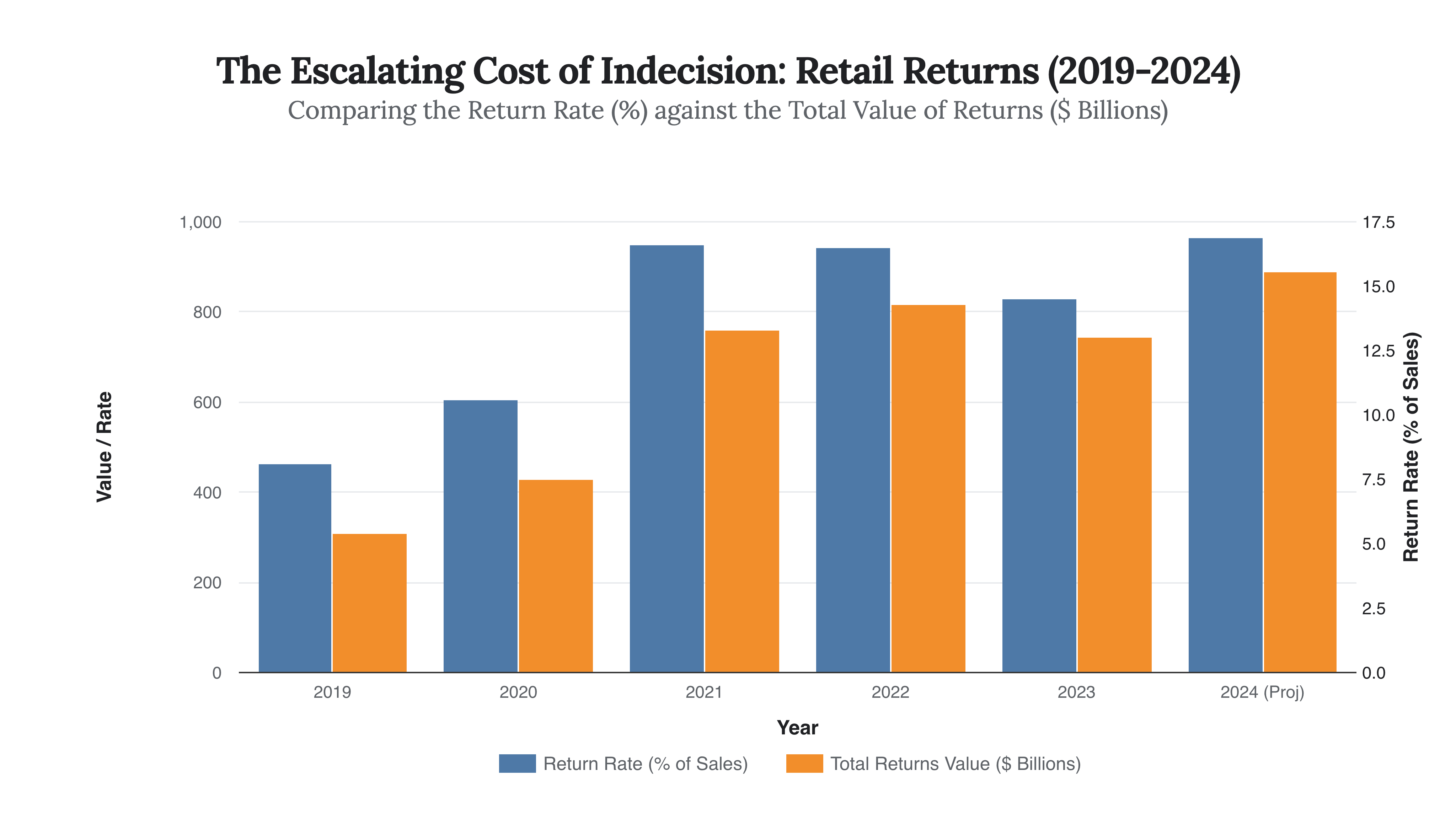
Strategic Foresight: This trend is unsustainable. We are approaching a “Returns Cliff” where the logistics cost of processing these choices wipes out the margin of the sale itself. Expect a hard pivot in 2025: “Free Returns” will die, replaced by AI-driven “Probability of Keep” scores that gate access to certain inventory. The retailers who win will be those who reduce choice, not expand it.
The Streaming Black Hole: 110 Hours of Nothing
In the digital attention economy, the paradox of choice has created a productivity black hole. We are not consuming content; we are consuming the menu. New data from UserTesting reveals that the average American subscriber now spends 110 hours per year just scrolling through streaming services. That is nearly five full days of life lost to the friction of interface design and content saturation.
The search times are lengthening, not shortening, despite billions spent on recommendation algorithms. This indicates a failure of the “Personalization” thesis. Algorithms that present “more of what you like” are actually compounding the anxiety of choice by removing the serendipity of limited options.
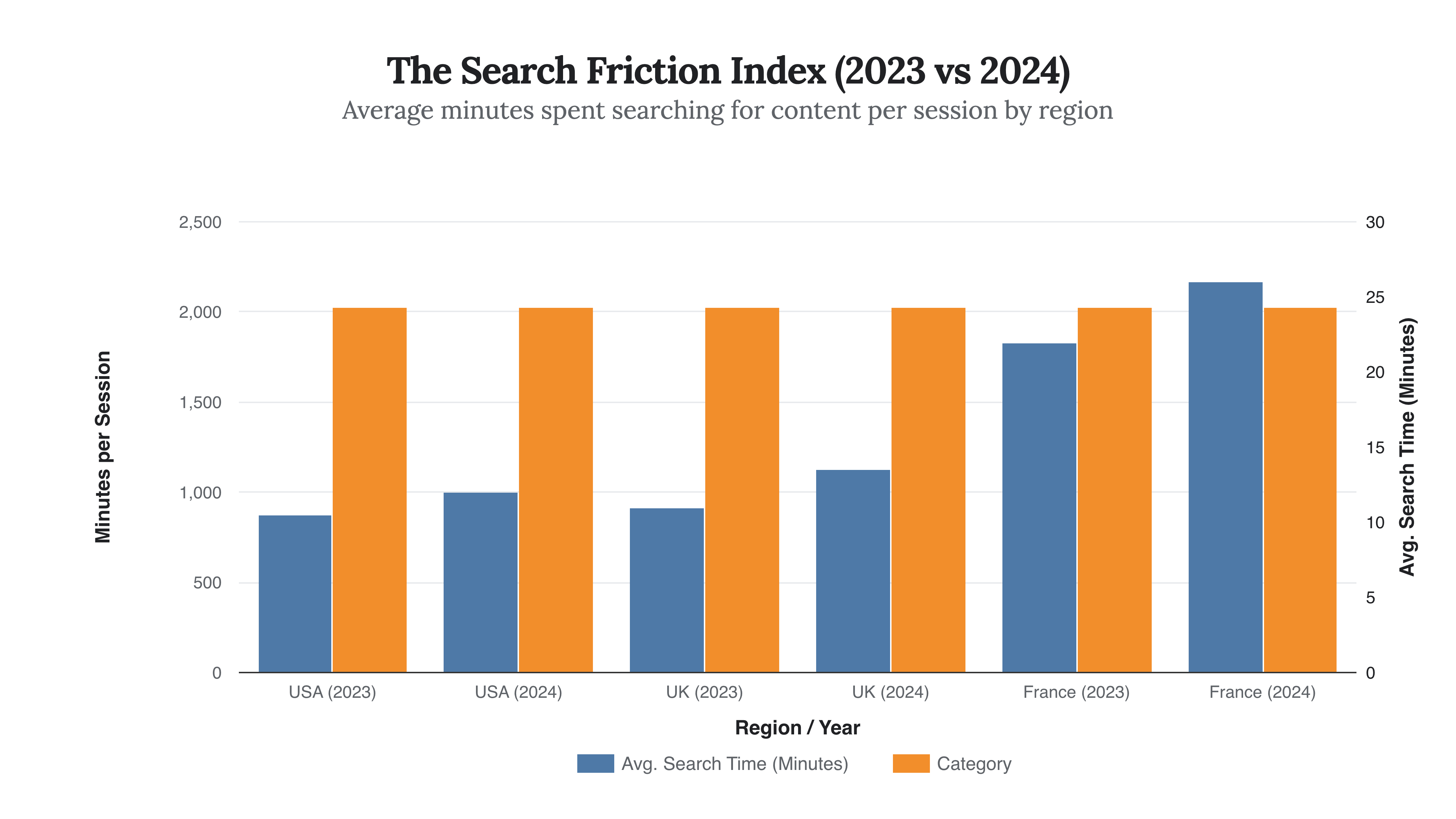
The “France Anomaly”—where viewers spend nearly an entire sitcom episode’s worth of time just searching—is a warning signal for global markets. As content fragmentation increases (more services, more exclusives), the “Time to Joy” metric degrades. We are seeing early signs of “Subscription Fatigue” transitioning into “Selection Revolt,” where users cancel services simply because the library is too vast to navigate.
The Executive Surrender: 70% Want Out
Perhaps the most disturbing signal comes from the top of the corporate ladder. Decision fatigue is not just a consumer problem; it is paralyzing the global C-Suite. The Oracle “Decision Dilemma” study uncovered a statistic that should keep every board member awake at night: 70% of business leaders would prefer a robot to make their decisions for them.
This is an unprecedented crisis of agency. Leaders are so inundated with data—”paralysis by analysis”—that they are willing to surrender their core value proposition (judgment) to a black box. This is not about AI efficiency; it is about psychological exhaustion.
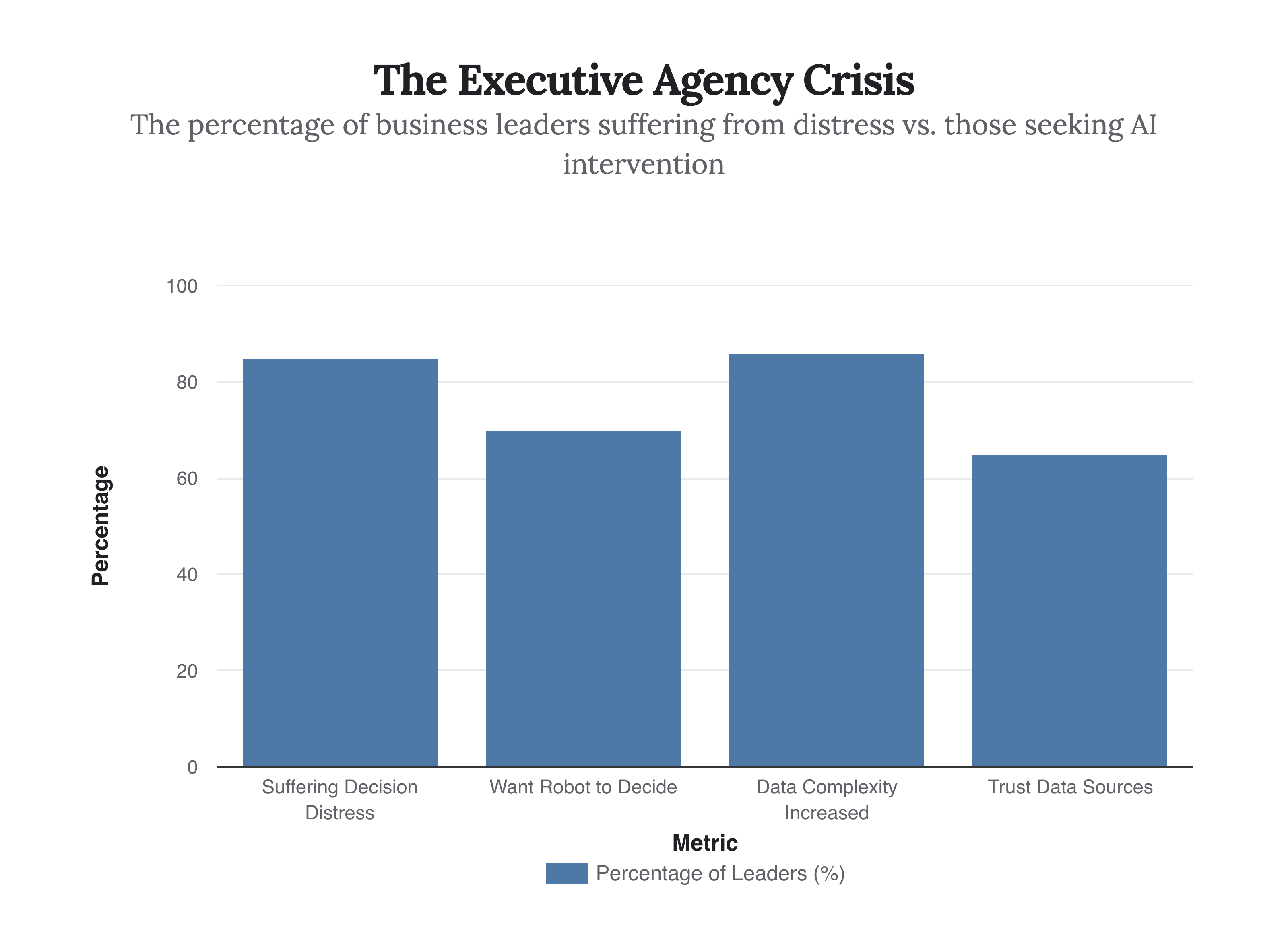
So What? If 70% of leaders are looking to outsource decision-making, we are entering an era of Algorithmic Governance by default, not by design. The companies that thrive will be those that use AI not to make decisions, but to reduce the option set presented to human leaders to a manageable three or four critical paths.
The Future: Choice-as-a-Service (CaaS)
The data paints a clear picture: The “Long Tail” is dead. The future belongs to the “Short List.” We are moving away from an economy of aggregation (Amazon, Netflix) toward an economy of curation. The Paradox of Choice has created a new premium on constraint.
Predictions for 2025-2026:
The Rise of “Zero-Option” Commerce: Subscription boxes were version 1.0. Version 2.0 will be “Zero-Click” ordering, where AI predicts your need and fulfills it, requiring effort only to cancel, not to choose.
B2B “Decision Support” Premiums: Enterprise software will no longer compete on feature lists (SKU proliferation) but on “Time to Decision.” Dashboards that present 50 metrics will be replaced by those that present 3 insights and 1 recommendation.
The “Unbundling” of Streaming: Expect a return to linear-style “Channels” within streaming apps. Viewers will pay extra for the privilege of not having to choose what to watch.
The winners of the next decade will not be the ones who give us the most options. They will be the ones who give us our time back.
Strategic Takeaway: Your customers and your leaders are begging for less. The ultimate luxury in 2025 is not infinite choice, but the freedom from having to choose at all.