



The global economy is currently bleeding $8.9 trillion annually—roughly 9% of global GDP—into a void of lost productivity. Corporate leadership and HR consultancies have labeled this the “Engagement Crisis,” treating it as a morale issue solvable with wellness apps, hybrid policies, and town halls. They are wrong.
This is not a crisis of morale; it is a structural crisis of Alienation. By applying Karl Marx’s 1844 theory of alienation to 2024-2025 global labor data, we uncover a profound strategic reality: the modern workforce has not just “quiet quit”; they have fundamentally decoupled from the economic engine they power. We are witnessing the industrialization of the white-collar mind, where digital tools intended to enhance productivity have instead severed the four critical connections Marx identified as essential for human labor.
This briefing deconstructs the $8.9 trillion deficit not as a failure of culture, but as the mathematical inevitability of a system that has optimized the humanity out of work. We analyze the four dimensions of this decoupling using the latest data from Gallup, the ILO, Microsoft, and global market studies.
1. Alienation from the Product: The Great Value Decoupling
Marx argued that when workers do not own the fruits of their labor, the product becomes an “alien object” that dominates them. In the 2024 economy, this theoretical concept has materialized as a measurable divergence between output and reward. The worker produces more than ever, yet retains a shrinking fraction of that value, creating a psychological and economic chasm between effort and outcome.
The Productivity-Wage Scissors
Data from the International Labour Organization (ILO) and the Economic Policy Institute reveals a widening “scissors” effect. While technology has exponentially increased the output per hour of the average worker, real compensation has flatlined or grown at a fraction of that pace. The surplus value is not reinvested in the workforce but captured by capital (shareholders) and the machinery itself (AI/SaaS investment).
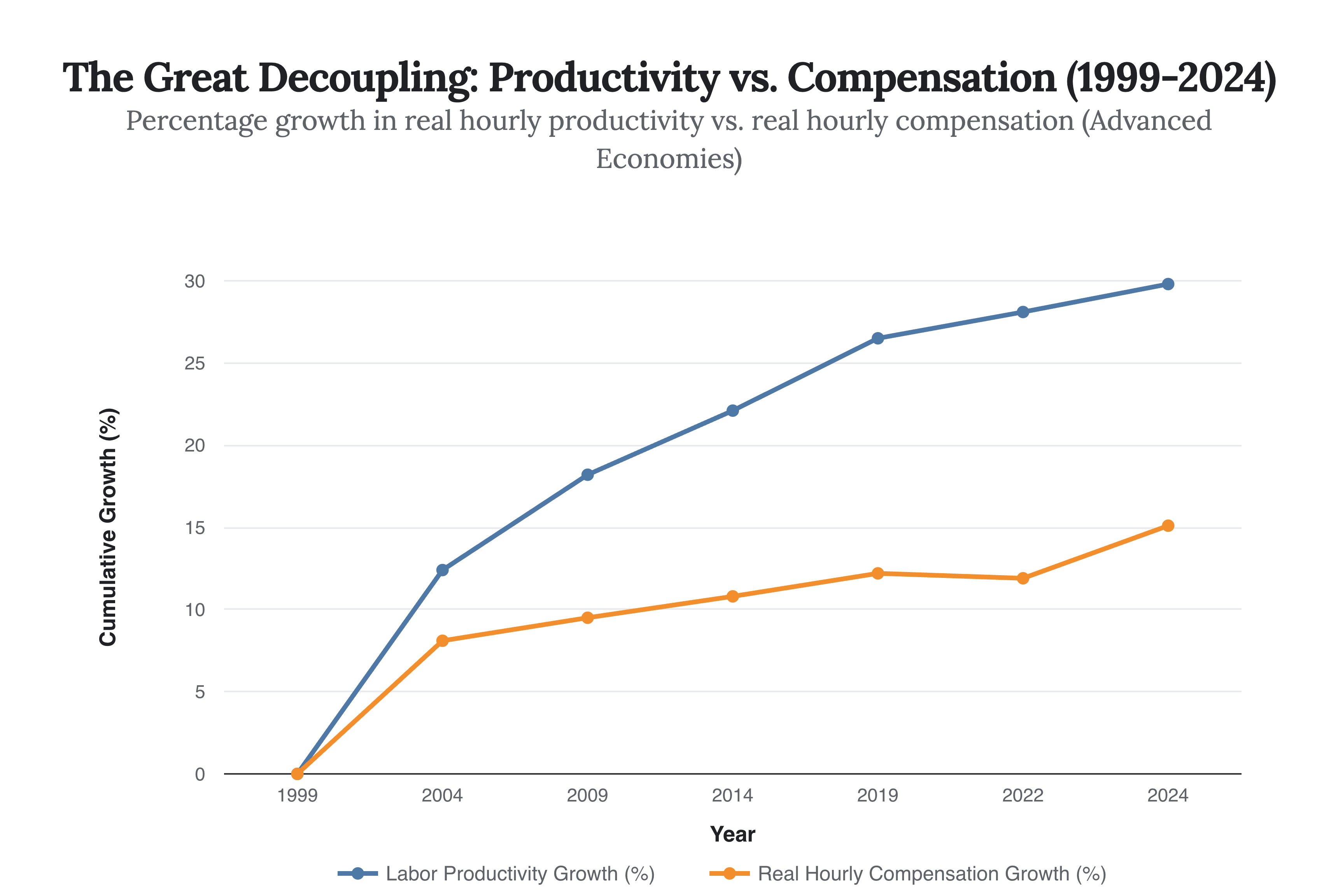
Strategic Implication: When a worker sees a 29.8% increase in their output result in only a 15% increase in their livelihood, the “product” of their work ceases to be a source of pride and becomes a source of resentment. The $8.9 trillion loss is the price of this resentment—a “tax” levied by workers who withhold their discretionary effort because they no longer see a connection between the success of the firm and their own survival.
2. Alienation from the Process: The Rise of the Digital Panopticon
The second form of alienation occurs when the worker has no control over the act of production. In the 19th century, this was the assembly line. In 2025, it is “Bossware” and algorithmic management. The worker is no longer a craftsman using a tool; they are a node in a digital workflow, directed by software they cannot question and monitored by eyes they cannot see.
The Quantification of Existence
The explosion of the Employee Monitoring Software market signals a shift from management by objective to management by surveillance. With 70% of large corporations now deploying some form of tracking, the modern office (remote or onsite) has become a digital panopticon. Marx’s prediction that work would become “external to the worker” is now literal: the workflow is dictated by an algorithm, and the worker’s compliance is measured in keystrokes.
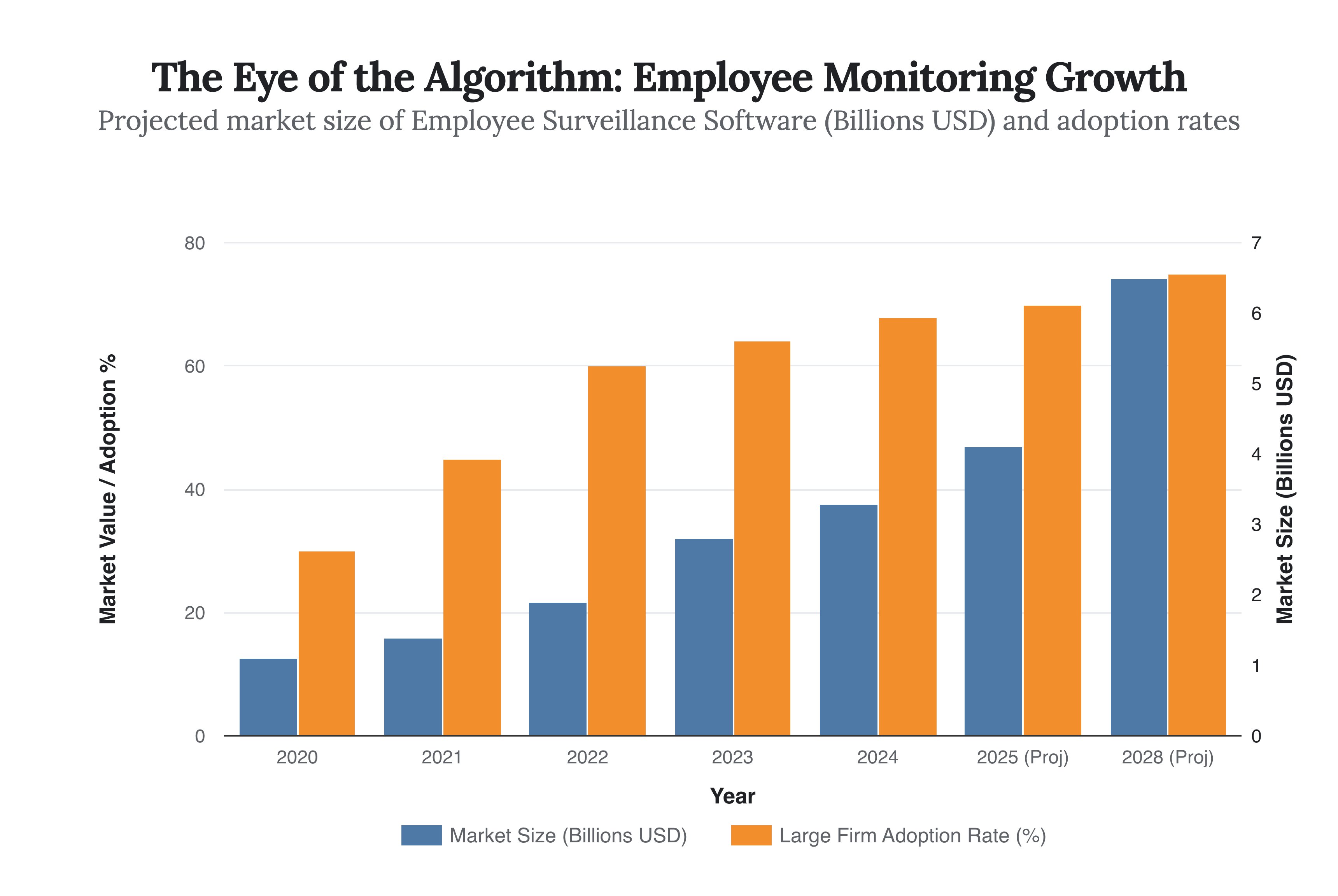
Strategic Implication: This surveillance creates a “compliance culture” rather than a performance culture. Data from 2024 indicates that 56% of employees report high anxiety due to monitoring. When the process is alien, innovation dies. Workers optimize for the metric (e.g., mouse movement, green status dots) rather than the outcome, creating a “hollowed out” productivity that looks efficient on a dashboard but lacks actual value generation.
3. Alienation from Species-Essence: The Human API
Marx defined our “species-essence” (Gattungswesen) as free, conscious activity—creativity. He argued that reducing humans to repetitive machines denies their humanity. Today, this denial takes the form of “Digital Debt.” The modern knowledge worker is not paid to think; they are paid to route information.
The Death of Deep Work
Microsoft’s 2024 Work Trend Index provides the smoking gun. A staggering 60% of the average workday is consumed by communication—emails, chats, and meetings—leaving only 40% for the actual creative or analytical work the employee was hired to do. We have turned high-paid professionals into human APIs, simply passing data between disparate systems.
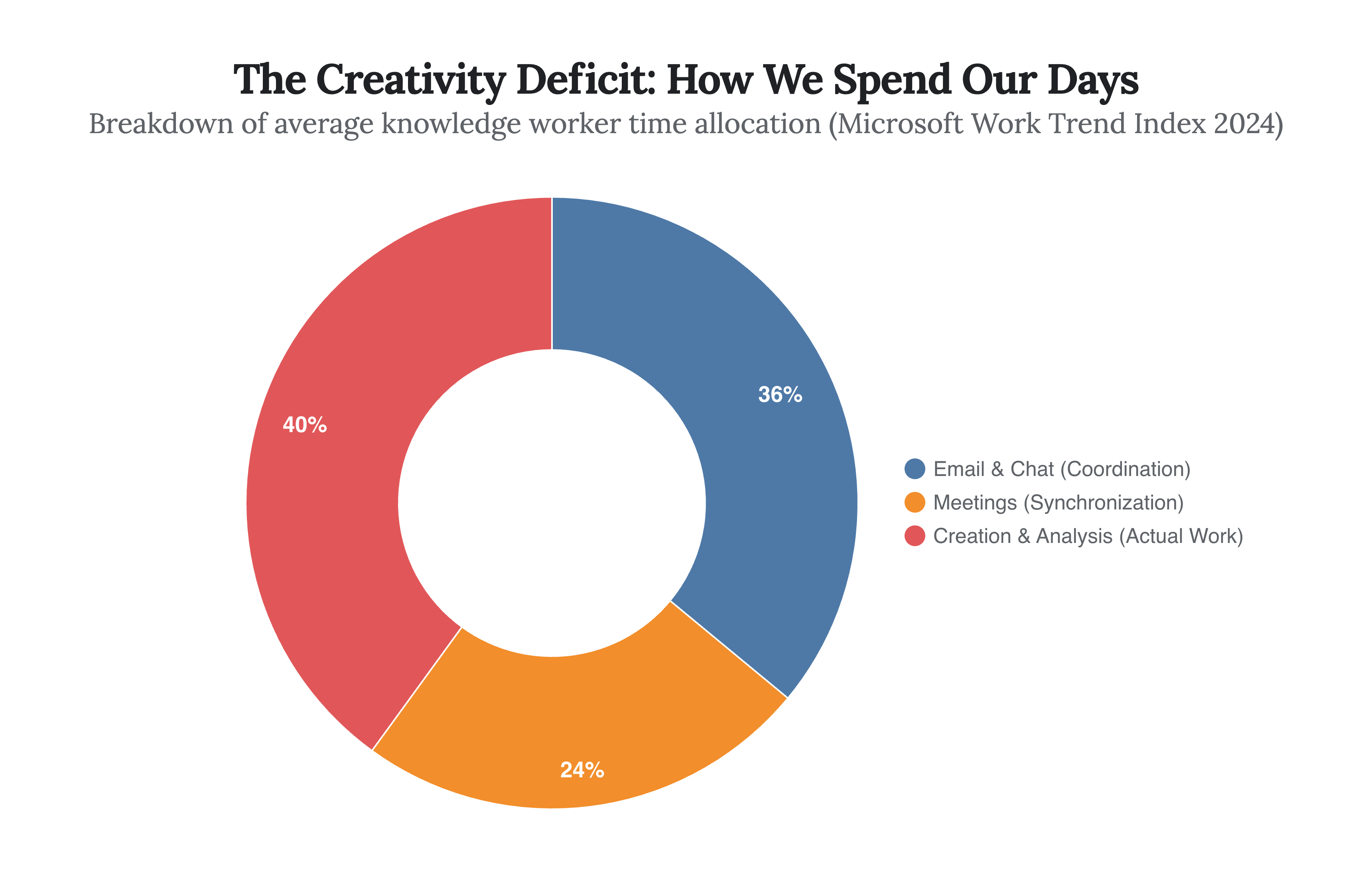
Strategic Implication: This is the primary driver of burnout. It is not “too much work”; it is “meaningless work.” When 60% of a human’s day is spent fighting entropy rather than creating order, they become estranged from their own potential. This explains why “bullshit jobs” (a term coined by David Graeber, echoing Marx) feels so prevalent. The $8.9 trillion cost is partially the salary paid for this friction, not for propulsion.
4. Alienation from Others: The Atomized Workforce
Finally, Marx warned that alienation from work leads to alienation from other men. In a capitalist structure, workers see each other not as collaborators, but as competitors or obstacles. The rise of remote work, while offering flexibility, has inadvertently accelerated this atomization. Without physical proximity, the “social glue” of labor dissolves, leaving only transactional exchanges.
The Loneliness Epidemic
Recent data is startling: remote workers report feeling lonely 98% more often than their onsite counterparts. This isn’t just a social issue; it’s a labor issue. Isolated workers lose the “collective consciousness” of the firm. They become mercenaries, devoid of loyalty to the “tribe” of the company.
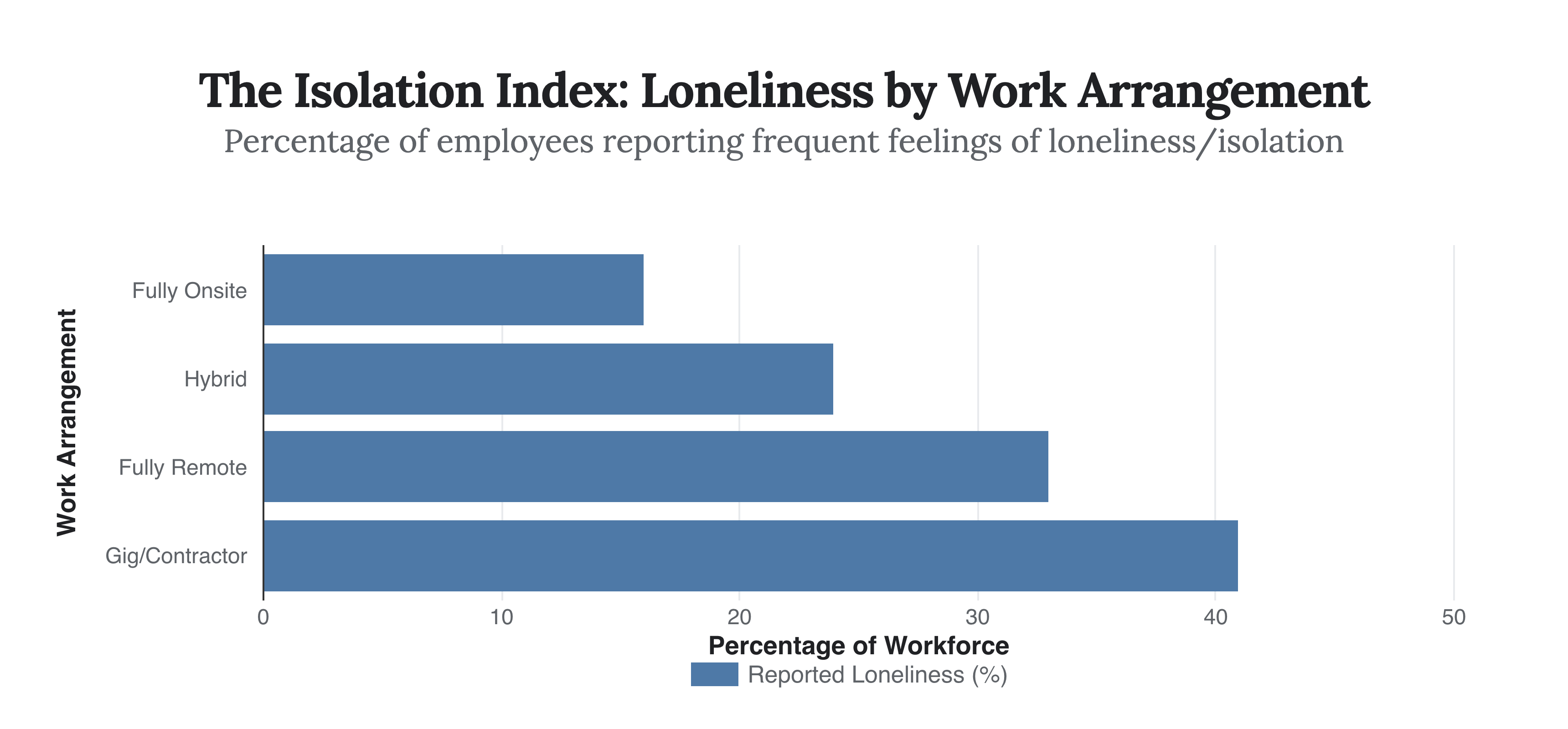
Strategic Implication: The breakdown of social bonds results in the breakdown of retention. It is easy to quit a URL; it is hard to leave a team. The 77% of disengaged workers are those who have no social tether to the organization. They are “free” in the Marxist sense—free to sell their labor to the highest bidder without sentimental attachment.
Conclusion: The $8.9 Trillion Choice
The data paints a stark picture. The modern workplace has inadvertently reconstructed the conditions of 19th-century alienation, disguised by 21st-century digital interfaces. We have separated workers from the value they create (Chart 1), stripped them of autonomy via surveillance (Chart 2), drowned their creativity in digital noise (Chart 3), and isolated them from their peers (Chart 4).
The $8.9 trillion cost identified by Gallup is not a fluctuation; it is the bill coming due for this structural dehumanization. The market’s response has been to double down on AI and automation, hoping to remove the “problematic” human element entirely. However, for the foreseeable future, human judgment remains the premium asset.
The single most important strategic insight for 2026 is this: The companies that will reclaim their share of this $8.9 trillion value are not those that buy better monitoring software, but those that systematically dismantle the mechanisms of alienation—restoring ownership, autonomy, and community to the act of labor.
“Labor is external to the worker... he does not feel content but unhappy, does not develop freely his physical and mental energy but mortifies his body and ruins his mind.” — Karl Marx, Economic and Philosophic Manuscripts of 1844