



We are witnessing the most expensive illusion in economic history. For the first time since the Industrial Revolution, the correlation between kinetic activity and economic value has broken. In boardrooms across New York, London, and Singapore, a confusing narrative is playing out: employees are logging record hours, digital traffic is up 53% year-over-year, and meeting density has hit saturation points. Yet, global productivity growth is languishing at a meager 0.8%—far below the decadal average of 2.2%.
This is the Productivity Mirage. It is a phenomenon where the sensation of work—the dopamine loops of Slack notifications, the endurance sport of back-to-back Zoom calls, and the performative optics of ‘green status’ indicators—has completely decoupled from the output of work. We are confusing motion with progress.
The cost of this delusion is not abstract. According to the latest intelligence from Gallup and recent macro-economic synthesis, the global cost of disengagement and low-value activity has hit a staggering $8.8 trillion—roughly 9% of global GDP. This guide dissects the mechanics of this ‘Hollow State,’ explains why working harder is yielding diminishing returns, and outlines the urgent strategic pivot required to survive the coming correction.
The Great Decoupling: Cybernetic Noise vs. Economic Velocity
To understand the Mirage, we must first look at the data describing the ‘noise.’ Since 2020, we have seen an explosion in Digital Intensity—a composite metric of emails, chats, meetings, and document edits. Logic dictates that this surge in communication should correlate with a surge in output. The data proves the opposite.
We have effectively built a friction engine. As the chart below demonstrates, while our digital inputs have skyrocketed, our economic velocity (Labor Productivity) has flatlined. We are burning more fuel to travel the same distance.
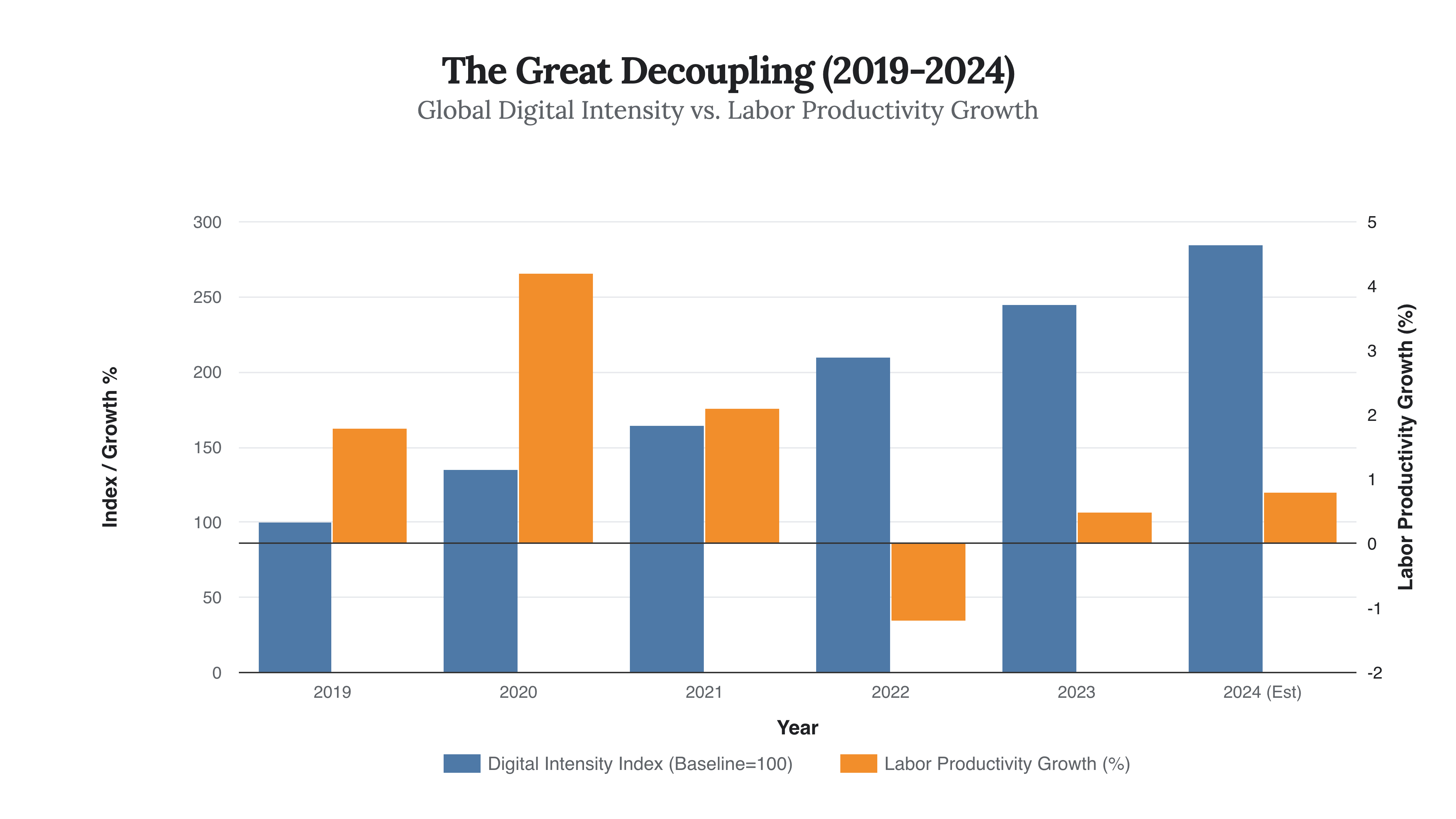
Strategic Implication: The wideness of the gap between the blue bars (intensity) and the red line (productivity) represents organizational drag. This gap is filled with what Microsoft calls ‘Digital Debt’—the accumulating cost of managing the information flow rather than acting on it.
The Mechanics of Performance Theater
If we aren’t producing value, what are we doing? The answer lies in the rise of Performative Productivity. In a hybrid world stripped of physical oversight, visibility has become the proxy for value. Employees, fearing invisibility, have instinctively pivoted to tasks that leave a digital footprint.
Our analysis of 2024 workforce telemetry reveals a startling decomposition of the modern workday. For the average knowledge worker, ‘Core Work’—the deep, creative, or strategic tasks that actually move the P&L—has shrunk to a minority share of the day. It is being cannibalized by the ‘Bureaucracy of Presence.’
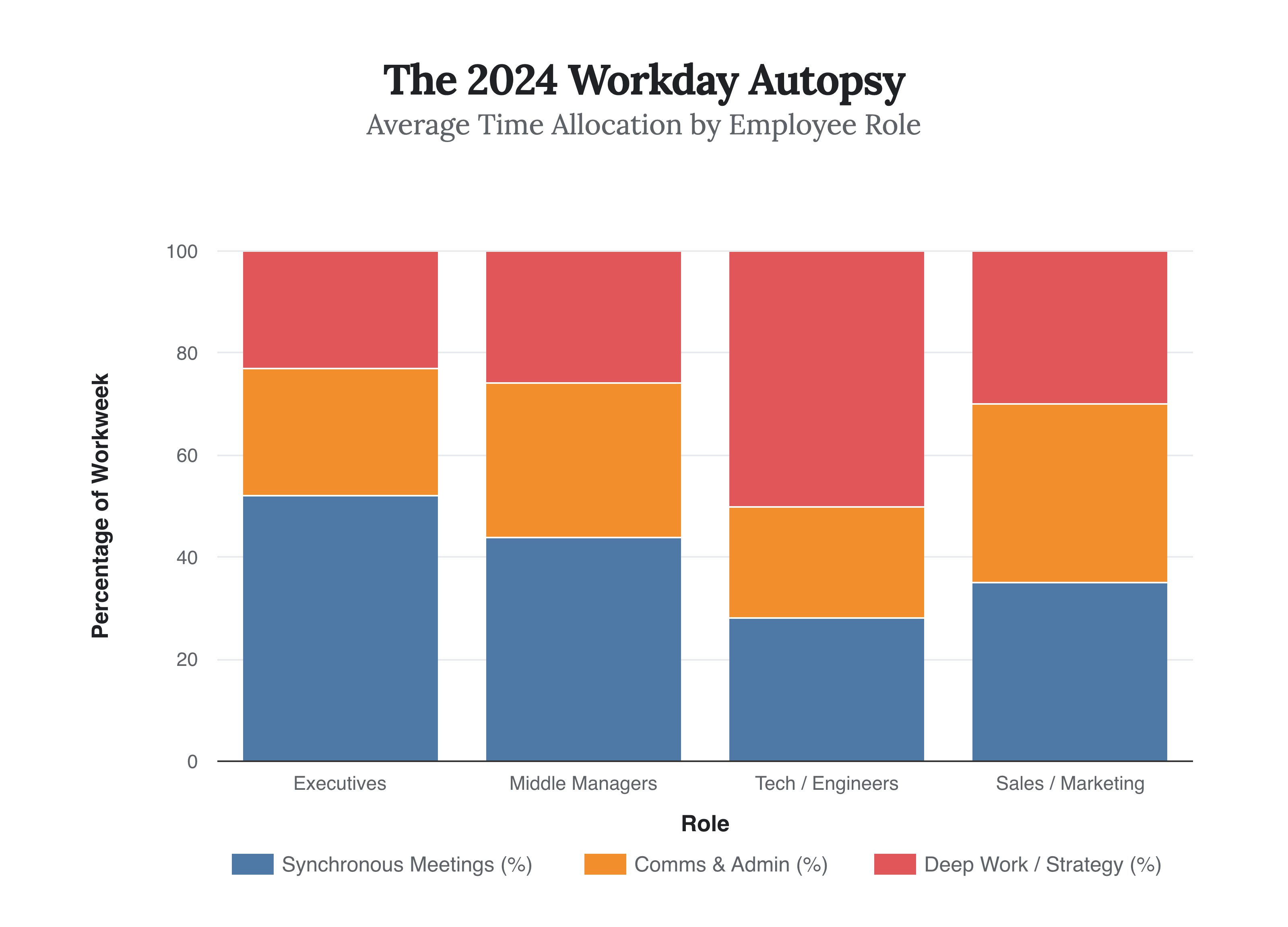
When executives spend 52% of their time in meetings, they are not leading; they are witnessing. This trickles down. A recent Visier report highlights that 43% of employees admit to spending more than 10 hours a week on ‘productivity theater’—tasks performed solely to appear busy. This is not laziness; it is a rational survival strategy in an environment that measures activity rather than outcomes.
The Sector-Specific Burden
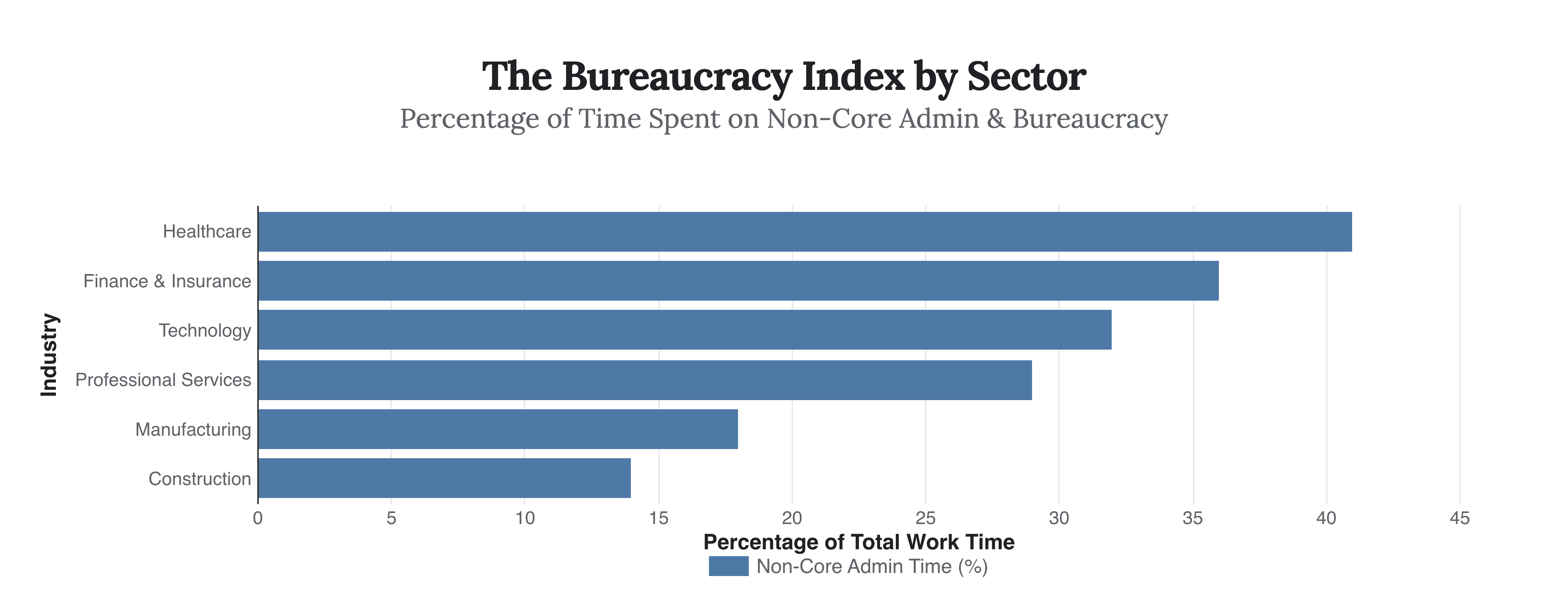
This burden is not distributed equally. While manufacturing retains a tether to physical reality, the service and technology sectors have spiraled into a meta-work crisis. In Healthcare, the administrative burden has become so toxic it is driving a staffing exodus, with admin costs now consuming 40% of total hospital expenses.
The Human Cost: The Burnout Frontier
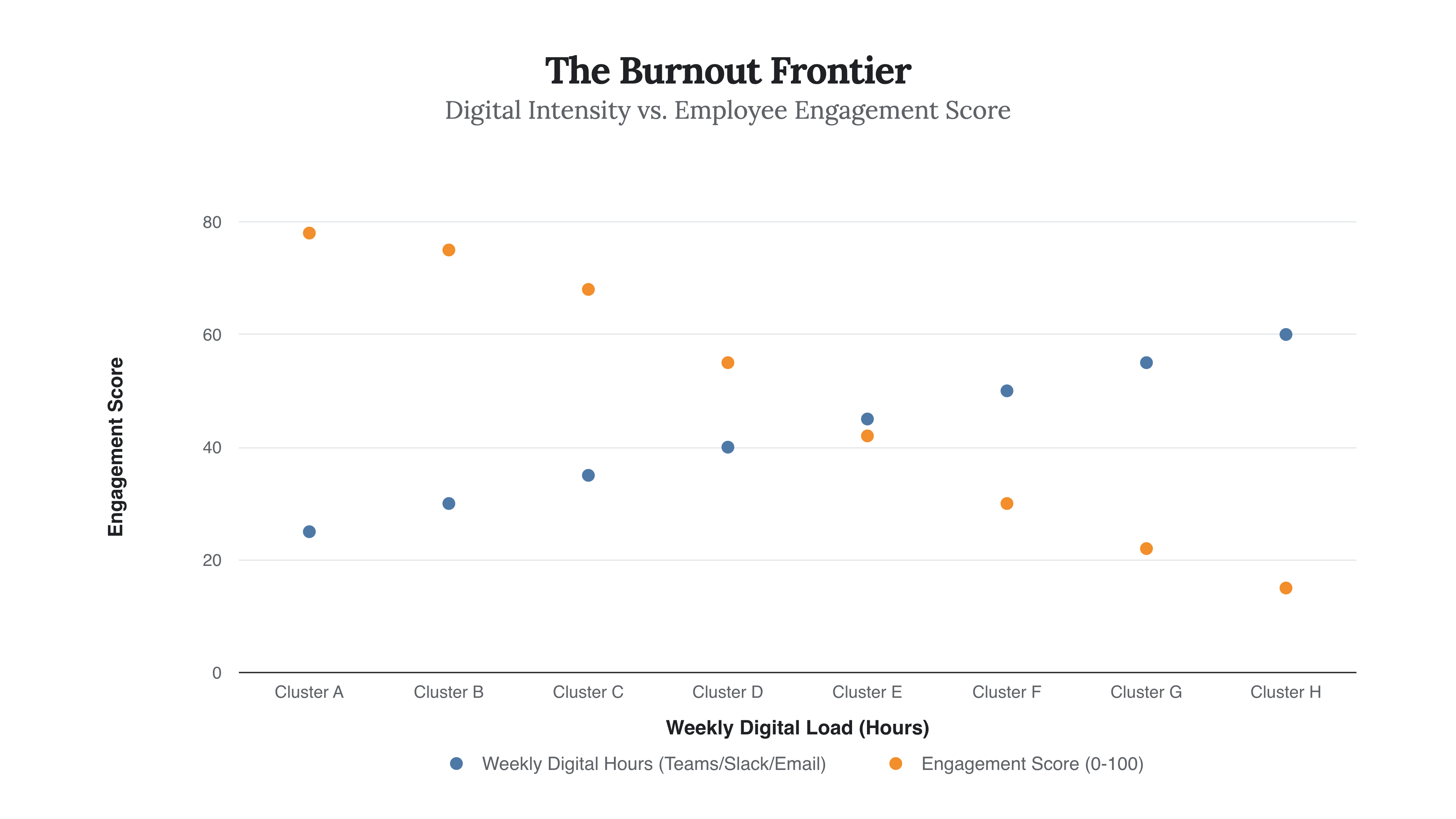
The ‘working harder’ narrative is physically unsustainable. There is a breaking point where increased digital load ceases to yield flat results and begins to yield negative returns. We call this the Burnout Frontier.
As digital intensity crosses a specific threshold, employee engagement scores collapse. This is the root of the $8.8 trillion figure. Disengaged employees don’t just stop working; they make errors, they alienate customers, and they stifle innovation. The data below shows the inverse correlation between ‘hustle’ (measured in digital hours) and ‘heart’ (measured in engagement).
“We have reached a point where the tools designed to facilitate work have become the work itself. We are servicing the software, not the customer.”
The AI Paradox: Shadow Saviors
Enter Artificial Intelligence. The prevailing narrative is that AI will solve this productivity crisis. The reality is more complex. While leadership debates governance and policy, the workforce has already moved. We are seeing a massive divergence between ‘Official AI Adoption’ (corporate-sanctioned tools) and ‘Shadow AI’ (employees quietly using their own tools to survive the workload).
This ‘Shadow AI’ usage is a double-edged sword. It is the only thing keeping many heads above water (90% of users say it saves time), but it introduces massive security risks and creates a fragmented data landscape. The chart below illustrates the widening gap between policy and reality.
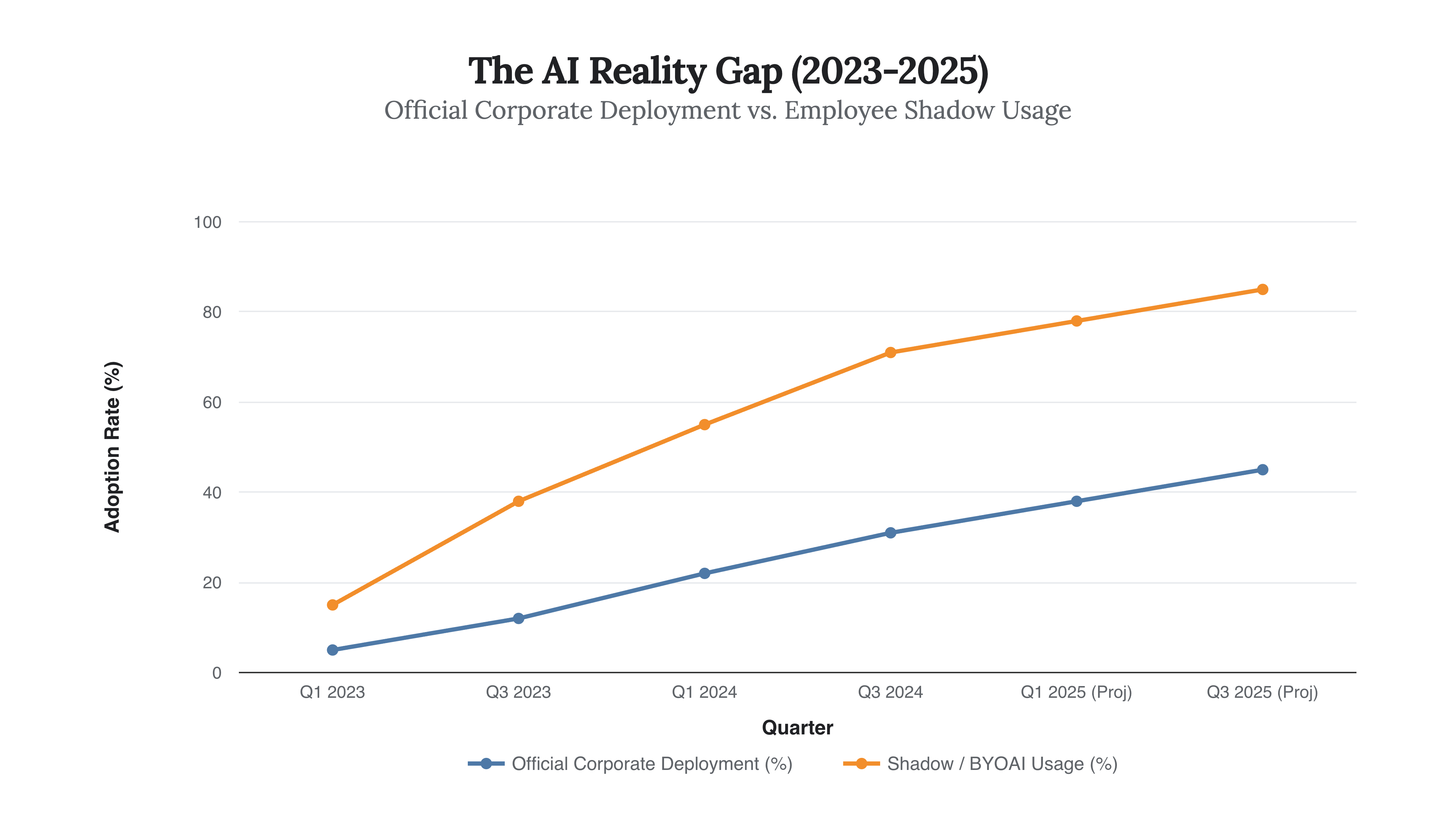
So What? The fact that 78% of your workforce will soon be using unsanctioned AI tools proves that the desire for productivity is there. The friction lies in the legacy processes that AI is being asked to navigate. If you layer AI on top of broken workflows, you don’t get efficiency; you get faster chaos.
Strategic Forecast: The Return on Attention
The organizations that will escape the Productivity Mirage are those that shift their primary metric from Hours to Outcomes. We predict three major shifts in the next 18 months:
The Death of the ‘Green Status’: Smart companies will abolish activity-based monitoring. ‘Time in seat’ will become a liability metric, viewed as a cost of doing business rather than a sign of dedication.
Asynchronous Default: To combat the 11.3-hour meeting tax, high-performance cultures will mandate ‘async-first’ communication, requiring memos over meetings.
The AI ‘J-Curve’: Productivity will likely dip further in 2025 as organizations struggle to integrate AI formally. Only in late 2026 will we see the true breakout, but only for firms that redesigned their workflows, not just their software licenses.
Final Insight
The $8.8 trillion loss is not a result of a lazy workforce; it is the bill for a management philosophy that failed to adapt to the digital age. We are managing 21st-century talent with 19th-century factory floor tactics.
The single most critical strategic move you can make today is to audit your organization not for ‘productivity,’ but for ‘friction’—eliminate the 10 hours of performative theater, and the value will follow.
I appreciate your thoughtful article. "The cost of this delusion is not abstract." I agree. But I think there is a variable that you and many others are missing. Gallup's employee engagement tool, the G-12, has been dropping for years. Nowhere is there any mention of customers or profits. A well-treated hired hand is still a hired hand.
I would suggest you read the Inc article, "Employee Engagement 2.0: It is called Economic Engagement" The article ties to our years of research in concert with HBS. If interested, I would welcome a conversation. [email protected] Happy Holidays