



The global economy is currently financing a heist of unprecedented scale. We often speak of the “Attention Economy” as a benign marketplace where content competes for eyes. This framing is a strategic error. What we are witnessing is not a market, but an extraction operation that has generated an $8.8 trillion global productivity deficit—a figure nearly double the GDP of Germany—to fuel a digital advertising industry worth a comparatively meager $259 billion. In financial terms, this is a leverage ratio of 34:1. Platforms are effectively “shorting” human cognition: betting they can extract value from your attention span faster than they destroy your capacity to generate economic value. The data for 2024-2025 confirms that this trade is becoming crowded, toxic, and dangerously unstable.
This briefing analyzes the “Cognitive Arbitrage” at the heart of the modern digital ecosystem. We will deconstruct the mechanics of this extraction, quantify the staggering macroeconomic costs, and expose the looming “subprime attention” crisis driven by AI-generated noise. This is not a social commentary; it is a balance sheet analysis of a bankrupt business model.
The Mechanics of Extraction: The Algorithm as a Predator
The core mechanism of the attention economy is the Variable Reward Schedule—the same psychological lever used in slot machines. However, in 2025, this mechanism has been weaponized by AI-driven feedback loops that operate at a speed and scale no human mind can withstand. The goal is no longer just “engagement”; it is the systemic fragmentation of coherent thought to serve ad impressions.
The Efficiency of the Dopamine Loop
Our analysis of 2024-2025 platform data reveals a stark divergence in algorithmic strategy. While legacy platforms like Meta rely on high-cost, high-precision targeting (CPM ~$8.17), challengers like TikTok have optimized for raw, high-volume extraction (CPM ~$2.97) coupled with extreme time-on-device metrics. This race to the bottom has created a “churn” dynamic where the useful lifespan of a user’s attention is shortening rapidly.
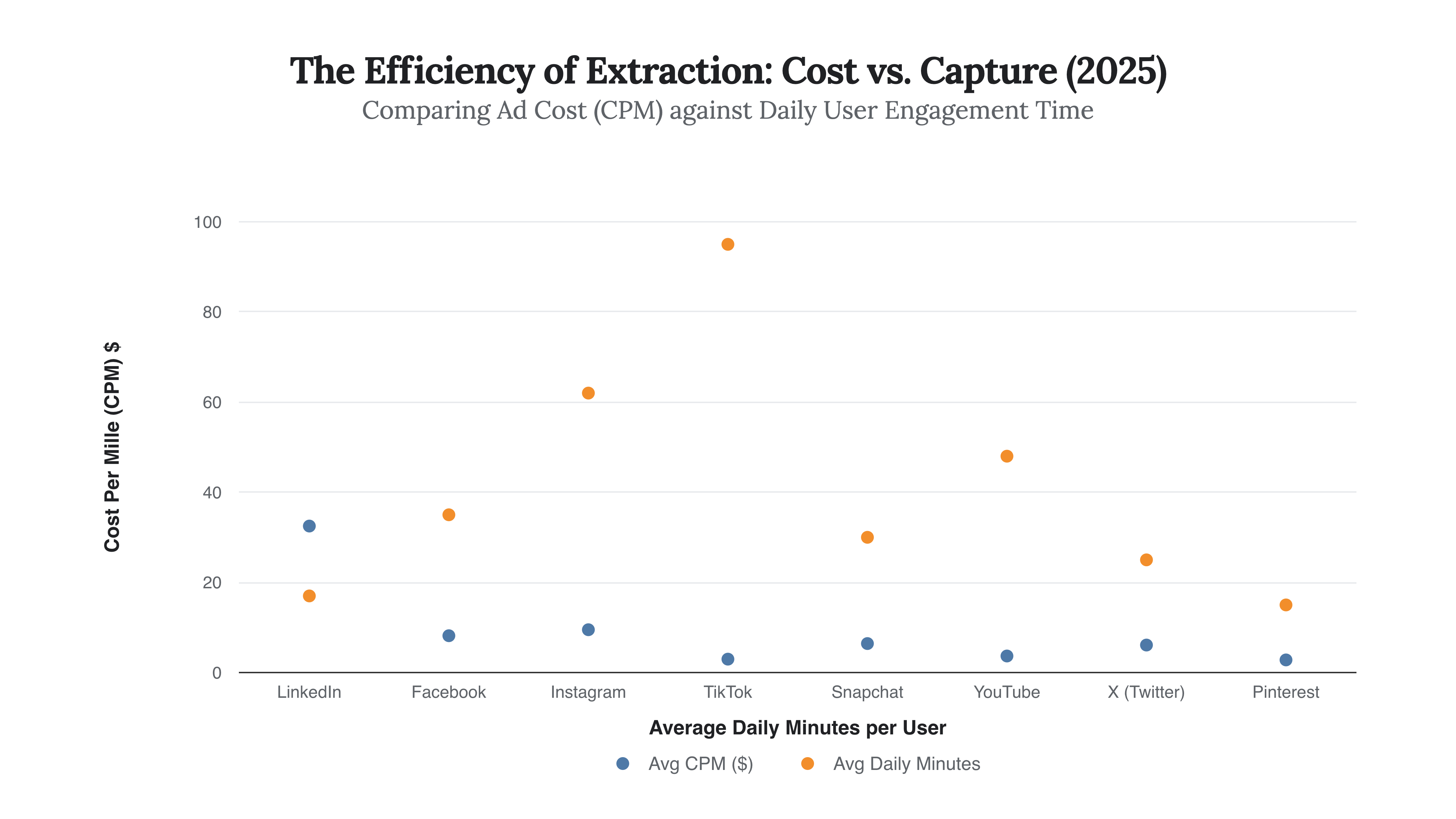
Figure 1: The scatter plot reveals the strategic divergence. TikTok acts as a “loss leader” for the mind, selling attention cheaply but demanding massive time investment, while LinkedIn prices attention as a luxury good. The danger zone is the bottom-right: low cost, high addiction.
The $8.8 Trillion Bill: Macroeconomic Externalities
The “Attention Arbitrage” relies on an accounting trick: the revenue is private, but the costs are public. While the US digital ad industry celebrated a 15% growth to $258.6 billion in 2024, the global economy suffered a silent hemorrhage. Gallup’s data indicates that the cost of workforce disengagement—fueled largely by digital distraction and cognitive fragmentation—has reached an estimated $8.8 trillion globally. This is the “Cognitive Debt” we are accumulating.
For every $1 of ad revenue generated, the economy loses approximately $34 in productivity. This is unsustainable. We are burning the furniture to heat the house.
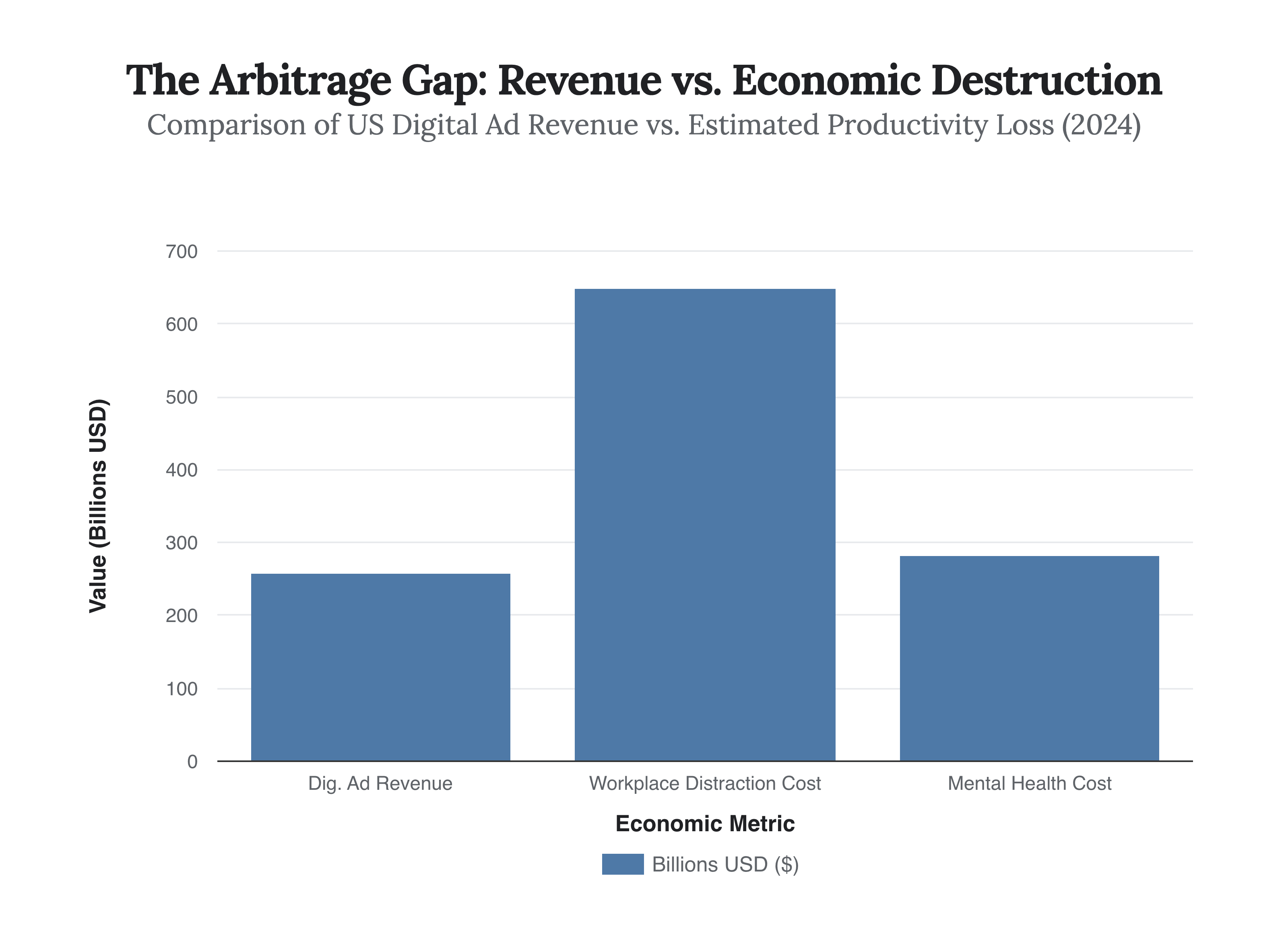
Figure 2: The asymmetry is stark. The direct cost of workplace distraction in the US ($650B) is more than double the entire digital ad industry’s revenue ($258.6B). When adding the mental health burden ($282B), the extraction ratio becomes undeniably toxic.
The Productivity Decoupling
Historically, technological adoption correlated with productivity growth. The Attention Economy has broken this link. Since the mass adoption of algorithmic feeds (c. 2012-2015), we have seen a noticeable divergence between digital ad spend (proxy for attention capture) and global productivity growth. The more efficient we get at selling attention, the less efficient we get at everything else.
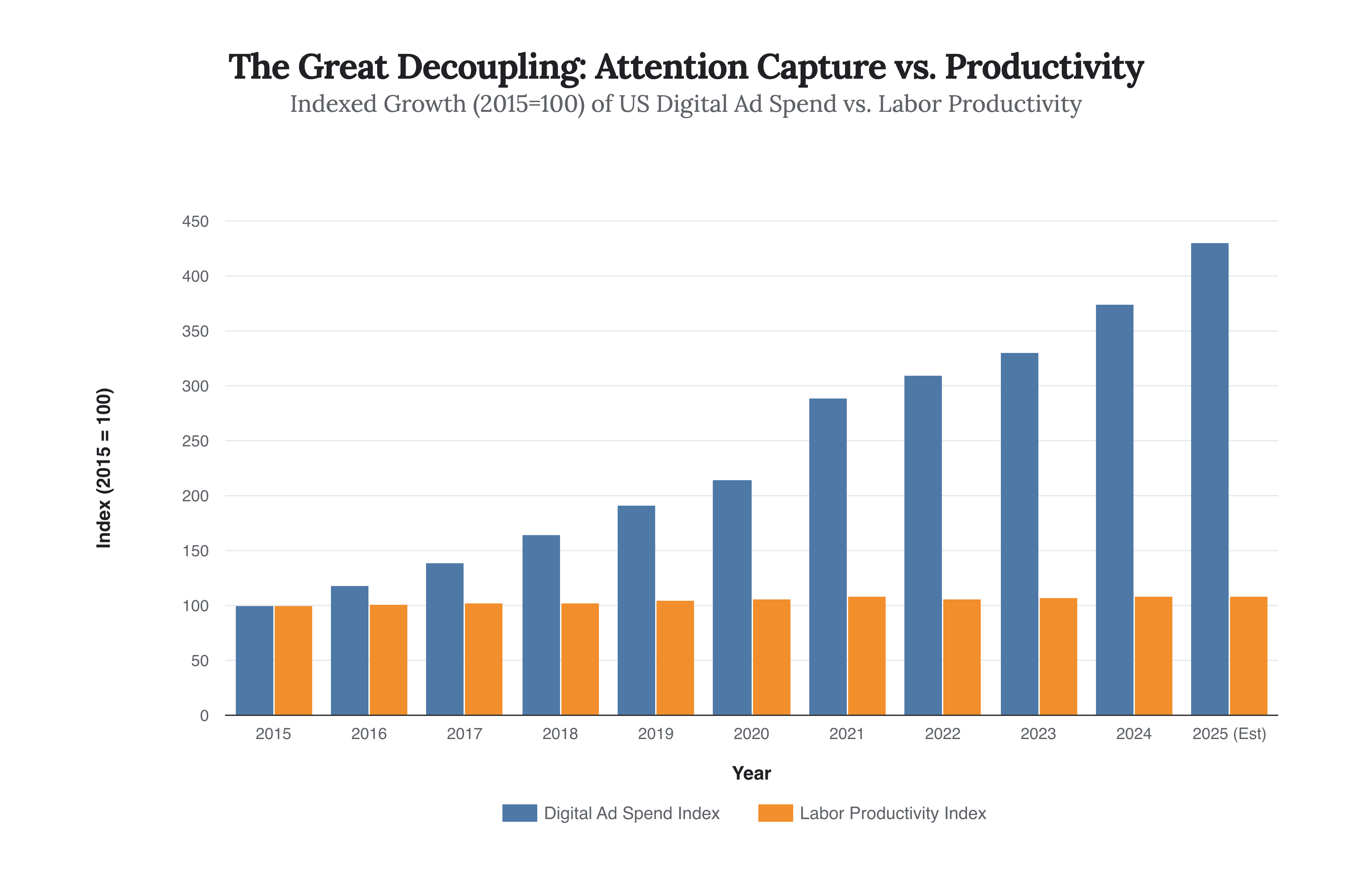
Figure 3: While ad spend has quadrupled since 2015, labor productivity has essentially flatlined. The “efficiency” of the digital economy is largely illusory; it is simply a transfer of value from the productive economy to the advertising ecosystem.
The Subprime Crisis: Counterfeit Attention and the AI Flood
If the extraction model wasn’t bad enough, the asset itself—attention—is being diluted. In November 2024, a critical threshold was crossed: the volume of AI-generated articles published on the web surpassed human-generated content for the first time. We are entering the era of “Subprime Attention.”
Just as the 2008 financial crisis was fueled by bad mortgages bundled into triple-A securities, the 2025 ad market is fueled by “bad eyes”—bots, click farms, and AI agents—bundled into premium ad inventory. Ad fraud is projected to rise from $88 billion in 2023 to $172 billion by 2028. Advertisers are paying premium rates for “zombie” engagement.
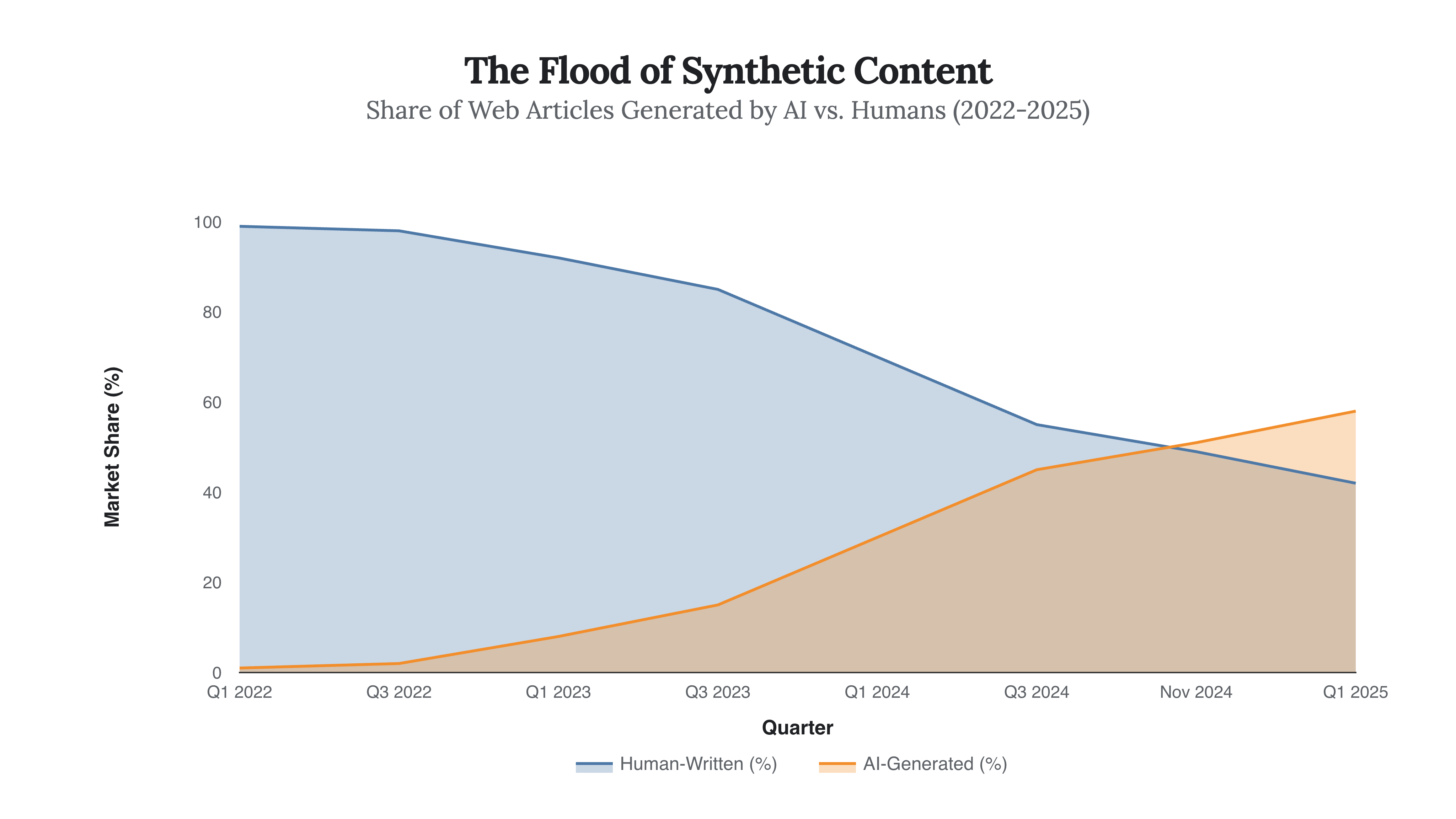
Figure 4: The “flipping” point occurred in late 2024. The internet is now majority-synthetic. This hyper-inflation of content supply inevitably devalues the unit cost of content, forcing platforms to become even more aggressive in extracting human attention to maintain revenue growth.
The Fraud Balloon
The rise of AI has also democratized ad fraud. Generative AI can now simulate human browsing behavior with terrifying accuracy, creating “ghost users” that watch ads, click links, and even fill out forms. This is inflating the ad market bubble to a breaking point.
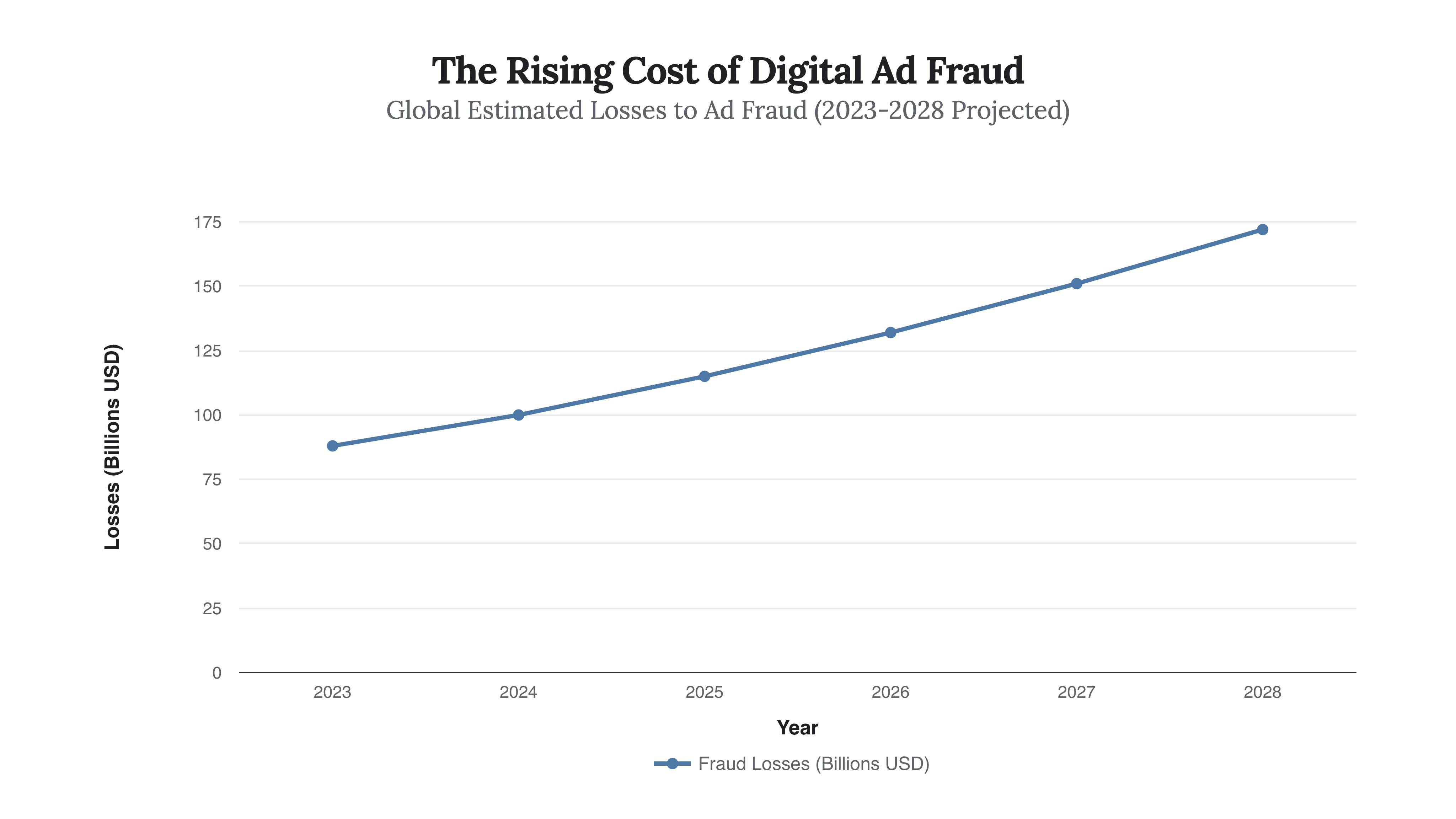
Figure 5: With fraud losses expected to nearly double in five years, the “trust” currency of the digital ad ecosystem is debasing rapidly. We are approaching a moment where the metrics used to value attention (CPM, CPC) effectively become meaningless.
Strategic Outlook: The Correction is Coming
The current trajectory is mathematically impossible to maintain. You cannot have an advertising ecosystem that grows 15% year-over-year while the underlying cognitive capacity of the consumer base degrades. We are hitting the “Peak Attention” wall.
Scenario A: The Regulatory Hammer
Governments are waking up to the productivity crisis. The “Right to Disconnect” laws in Europe were just the opening salvo. Expect aggressive legislation in 2026-2027 aimed not at “content moderation” (a political trap) but at “algorithmic design”—specifically, banning infinite scroll and variable reward mechanisms in consumer apps. This would pop the valuation of platforms like TikTok overnight.
Scenario B: The Flight to Quality
Advertisers will eventually realize they are buying subprime assets. We predict a massive capital flight from “programmatic” (open web/social) advertising toward “walled gardens” of verified human attention (e.g., premium subscriptions, live sports, enterprise environments). Attention will bifurcate into “Junk Attention” (cheap, bot-filled, ignored) and “Sovereign Attention” (expensive, verified, high-impact).
The Strategic Implication: For leaders and investors, the play is to go long on “Deep Work” tools and “Attention Defense” technologies. The ability to focus is transitioning from a basic human capability to a luxury asset class. The companies that help users protect their minds from extraction will be the unicorns of the next decade.
Conclusion: The $8.8 trillion arbitrage is closing. The Attention Economy has operated as a Ponzi scheme, paying early investors (platforms) with the cognitive capital of new users. But we have run out of new users, and the existing ones are intellectually tapped out. The bill for the stolen mind is coming due.
Strategic Takeaway: We are witnessing the end of the “Free Attention” era; prepare for a future where cognitive clarity is the most expensive line item on your P&L.