


The AI-First Mandate
After a period of strategic uncertainty marked by restructuring and a high-profile IPO cancellation, Alibaba Cloud has fundamentally re-engineered its growth engine. The narrative of slowing, single-digit expansion has been decisively replaced by a new, focused reality: AI is now the primary driver of its future. For an unprecedented eight consecutive quarters, Alibaba Cloud’s AI-related product revenue has recorded triple-digit year-over-year growth, a powerful trend that is reshaping the company’s financials and strategic priorities.
This surge has transformed the AI segment from a promising venture into a core component of the cloud business, now accounting for over 20% of external revenue. This briefing deconstructs the full-stack infrastructure, aggressive market strategy, and fraught geopolitical landscape defining Alibaba’s high-stakes bet. We will analyze how the company is leveraging proprietary silicon, a rapidly adopted open-source model ecosystem, and strategic price wars to secure dominance in China’s burgeoning AI economy, even as it navigates formidable external pressures. The central thesis is clear: for Alibaba, the cloud is no longer just about cloud—it is a vertically integrated delivery mechanism for artificial intelligence, and its success now hinges entirely on winning this new, intelligent layer of the digital economy.
Domestic Dominance: Solidifying the Home Turf
Alibaba Cloud’s strategy is anchored in its commanding position within the Chinese market. As of the first quarter of 2025, the company maintained a formidable 33% share of Mainland China’s overall cloud infrastructure market, a lead that provides a crucial foundation for its more specialized AI ambitions. This dominance gives it the scale and enterprise reach necessary to deploy and monetize its AI innovations effectively. When narrowing the focus to the more strategic AI cloud services segment, Alibaba’s leadership is even more pronounced, capturing 35.8% of the market in the first half of 2025.
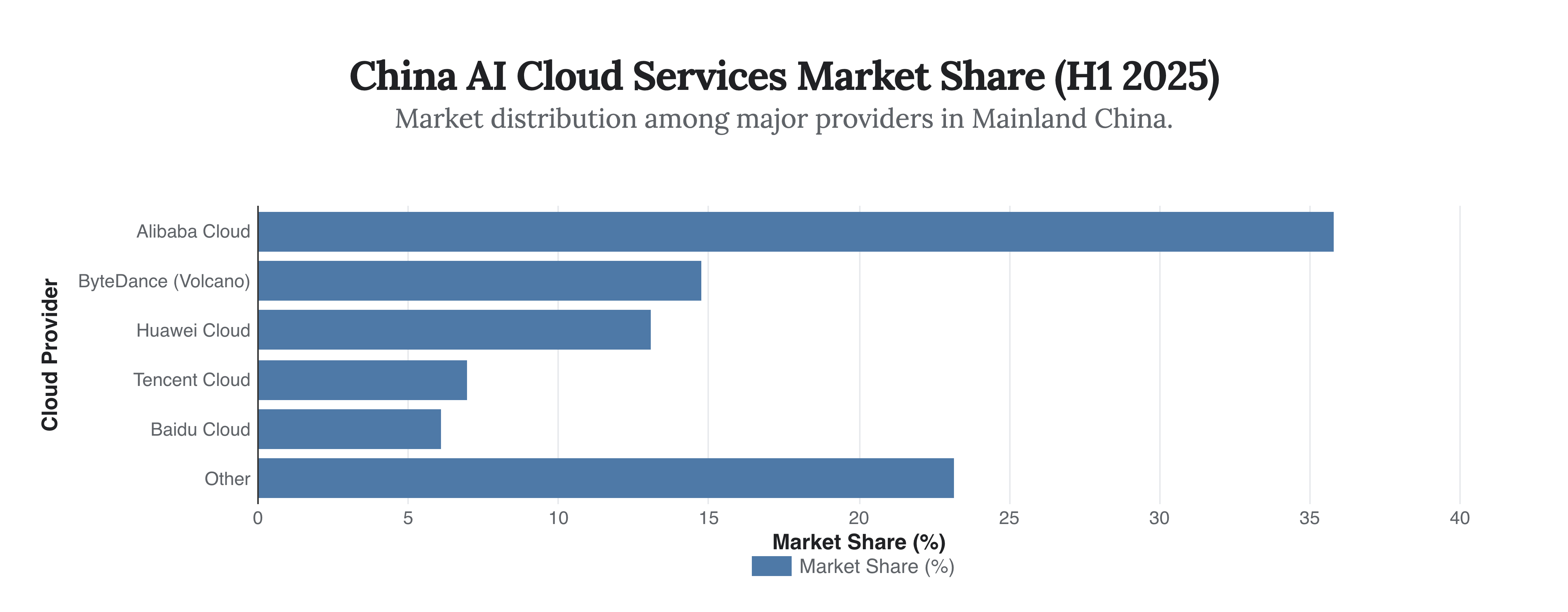
Data Source: Omdia Research. This chart illustrates Alibaba Cloud’s significant lead in the specialized AI cloud market, outpacing rivals like ByteDance and Huawei.
This leadership is not accidental; it is the result of a deliberate, multi-year investment in a full-stack AI ecosystem. This strategy has allowed Alibaba to capitalize on the explosion in AI demand, which fueled a 16% year-over-year expansion of China’s total cloud infrastructure spending to $11.6 billion in Q1 2025 alone. While rivals like Tencent have faced GPU supply constraints, Alibaba’s proactive infrastructure and hardware strategy have enabled it to meet this surging demand.
The Re-acceleration Engine
The impact of this AI focus is starkly visible in Alibaba Cloud’s financial turnaround. After several periods of lackluster single-digit growth, the division’s revenue growth has re-accelerated significantly. In the quarter ending June 2025, the Cloud Intelligence Group reported revenue of ¥33.4 billion (approx. $4.7 billion), a 26% year-over-year increase. This revival is almost entirely attributable to the relentless growth of its AI services.
“AI-related product revenue sustained triple-digit growth, continuing to increase its share of public cloud revenue.”
- Eddie Wu, CEO, Alibaba Group
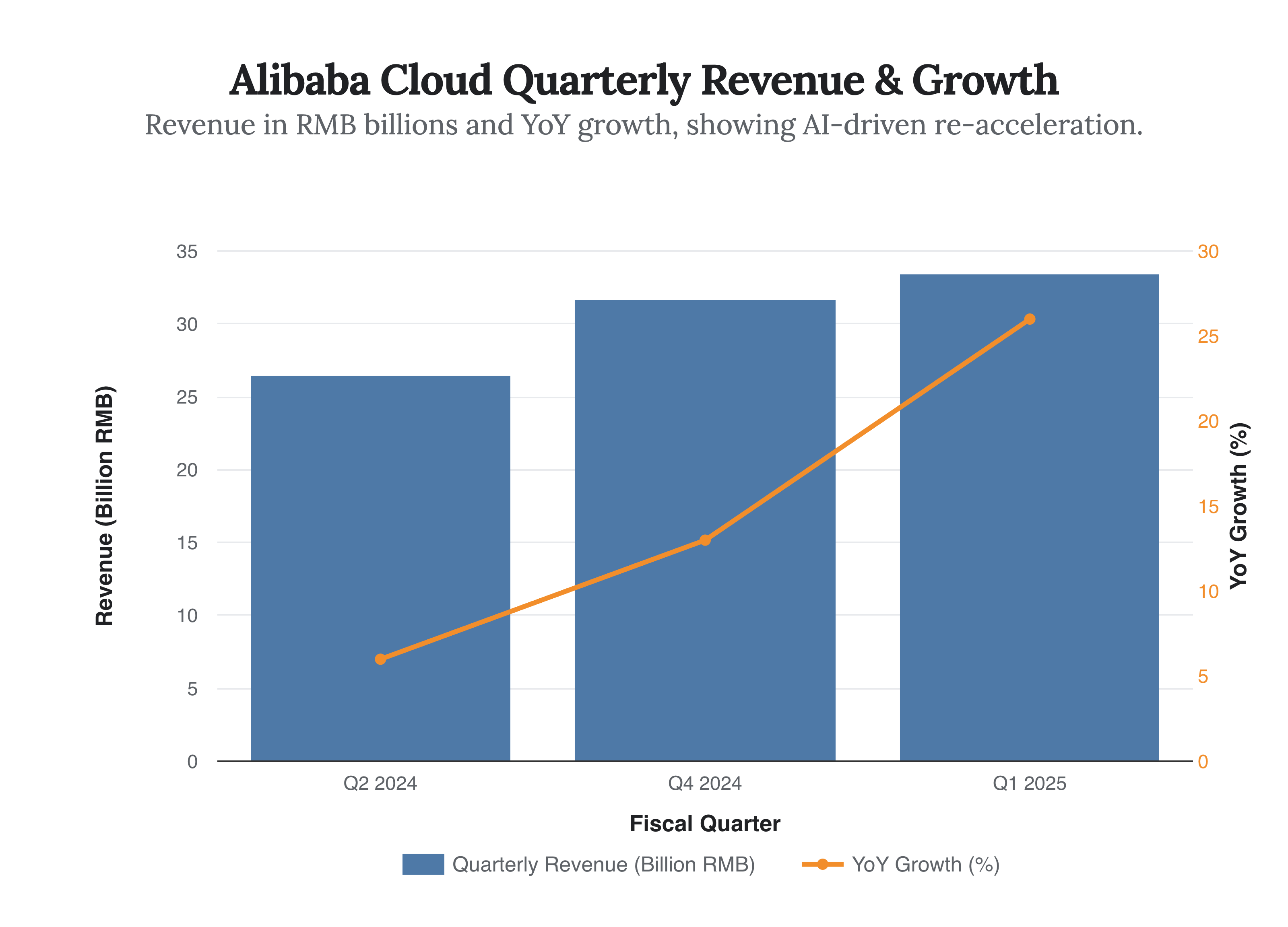
This chart highlights the clear re-acceleration in Alibaba Cloud’s revenue growth, coinciding with its strategic pivot to prioritize AI services.
The Full-Stack Arsenal: From Silicon to Software
Alibaba’s competitive advantage is built on a vertically integrated AI infrastructure stack, designed to optimize performance and reduce reliance on external suppliers—a critical factor given geopolitical tensions. This strategy extends from custom-designed silicon to a comprehensive AI development platform.
Hardware Foundation: The Yitian Advantage
At the base of the stack is Alibaba’s proprietary server CPU, the Yitian 710. Developed by its in-house chip unit T-Head, this Arm-based processor is built on a 5nm process and features 128 cores. Rather than selling the chip directly, Alibaba uses it to power its own Panjiu servers, optimizing them for its cloud workloads. The strategic benefit is twofold: performance and autonomy. Studies have shown the Yitian 710 to be a top-performing Arm-based server CPU, outperforming competitors in database workloads and challenging established players. More importantly, this in-house silicon strategy provides a degree of insulation from U.S. export controls on advanced semiconductors, a vulnerability that directly contributed to the cancellation of the cloud unit’s spin-off.
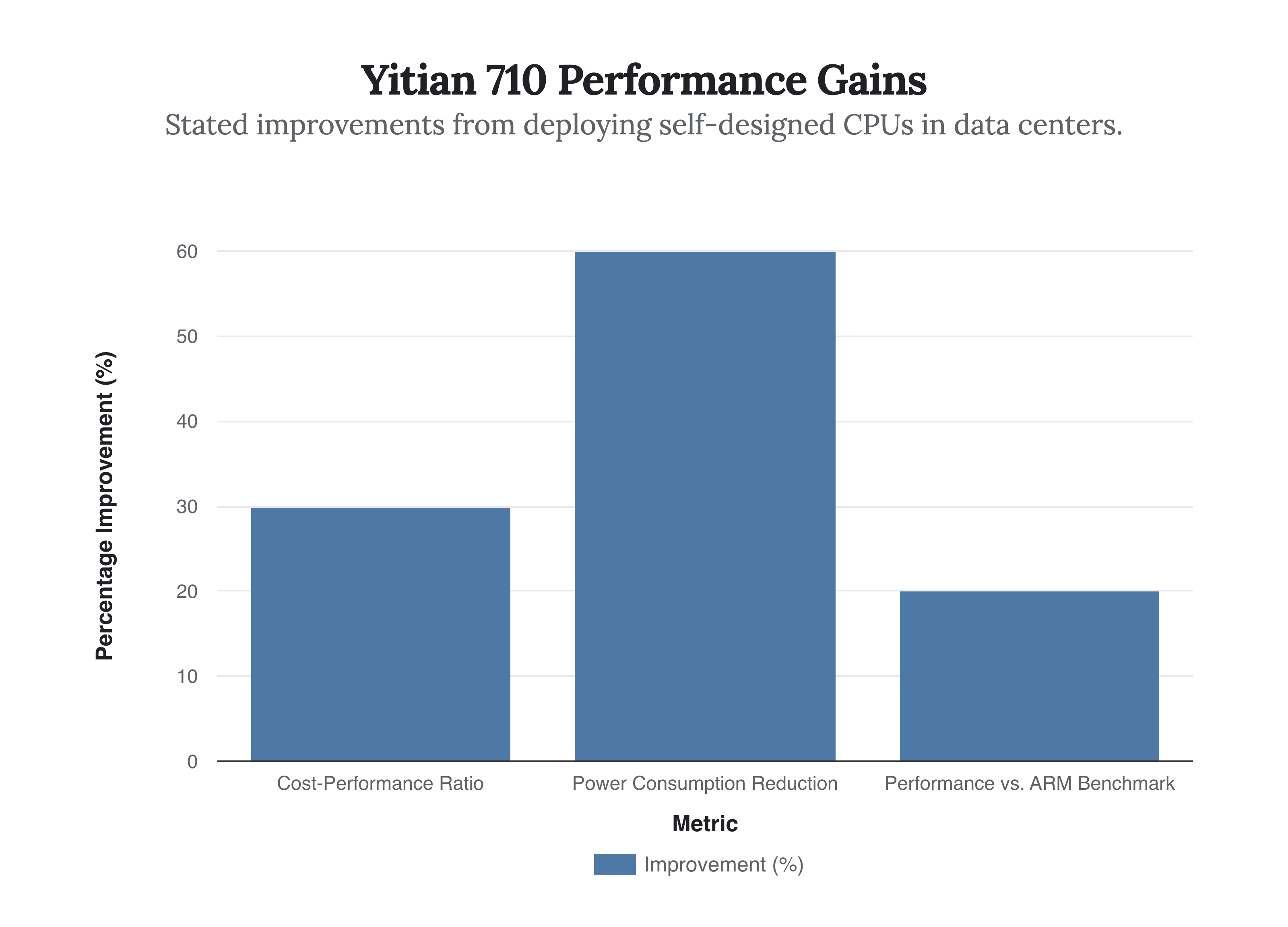
Data Source: Yicai Global, ZDNet. Alibaba’s investment in custom silicon yields significant efficiency and performance gains, crucial for managing the costs of large-scale AI workloads.
Software and Models: The Tongyi Qianwen Ecosystem
The software layer is where Alibaba drives adoption. Its family of proprietary large language models, Tongyi Qianwen (also known as Qwen), has become a cornerstone of its AI strategy. By pursuing an aggressive open-source approach, Alibaba has fostered a massive developer community. The Qwen model series has seen over 7 million downloads on platforms like Hugging Face, leading to the creation of over 100,000 derivative models—surpassing Meta’s Llama ecosystem in that regard.
This strategy serves several purposes:
Rapid Adoption: By May 2024, over 90,000 enterprise users had deployed Qwen models via Alibaba’s Model Studio platform.
Market Penetration: The open-source models act as a funnel, drawing developers and enterprises into Alibaba’s broader paid cloud ecosystem, including its Platform for AI (PAI).
Competitive Benchmarking: Newer iterations like Qwen2 have demonstrated performance competitive with leading global models from OpenAI and Anthropic, particularly in coding and multilingual capabilities.
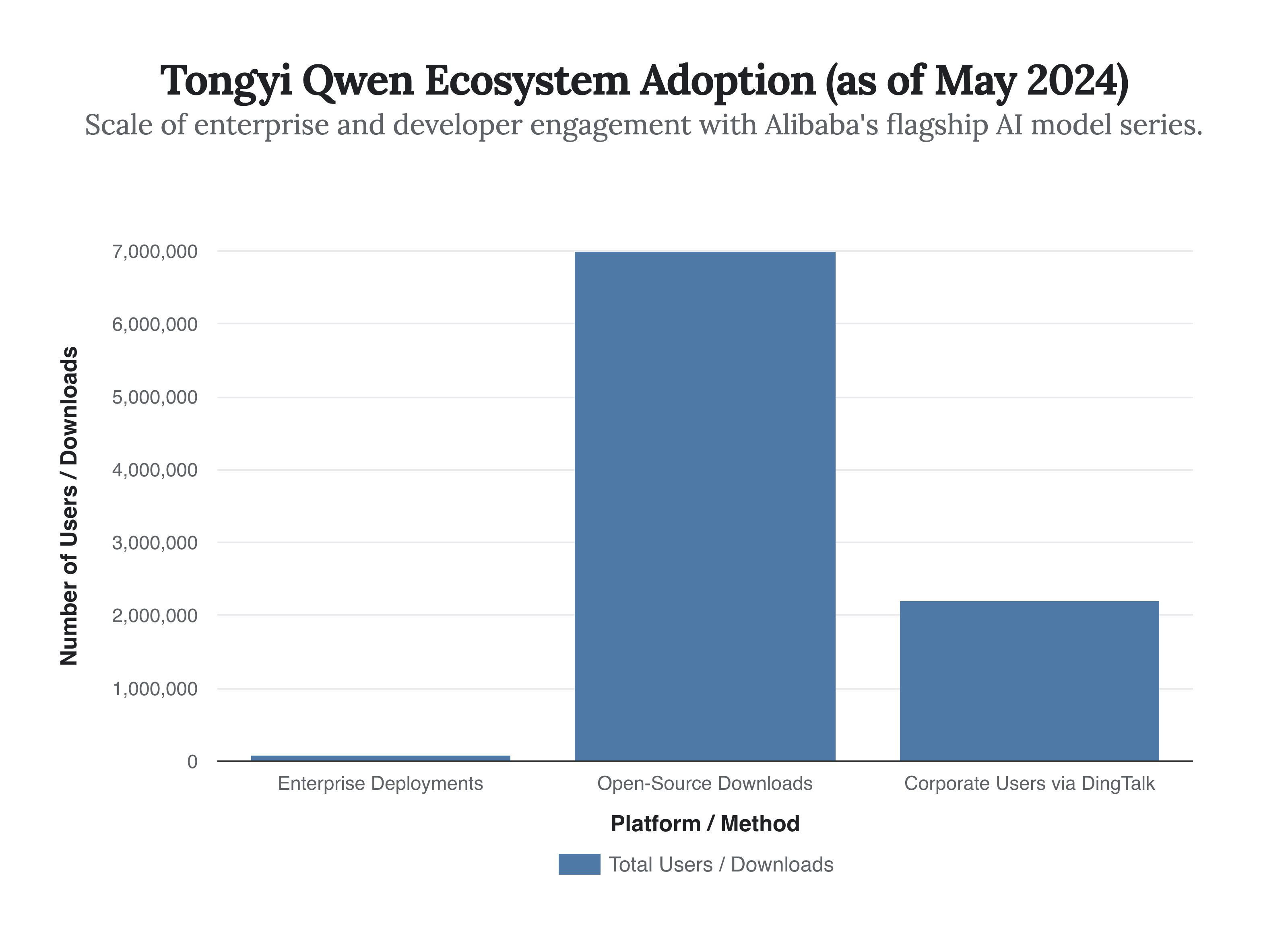
Data Source: Alibaba Cloud press releases. The massive scale of open-source and enterprise adoption demonstrates the success of Qwen’s go-to-market strategy.
Strategy and Geopolitics: Navigating a Fractured World
Alibaba’s AI ambitions are unfolding in a complex environment defined by intense domestic price wars and escalating international technology restrictions. The company’s strategy reflects a pragmatic response to these dual pressures.
The Price War Gambit
To accelerate adoption and squeeze competitors, Alibaba has initiated aggressive price cuts on its AI services. In early 2025, the company slashed prices for its advanced LLMs by as much as 85%, with its flagship Qwen-VL-Max model priced at a fraction of rivals’ offerings. This move is designed to make advanced AI accessible to a broader range of enterprises, commoditizing the lower end of the market while aiming to upsell customers on its full suite of integrated, higher-margin PAI services. This mirrors earlier price cuts of up to 55% on core cloud computing services, signaling a clear strategy to use price as a weapon to secure market share.
Global Expansion vs. Geopolitical Headwinds
While solidifying its domestic base, Alibaba Cloud continues a cautious but deliberate global expansion. The company has announced new data centers in Malaysia, the Philippines, Brazil, France, and the Netherlands, among others, expanding its footprint to 91 availability zones across 29 regions. This global infrastructure is critical for serving Chinese enterprises going abroad and attracting international customers, particularly in the high-growth markets of Southeast Asia and the Middle East.
“We will continue to execute against our strategic priorities in e-commerce and cloud computing, including further investment to drive long-term growth.”
- Alibaba Group Statement
However, this expansion is tempered by the reality of US export controls, which aim to limit China’s access to high-end AI chips. These restrictions create significant operational uncertainty and were a primary factor in the decision to halt the cloud unit’s IPO. In response, Alibaba is doubling down on its domestic supply chain and self-reliance in hardware, a strategy born of necessity that may become a long-term advantage if successful. The company has committed a massive 380 billion yuan (over $52 billion) over the next three years to AI and cloud infrastructure, a clear signal of its determination to build a resilient, world-class AI stack despite external pressures.
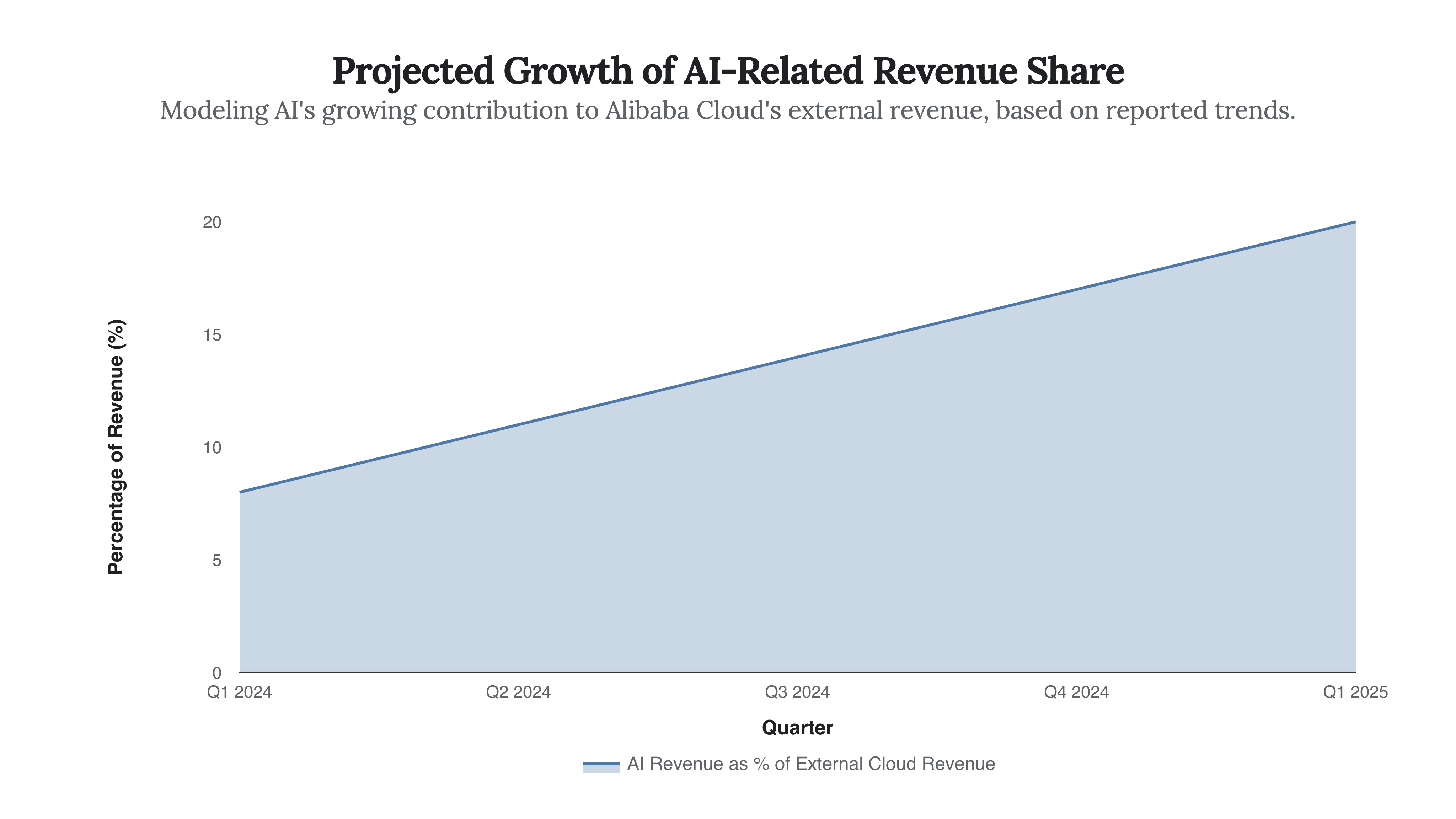
This chart models the escalating contribution of AI services to Alibaba Cloud’s revenue, a trend that underpins its entire corporate strategy.
Strategic Outlook: The Path Forward
Alibaba Cloud has successfully navigated a difficult transition, emerging with a clear and potent strategic focus. The “AI-First” mandate has not only revived its growth but has also clarified its mission in a tumultuous market. The road ahead presents clear challenges, including sustaining profitability amidst fierce price competition and innovating around hardware supply chain restrictions. However, the company’s commanding market share in China, its full-stack technological capabilities, and the explosive growth of its AI services provide a powerful foundation. For industry leaders, investors, and policymakers, the key takeaway is that Alibaba Cloud is no longer simply a Chinese hyperscaler; it is a dedicated artificial intelligence company operating at immense scale. Its success or failure will serve as a critical bellwether for the future of China’s technological ambitions and the evolving global balance of digital power.
The singular strategic imperative for Alibaba is now to convert its massive AI adoption funnel into a sustainable, high-margin ecosystem before domestic rivals can close the technological gap or geopolitical pressures irrevocably fragment the global AI landscape.
Brilliant. What if every cloud becomes AI-only?