


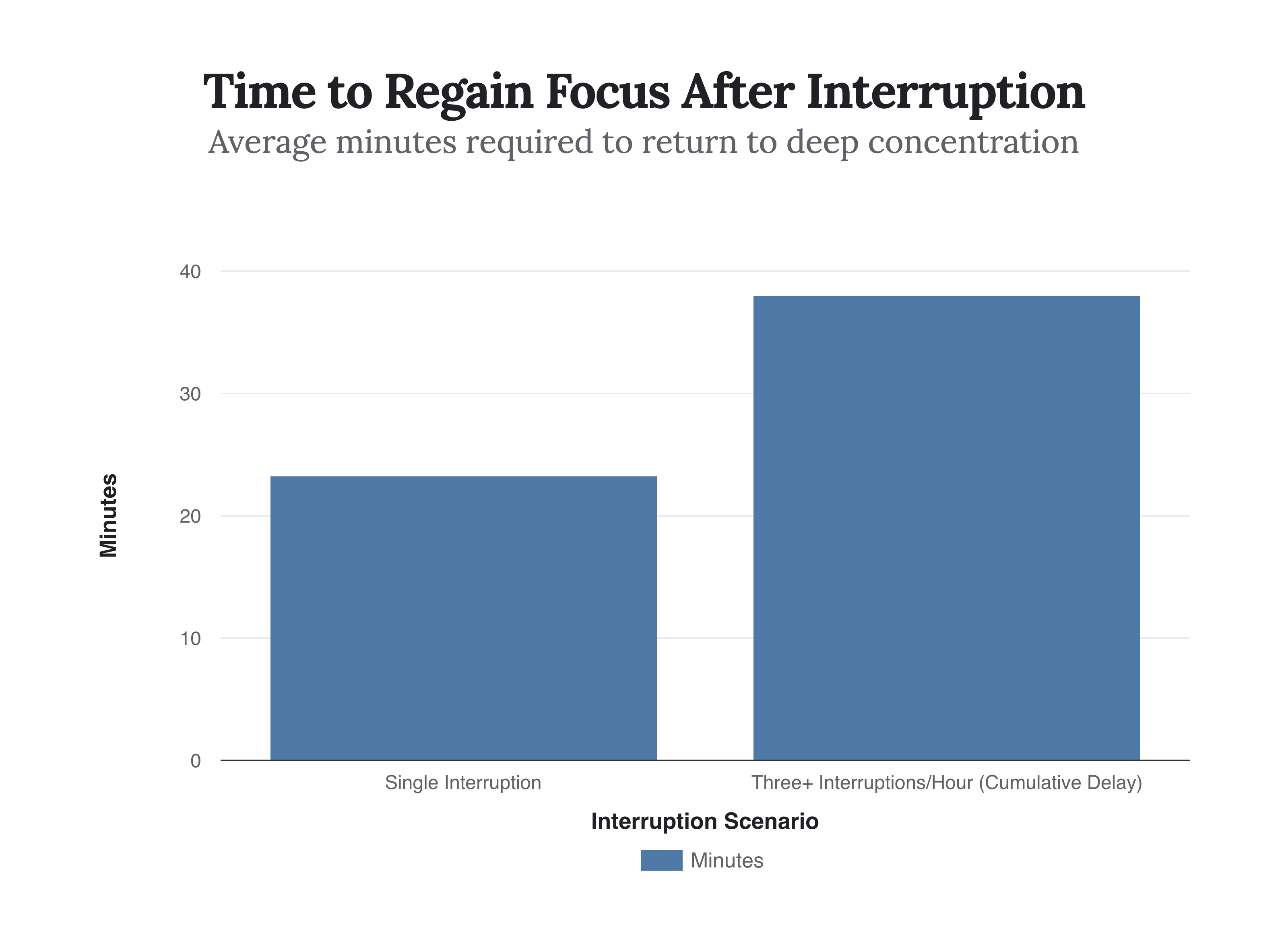
After a single interruption—a notification, a quick check of an email, a team chat ping—the average knowledge worker requires **23 minutes and 15 seconds** to return to a state of deep focus. This isn’t merely a delay; it’s a tax on cognition, levied minute by minute, eroding our capacity for sustained thought. In a world designed for perpetual engagement, our minds are increasingly fractured, resembling a mosaic of fleeting stimuli rather than a canvas of coherent ideas. This constant toggling between tasks and notifications isn’t just an inefficiency; it’s fundamentally reshaping our cognitive architecture, preventing the deep, deliberate thought that Spinoza identified as the cornerstone of intellectual freedom.

The Fractured Self: A Symphony of Interruptions
The contemporary digital environment orchestrates a symphony of distractions, each note a subtle pull away from concentrated effort. Microsoft 365 users, a proxy for many office workers, are interrupted every **2 minutes** on average, accumulating to 275 pings daily. This incessant fragmentation ensures that for **79%** of workers, deep focus becomes an aspiration, not a reality, as they are pulled away from their primary tasks within the first hour of starting. The consequence is not just lost time, but a profound ‘attention residue’ where remnants of previous tasks or distractions linger, impairing performance on subsequent, unrelated activities. This continuous task-switching costs the US economy an estimated **$650 billion** annually, illustrating a systemic cognitive degradation with tangible economic impact. The modern mind is not merely distracted; it is being structurally rewired for superficial engagement.
Beyond understanding Spinoza’s path to cognitive freedom, a subscription unveils the strategic synthesis and actionable implications for cultivating sustained focus in our interrupt-driven era.
From Passive Passion to Active Understanding
Baruch Spinoza, writing in the 17th century, articulated a philosophy profoundly relevant to our digitally saturated age. For Spinoza, true freedom lay not in unbridled will, but in the intellect’s capacity to form ‘adequate’ ideas—clear and distinct understandings of the causes that govern our experience. He distinguished these from ‘inadequate’ ideas, which are confused, passive perceptions, often driven by external forces or ‘passions.’ In Spinoza’s terms, our digital interruptions are precisely these external ‘passions,’ constantly pulling us into states of confusion and intellectual unfreedom. His remedy was radical clarity: ‘An affect which is a passion ceases to be a passion as soon as we form a clear and distinct idea of it.’ By intellectually dissecting the mechanisms of distraction—understanding how notifications are designed to hijack attention, or how social media algorithms exploit our desire for connection—we can transform these passive experiences into active insights. This is the essence of Spinoza’s ‘order of the intellect,’ where instead of being slave to external stimuli, we actively organize our internal world. He states, ‘So long as we are not torn by affects contrary to our nature, we have the power of ordering and connecting the affections of the body according to the order of the intellect.’ This is a call to intellectual sovereignty, demanding that we impose rational order on the chaos of sensory input.
Engineering Attention: Maxims for a Modern Mind
Spinoza understood that intellectual freedom was not merely an abstract concept but a practical discipline. He advocated for the deliberate cultivation of ‘sure maxims of life,’ principles to be committed to memory and consistently applied against the onslaught of external pressures. In an era where digital platforms are engineered to maximize engagement through constant interruption, adopting Spinoza’s approach means consciously engineering our own attention. This might manifest as scheduled ‘deep work’ blocks, aggressive notification management, or the intentional creation of ‘attention sanctuaries’—spaces and times free from digital interference. It means internalizing a framework that prioritizes sustained, meaningful engagement over fleeting responses. ‘The best thing, then, that we can do... is to conceive a correct principle of living, or sure maxims of life, to commit them to memory, and to apply them constantly to the particular cases frequently encountered in life.’ This isn’t about ascetic withdrawal, but about strategically reclaiming cognitive control, consciously deciding where and how our precious intellectual energy is spent. It is, in essence, building a personal firewall against the encroaching demands of the attention economy. But as the digital currents strengthen, pulling us ever outward, how do we truly cultivate an internal compass strong enough to consistently chart Spinoza’s path to cognitive freedom?