



In 2024, the U.S. Surgeon General and major insurers like Cigna quantified the cost of loneliness to the American economy at approximately $154 billion annually in lost productivity and absenteeism. This figure, often cited in Davos panels and HR strategy meetings, frames isolation as a defect—a systemic bug that needs patching. This view is dangerously obsolete.
A deeper analysis of global market data reveals a far more uncomfortable truth: Loneliness is not a drain on the global economy; it is becoming one of its primary engines. When we aggregate the revenue generated by industries explicitly designed to service the isolated individual—solo travel ($482 billion), solo dining ($268 billion), AI companionship ($28 billion), and social robotics ($6 billion)—we find a burgeoning “Solitude Economy” valued at approximately $784 billion in 2024.
This represents a 5x multiple over the estimated economic losses. The market has ceased trying to “cure” loneliness and has instead begun to financialize it. We are witnessing the transition from an economy based on household efficiency to one based on atomized consumption, where the single-person unit is the most profitable demographic in history. This briefing analyzes the structural shift toward the “Economy of One,” the explosive growth of synthetic intimacy, and the second-order effects for investors and policymakers.
The Hardware of Isolation: The Demographic Floor
The foundation of the Solitude Economy is demographic. The fundamental economic unit is shrinking. In South Korea, single-person households hit a record 36.1% in 2024 (over 8 million households). In Sweden, that figure hovers near 33%. In the United States, the “nuclear family” model has eroded to the point where 29% of households contain exactly one person.
This shift is not merely sociological; it is an infrastructure signal. A single-person household is economically inefficient by design. It requires its own refrigerator, its own subscription services, and its own energy baseline. It lacks the economies of sharing inherent in family units. For the consumer goods sector, this inefficiency is a windfall. The “singles premium” means more units sold per capita, higher packaging costs passed to the consumer, and a total addressable market that expands even as population growth slows.
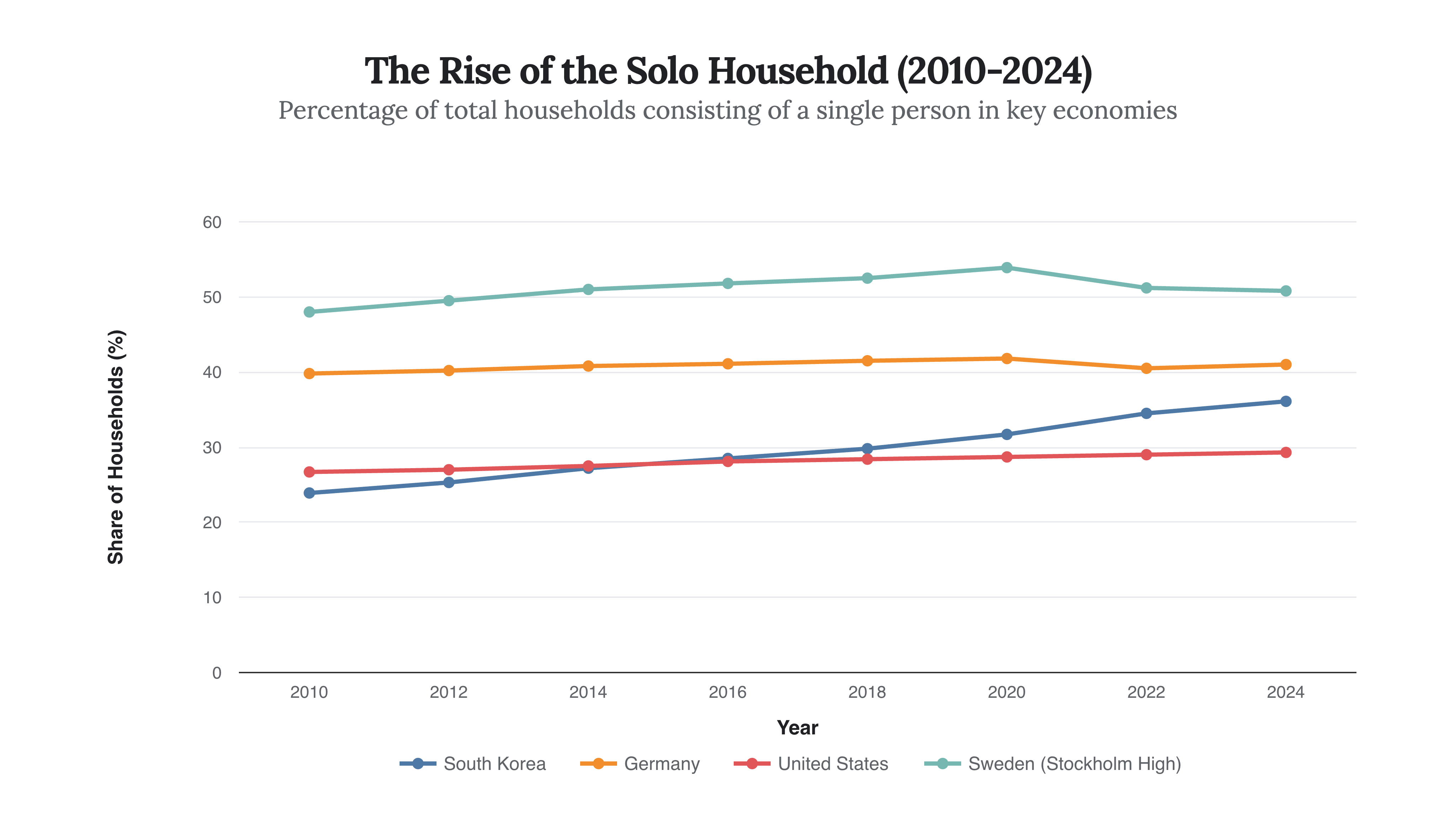
The chart above illustrates the relentless upward trajectory of the “Solo Household” in major economies. While Sweden represents a mature saturation point (data fluctuations often due to reclassification of co-living), South Korea’s rapid ascent signals a structural breakdown of the traditional family unit in Asia, creating a massive opening for convenience-focused, single-serve economies.
The Software of Solitude: Monetizing the Void
If real estate provides the hardware for isolation, the technology sector is building the software. The most startling growth vector in 2024 has been the AI Companion Market. Valued at $28.2 billion today, it is projected to grow at a CAGR of nearly 31% to reach $140 billion by 2030. This is not a niche for the socially awkward; it is becoming a primary form of interaction for a generation.
We are seeing the emergence of “Kinship-as-a-Service” (KaaS). Platforms like Replika and Character.ai are not selling chat services; they are selling emotional validation. Unlike human relationships, which are friction-heavy and require compromise, AI companions offer “frictionless intimacy.” They are always available, always agreeable, and endlessly customizable.
This shift represents a dangerous but profitable feedback loop: as time spent alone increases, social skills atrophy, making real-world interaction more “expensive” (emotionally and cognitively), which in turn drives higher demand for synthetic alternatives.
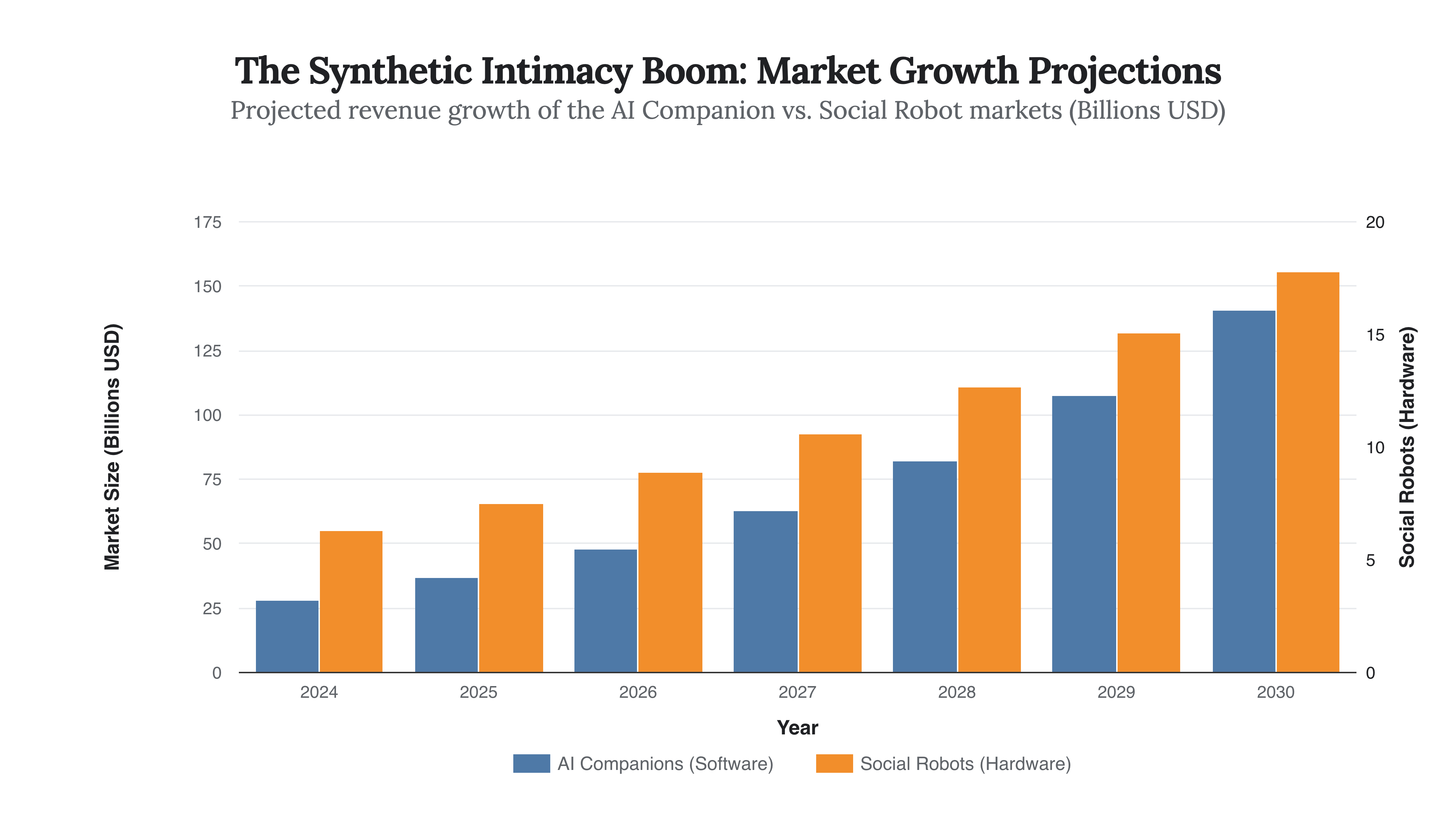
The divergence between software (AI companions) and hardware (robots) is critical. While robotics faces supply chain and manufacturing constraints, AI companionship scales with zero marginal cost. The “friend” of 2030 will likely be a subscription service hosted in the cloud, not a physical droid in the living room.
The Collapse of Social Time
To understand the demand for these services, we must look at the “Time Deficit.” Data from the U.S. Bureau of Labor Statistics (ATUS) paints a stark picture of
American social life. For young people (ages 15-29), time spent alone has increased by roughly 45% since 2010. Conversely, time spent with friends has collapsed.
This is the “Social Recession.” It explains why the Solo Dining and Solo Travel markets are booming. The Solo Travel market alone is projected to hit $1.07 trillion by 2030. This isn’t just about people wanting to see the world; it’s about a demographic that literally has no one else to go with. The hospitality industry is pivoting from “family packages” to “curated solo experiences,” charging a premium for the privilege of uncompromised itinerary control.
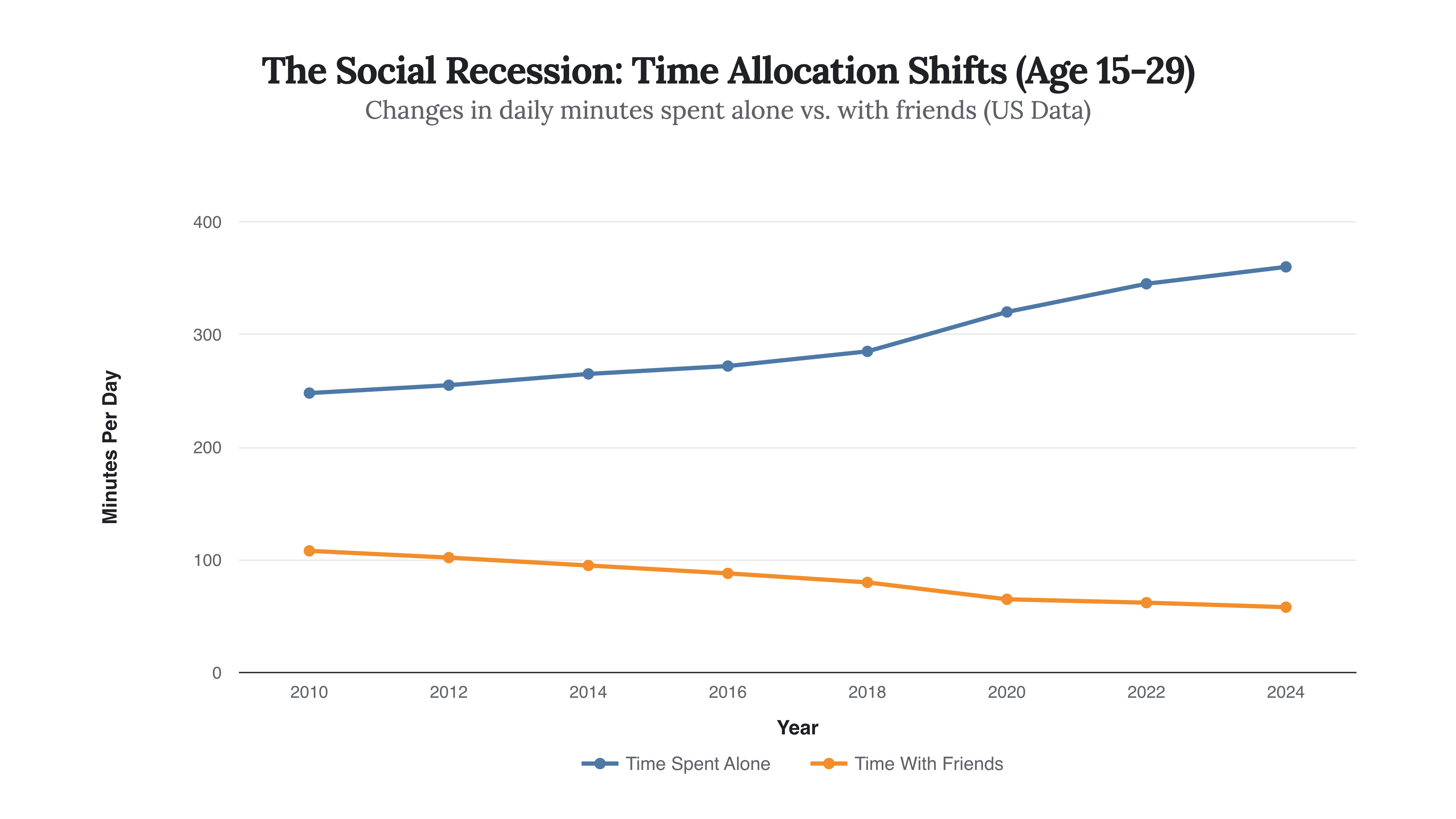
The chart above is the most terrifying graphic in this briefing. The crossover occurred years ago, but the gap is widening. We are engineering a society where “alone” is the default state, and “together” is a scheduled anomaly.
Strategic Implications: The Solitude Premium
For the investor and the strategist, the “Solitude Economy” presents a dual reality. On one hand, it is a massive growth vector. On the other, it represents a systemic risk to the labor force. The $154 billion cost of lost productivity cited by Cigna is real, but it is being offset by the $784 billion revenue generation of the isolation industries.
We are observing a “Solitude Premium”—the extra margin companies can extract from single consumers who lack the bargaining power and efficiency of groups.
Real Estate: The micro-apartment trend (200-300 sq ft units) yields significantly higher rent per square foot than family-sized units.
Food & Beverage: The “table for one” turnover rate is faster, and the rise of delivery apps (interacting with an algorithm rather than a waiter) favors the isolated diner.
Travel: The “Single Supplement” (the surcharge for occupying a double room alone) has been rebranded as “Solo Pricing,” effectively institutionalizing a tax on loneliness.
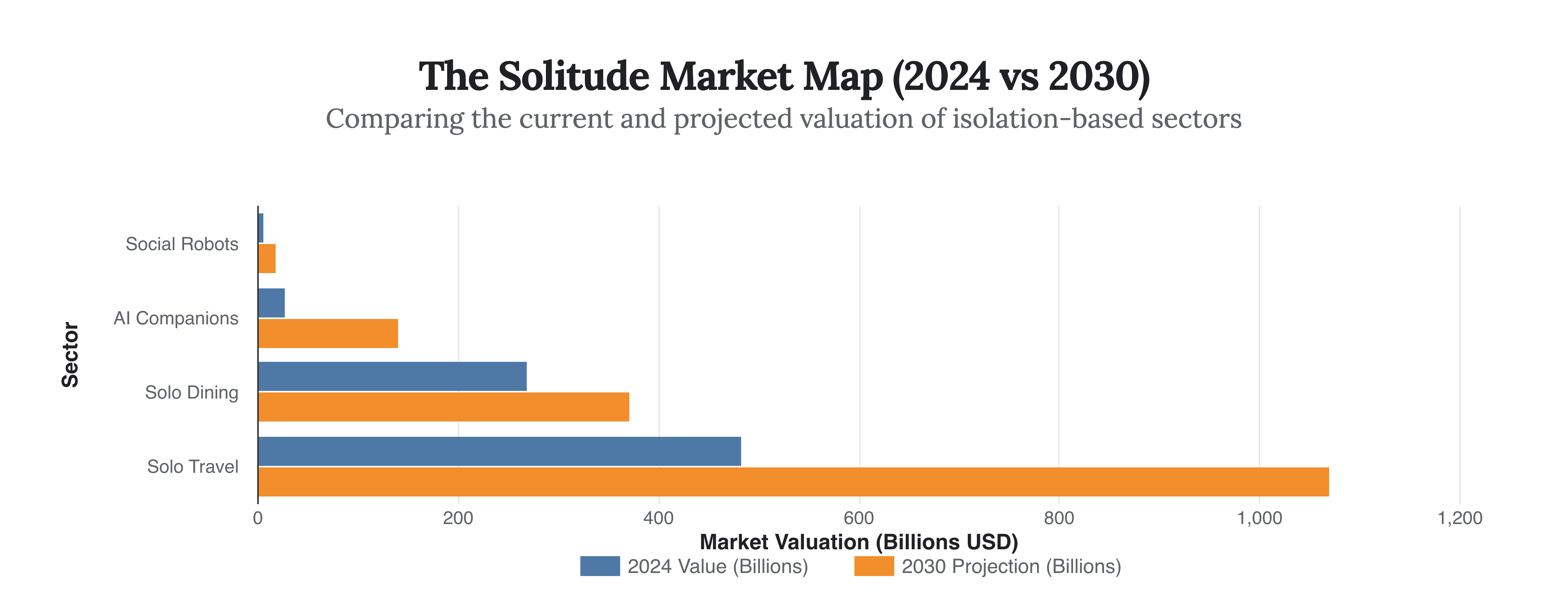
The data confirms that the business of serving the solitary individual is growing faster than the general economy. Solo Travel alone is set to become a trillion-dollar industry. This suggests that the “cure” for loneliness will not come from the market, because the market is currently incentivized to maintain the condition.
The Future: Social-as-a-Service
We are moving toward a future where organic connection is a luxury good, while synthetic connection is the mass-market utility. Just as fresh food is more expensive than processed food, “fresh” human interaction will become the domain of the wealthy, who can afford the time and environments (clubs, retreats, conferences) to foster it.
For the mass market, the gap will be filled by AI. We predict that by 2027, major healthcare providers will begin reimbursing “Digital Companion” subscriptions as a cost-saving measure to combat the physical health effects of loneliness (heart disease, stroke), effectively legitimizing the synthetic friend as a medical device.
“We are not just selling a chat-bot. We are selling the feeling of being known, without the risk of being judged. It is the ultimate consumer product: a relationship that is entirely about you.” — Industry Executive, AI Summit 2024
Conclusion: The $784 Billion Blind Spot
The narrative that loneliness is a “crisis” misses the economic reality: it is a structural asset class. The $784 billion Solitude Economy is not a bubble; it is a response to the fundamental atomization of modern life. For investors, the “Long Loneliness” trade—betting on AI companions, single-household real estate, and solo-experience hospitality—is one of the most robust macro trends of the decade.
However, the long-term risk is existential. An economy that relies on the atomization of its workforce eventually cannibalizes its own social capital. Innovation requires collaboration, and collaboration requires connection. We are efficiently monetizing the decline of our own social fabric.
The strategic takeaway: The most valuable companies of the 2030s will be those that either sell the most convincing synthetic relationships or those that gatekeep the last remaining spaces for authentic human connection.