


In a move that sent shockwaves through the worlds of corporate governance and finance, Tesla shareholders have once again lashed their fortunes to the vision of Elon Musk. With a stunning 75% of voting shares cast in favor, investors approved a colossal new compensation package potentially worth $1 trillion. This decision, reached at the company’s annual meeting on November 6, 2025, is more than just the largest executive pay plan in history; it is a profound statement on the perceived value of a singular leader and a high-stakes bet on his ability to navigate Tesla through the uncharted territories of artificial intelligence and robotics.
The vote both resolves and intensifies a multi-year saga that has pitted shareholder factions against each other, challenged legal precedents in Delaware and Texas, and forced a referendum on whether Musk is a visionary genius essential for Tesla’s future or a distracted leader whose gargantuan pay comes at the expense of shareholder value. This briefing deconstructs the intricate layers of this unprecedented decision, analyzing the legal battles that precipitated it, the stark divide between retail and institutional investors, and the audacious performance milestones that could make Elon Musk the world’s first trillionaire.
The Road to a Trillion-Dollar Payday: A Legal and Corporate Odyssey
The recent shareholder vote did not occur in a vacuum. It is the culmination of a dramatic corporate and legal battle stretching back to 2018, defined by court rulings, corporate relocations, and a board steadfast in its belief that Musk’s leadership requires extraordinary incentives.
The 2018 Package and the Delaware Rebuke
The story begins with the 2018 CEO Performance Award, a 10-year grant of stock options contingent on Tesla achieving a series of ambitious market capitalization and operational milestones. Valued at up to $56 billion at the time, it was already the largest executive compensation plan on record. That plan was overwhelmingly approved by 73% of disinterested shareholders in March 2018. However, a lawsuit brought by a small shareholder, Richard Tornetta, challenged the package in the Delaware Court of Chancery. In a landmark decision in January 2024, Chancellor Kathaleen McCormick voided the package, delivering a scathing 200-page ruling. She found the board’s approval process “deeply flawed” due to Musk’s status as a “controlling stockholder” and his close ties to the directors negotiating the deal. The court determined the board had not proven the deal was fair to shareholders, calling the sum “unfathomable” and criticizing the lack of transparency in the shareholder vote. Despite a subsequent shareholder vote in June 2024 ratifying the 2018 plan with 72% support, the Delaware court again rejected Tesla’s attempt to reinstate it in December 2024, stating the company could not simply create new facts to reverse an adverse ruling.
“Was the richest person in the world overpaid? The defendants failed to prove that the stockholder vote was fully informed, and they failed to prove that the compensation plan was fair.”
- Chancellor Kathaleen McCormick, Delaware Court of Chancery
This legal stalemate, which included Tesla moving its corporate incorporation from Delaware to Texas, set the stage for the board to propose an entirely new, even larger compensation plan for 2025.
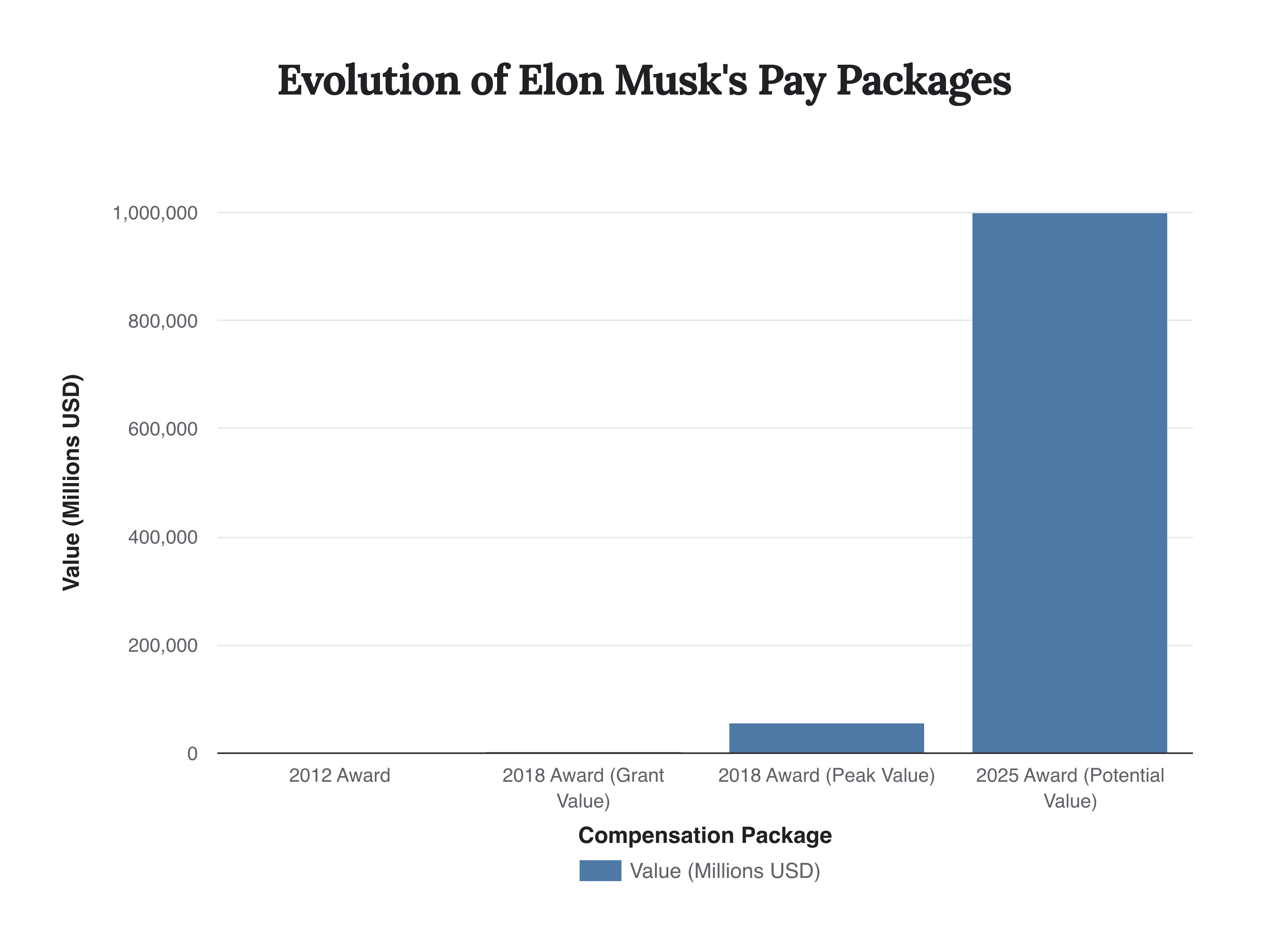
Caption: This chart illustrates the exponential growth in the potential value of Elon Musk’s compensation packages, highlighting the unprecedented scale of the newly approved 2025 plan compared to his previous awards.
Anatomy of a Pay Plan: The Audacious Milestones
The newly approved 2025 performance award is structured to dwarf its controversial predecessor. It is a 100% at-risk plan with no salary or cash bonuses, vesting entirely upon the achievement of a dozen tranches of staggering market capitalization and operational goals over the next decade. If fully realized, the plan would grant Musk an additional 12% of Tesla’s stock, bringing his total ownership to over 25%.
The Trillion-Dollar Hurdles
The core of the plan involves growing Tesla from its current valuation of approximately $1.5 trillion to an astronomical $8.5 trillion. This requires creating roughly $7.5 trillion in new shareholder value. The operational milestones are equally ambitious and paint a clear picture of Musk’s vision for Tesla’s future beyond electric vehicles:
Vehicle Deliveries: Selling 20 million vehicles annually.
Autonomous Driving: Deploying a fleet of 1 million robotaxis in commercial service.
Robotics: Developing and selling 1 million humanoid “Optimus” robots.
Profitability: Achieving staggering levels of earnings.
These goals underscore the board’s argument: that this pay package is not a reward for past performance, but a necessary incentive to keep Musk focused on transforming Tesla into a dominant force in AI and robotics. The Tesla board chair, Robyn Denholm, explicitly warned shareholders that failure to approve the package could result in Musk dedicating his attention to his other ventures like SpaceX and xAI.
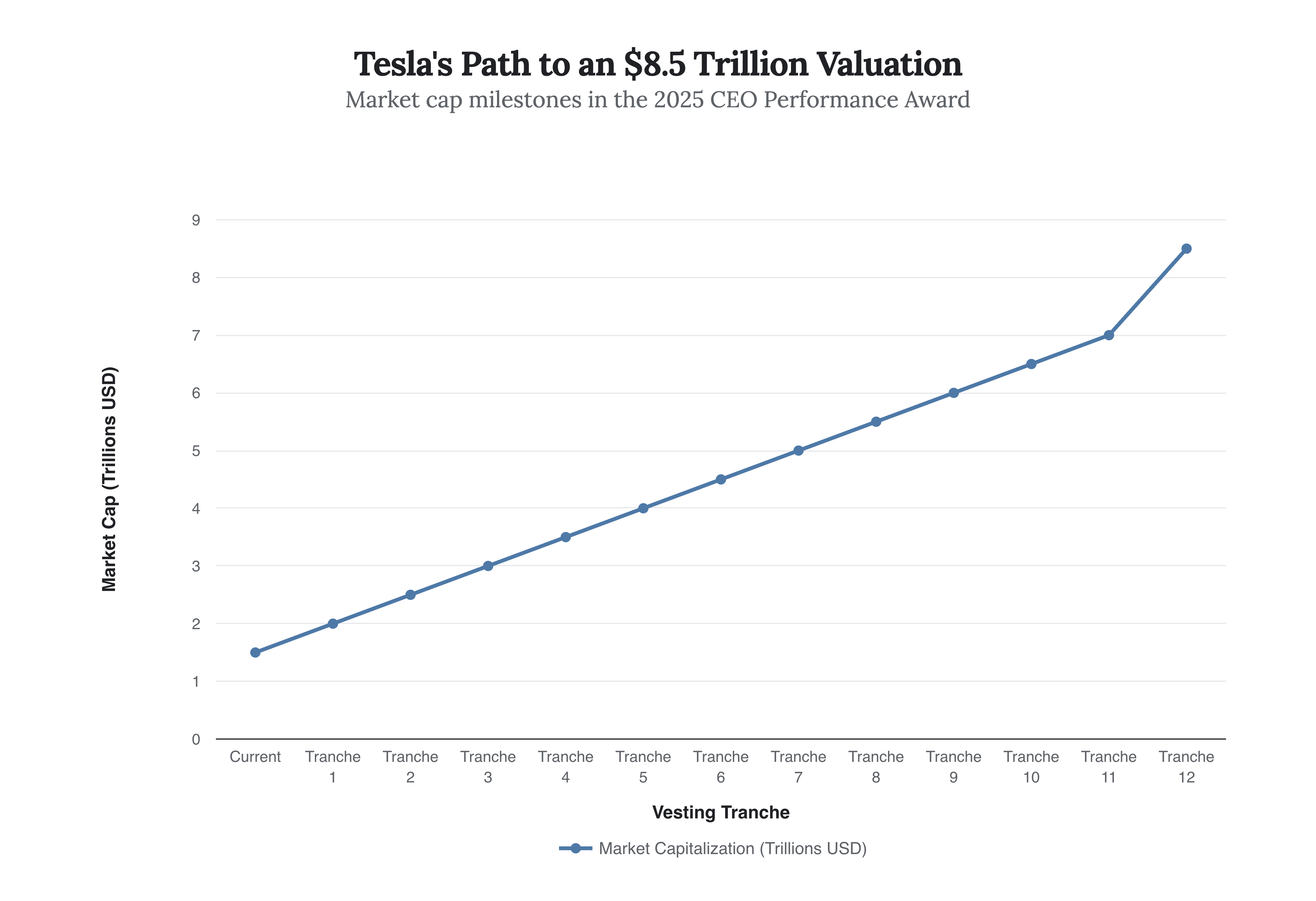
Caption: The chart visualizes the escalating market capitalization hurdles Elon Musk must clear for his 2025 pay package to fully vest, illustrating the sheer scale of growth required.
A Divided Shareholder Base: Institutions vs. Retail
The 75% approval margin masks a significant rift within Tesla’s shareholder base. The vote became a battleground between a loyal army of retail investors and a skeptical contingent of large institutional asset managers and pension funds.
The Institutional Opposition
Many of the world’s most influential institutional investors and proxy advisory firms lined up against the proposal. Norges Bank Investment Management, Norway’s massive sovereign wealth fund and one of Tesla’s largest investors, voted against the package, citing concerns about its total size and dilution. They were joined by major U.S. pension funds like CalPERS and the California State Teachers’ Retirement System (CalSTRS), who deemed the compensation “exorbitant” and “not tied to the long-term profitability of Tesla.” Proxy advisory firms Glass Lewis and ISS also recommended a “no” vote, arguing the performance targets were vague and that the plan would excessively dilute existing shareholders.
“This exorbitant compensation package is at odds with CalPERS’ longstanding views on executive pay. The compensation is excessive when compared to executives at peer companies, highly dilutive to shareholders, and isn’t tied to the long-term profitability of Tesla.”
- Marcie Frost, CalPERS CEO
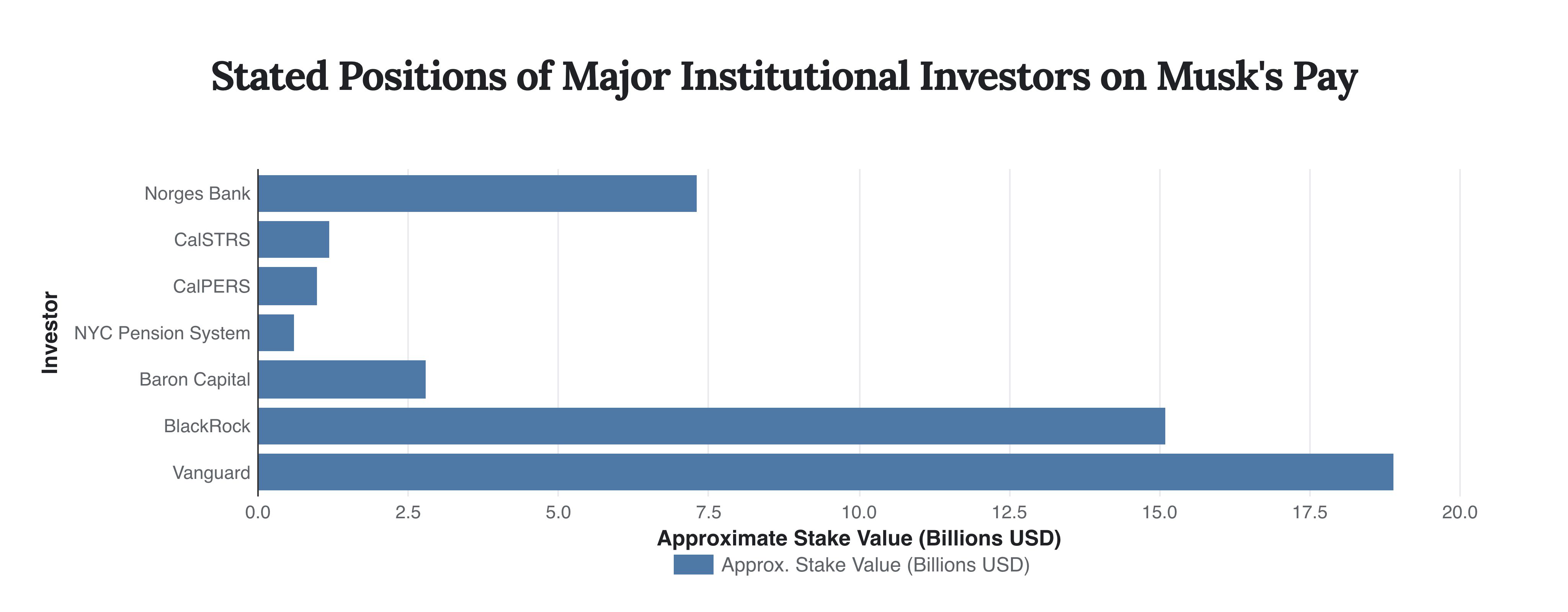
Caption: This chart displays the voting stance of several key institutional investors on Elon Musk’s compensation package, contrasted with the approximate value of their stake in Tesla.
The Retail Army and Wall Street Bulls
The institutional opposition was ultimately overwhelmed by strong support from retail investors, who own a significant portion of Tesla’s stock, and bullish institutional backers. Supporters like Ron Baron of Baron Capital called Musk “indispensable” to the company. The prevailing argument, amplified by the Tesla board, was simple: Tesla is Elon, and Elon is Tesla. His leadership is seen as the singular driving force behind the company’s past success and the key to unlocking its future as an AI and robotics leader. The vote was framed as a referendum on Musk’s continued leadership, with the CEO himself suggesting he would be uncomfortable growing Tesla’s AI and robotics divisions without a larger ownership stake of around 25%. The strong showing of support from individual shareholders demonstrates a powerful belief in Musk’s unique ability to deliver exponential returns, even in the face of controversy.
Strategic Implications and Future Outlook
The approval of this historic pay package sets a new precedent for CEO compensation and has profound strategic implications for Tesla’s future.
The Governance Precedent
The sheer size of the award, equivalent to the combined pay of all S&P 500 CEOs over several years, will undoubtedly fuel the debate on executive compensation. Critics argue it creates a dangerous precedent, rewarding a “Superstar CEO” with an amount untethered from conventional corporate pay scales. The successful shareholder campaign, which framed the vote as a loyalty test, also raises questions about board independence and the ability of shareholders to hold even the most powerful executives accountable.
A Future Forged by AI and Robotics
The operational milestones baked into the plan are not just targets; they are a strategic roadmap. Shareholder approval is an endorsement of Musk’s pivot from being solely an electric vehicle company to a leader in artificial intelligence, autonomous driving, and humanoid robotics. The next decade will be a test of whether this vision is achievable or an overreach. The company’s valuation will now be increasingly tied to progress in these futuristic, and highly speculative, domains.
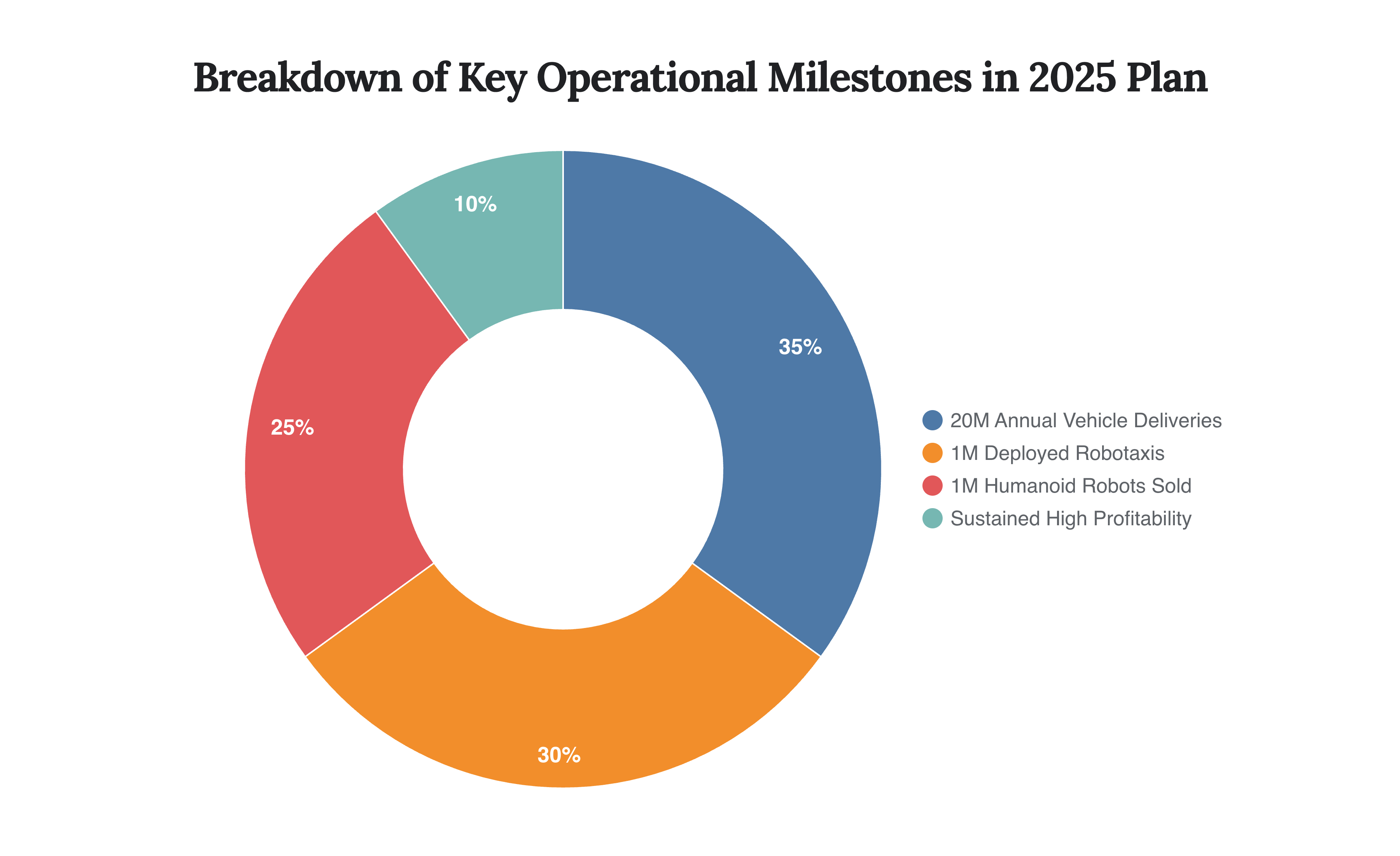
Caption: An illustrative breakdown of the key operational pillars of Musk’s 2025 compensation plan, showing the strategic shift towards robotaxis and robotics alongside vehicle sales growth.
The shareholder vote is a decisive moment, effectively creating a 10-year partnership between Musk and Tesla investors predicated on achieving goals that would redefine multiple industries. While the legal challenges surrounding the 2018 package may continue on appeal, the path forward is clear: Tesla’s fate is now more inextricably linked to Elon Musk than ever before. Investors have not just approved a pay package; they have endorsed a high-risk, high-reward vision of the future. The world will be watching to see if this trillion-dollar gamble pays off.
The single most important strategic insight for investors and policymakers is that the 75% shareholder approval has transformed the debate from one of retrospective fairness into a forward-looking mandate, effectively locking in Musk’s AI-centric vision as Tesla’s non-negotiable strategic direction for the next decade.