



The era of the global, interoperable internet is not dying; it is dead. For the past decade, “The Splinternet” was a warning issued by futurists and civil liberties advocates—a theoretical dystopia of firewalls and censorship. In 2025, it has graduated from a theory to a line item on your balance sheet. The digital world has not merely fractured; it has calcified into distinct, competing tectonic plates.
The latest intelligence from the IMF and World Bank paints a stark picture: severe geoeconomic fragmentation, driven by the decoupling of Western and authoritarian technology stacks, could cost the global economy up to 7% of GDP. To put that in perspective, that is a $7.4 trillion loss—equivalent to erasing the combined economies of France and Germany from the global map. This is not a temporary trade spat. It is the structural dismantling of the digital commons.
For strategists and investors, the question is no longer if this divide will deepen, but how to navigate a world where data, code, and capital can no longer cross borders freely. The “Splinternet Forecast” is not about political ideology; it is about the cold calculus of compliance, latency, and redundant infrastructure. We are witnessing the bifurcation of the physical layer (cables and chips), the logical layer (protocols and routing), and the cognitive layer (AI and content). This briefing dissects the anatomy of this divorce and prices the cost of digital sovereignty.
The Infrastructure Divorce: Rewiring the Ocean Floor
The most tangible evidence of the Splinternet is found not in the cloud, but at the bottom of the ocean. For decades, submarine cables were neutral pipes, routed purely for efficiency and latency. Today, they are geopolitical assets, subject to the same strategic scrutiny as oil pipelines. The “Great Bifurcation” is physically rerouting the internet.
We are seeing a massive shift in ownership. The telecommunications consortiums of the past have been replaced by “Hyperscalers” (Google, Meta, Microsoft, Amazon), who are now the dominant financiers of subsea infrastructure. This shift is not just commercial; it is strategic. New cable routes are actively bypassing the South China Sea and other contested waters to avoid the “Authoritarian Stack.” The U.S. “Clean Network” initiative has effectively barred Chinese providers like HMN Tech from major Western projects, forcing a parallel construction of Chinese-financed cables connecting the Global South (the “Digital Silk Road”).
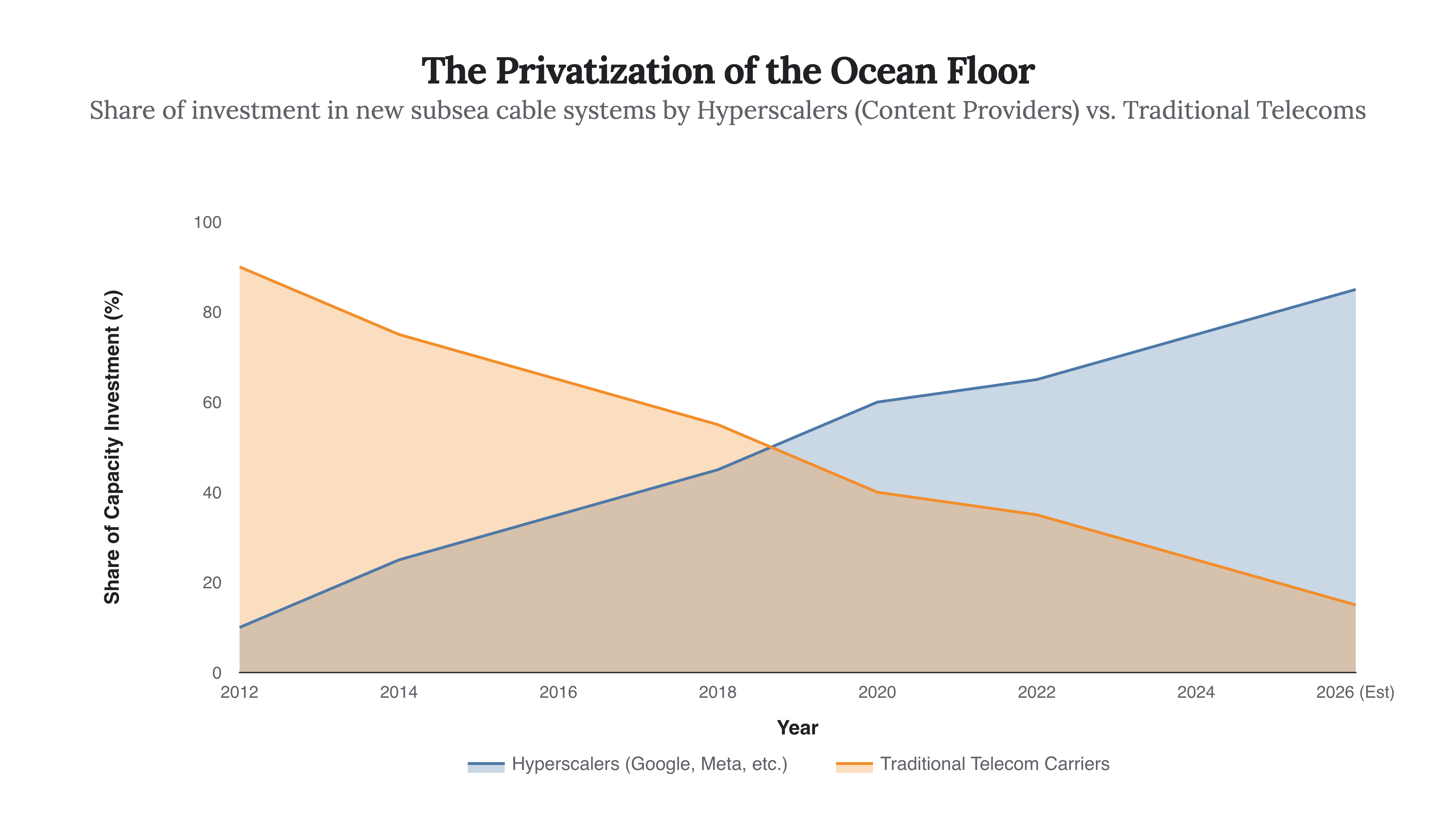
This chart reveals the strategic takeover of the physical internet. As Hyperscalers capture nearly 85% of new capacity investment by 2026, the internet is shifting from a public utility model to a private, club-goods model. This allows for tighter control over routing and security but creates a fragmented network where connectivity depends on which “club” your nation belongs to.
The “Clean” vs. “Silk” Route
The practical implication is redundancy at a massive cost. Multinational corporations must now architect their networks to traverse “trusted” routes. A packet sent from Berlin to Tokyo may no longer take the shortest path through
