


We are witnessing a mass ontological event. It is not merely a mental health crisis, nor is it simply an addiction to dopamine. It is a fundamental restructuring of the human self, predicted nearly 175 years ago by the Danish philosopher Søren Kierkegaard. In his 1849 masterpiece, The Sickness Unto Death, Kierkegaard defined “despair” not as sadness, but as a misalignment of the self—a failure to balance the “finite” (our physical reality, limitations, and necessities) with the “infinite” (our imagination, possibilities, and consciousness).
Today, this delicate synthesis has been hijacked by an algorithmic architecture designed to monetize the “infinite” at the expense of the “finite.” Recent intelligence indicates that 74% of digital natives now present a “fundamentally different” persona online than in reality, creating a permanent fracture in their identity. This is the new form of despair: a state of being where the digital avatar is more vivid, more demanding, and more “real” than the biological self. For industry leaders and policymakers, understanding this shift is no longer optional—it is the key to decoding the erratic behavior of the modern consumer, the polarization of the electorate, and the collapsing engagement of the workforce.
The Anatomy of Algorithmic Despair
Kierkegaard identified two primary forms of despair: the despair of weakness (not willing to be oneself) and the despair of defiance (willing to be a self that you are not). Social media has industrialized both, creating a closed-loop ecosystem that punishes authenticity and rewards the fabrication of identity.
The Despair of Weakness: The “Crowd” as the New Truth
Kierkegaard famously warned that “the crowd is untruth.” He argued that the individual loses their soul when they surrender their judgment to the masses. In 2025, the “crowd” is no longer a physical gathering; it is a quantified metric. The algorithm creates a hyper-visible “universal standard” of beauty, success, and happiness that is statistically impossible to achieve, yet universally presented as the norm.
This generates the “Despair of Weakness”: the individual looks at the aggregated perfection of the feed, despises their own finite reality, and wishes to be anyone but themselves. They dissolve their identity into the trend, the filter, and the consensus.
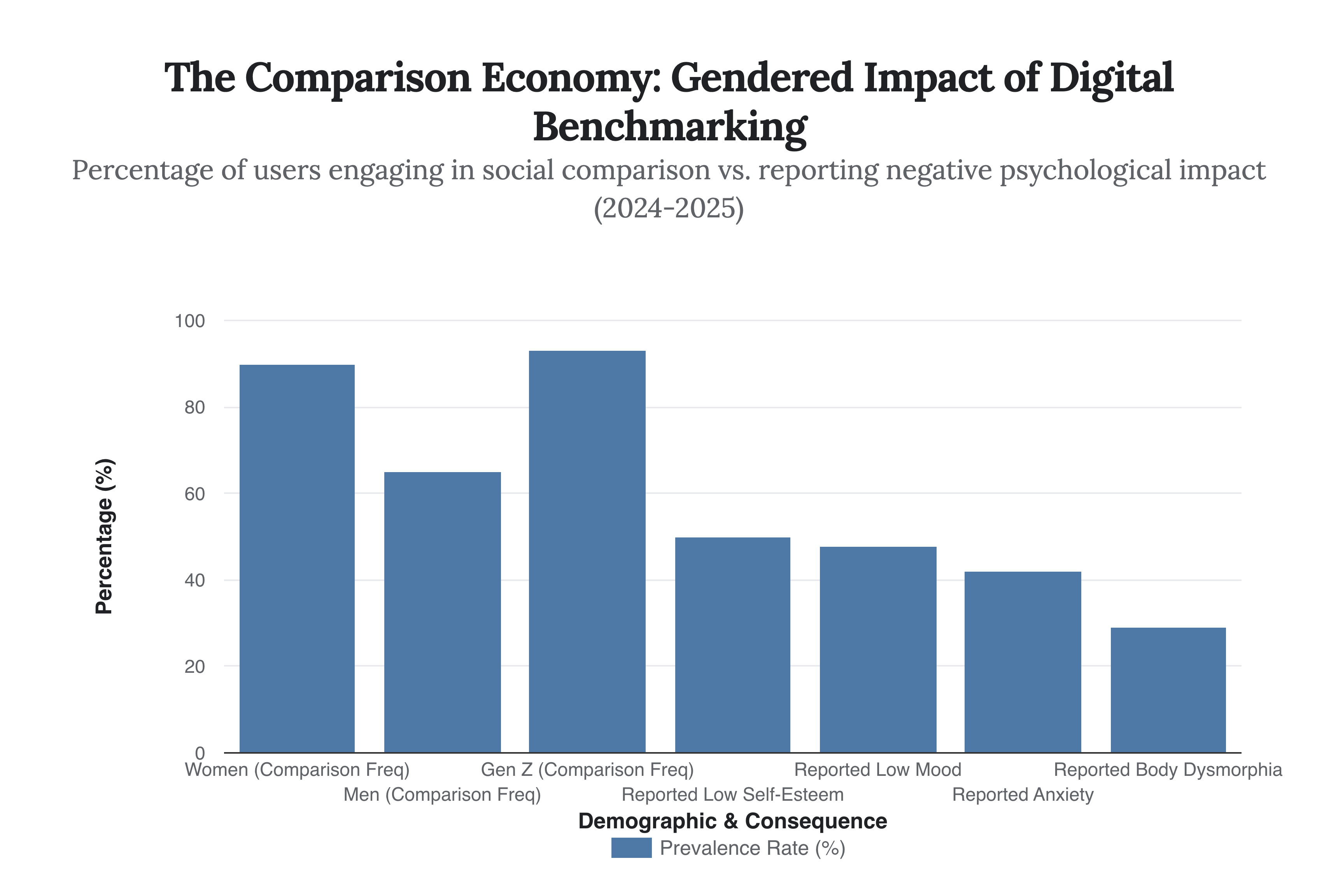
The data above reveals the efficiency of this machine. With 90% of women and 93% of Gen Z actively comparing their “finite” lives to the “infinite” curation of others, the result is a mass production of inadequacy. This is not an accidental byproduct; it is the economic engine of the platform. A user in despair is a user who buys. They buy beauty products to fix the “finite,” courses to unlock the “infinite,” and subscriptions to maintain the illusion.
The Despair of Defiance: The Rise of the Phantom Self
If the despair of weakness is wishing to be another, the despair of defiance is the attempt to create a self ex nihilo—out of nothing. This is the influencer, the curator, the user who meticulously crafts a digital avatar that bears no
resemblance to their biological reality. Kierkegaard described this as the self wanting to be the “master” of itself, rejecting any external grounding (like biology, history, or truth).
In the digital age, this manifests as the “Reality Gap.” We are spending billions of dollars and hours maintaining “Phantom Selves”—digital entities that require constant content feeding to survive.
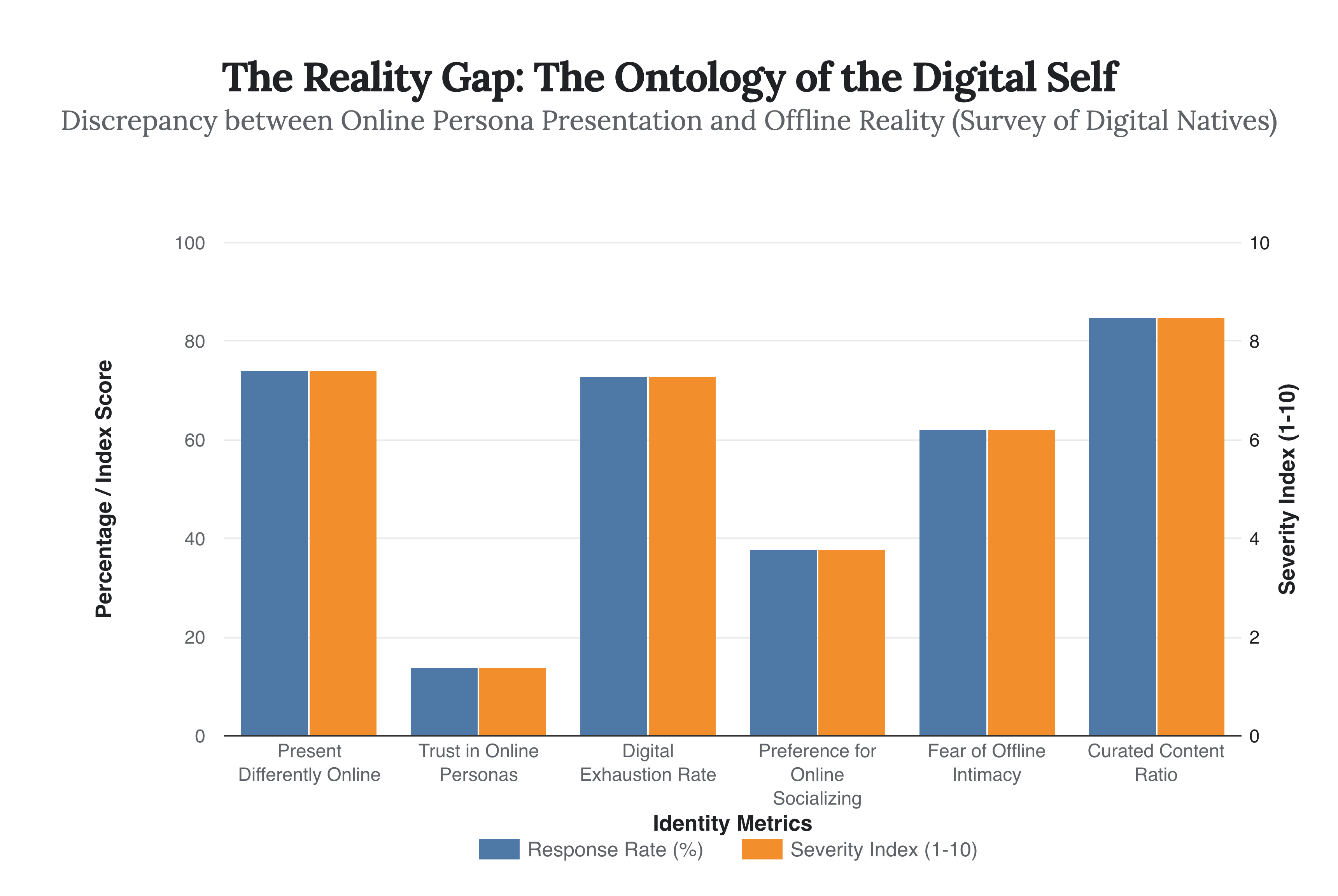
The strategic implication here is profound. When 74% of a generation admits to a fundamental disconnect between their digital and physical selves, we are no longer dealing with “users.” We are dealing with a population engaging in mass dissociation. The “Digital Exhaustion” rate of 73% is the direct result of the energy required to sustain two separate existences. The “Phantom Self” eats the energy of the “Real Self,” leading to burnout, ghosting, and the collapse of traditional workforce reliability.
“To be a self is the greatest concession made to man, but at the same time it is eternity’s demand upon him.” — Søren Kierkegaard, The Sickness Unto Death
The Dizziness of Freedom: Algorithmic Paralysis
Kierkegaard famously described anxiety as the “dizziness of freedom.” He argued that when a human looks down into the abyss of infinite possibility without a finite foothold, they become paralyzed. The infinite scroll is the technological manifestation of this abyss. It offers infinite content, infinite choices, and infinite comparisons, stripping the user of the ability to make a meaningful choice.
This phenomenon, known as the “Paradox of Choice,” has now mutated into “Algorithmic Outsourcing.” Overwhelmed by the dizziness of the infinite feed, users are voluntarily surrendering their agency to the machine. They no longer choose; they are served.
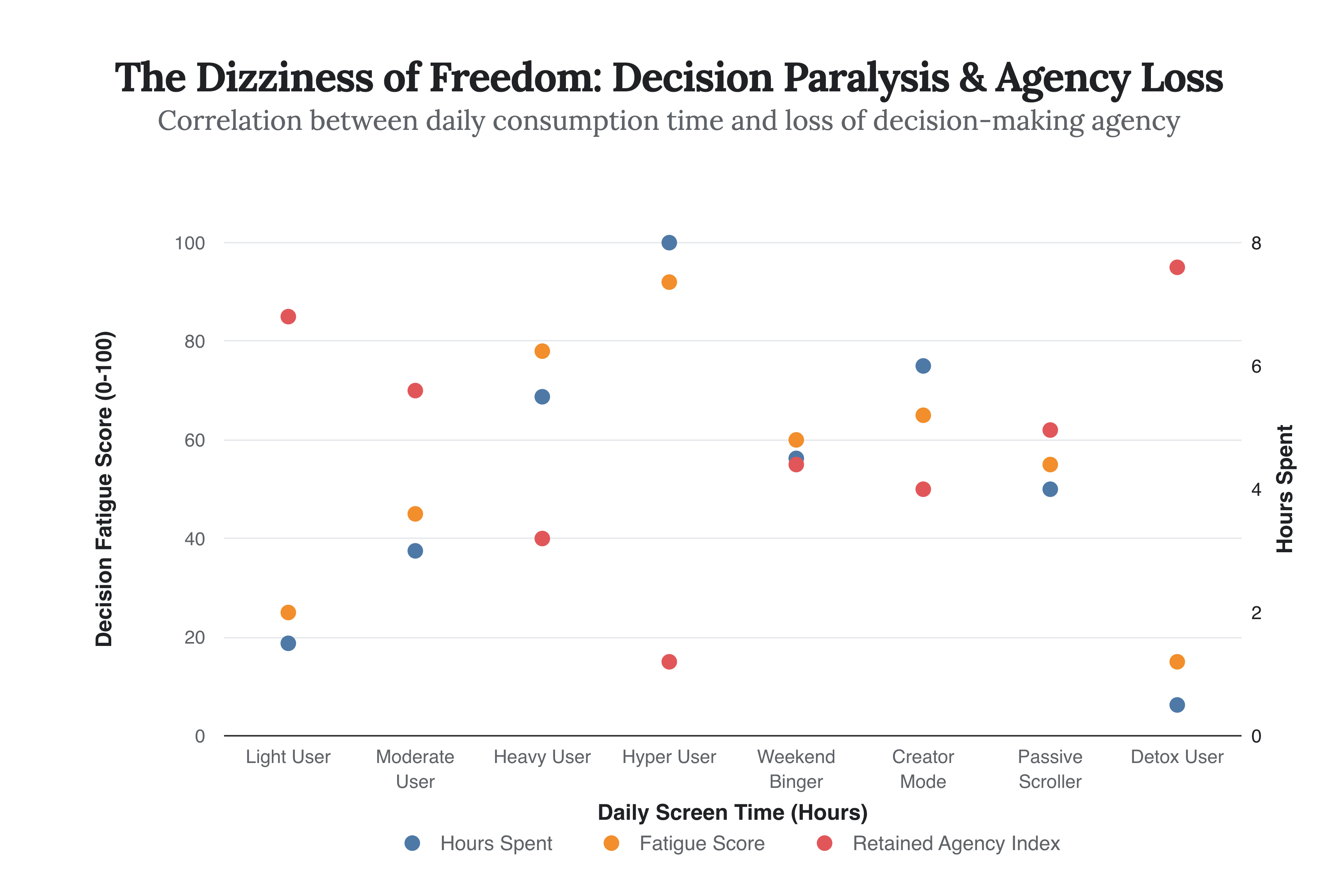
The chart above illustrates the inverse relationship between consumption and agency. As screen time escalates towards the 4+ hour mark (typical for 35% of Gen Z), decision fatigue spikes and “Agency”—the ability to act according to one’s own will—collapses. The algorithm steps in to fill this void, dictating everything from purchasing decisions to political affiliation. This is the “sickness”: a will that refuses to will itself, preferring the comfortable numbness of the feed.
The Strategic Horizon: The Depersonalization Economy
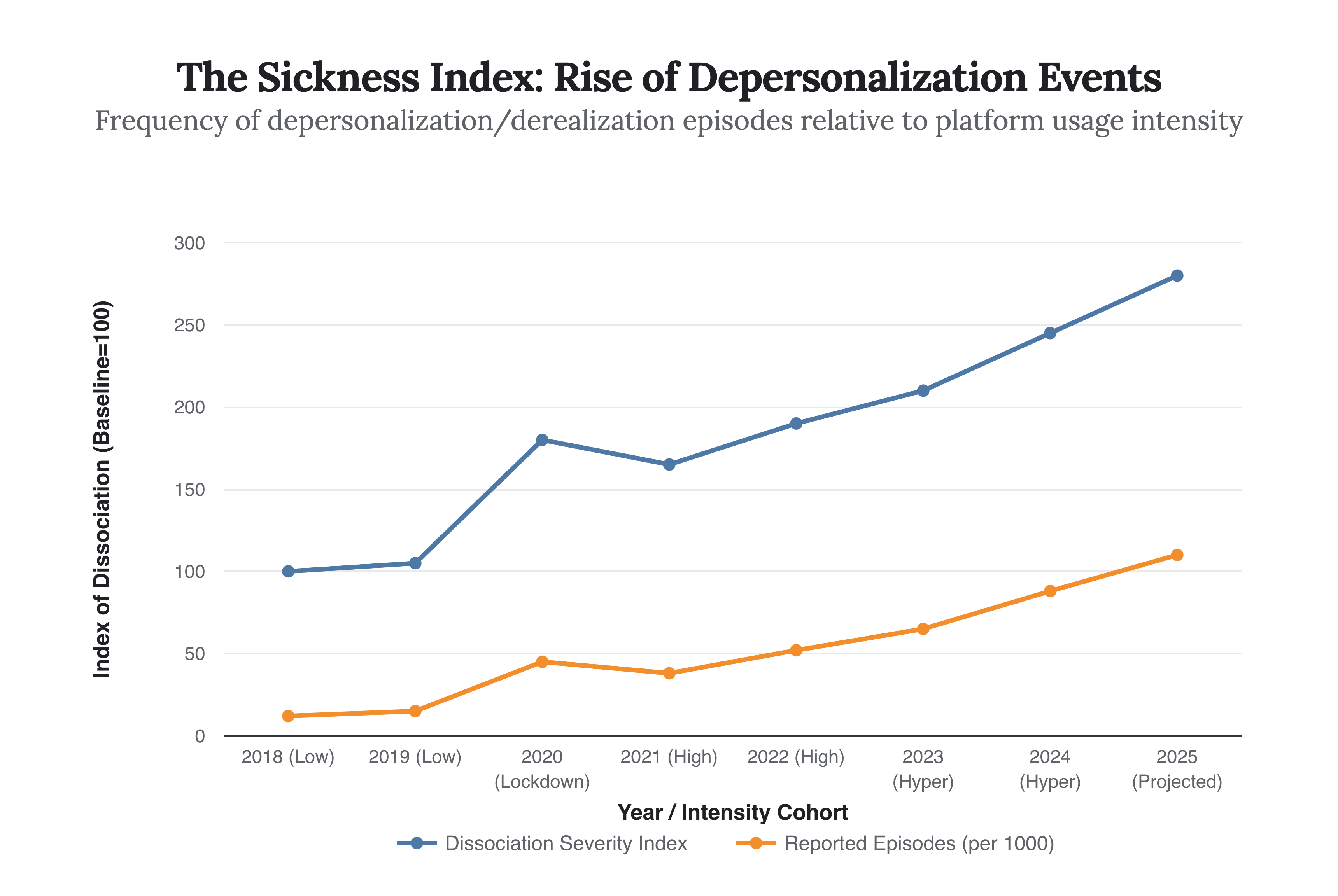
The terminal stage of this Kierkegaardian sickness is depersonalization—a psychological state where the individual feels detached from their body and thoughts, as if they are an observer of their own life. In a digital context, this is the “Zoomed Out” effect. The user becomes a ghost in the machine, viewing their own life as content to be optimized rather than an existence to be lived.
We are seeing a surge in “derealization” events, where users feel the physical world is less real than the digital one. This has catastrophic implications for physical economy sectors (real estate, travel, live events) and massive upside for the “isolation economy” (virtual goods, delivery, escapist entertainment).
Forward Guidance: Reclaiming the Finite
For the strategist, the “Phantom Self” is a volatile asset. It is prone to rapid shifts in sentiment, has zero loyalty, and is easily radicalized by the “crowd.” The antidote to this despair is what Kierkegaard called the “leap of faith”—a commitment to the objective uncertainty of the real world. In 2025, this translates to a premium on friction.
We predict a counter-movement towards “High-Friction Experiences.” As the despair of the seamless, infinite digital world grows, value will accrue to experiences that force the user back into their finite body: un-recordable live events, analogue skills, and community structures that banish the algorithm. The winners of the next decade will not be those who optimize the digital phantom, but those who can resurrect the real self.
The single most critical insight for 2025: The consumer economy is pivoting from selling “aspirational identity” (feeding the Phantom) to selling “ontological grounding” (healing the Sickness).
This is a strong diagnosis of identity fragmentation at the individual level.
The deeper implication is institutional: systems built for stable selves are now governing populations with split agency, phantom incentives, and outsourced will.
That mismatch, not despair alone is what’s driving volatility across markets, politics, and organizations.
I’m a musician/performance artist by vocation, and I’ve always been weirdly bad at recording, archiving, and sharing my work in non-real time. I have colleagues, friends, and teachers who record, archive, and distribute obsessively, but it’s just not something I think about. I have struggled to pinpoint why it’s not a natural or intrinsic priority for me, and I think you nailed it in this piece. Internally I am inherently more impelled toward the connection that can only come from the “high friction” of real-time, ritual/ritualistic performance.
Recordings are great, but I live for a good ol’ fashioned “ya had to be there” kind of experience.